
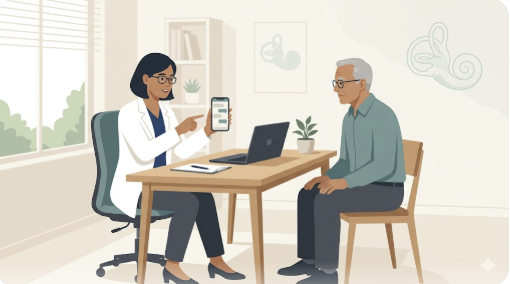
A patient sat in clinic recently and asked, “Doc, my friend’s been talking to a chatbot about her ringing ears. Does that actually work?” The question of whether an AI chatbot for tinnitus can actually help just got its largest evidence test yet — in April 2026, Internet Interventions published the largest randomized trial yet on app-based conversational agents for tinnitus: a three-arm comparison of a tinnitus-specific chatbot (Tinnibot), a general mental-health chatbot (Woebot), and a waitlist control (Jackson et al., Internet Interventions, 2026). This article walks through what the trial actually found, where AI chatbots fit in tinnitus care, and the line between augmentation and replacement.
What the 2026 Tinnibot RCT Actually Showed
Jackson and colleagues randomized 105 adults with chronic tinnitus (mean duration ~10.8 years) to three parallel arms — Tinnibot (since rebranded as Mindear), Woebot, or waitlist — for an 8-week intervention with intention-to-treat analysis. The primary outcome was the Tinnitus Functional Index (TFI). Secondary outcomes included anxiety (GAD-7), depression (PHQ-9), insomnia (ISI), mindfulness (MAAS-15), and life satisfaction (SWLS).
The headline result is straightforward. On TFI, Tinnibot produced a 13.23-point reduction (from 52.66 to 39.42 — a highly significant change with a large effect size). Woebot produced a smaller but still significant 7.38-point reduction (from 50.11 to 42.73, a small-to-moderate effect). The waitlist control did not move (49.25 to 49.19). Only Tinnibot crossed the established threshold for a clinically meaningful TFI change of more than 13 points (Henry et al., Hearing Research, 2016) — though that label should be read with caution, since the judgment rests on 8-week follow-up and patient self-report alone.
The 3-arm design is what makes this signal interpretable. By including both a generic cognitive behavioral therapy (CBT) chatbot (Woebot) and a no-intervention waitlist alongside Tinnibot, the trial separates three distinct effects: spontaneous regression to the mean, the benefit of any chatbot-delivered CBT, and the additional benefit of tinnitus-specific tailoring. Few digital-therapeutic trials in this space have that internal contrast. An earlier Tinnibot pilot (n=28, no control) reported clinically meaningful improvement in 42–64% of users (Bardy et al., Frontiers in Audiology and Otology, 2024), but Jackson 2026 is the first to actually compare against active and inactive controls.
For comorbid symptoms, both chatbots beat the waitlist:
- Anxiety (GAD-7): Tinnibot dropped 2.50 points (highly significant), Woebot dropped 1.47 points (significant), the control group rose 0.71 points (no significant change).
- Depression (PHQ-9): Tinnibot dropped 3.09 points (highly significant), Woebot dropped 1.97 points (significant), the control group rose 0.35 points (no significant change).
- Insomnia (ISI): Tinnibot dropped 2.59 points (significant); Woebot and control did not change significantly. Only the tinnitus-specific arm improved sleep.
Mindfulness and life satisfaction shifted modestly with no significant time × condition interaction.
A few honest caveats. The trial was open-label (patients knew which app they used), recruitment was online and unverified by audiology, the trial was not prospectively registered, follow-up ended at 8 weeks, and adherence was not systematically tracked. The authors flag all of these. The strengths — three-arm design with an active comparator, ITT analysis, and a validated tinnitus-specific primary outcome — make the result meaningful but not definitive.
Why CBT Works for Tinnitus — and Why a Chatbot Can Deliver It
CBT is the psychological intervention with the most consistent randomized evidence for reducing tinnitus-related distress (Fuller et al., Cochrane Database of Systematic Reviews, 2020). CBT does not silence the ringing. It changes the cognitive and emotional response to the auditory signal — reducing catastrophizing, breaking the symptom-anxiety-amplification loop, and supporting habituation (Cima et al., Lancet, 2012). AI chatbot for tinnitus can handle this.
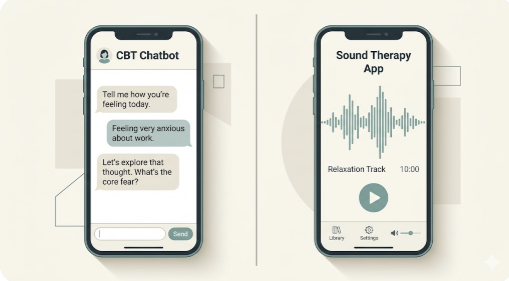
This mechanism is unusually well-suited to chatbot delivery. CBT for tinnitus follows standardized protocols with predictable progressions: psychoeducation, thought challenging, attention diversion, sleep hygiene, exposure to feared sound contexts. A conversational agent can reliably walk a patient through these scripts, available at 3 a.m. when tinnitus distress peaks, without the appointment friction or stigma that keeps many patients away from formal psychotherapy referral.
The Jackson 2026 trial sharpens one more point: tinnitus-specific tailoring matters. Tinnibot integrates tinnitus psychoeducation, sound therapy modules, and mindfulness-based components alongside CBT. Woebot, by contrast, is a general mood-and-anxiety chatbot. Both improved anxiety and depression, but only the tinnitus-tailored arm shifted tinnitus distress and sleep — exactly what a careful clinician would predict if domain-specific content drives domain-specific benefit.
Tinnibot vs. Tinnitus Pro: Two Different Bets
Tinnibot and Neurotone AI’s Tinnitus Pro are sometimes discussed as competitors, but they target different components of the tinnitus experience.
| Feature | Tinnibot | Tinnitus Pro (Neurotone AI) |
|---|---|---|
| Mechanism | CBT chatbot + sound therapy + MBCT modules | AI-personalized sound therapy |
| Target component | Distress, anxiety, depression, sleep | Acoustic perception, masking |
| Published RCT | Jackson et al., Internet Interventions, 2026 (N=105, 3-arm) | Industry-reported launch; no peer-reviewed RCT identified |
| Best paired with | Patients with high distress, sleep disruption, mood comorbidity | Patients seeking acoustic enrichment, partial masking |
| Regulatory framing | Wellness / digital therapeutic track | Medical device pathway pending |
The two approaches are complementary rather than mutually exclusive. A patient with chronic tinnitus and significant emotional impact may reasonably benefit from CBT delivered by a chatbot AND personalized sound therapy in parallel — much as conventional ENT practice already combines CBT with masking devices.
Can AI Replace Your ENT?
No. The more important question is whether AI should be a substitute or a supplement.
An AI chatbot for tinnitus can do several things well: deliver standardized CBT content, track symptoms longitudinally, provide 24-hour access, reduce reliance on scarce psychotherapy slots, and lower the social barrier to engaging with a behavioral intervention. The Jackson 2026 trial shows these gains can be real — anxiety, depression, sleep, and tinnitus distress all moved in the right direction.
What the chatbot cannot do: take a focused otologic history, examine the tympanic membrane, order or interpret an audiogram, recognize red flags, or screen for serious underlying pathology. The last point matters most. Tinnitus is a symptom, not a disease, and certain presentations require urgent ENT evaluation rather than self-directed CBT.
Clinical Perspective — When a chatbot is the wrong first step. Pulsatile tinnitus; sudden or new-onset unilateral or asymmetric tinnitus; tinnitus accompanied by hearing loss; tinnitus with other otologic or neurologic findings (vertigo, otorrhea, focal deficit) — these patients need an ENT, an audiogram, and often imaging. A chatbot will not detect treatable middle- and inner-ear disease, vascular anatomical anomalies, or intracranial tumors. Notably, the Jackson trial recruited online and did not perform any audiologic assessment — a real limitation for clinical translation, and exactly the gap an ENT visit fills.
For the much larger group of patients with chronic, bilateral, non-pulsatile tinnitus who have already been worked up — this is where a CBT chatbot earns its place.
Clinical Perspective
In most ENT clinics, the tinnitus pathway has historically had a frustrating gap. After the audiogram, the imaging if indicated, and the reassurance, patients often need ongoing behavioral support that brief ENT follow-up visits cannot realistically provide. Referral to formal CBT is excellent when accessible, but waiting lists, cost, and stigma keep many patients from ever starting.
A validated CBT chatbot fits that gap precisely. The reasonable use case is as an adjunct after workup is complete and serious causes are excluded — not as triage, not as substitute, and never as a “treatment” that replaces follow-up.
Key Takeaways
- The 2026 Tinnibot RCT is the largest randomized trial to date on app-based chatbots for tinnitus: three arms, 105 adults, 8 weeks, intention-to-treat.
- Only the tinnitus-specific Tinnibot arm achieved a clinically meaningful reduction in tinnitus distress — a 13-point drop on the Tinnitus Functional Index, exceeding the validated threshold — interpreted with caution given the 8-week follow-up and self-report-only outcome.
- Both chatbots reduced anxiety and depression versus the waitlist; only Tinnibot also improved insomnia.
- Tailoring matters — a general mental-health chatbot improved mood but not tinnitus distress or sleep, supporting condition-specific design.
- Open-label design, online recruitment, no audiologic confirmation, no prospective registration, and 8-week follow-up are real limitations; chatbots remain an adjunct downstream of ENT clearance, not a substitute for it.
FAQ
Q: Can an AI chatbot actually treat tinnitus?
A: A CBT chatbot can meaningfully reduce tinnitus distress, anxiety, depression, and insomnia — but it does not cure tinnitus. The 2026 Internet Interventions RCT showed the tinnitus-specific Tinnibot achieved a 13.23-point drop on the Tinnitus Functional Index, crossing the validated threshold for clinically meaningful change (with the caveat that this judgment is based on 8-week follow-up and patient self-report alone). The mechanism is CBT delivery, not suppression of the auditory signal.
Q: Is Tinnibot FDA approved?
A: As of April 2026, Tinnibot sits in the digital-therapeutic and wellness category rather than as an FDA-cleared medical device. Regulatory status changes quickly in this space, so check the manufacturer’s current label before clinical recommendation.
Q: Should I see an ENT before using a tinnitus chatbot?
A: Yes. Sudden, unilateral, pulsatile, or asymmetric tinnitus, and any tinnitus accompanied by hearing loss, vertigo, or neurologic symptoms, warrants ENT evaluation first. A chatbot is appropriate after red flags are excluded, not before. The Jackson 2026 trial itself did not perform audiologic screening — an honest limitation that argues for ENT clearance in real-world use.
Q: How is Tinnibot different from a general mental-health chatbot like Woebot?
A: Tinnibot adds tinnitus-specific psychoeducation, sound therapy, and mindfulness modules to CBT. In the head-to-head 2026 trial, both apps improved anxiety and depression, but only Tinnibot reduced tinnitus distress and insomnia — the components most patients actually came to it for.
Joonpyo Hong, MD is a board-certified otolaryngologist practicing in Korea. This article reflects his clinical interpretation of published research and does not constitute individual medical advice.
References
Jackson JG, Yeates F, Morris B, Hollands S, Drybrough GE. App-based conversational agents for tinnitus distress and mental health: a randomised controlled trial. Internet Interv. 2026;44:100944.
Cima RFF, Maes IH, Joore MA, et al. Specialised treatment based on cognitive behaviour therapy versus usual care for tinnitus: a randomised controlled trial. Lancet. 2012;379(9830):1951-1959.
Fuller T, Cima R, Langguth B, Mazurek B, Vlaeyen JW, Hoare DJ. Cognitive behavioural therapy for tinnitus. Cochrane Database Syst Rev. 2020;1(1):CD012614.
Henry JA, Griest S, Thielman E, McMillan G, Kaelin C, Carlson KF. Tinnitus Functional Index: development, validation, outcomes research, and clinical application. Hear Res. 2016;334:58-64.
Bardy F, Jacquemin L, Wong CL, Maslin MR, Purdy SC, Thai-Van H. Delivery of internet-based cognitive behavioral therapy combined with human-delivered telepsychology in tinnitus sufferers through a chatbot-based mobile app. Front Audiol Otol. 2024;1:1302215.
For more interesting contents:
https://curiousmd.com/tinnitus-bimodal-stimulation-cbt-2026/
https://curiousmd.com/tms-therapy-conditions-tinnitus/
Link out to:
https://www.sciencedirect.com/science/article/pii/S2214782926000436: the largest randomized trial yet
https://doi.org/10.1002/14651858.CD012614.pub2: the most consistent randomized evidence for reducing tinnitus-related distress