
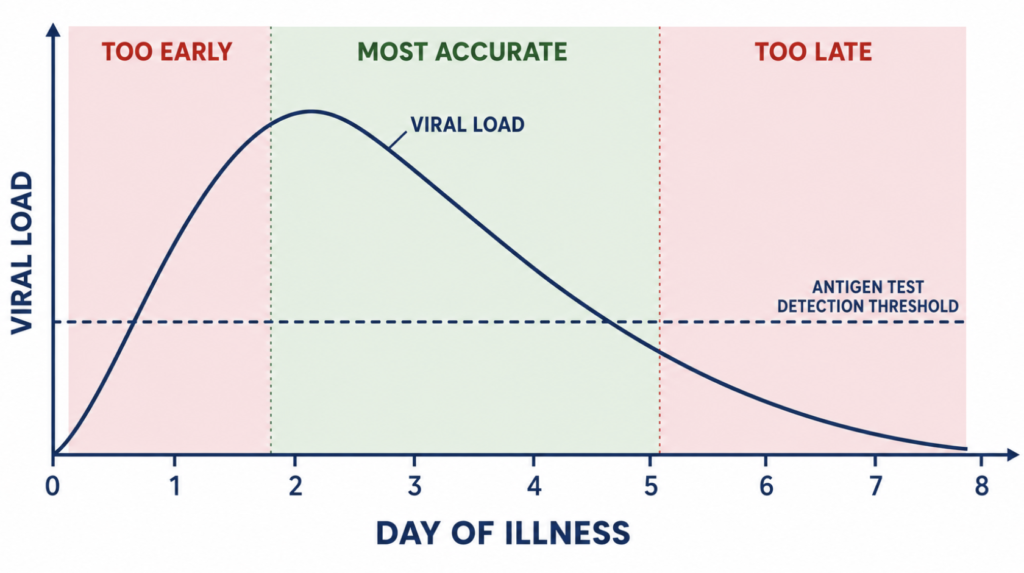
Someone wakes up with chills, swabs both nostrils, sees a single line, and goes to work. Two days later the same kit shows two lines. Nothing about the virus changed in those 48 hours. What changed was how much of it was sitting in the nose, and that quantity is what a rapid test is actually measuring. The timing of the swab therefore does most of the work: it decides how much the result can be trusted.
The effect is bigger than most people assume. In a serial home-testing study, participants swabbed themselves every 48 hours for two weeks. On the day a person first turned PCR-positive, the rapid antigen test caught only 15.5% of Delta and 22.1% of Omicron infections. Forty-eight hours later, the same test caught 44.8% and 49.7% [Soni, Comparison of Rapid Antigen Tests’ Performance Between Delta and Omicron Variants of SARS-CoV-2, 2022]. The kit was not faulty. It was used too early.
Four questions follow from this: when the swab is most accurate, when it stops being accurate, whether symptoms can substitute for a test, and how the testing window relates to the treatment window. The last one has the shortest answer, because the two windows cover much the same stretch of days.
When to test for flu and COVID: why timing decides the result
Both influenza and SARS-CoV-2 replicate fast in the upper airway, peak within the first few days of symptoms, and then decline. Antigen tests detect viral protein directly, without amplification, so they need a lot of virus in the sample to produce a line. Molecular tests amplify what is there and tolerate much lower viral loads, though even PCR cannot detect a virus that has not yet replicated to a detectable level.
Every rapid test therefore has two failure zones rather than one. Swab in the first hours of symptoms and there may not be enough antigen yet; swab a week in and there may not be enough left.
For influenza, the long-standing laboratory guidance is specific: specimens should ideally be collected 12 to 36 hours after illness onset, which also keeps antiviral therapy inside the recommended 48-hour window, with 72 hours as the outer limit for maximum detection [Peaper, Rapid diagnosis of influenza: state of the art, 2014]. The biology has not shifted in the decade since, and neither has the guidance.
Not every “rapid test” has the same window
The 12-to-36-hour target is calibrated to antigen tests, and by now the phrase “rapid test” covers instruments with very different detection limits. A meta-analysis of 162 studies found pooled sensitivity for influenza A of 54.4% for traditional rapid antigen tests, 80.0% for digital immunoassays, and 91.6% for rapid nucleic acid amplification tests, with specificity above 98% across all three. The pattern held for influenza B, where rapid NAATs reached 95.4% [Merckx, Diagnostic Accuracy of Novel and Traditional Rapid Tests for Influenza Infection Compared With Reverse Transcriptase Polymerase Chain Reaction: A Systematic Review and Meta-analysis, 2017].
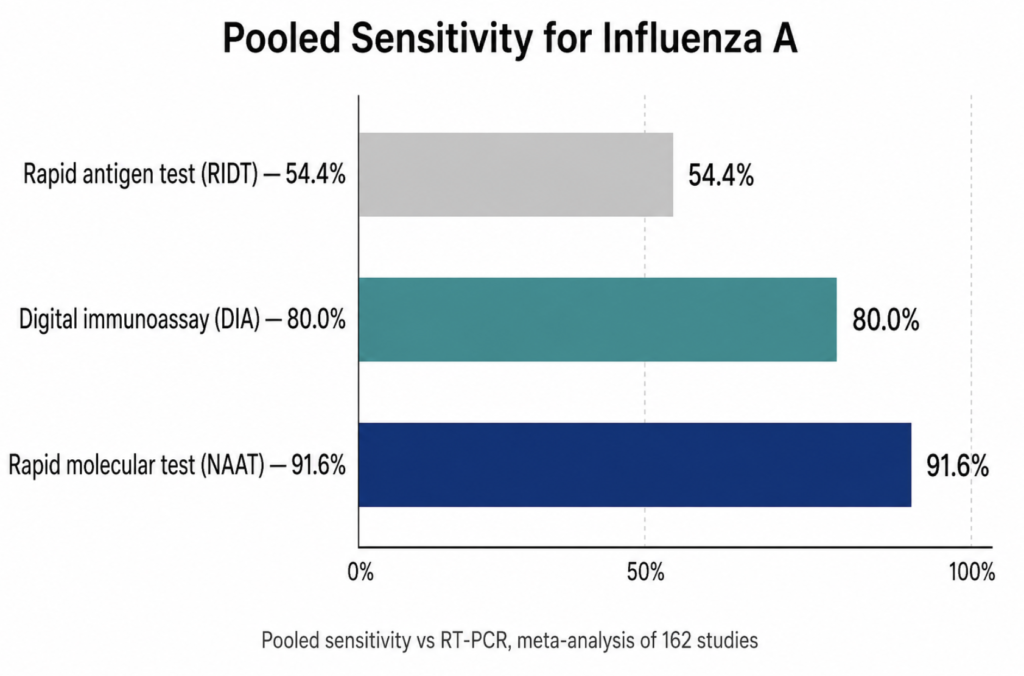
The difference comes down to the detection limit. Because molecular assays register far lower viral loads, they stay informative later in the illness, after antigen has fallen below what a lateral-flow strip can register. If the only test available is an antigen test, the 12-to-36-hour window matters a great deal. If a rapid molecular test is available, the diagnostic window is meaningfully wider.
The treatment clock does not widen with it. The 48-hour target applies whichever test was used, and in high-risk patients the guidance is to treat rather than wait once that point has passed. A more sensitive test gives a more reliable answer, but it does not push the deadline back.
National practice patterns show what the antigen baseline looks like when timing is good. In Japan, where roughly 90% of influenza patients are tested and treated within 48 hours of onset, a widely used rapid influenza test showed 97.1% sensitivity and 89.2% specificity against RT-PCR [Seki, Very high sensitivity of a rapid influenza diagnostic test in adults and elderly individuals within 48 hours of the onset of illness, 2020]. The authors attribute the gap to timing rather than to the kit.
The same physics applies at the late end. Among 605 people self-testing at home, influenza rapid test sensitivity was 63% when symptoms had started within 72 hours and 58% after that. The confidence intervals overlap, so the difference between those two numbers is not decisive on its own. The supporting detail is that viral load on the reference swabs fell as symptom duration rose, and the false negatives were not explained by inadequate swab collection or by milder illness [Geyer, Diagnostic Accuracy of an At-Home, Rapid Self-test for Influenza: Prospective Comparative Accuracy Study, 2022].
The COVID antigen test is not a one-shot test
The most common misuse of a home COVID test is treating one negative as an answer. Regulators moved away from that framing in 2022, and the requirement still stands in 2026: FDA-authorized labeling for at-home antigen tests instructs symptomatic users to test at least twice over three days, at least 48 hours apart, and asymptomatic users to test three times over five days.
That instruction comes straight from the serial-testing data above, where repeating the test after 48 hours roughly doubled detection, and the improvement held for both Delta and Omicron [Soni, 2022].
The late end of the window is labeled too. Manufacturers’ authorized labeling notes that antigen quantity falls as illness continues, and that negative results from specimens collected roughly five to seven days into illness, with the exact day varying by kit, should be treated as presumptive and confirmed with a molecular assay if the answer matters clinically.
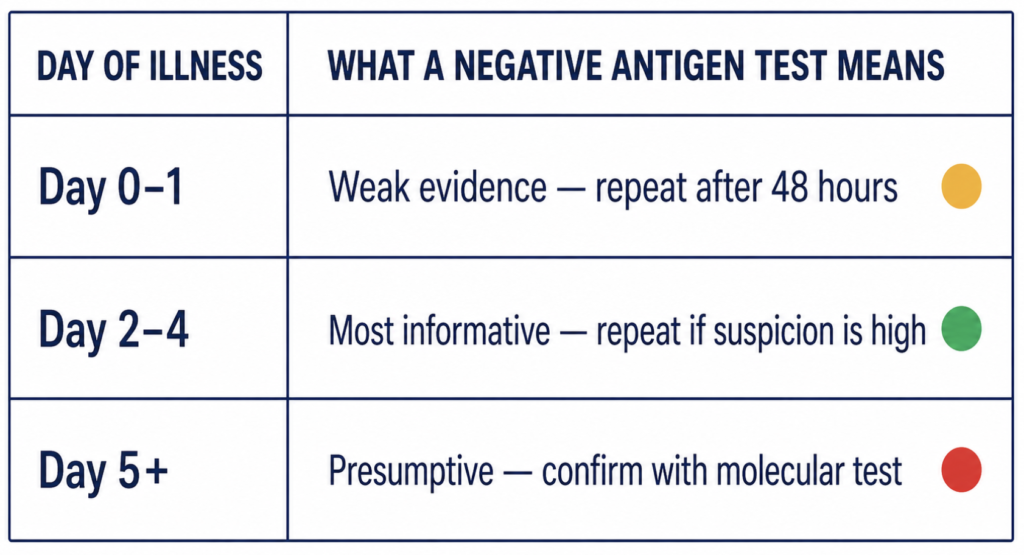
Taken together, the labeling makes a negative antigen result mean quite different things depending on where the patient sits on the curve:
| Day of illness | What a negative antigen test means |
|---|---|
| Day 0-1 | Weak evidence. Labeling directs a repeat test after 48 hours. |
| Day 2-4 | Most informative window, but a single negative in a high-suspicion case still warrants a repeat or PCR. |
| Day 5+ | Presumptive negative. Confirm with a molecular assay if the result would change management. |
What changes at the end of 2026
One piece of the regulatory scaffolding above has an expiry date. In June 2026, the Department of Health and Human Services determined that the circumstances justifying emergency use authorization for SARS-CoV-2 in vitro diagnostics no longer exist. The declarations underpinning those authorizations terminate on December 26, 2026, and on that date the COVID-19 EUAs for the tests currently listed by the FDA stop being in effect.
COVID testing does not end with them. A number of SARS-CoV-2 antigen tests have already been authorized through the FDA’s traditional premarket review pathways rather than under emergency use, and those authorizations are unaffected. What ends is the emergency framework, and with it the category-wide EUA revision that put the serial-testing instruction on every authorized at-home test at once.
The advice itself holds, because the biology behind it does: a single negative on the first day of symptoms is still weak evidence, and repeating after 48 hours still roughly doubles detection. What changes is where to look it up. After December, the authoritative instruction for how many times to test lives in the instructions-for-use in your particular kit’s box rather than in a blanket emergency revision covering the whole category.
Can symptoms tell them apart? No.
Plenty of symptom checklists online imply otherwise, so this is worth stating plainly. No individual symptom reliably distinguishes influenza from COVID-19. Fever, cough, sore throat, myalgia, headache, and fatigue occur in both. The abrupt onset once considered characteristic of influenza is neither sensitive nor specific enough to act on.
The most careful attempt to quantify this compared 839,288 CDC-reported COVID cases against influenza and influenza-like-illness controls across 45 prevalence scenarios. Symptom-based discrimination worked only when many variables were combined at once, and the value of any given symptom shifted with the local prevalence of each pathogen and with patient age. A model using a five-way combination of symptoms plus age and sex reached a cross-validated AROC of 90%, and the authors concluded it was too complex for clinical practice without a computer-based decision aid [Alemi, Differential diagnosis of COVID-19 and influenza, 2022].
That last conclusion is the practical one. A model accurate enough to separate the two illnesses is not something a clinician can run in their head, so pattern recognition cannot stand in for a swab here.
Clinical judgment still does real work on pretest probability. Local epidemic activity, a known exposure, occupational risk, and vaccination status all legitimately shift how much weight a negative test should carry. They cannot replace the test itself.
Clinical Perspective
The line worth giving a patient on day one is that a negative test at that stage does not rule the illness out. It means the virus has not built up enough to show yet. That is why serial testing appears in the labeling as an instruction rather than a suggestion.
There is a second problem, quieter and easier to miss. In a high-risk patient, waiting for a confirmatory result can consume the very window in which treatment works. Guidelines address this directly: influenza antiviral therapy should not be withheld pending laboratory confirmation when clinical suspicion is high [Uyeki, Clinical Practice Guidelines by the Infectious Diseases Society of America: 2018 Update on Diagnosis, Treatment, Chemoprophylaxis, and Institutional Outbreak Management of Seasonal Influenza, 2019]. The test should inform the decision rather than make it.
The treatment clock: 48 hours versus 5 days
The two illnesses have genuinely different treatment windows, and conflating them is a common error.
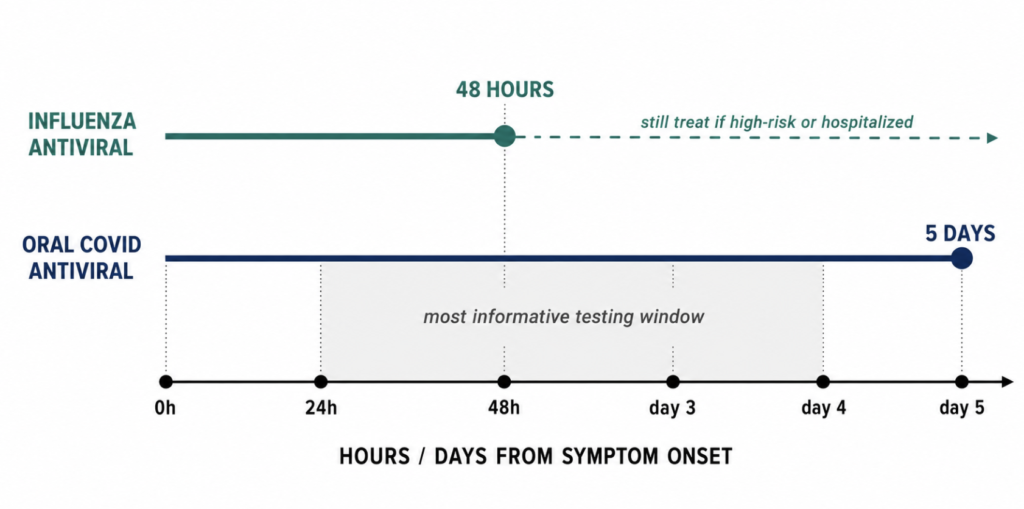
Influenza: 48 hours. Antiviral therapy is most effective when started within 48 hours of illness onset, and the pivotal trials were built around that boundary. CAPSTONE-2 enrolled high-risk outpatients whose symptoms had lasted less than 48 hours and found that single-dose baloxavir shortened median time to symptom improvement from 102.3 hours on placebo to 73.2 hours. The difference versus a five-day course of oseltamivir was 7.7 hours and did not reach significance, so the two were comparable on that endpoint [Ison, Early treatment with baloxavir marboxil in high-risk adolescent and adult outpatients with uncomplicated influenza (CAPSTONE-2): a randomised, placebo-controlled, phase 3 trial, 2020].
The 48-hour rule has an exception that patients rarely hear about. For hospitalized patients, those with severe or progressive illness, and those at high risk of complications, treatment is still recommended even when it starts later. Starting late narrows the benefit rather than erasing it [Uyeki, 2019].
COVID-19: 5 days. Oral nirmatrelvir/ritonavir is a five-day course started within five days of symptom onset. In EPIC-HR, treatment reduced COVID-related hospitalization or death by 89.1% among patients treated within three days of onset, and by 88.9% across the full analysis population treated within five days [Hammond, Oral Nirmatrelvir for High-Risk, Nonhospitalized Adults with Covid-19, 2022]. One caveat matters when reading those numbers today: EPIC-HR enrolled unvaccinated adults at high risk of progression, and the absolute benefit in a vaccinated or lower-risk population is smaller. The 2025 IDSA panel suggests against routine use in adults without risk factors for progression.
This is where the diagnostic section closes its loop. The most informative antigen window sits roughly in the middle of the treatment window, so a patient who holds out for a confidently positive test before seeking care has often spent much of their eligibility getting one.
What gets combined with what
Guideline-based combinations are simpler than most patients expect.
For mild-to-moderate COVID-19, the 2025 IDSA update issues nine recommendations across three drugs. Nirmatrelvir/ritonavir is generally the preferred first-line option for eligible ambulatory patients; when drug-drug interactions rule it out, remdesivir may be used; molnupiravir is reserved for high-risk patients when neither of the others is feasible. The panel explicitly found insufficient evidence to support combination antiviral therapy in mild-to-moderate disease [Shumaker, 2025 Clinical Practice Guideline Update by the Infectious Diseases Society of America on the Treatment and Management of COVID-19: Antiviral Treatment for Mild to Moderate COVID-19 in Adults, 2026].
For influenza, the standard is a single antiviral agent plus supportive care, not a cocktail. Where combination thinking legitimately enters is bacterial co-infection: guidelines advise evaluating and empirically treating for bacterial infection in patients who present severely, and in those who deteriorate after initial improvement while on antivirals [Uyeki, 2019]. Antibiotics treat that complication. They do nothing for the virus itself.
Post-exposure prophylaxis runs on its own clock, a 48-hour window measured from exposure rather than from symptom onset, and is reserved for selected high-risk contacts rather than offered broadly [Uyeki, 2019].
Key Takeaways
- Influenza specimens are most accurate when collected 12 to 36 hours after symptom onset, with 72 hours as the practical outer limit for detection.
- A single negative COVID antigen test is not a result. FDA-authorized labeling directs symptomatic users to test at least twice over three days, 48 hours apart.
- Rapid antigen sensitivity roughly doubled when the same people repeated the test 48 hours after their first PCR-positive day.
- No single symptom distinguishes influenza from COVID-19, and the symptom models accurate enough to try are too complex for bedside use.
- Influenza antivirals work best within 48 hours of onset, while oral COVID antivirals are started within 5 days.
- In high-risk or hospitalized patients, neither a negative test nor an elapsed window is a reason to withhold influenza treatment.
- COVID-19 test EUAs terminate on December 26, 2026. Tests cleared through the FDA’s traditional pathways remain, each carrying its own instructions for use.
FAQ
How soon after symptoms should I test for flu? Within the first 12 to 36 hours is ideal, and within 72 hours for the best chance of detection. Testing in the first few hours can miss the infection because viral load has not peaked, while testing after three days risks a false negative from declining virus. This window also keeps you inside the 48-hour antiviral treatment window, which is the more consequential deadline.
Why did I test negative but still feel sick? Most likely you tested too early or too late in the illness. Antigen tests need a high viral load to turn positive, and that load is still climbing on day one and falling by day five or six. A single negative in someone with clear symptoms should be repeated after 48 hours, or followed by a molecular test if the answer would change treatment.
Is it too late for Tamiflu or Paxlovid? It depends on which illness and which patient. Influenza antivirals are most effective within 48 hours of symptom onset, and oral COVID antivirals are started within five days. But for hospitalized patients, severe or progressive illness, or those at high risk of complications, influenza treatment is still recommended beyond 48 hours, so a late presentation is a reason to be evaluated rather than a reason to skip the visit.
Can I have flu and COVID at the same time? Yes. CDC guidance states plainly that a positive result for one of these viruses does not rule out the other, and that co-infection should be considered particularly in hospitalized patients with severe respiratory disease. Combination panels test for both at once. If someone tests positive for one virus but deteriorates in a way that does not fit the expected course, that is a signal to reassess rather than assume.
References
- Peaper DR, Landry ML. Rapid diagnosis of influenza: state of the art. Clin Lab Med. 2014;34(2):365-85.
- Merckx J, Wali R, Schiller I, et al. Diagnostic Accuracy of Novel and Traditional Rapid Tests for Influenza Infection Compared With Reverse Transcriptase Polymerase Chain Reaction: A Systematic Review and Meta-analysis. Ann Intern Med. 2017;167(6):394-409.
- Seki Y, Oda Y, Sugaya N. Very high sensitivity of a rapid influenza diagnostic test in adults and elderly individuals within 48 hours of the onset of illness. PLoS One. 2020;15(5):e0231217.
- Geyer RE, Kotnik JH, Lyon V, et al. Diagnostic Accuracy of an At-Home, Rapid Self-test for Influenza: Prospective Comparative Accuracy Study. JMIR Public Health Surveill. 2022;8(2):e28268.
- Soni A, Herbert C, Filippaios A, et al. Comparison of Rapid Antigen Tests’ Performance Between Delta and Omicron Variants of SARS-CoV-2: A Secondary Analysis From a Serial Home Self-testing Study. Ann Intern Med. 2022;175(12):1685-1692.
- Alemi F, Vang J, Wojtusiak J, et al. Differential diagnosis of COVID-19 and influenza. PLOS Glob Public Health. 2022;2(7):e0000221.
- Uyeki TM, Bernstein HH, Bradley JS, et al. Clinical Practice Guidelines by the Infectious Diseases Society of America: 2018 Update on Diagnosis, Treatment, Chemoprophylaxis, and Institutional Outbreak Management of Seasonal Influenza. Clin Infect Dis. 2019;68(6):e1-e47.
- Ison MG, Portsmouth S, Yoshida Y, et al. Early treatment with baloxavir marboxil in high-risk adolescent and adult outpatients with uncomplicated influenza (CAPSTONE-2): a randomised, placebo-controlled, phase 3 trial. Lancet Infect Dis. 2020;20(10):1204-1214.
- Hammond J, Leister-Tebbe H, Gardner A, et al. Oral Nirmatrelvir for High-Risk, Nonhospitalized Adults with Covid-19. N Engl J Med. 2022;386(15):1397-1408.
- Shumaker AH, Bhimraj A, Bedimo R, et al. 2025 Clinical Practice Guideline Update by the Infectious Diseases Society of America on the Treatment and Management of COVID-19: Antiviral Treatment for Mild to Moderate COVID-19 in Adults. Clin Infect Dis. 2026.
Regulatory labeling and the December 2026 termination notice referenced above are available from the U.S. Food and Drug Administration’s authorization documents for SARS-CoV-2 antigen tests.
Joonpyo Hong, MD is a board-certified otolaryngologist practicing in Korea. This article reflects his clinical interpretation of published research and does not constitute individual medical advice.
For more articles:
https://curiousmd.com/is-covid-over-2026/
https://curiousmd.com/rsv-vaccine-effectiveness-adults-infants/
Link out to:
- CDC — Influenza Antiviral Medications: Summary for Clinicians https://www.cdc.gov/flu/hcp/antivirals/summary-clinicians.html The current-season clinician reference for the 48-hour window, priority groups, and the instruction not to wait on lab confirmation before treating.
- FDA — In Vitro Diagnostics EUAs: Antigen Diagnostic Tests for SARS-CoV-2 https://www.fda.gov/medical-devices/covid-19-emergency-use-authorizations-medical-devices/in-vitro-diagnostics-euas-antigen-diagnostic-tests-sars-cov-2 The authorization documents behind the serial-testing requirement, including the November 2022 repeat-testing revision and the notice that these EUAs terminate on December 26, 2026.
- IDSA — Guidelines on the Treatment and Management of Patients with COVID-19 https://www.idsociety.org/practice-guideline/covid-19-guideline-treatment-and-management/ The living guideline containing the antiviral selection algorithm and the finding that evidence does not support combination antiviral therapy in mild-to-moderate disease.