
Have you ever heard about “Ozempic Ear Side Effect”? In recent months, it has become increasingly common to see patients in the clinic who are thrilled about losing significant weight on a GLP-1 agonist, but deeply frustrated by a constant, severe echoing of their own voice. This article explores the anatomical link between rapid fat reduction and Patulous Eustachian Tube (PET), explaining the mechanics behind these surprising auditory symptoms.
The Eustachian Tube: Anatomy and Physiology
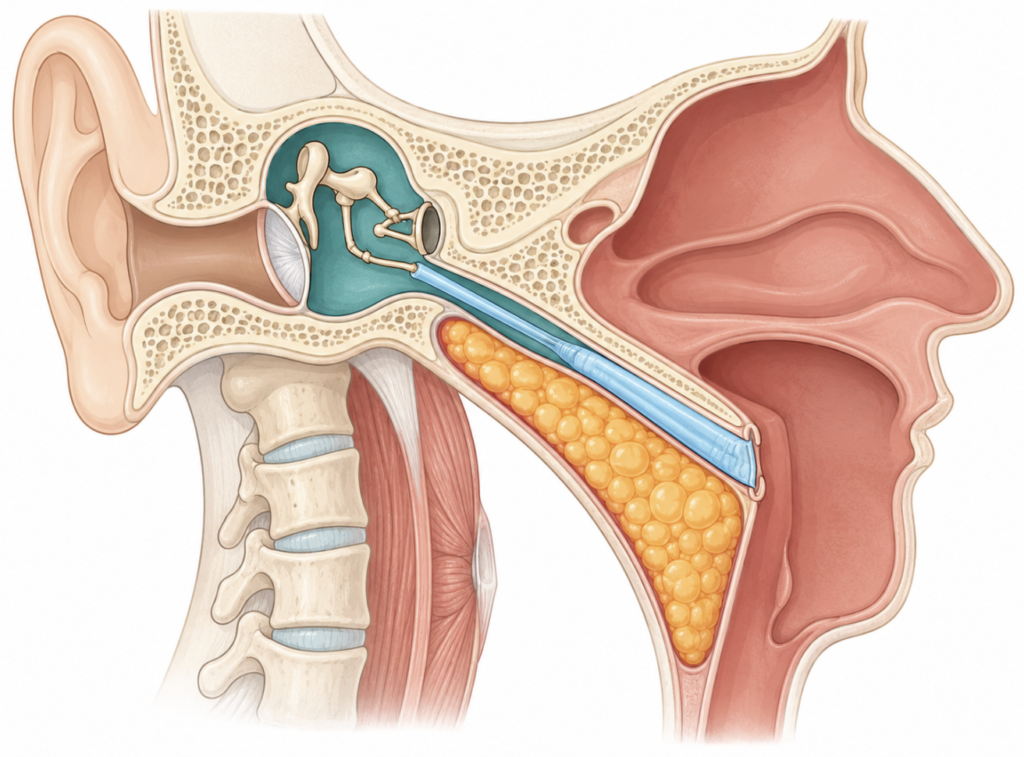
The Eustachian tube is a narrow channel connecting the back of the throat to the middle ear. Its primary physiological role is to protect, aerate, and clear the middle ear space. Under normal circumstances, this tube remains firmly closed, opening only briefly when we swallow or yawn to equalize atmospheric pressure.
The Role of the Ostmann Fat Pad
The Ostmann fat pad is a specialized layer of adipose tissue positioned longitudinally along the cartilaginous portion of the Eustachian tube. It acts much like a soft cushion or a structural doorstop, providing the necessary tissue bulk to keep the tubal valve securely shut at rest (Yoshida et al, Otol Neurotol, 2019). Without this specific fat pad, the tube loses its resting competence.
When individuals undergo massive and rapid weight loss, the body does not selectively burn subcutaneous fat around the waistline. The systemic metabolic response also depletes deep visceral and structural fat, which directly includes the Ostmann fat pad (Muñoz et al, Otolaryngol Head Neck Surg, 2010). This localized tissue loss deprives the Eustachian tube of its natural compression. Consequently, the tube remains persistently open, a mechanical condition known clinically as Patulous Eustachian Tube (PET).
How GLP-1 Associated Ear Symptoms Manifest
When the Eustachian tube remains abnormally patent (open), the protective acoustic barrier between the nasopharynx and the middle ear disappears. Patients suddenly experience a direct transfer of sound and pressure from their upper airway to their eardrum.
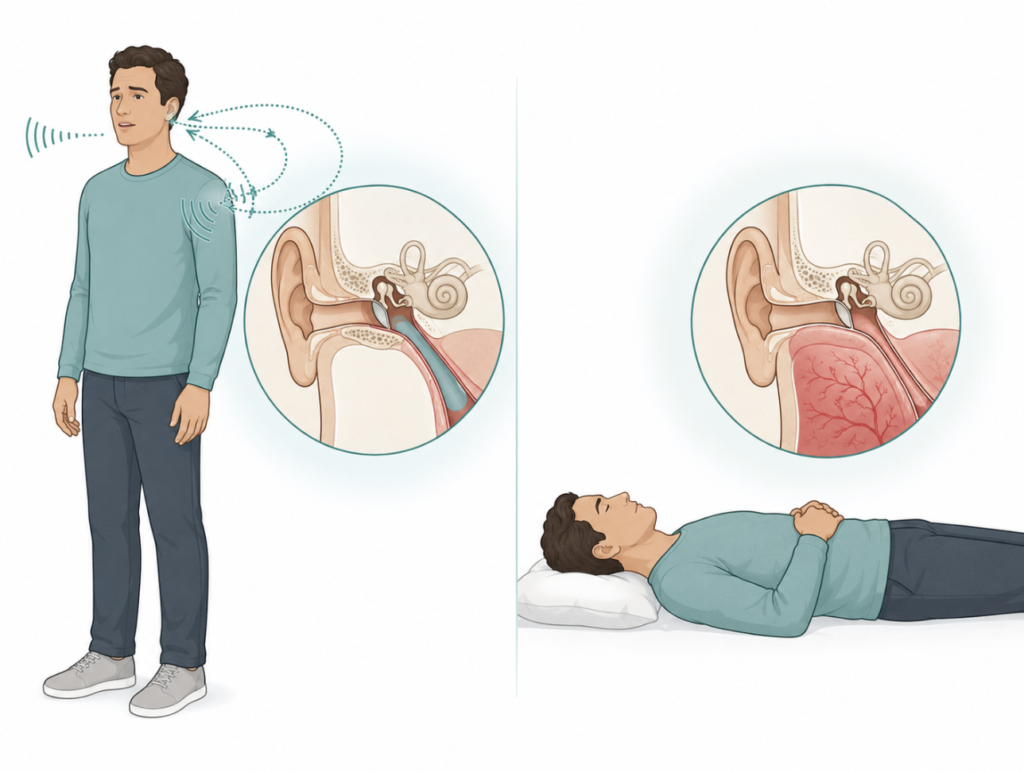
The most common symptom is autophony—patients hear their own voice, breathing, and chewing at an unnaturally loud volume (Muñoz et al, Otolaryngol Head Neck Surg, 2010). They frequently describe the sensation as feeling like their head is stuck inside a resonant barrel. Accompanying this is severe aural fullness, leading many to mistakenly assume they have impacted cerumen (earwax) or a middle ear infection.
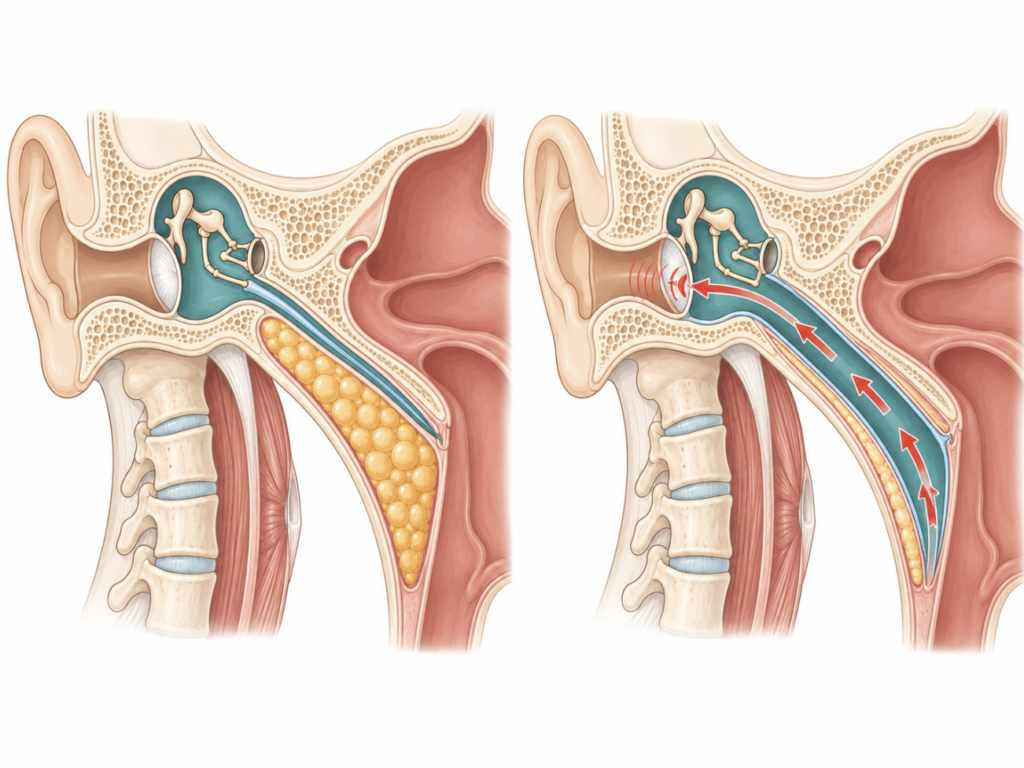
The hallmark diagnostic sign of PET is positional variation. Symptoms typically worsen during cardiovascular exercise or when standing in an upright posture. Conversely, the symptoms resolve almost immediately when the patient lies completely flat, as increased venous blood flow to the head temporarily engorges the tissues surrounding the Eustachian tube and forces it shut.
Ozempic ear side effect: Clinical Significance and Research Data
A landmark study examining rapid weight loss following bariatric surgery found that autophony was reported in 96.6% of patients who developed PET (Muñoz et al, Otolaryngol Head Neck Surg, 2010). Notably, patients who developed PET experienced significantly faster weight loss (mean 48.63 kg over 12.11 months) compared to patients without PET (mean 39.54 kg over 16.59 months). This correlation underscores the direct relationship between the rate and magnitude of fat loss and PET development.
Ozempic ear side effect: Clinical Perspective: Understanding the Mechanism
Patients often panic, assuming their new weight loss medication is causing permanent nerve damage to their inner ear. It is highly reassuring to explain that the auditory symptoms are a structural, mechanical issue caused by the rapid fat loss itself, not a direct chemical or ototoxic effect of drugs like semaglutide (Poe et al, Otol Neurotol, 2007).
Ozempic ear side effect: Conservative Management Strategies
In clinical practice, conservative management for PET focuses on modifying the local tissue environment. The following approaches have demonstrated efficacy:
Aggressive systemic hydration: Maintaining adequate fluid intake helps preserve tissue hydration around the Eustachian tube, promoting mucosal swelling that can help keep the tube closed.
Hypertonic saline nasal drops: Targeted irritation of the Eustachian tube orifice induces mild, therapeutic mucosal edema.
Anti-cholinergic nasal sprays: These agents help regulate mucosal tone, reducing the functional patency of the Eustachian tube.
Avoiding decongestants: Patients experiencing PET symptoms should avoid both systemic and topical decongestants. While decongestants are effective for nasal congestion from acute illness, they actively dry out the nasal mucosa. Shrinking tissues further will only make the Eustachian tube wider and exacerbate the echoing symptoms (Lee et al, Korean J Otolaryngol, 2004).
Ozempic ear side effect: Definitive Treatment: Weight Recovery and Beyond
While conservative treatments provide symptomatic relief, the most definitive solution for restoring the structural integrity of the Ostmann fat pad is partial weight recovery. In some cases, particularly refractory cases, consideration may be given to endoscopic fat grafting procedures to augment the periEustachian tissues (Muñoz et al, Otolaryngol Head Neck Surg, 2010).
Key Clinical Takeaways
- The “GLP-1 ear side effect” is a mechanical result of rapid weight loss, not a direct drug reaction
- Significant weight reduction depletes the Ostmann fat pad, a specialized tissue that keeps the Eustachian tube closed
- The loss of this structural fat causes a Patulous Eustachian Tube (PET), allowing throat pressure to enter the middle ear
- Primary symptoms include autophony (a loud echoing of one’s own voice) and severe aural fullness
- Medical management includes hydration, hypertonic saline irritation, and anti-cholinergic sprays, though partial weight recovery is the definitive fix
- Decongestants should be strictly avoided as they worsen symptoms
Frequently Asked Questions
Q: Why do my ears feel clogged after starting GLP-1 medications?
Your ears feel clogged because rapid weight loss depletes the fat pad around your Eustachian tube, causing it to remain abnormally open. This open state allows air and sound from your throat to travel directly into the middle ear, creating a feeling of persistent pressure and fullness.
Q: How does rapid weight loss affect the ears?
Rapid weight loss affects the ears by depleting the Ostmann fat pad, leading to a structural change known as patulous eustachian tube. Without this fat cushion, the valve that normally protects your middle ear stays open, causing mechanical hearing issues like echoing and fullness.
Q: Can GLP-1 drugs cause permanent hearing loss?
Current medical evidence does not directly link GLP-1 receptor agonists to sensorineural hearing loss. However, the rapid weight reduction they induce can cause mechanical auditory symptoms like autophony, which patients frequently mistake for true hearing loss until evaluated by an otolaryngologist.
Joonpyo Hong, MD is a board-certified otolaryngologist practicing in Korea. This article reflects his clinical interpretation of published research and does not constitute individual medical advice.
References
Lee HY. Diagnosis and treatment of patulous Eustachian tube-review. Korean J Otolaryngol. 2004;47(3):197–205.
Muñoz D, Aedo C, Der C. Patulous eustachian tube in bariatric surgery patients. Otolaryngol Head Neck Surg. 2010;143(4):521–524.
Poe DS. Diagnosis and management of the patulous eustachian tube. Otol Neurotol. 2007;28(5):668–677.
Yoshida H, Takahashi H, Morikawa M. Anatomy of the surrounding tissue of the Eustachian tube in patulous Eustachian tube: 3 tesla magnetic resonance imaging approach. Otol Neurotol. 2019;40(2):e107–e114.
For more interesting contents:
https://curiousmd.com/random-stabbing-ear-pain-few-seconds/
https://curiousmd.com/ear-and-sinus-barotrauma-decongestant-guide/
Link out to:
https://aao-hnsfjournals.onlinelibrary.wiley.com/doi/abs/10.1016/j.otohns.2010.07.004
https://www.frontiersin.org/journals/surgery/articles/10.3389/fsurg.2025.1614291/full