
Two people stand on the same street corner on the same April morning. The pollen index says “very high.” One sneezes within an hour. The other feels nothing all day. The forecast was right for the city and wrong for both of them.
That gap is what AI allergy forecasts are trying to close. Between 2024 and 2026, a new class of tools moved from research papers into consumer apps, promising to swap regional pollen maps for personalized attack predictions. This article walks through how these systems actually work, where the evidence stands, and what an ENT specialist makes of the claims.
How AI Allergy Forecasts Actually Work
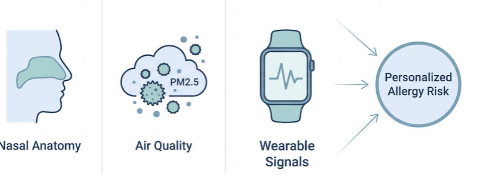
Modern AI allergy prediction stacks combine three data streams that traditional pollen counts ignore: personal anatomy, real-time environmental exposure, and continuous physiologic signals. None of these is new on its own. The shift is in fusing them so the output is “your risk in the next 6 hours” rather than “your neighborhood’s pollen score today.”
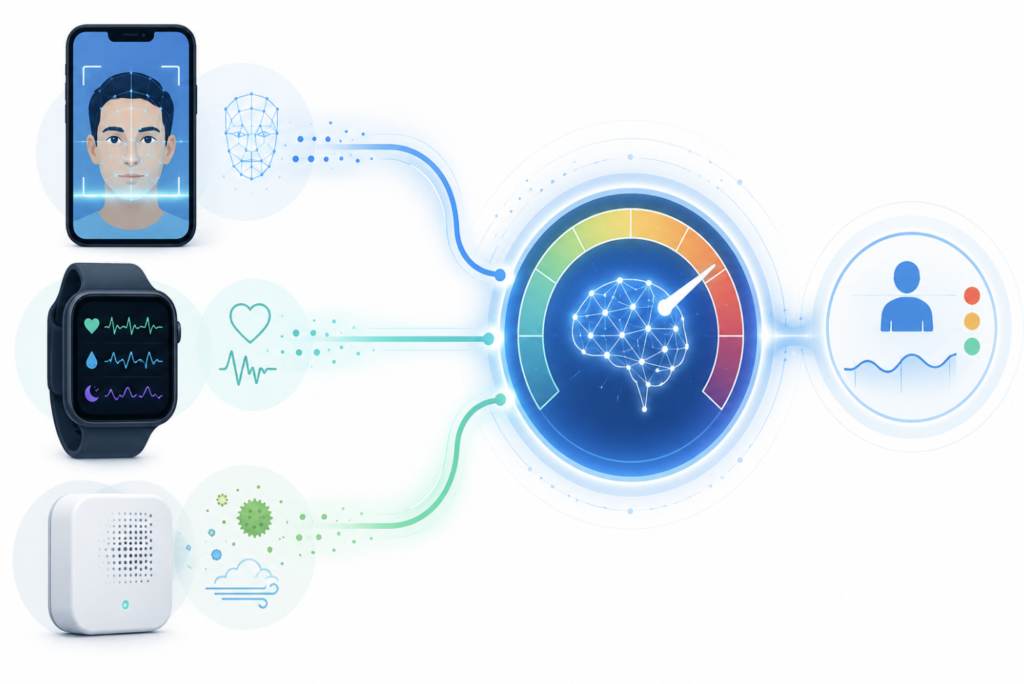
A 2025 review in The Journal of Allergy and Clinical Immunology: In Practice organized the field along exactly these axes [Konstantinou, Artificial Intelligence–Driven Wearable and Connected Technology for Allergy, 2025]. The authors group AI-enabled allergy tools into physiologic sensors, environmental exposure trackers, and connected medication-adherence devices such as digital inhalers, and they argue that the value comes from the integration rather than from any single signal.
From Pollen Index to SONUCast
The first commercial product to push facial anatomy into the equation is SONUCast, launched by SoundHealth in September 2024. The user takes a smartphone selfie, and machine-learning models trained on hundreds of CT scans estimate internal sino-nasal dimensions — the company reports accuracy within roughly 5% of CT measurements, a figure that has not yet been independently validated in peer-reviewed literature [SoundHealth, BusinessWire press release, 2024]. The app then runs a particle-aerodynamics simulation against location-based air quality data and produces a personalized allergy forecast.
Founder Paramesh Gopi told Fox Business that this is the first time “users can know their allergy to air quality based on their facial structure” [Fox Business, AI-powered app offers personalized allergy forecasts, 2024]. SONUCast lives inside the SONU app, which also pairs with the SONU Band — an FDA-authorized wearable that uses acoustic resonance to relieve nasal congestion. The forecast is therefore both a warning system and a trigger for treatment.
Wearables: Predicting Attacks Before Symptoms
The second frontier is using wearables to read the body itself. Respiratory rate, heart-rate variability, sleep fragmentation, and inhaler-use patterns can shift before a patient consciously notices wheezing or itching. The Konstantinou review concludes that AI models built on these signals can deliver earlier warnings of clinical deterioration and improve adherence, but most published evidence still comes from feasibility or short-term studies rather than outcome-driven trials [Konstantinou, Artificial Intelligence–Driven Wearable and Connected Technology for Allergy, 2025].
The same logic is being tested in food allergy and anaphylaxis, where AI risk models built on biometric streams aim to flag impending reactions before clinical symptoms appear — a use case that, if validated, would change emergency planning for severe allergy patients [Miller, Artificial Intelligence and Machine Learning for Anaphylaxis Algorithms, 2024].
Are These AI Forecasts Accurate Enough to Trust?
The honest answer is: more accurate than a regional pollen count, less validated than a clinic visit. A 2026 review in Frontiers in Allergy maps the evidence and identifies a consistent set of gaps that haven’t yet closed [Lourenço, Digital Health in Allergy Care, 2026]. Data accuracy and reliability vary across devices. Equity, privacy, and regulatory pathways are still under construction. External validation in pragmatic trials is rare.
A short comparison is useful here.
| Approach | Personalization | Real-time | Outcome evidence |
|---|---|---|---|
| Traditional pollen index | None | Daily | Decades of correlation, low individual resolution |
| SONUCast (anatomy + air quality) | High (anatomy-based) | Hourly | Commercial launch 2024, peer-reviewed outcome data limited |
| Wearable + AI (physiology) | High (signal-based) | Continuous | Feasibility-stage trials, few prospective outcome studies |
The pattern is clear. AI tools win on resolution and timeliness. They lose, for now, on the kind of randomized evidence that drives clinical guidelines.
Clinical Perspective
After reading the studies and using SONU-class tools in practice, three observations matter for patients sitting in an ENT chair.
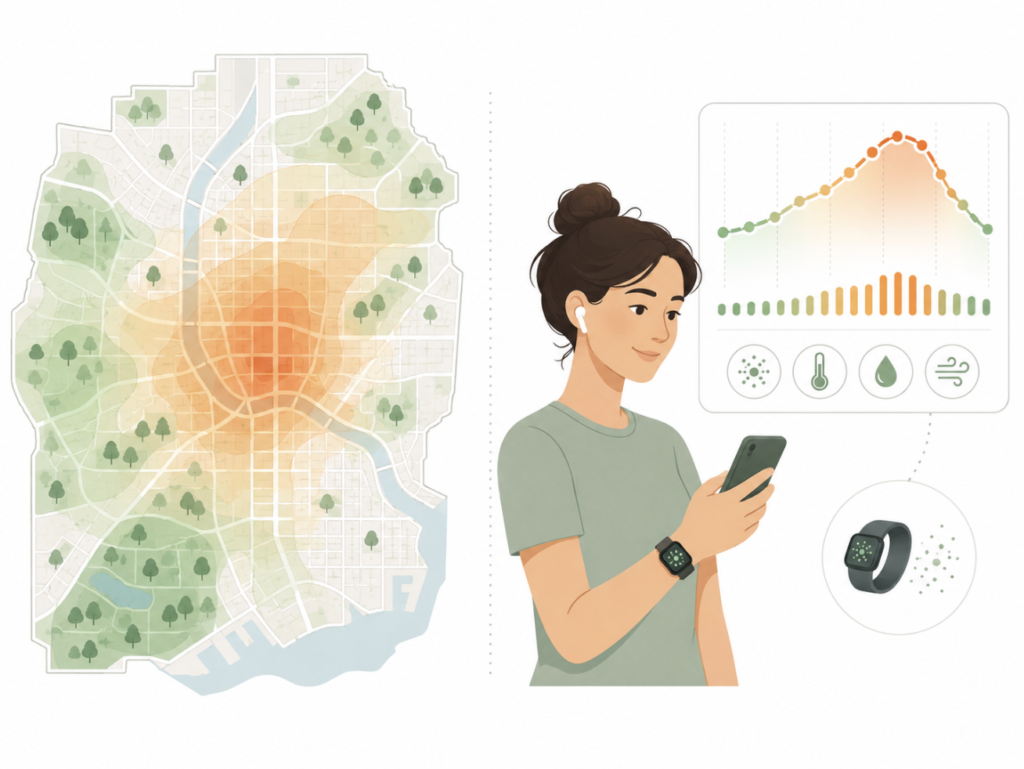
First, the forecast is a planning tool, not a diagnosis. A high-risk prediction is a reasonable cue to take an antihistamine earlier, wear a mask on a commute, or postpone outdoor exercise. It is not a substitute for skin-prick testing, IgE panels, or nasal endoscopy when symptoms are persistent.
Second, anatomy estimation from a selfie is impressive engineering, but it remains a model estimate based on company-reported accuracy figures. Even if the cited 5% range against CT held in independent validation, the model can still miss meaningfully when applied to a patient with significant septal deviation or turbinate hypertrophy. Treating the SONUCast output as a CT-equivalent is a category error.
Third, the most useful clinical role for these apps right now is patient education and adherence. A patient who watches their personalized risk score climb before a confirmed flare tends to take preventive medication more reliably and to engage more seriously in immunotherapy decisions. That behavioral effect may end up mattering more than the raw forecasting accuracy.
Key Takeaways
- AI allergy forecasts personalize predictions by combining facial scans, wearables, and real-time air quality — moving allergy alerts beyond regional pollen counts.
- SONUCast (SoundHealth, 2024) is the first commercial app to fuse facial anatomy, location-based air quality, and particle aerodynamics into a personal allergy forecast.
- Wearables paired with AI can detect physiologic shifts before symptoms appear, but most published evidence remains feasibility-stage rather than outcome-driven
- These tools augment — they do not replace — ENT diagnosis, pharmacotherapy, and immunotherapy.
FAQ
Can an app really predict my allergy attack?
Partially, and better than a regional pollen index. Apps like SONUCast estimate individual risk from anatomy, location-based air quality, and particle physics. Accuracy depends on input data quality and is still being validated in clinical studies, so the forecast is best treated as a planning tool rather than a diagnostic verdict.
What is SONUCast?
SONUCast is a feature of the SoundHealth SONU app, launched in September 2024. It uses a smartphone selfie to model your nasal anatomy, then combines that model with real-time local air quality data and particle aerodynamics to produce a personalized allergy forecast.
Are AI allergy forecasts better than traditional pollen counts?
For individual decision-making, yes — they offer personalized resolution that regional pollen counts cannot match. For population-level public health messaging, traditional pollen indices remain the standard, and peer-reviewed outcome data showing that AI forecasts reduce symptom burden is still emerging.
Can wearables detect allergic rhinitis before symptoms?
Early research suggests respiratory rate, heart rate variability, and sleep changes can precede symptom onset, supporting the case for predictive wearables. Commercial wearables specifically validated for rhinitis are still investigational, with most evidence at the feasibility stage [Konstantinou, 2025].
Joonpyo Hong, MD is a board-certified otolaryngologist practicing in Korea. This article reflects his clinical interpretation of published research and does not constitute individual medical advice.
References
- Konstantinou GN, et al. Artificial Intelligence–Driven Wearable and Connected Technology for Allergy: Real-Time Monitoring and Predictive Management for Personalized Care. J Allergy Clin Immunol Pract. 2025;13(11).
- Lourenço O, Raposo AN. Digital health in allergy care: current practices, evidence, and future prospects. Front Allergy. 2026;7:1760856.
- Miller C, Manious M, Portnoy J. Artificial intelligence and machine learning for anaphylaxis algorithms. Curr Opin Allergy Clin Immunol. 2024;24(5):305-312.
- SoundHealth. SoundHealth Unveils SONUCast, the First-Ever Real-Time Personalized Allergy Forecast Based on Facial Anatomy and Air Quality. BusinessWire press release. September 17, 2024.
- Fox Business. AI-powered app offers personalized allergy forecasts. 2024.
For more interesting contents:
https://curiousmd.com/olfaction-memory-brain-neurodegenerative-disease/
https://curiousmd.com/korea-2026-pollen-allergies/
https://curiousmd.com/evolutionary-reason-for-allergies/
Link out to:
https://www.jaci-inpractice.org/article/S2213-2198(25)00907-9/fulltext
https://www.frontiersin.org/journals/allergy/articles/10.3389/falgy.2026.1760856/full