
Two patients can leave the same clinic with the same diagnosis on the chart: thyroid cancer. Yet thyroid cancer types differ so much that the label alone says little about what comes next. One patient is a woman in her thirties with a papillary microcarcinoma smaller than 1 cm, found on a screening ultrasound. The other is a man in his seventies whose neck mass has grown over a few weeks.
Under active surveillance, about 5.3% of small, low-risk papillary cancers grew by 3 mm or more within 5 years [Cho, Active Surveillance, 2019]. For anaplastic cancer, median survival was historically about 4 to 6 months, and about 20% of patients were alive at 1 year [Bible, ATA ATC Guidelines, 2021].
Most thyroid cancers grow so slowly that treatment can do more harm than the tumor, while a few types kill within months. The cell of origin, the grade, and a small set of mutations predict where a patient falls in this range far better than the organ name does.
This article compares the main thyroid cancer types by how common they are, how they behave, how they are diagnosed and treated, and their inherited risk.
How Thyroid Cancer Types Are Classified Now
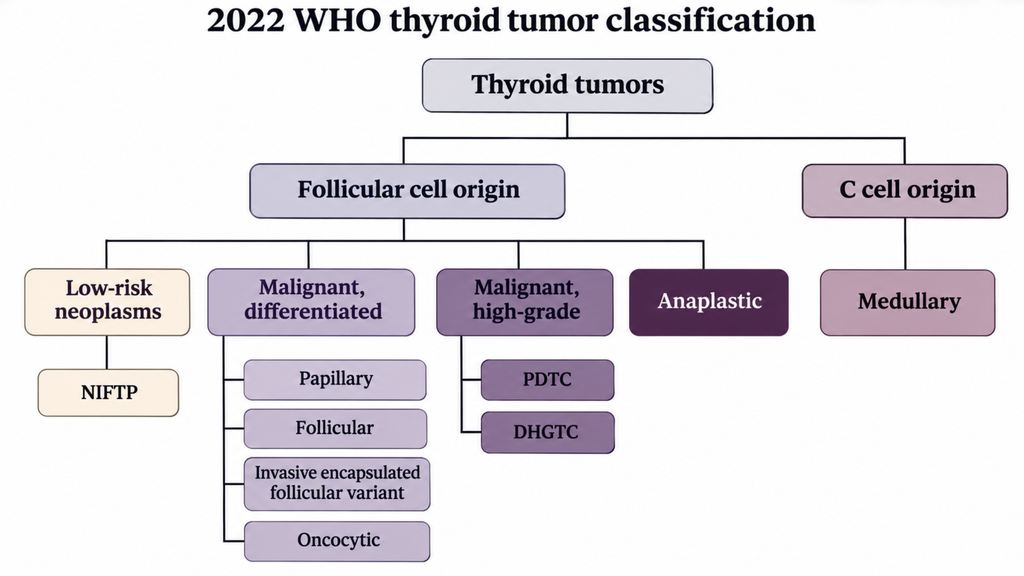
The 2022 WHO classification sorts thyroid tumors first by cell of origin [Baloch, WHO Classification, 2022]. Follicular cells give rise to papillary thyroid cancer (PTC), follicular thyroid cancer (FTC), the invasive encapsulated follicular variant of PTC, oncocytic carcinoma, high-grade carcinomas, and anaplastic thyroid cancer (ATC). Parafollicular C cells give rise to medullary thyroid cancer (MTC). Oncocytic carcinoma, formerly called Hürthle cell carcinoma, is now a separate type with more than 75% oncocytic cells and no papillary nuclear or high-grade features.
The scheme also adds grade. Poorly differentiated thyroid carcinoma (PDTC) and the newer differentiated high-grade thyroid carcinoma (DHGTC) now form one group of high-grade cancers that are not anaplastic. Both are defined partly by tumor necrosis and a raised mitotic count; for DHGTC, the threshold is 5 or more mitoses per 2 mm².
At the slow end of the range, one lesion was moved out of the cancer category. In a pathology-reviewed cohort, all 109 patients with noninvasive encapsulated follicular variant tumors were alive with no evidence of disease after a median of 13 years [Nikiforov, EFVPTC Nomenclature, 2016]. By comparison, adverse events occurred in 12 of 101 (12%) patients with invasive tumors. The noninvasive lesion was renamed NIFTP, and the 2025 ATA guideline describes its malignant potential as very low [Ringel, ATA DTC Guidelines, 2025].
Papillary cancers mostly carry BRAF-like signaling, while follicular-pattern cancers are mostly RAS-like [Cancer Genome Atlas Research Network, PTC Genomics, 2014].
Mutation status adds prognostic information, mostly when TERT is involved. Among 1,849 patients, PTC deaths were 5.3% with BRAF V600E and 1.1% without [Xing, BRAF and Mortality, 2013]. After nodal disease, extension, and distant spread were added to the model, the hazard ratio fell to 1.21 and was no longer significant. TERT status separates risk more clearly. Among 1,051 patients, PTC-specific death was 0.6% with neither mutation and 22.7% with both, with an adjusted HR of 9.34 [Liu, BRAF and TERT, 2017]. These cohorts came from referral centers, and the 2025 ATA guideline advises against routine somatic testing to set the extent of surgery [Ringel, ATA DTC Guidelines, 2025].
How Common Each Type Is, and Why the Numbers Moved

In US registry data from 1974 to 2013, 64,625 of 77,276 cases were papillary, about 84% [Lim, Thyroid Cancer Trends, 2017]. Anaplastic cancer made up about 1.7% of US thyroid cancers [Bible, ATA ATC Guidelines, 2021]. In SEER data cited by the 2015 ATA guideline, medullary cancer accounts for 1% to 2%, lower than the often-cited 3% to 5%, mainly because papillary diagnoses grew [Wells, ATA MTC Guidelines, 2015].
Overall incidence rose for decades. From 1975 to 2009, US incidence climbed from 4.9 to 14.3 per 100,000, and papillary incidence from 3.4 to 12.5 [Davies, Thyroid Cancer Trends, 2014]. Mortality stayed near 0.5 per 100,000. Medullary and anaplastic incidence stayed constant from 1975 to 2016 [Pereira, Incidence and Guidelines, 2020]. Autopsy series find hidden thyroid cancer in 4.1% to 11.2% of adults, depending on how closely the gland was examined, with no rise over time [Furuya-Kanamori, Autopsy Prevalence, 2016].
Most of the rise therefore reflects more detection of small papillary cancers, though the data also show a small real increase. Incidence-based mortality rose 1.1% per year from 1994 to 2013, and 2.9% per year for distant-stage papillary cancer [Lim, Thyroid Cancer Trends, 2017]. The absolute rate moved only from 0.40 to 0.46 per 100,000.
Korea shows the detection effect at national scale. During 2008 to 2010, incidence was 64.1 per 100,000: 107.3 for women and 21.1 for men [Ahn, Screening in South Korea, 2016]. Regional screening rates tracked incidence (r = 0.77), but screening was linked only to papillary cancer and not to thyroid cancer deaths. National registry data show that incidence rose from 1999 to 2011, fell from 2011 to 2016, and rose again from 2016 [Park, Cancer Statistics in Korea, 2025]. Thyroid cancer has again been the most common cancer in Korea since 2019, and the reasons for the renewed rise have not been established.
In the United States, incidence peaked around 2015 [Ringel, ATA DTC Guidelines, 2025] and has been roughly flat since, at 13.7 per 100,000 during 2019 to 2023 [National Cancer Institute, SEER Stat Facts, 2026]. Women are diagnosed far more often than men, at 20.0 versus 7.4 per 100,000 a year. The US Preventive Services Task Force recommends against screening adults without symptoms [US Preventive Services Task Force, Thyroid Cancer Screening, 2017]. The recommendation does not apply to people with symptoms or neck lumps, and the statement notes that childhood radiation and a family history raise risk.
Papillary, Follicular, and Oncocytic Cancers
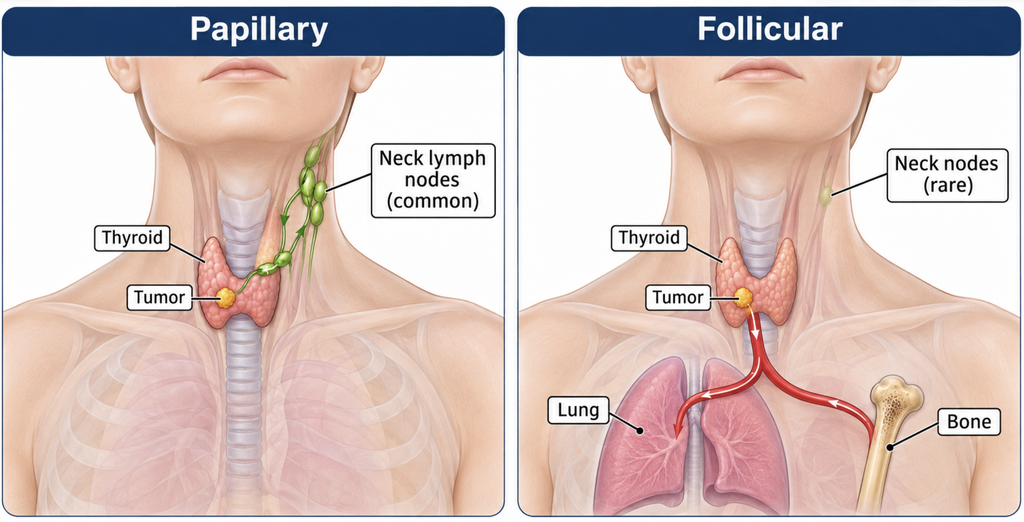
Standard pathology finds lymph node spread in 20% to 50% of papillary cancers, and tiny deposits in up to about 90% [Ringel, ATA DTC Guidelines, 2025]. Follicular cancer usually spreads through the blood to lung and bone, and rarely to neck nodes [Stenman, Lymph Node Metastases, 2022]. Oncocytic carcinoma often does not take up radioiodine and tends to spread to nodes and distant sites [Ringel, ATA DTC Guidelines, 2025]. Its genome shows mitochondrial DNA mutations and widespread chromosome loss, often down to a near-haploid state [Gopal, Hürthle Cell Genomics, 2018].
Ultrasound risk scoring, such as ACR TI-RADS, selects nodules for fine-needle aspiration [Tessler, ACR TI-RADS, 2017]. Results are reported in the 2023 Bethesda System [Ali, Bethesda System, 2023]. Average cancer risks are about 4% for benign, 22% for atypia of undetermined significance, and 30% for follicular neoplasm, and they vary by institution [Baloch, Bethesda Terminology, 2023]. Follicular carcinoma is defined by capsular or vascular invasion, so cytology alone cannot distinguish it from follicular adenoma.
In a prospective blinded study of Bethesda III and IV nodules, ThyroSeq v3 had sensitivity of 94%, specificity of 82%, and NPV of 97% at 28% cancer prevalence [Steward, Multigene Classifier, 2019]. In a blinded validation set, Afirma GSC had sensitivity of 91%, specificity of 68%, and NPV of 96% at 24% prevalence [Patel, Genomic Sequencing Classifier, 2018]. A negative result therefore left about a 3% to 4% chance of cancer. These figures come from US cohorts, and performance depends on how common cancer is in the tested group.
For adults with low-risk papillary microcarcinoma, the 2025 ATA guideline accepts active surveillance [Praw, ATA Executive Summary, 2025]. In pooled data, about 5.3% of tumors grew 3 mm or more and 1.6% developed node spread within 5 years [Cho, Active Surveillance, 2019]. Among 1,235 observed patients at one center, none developed distant spread or died of thyroid cancer, though younger patients progressed more often [Ito, PTMC Observation, 2014]. In the Korean MAeSTro cohort, rates of total thyroidectomy, hypoparathyroidism, and vocal cord palsy were similar after delayed and immediate surgery [Hwang, MAeSTro Surgical Outcomes, 2023]. Delayed cases had larger tumors and more lymphatic invasion, and 39 of 132 (29.5%) had disease progression. Long-term cancer outcomes in this cohort are still being followed.
For low-risk tumors, the 2025 ATA guideline recommends lobectomy up to 2 cm and accepts either operation above 2 cm up to 4 cm [American Thyroid Association, Extent of Surgery, 2025]. Total thyroidectomy is advised above 4 cm. For tumors above 2 cm, patients choosing lobectomy should know about a roughly 20% chance of conversion or completion thyroidectomy. In 61,775 patients with 1.0 to 4.0 cm papillary cancers, overall survival was similar after both operations (HR 0.96; 95% CI 0.84 to 1.09) [Adam, Extent of Surgery, 2014]. The groups differed at baseline, so residual confounding remains possible.
Radioiodine use has been reduced in the same way. In ESTIMABL2, among 730 evaluable low-risk patients, 95.6% were event-free at 3 years without radioiodine and 95.9% with it [Leboulleux, ESTIMABL2, 2022]. In IoN, 5-year recurrence-free survival among 504 patients was 97.9% without ablation and 96.3% with it [Mallick, IoN Trial, 2025]. Both non-inferiority trials support omitting radioiodine for small tumors without nodal spread or adverse features.
After surgery, recurrence risk is graded in four tiers, from under 10% to over 30% [Ringel, ATA DTC Guidelines, 2025], and TSH targets follow risk and treatment response. Staging uses age 55 as the cutoff, raised from 45 [Tuttle, AJCC Staging Update, 2017].
High-Grade and Anaplastic Cancers
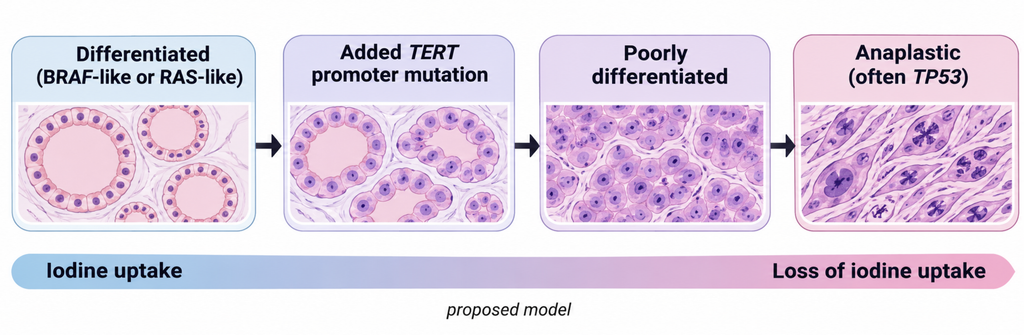
At the other end of the range, tumors lose their follicular features. Advanced cancers are thought to arise from differentiated ones through added changes such as TERT promoter and TP53 mutations [Landa, PDTC and ATC Genomics, 2016]. In anaplastic cancer, BRAF V600E appears in 40% to 70%, TERT in 65% to 75%, and TP53 in 50% to 70% [Bible, ATA ATC Guidelines, 2021]. Loss of iodine uptake is thought to follow this dedifferentiation.
High-grade cancers that are not anaplastic fall between these extremes. Among 364 patients, disease-specific survival was 89%, 76%, 60%, and 35% at 3, 5, 10, and 20 years, with similar survival for PDTC and DHGTC [Xu, High-grade Thyroid Carcinoma, 2022]. In a separate PDTC cohort, 5-year disease-specific survival was 66%, and 85% of disease deaths came from distant spread [Ibrahimpasic, PDTC Outcomes, 2014]. Both series come from single centers.
When differentiated cancer stops taking up radioiodine and progresses, multikinase inhibitors have the strongest trial evidence. Median PFS was 18.3 versus 3.6 months with lenvatinib versus placebo (HR 0.21) [Schlumberger, SELECT, 2015], and 10.8 versus 5.8 months with sorafenib versus placebo (HR 0.59) [Brose, DECISION, 2014]. Neither trial showed a clear overall survival gain, partly because placebo patients could cross over.
Anaplastic cancer often presents in older adults as a large, rapidly growing, symptomatic neck mass, and every case is stage IV [Bible, ATA ATC Guidelines, 2021]. Guidelines strongly recommend checking BRAF V600E quickly by immunohistochemistry, then confirming with DNA testing, because a targeted option now exists for BRAF-mutant tumors.
The FDA approved dabrafenib plus trametinib for BRAF V600E anaplastic cancer on May 4, 2018, based on a 61% response rate in 23 patients [ESMO, FDA Approval, 2018]. In the updated ROAR analysis of 36 patients, the response rate was 56%, median PFS 6.7 months, and median OS 14.5 months [Subbiah, ROAR Update, 2022]. At one center, 1-year survival for all patients with anaplastic cancer rose from 35% in 2000 to 2013 to 59% in 2017 to 2019 (HR 0.50) [Maniakas, ATC Survival, 2020]. The 20 patients who had surgery after neoadjuvant BRAF-directed therapy had 94% survival at 1 year.
These gains come from small single-arm trials and one center’s experience, with selected patients and no randomized comparison. The 14.5-month median and the historical 4 to 6 months come from different study types, so the size of the benefit remains uncertain.
Medullary Thyroid Cancer Follows Different Rules

Medullary cancer starts in calcitonin-producing C cells, and activating RET mutations drive most hereditary and many sporadic cases [Shariq, Hereditary MTC, 2025]. About 25% of adult cases are inherited, as part of MEN2A or MEN2B. Among sporadic tumors, somatic RET mutations appear in about 40% to 50%; one series found them in 43%, and 79% of these were M918T [Elisei, Somatic RET, 2008]. RAS mutations appear in 17.6% of RET-negative tumors [Ciampi, RAS in MTC, 2013].
Family history misses many inherited cases. At one center, 35 of 481 (7.3%) patients with apparently sporadic disease carried a germline RET variant [Elisei, RET Screening, 2007]. Series from Portugal and Turkey reported 4% [Bugalho, RET Analysis, 2007] and 10.7% [Erdogan, Turkmen Study, 2005]. Germline RET testing is therefore recommended for every patient with medullary cancer [Zhang, Hereditary MTC, 2024].
In carriers, the timing of surgery depends on the variant. Guidelines advise thyroidectomy within the first year of life for M918T and at or before age 5 for codon 634 or A883F variants [Wells, ATA MTC Guidelines, 2015]. For moderate-risk variants, monitoring starts around age 5, and calcitonin guides the timing.
Because C cells do not take up iodine, radioiodine is not used after surgery unless the tumor is mixed with papillary or follicular cancer [Wells, ATA MTC Guidelines, 2015]. Thyroid hormone is dosed only to keep TSH normal. Basal calcitonin tracks disease extent. In a surgical series of 300 patients, nodes appeared in wider neck zones as calcitonin rose past 20, 50, 200, and 500 pg/mL [Machens, Biomarker Risk Stratification, 2010]. In a small series of 65 patients, a postoperative calcitonin doubling time under 6 months carried 25% 5-year survival, while all patients with doubling times over 2 years were alive [Barbet, Doubling Times, 2005].
Fine-needle aspiration detects only 56.4% of medullary cancers in pooled data [Trimboli, FNA in MTC, 2015]. In a Cochrane review, basal calcitonin at 10 pg/mL had sensitivity of 100% and specificity of 97.2%, but most studies lacked an adequate reference standard [Verbeek, Calcitonin Testing, 2020]. At a prevalence of 0.23%, the PPV was 7.7%, so about 12 of 13 positives are false. Routine calcitonin testing for all nodules remains debated, and practice varies between institutions and societies.
For advanced RET-mutant disease, selpercatinib had longer progression-free survival than cabozantinib or vandetanib. In the phase 3 LIBRETTO-531 trial of 291 patients, 12-month PFS was 86.8% versus 65.7% with the control drugs (HR 0.28; 95% CI 0.16 to 0.48) [Hadoux, LIBRETTO-531, 2023]. This corresponds to about a 72% lower risk of progression or death. Only 4.7% stopped selpercatinib for side effects, versus 26.8% of controls, and overall survival data are not yet mature. Another RET inhibitor, pralsetinib, had its US medullary cancer indication voluntarily withdrawn on June 30, 2023 [ThyCa, Pralsetinib Withdrawal, 2023]. The withdrawal followed an infeasible confirmatory trial and was not prompted by new safety or efficacy data.
Five-year relative survival for medullary cancer is over 99% when localized, 94% with regional spread, and 50% with distant spread [American Cancer Society, Survival Rates, 2025]. Registry data suggest modest gains in recent decades, with distant-stage disease-specific survival rising from 40% to 51% [Randle, MTC Trends, 2017].
Risk Factors, Inherited Risk, and Outcomes Side by Side
Childhood exposure to ionizing radiation is a well-established risk factor. For exposure before age 15, the pooled excess relative risk was 7.7 per gray (95% CI 2.1 to 28.7) [Ron, Radiation Pooled Analysis, 1995]. Exposure after age 20 carried little risk, and risk was still raised 40 years later. A pooled analysis of nine cohorts found rising risk even below 0.2 Gy [Lubin, Low-dose Radiation, 2017]. After the 1986 Chernobyl accident, higher doses were associated with more gene-fusion drivers in papillary cancer, especially in those exposed young [Morton, Chernobyl Genomics, 2021].
Evidence for other risk factors is weaker. In pooled observational data, obesity carries about a 55% higher risk, though cause and effect are not proven [Schmid, Adiposity, 2015]. Surgical series link Hashimoto’s thyroiditis to papillary cancer (OR 2.8) [Lee, Hashimoto Meta-analysis, 2013], but biopsy-based series do not, with an average relative risk of 0.69 versus 1.59 for surgical series [Jankovic, Hashimoto and PTC, 2013]. Some regional data suggest follicular cancer became less common after iodine was added to diets, but this evidence is weak [Boukheris, Oran Registry, 2022].
Inherited disease is uncommon: about 5% to 10% of non-medullary thyroid cancers run in families [Ringel, ATA DTC Guidelines, 2025]. PTEN hamartoma tumor syndrome, familial adenomatous polyposis, DICER1 syndrome, Carney complex, and Werner syndrome raise the risk of follicular-cell cancers. The 2025 ATA guideline suggests germline testing when thyroid cancer appears with features of these syndromes. For PTEN carriers, estimates of lifetime thyroid cancer risk vary widely between studies [Tan, PTEN Cancer Risks, 2012].
| Feature | Papillary | Follicular | Oncocytic | High-grade non-anaplastic | Anaplastic | Medullary |
|---|---|---|---|---|---|---|
| Share of US cases | About 84% | Second most common | — | — | About 1.7% | 1% to 2% |
| Typical spread | Neck nodes | Blood, to lung and bone | Nodes and distant sites | Distant sites | Fast local growth | Neck nodes |
| Key test | FNA cytology | Histology for invasion | Histology | Necrosis, mitoses | Rapid BRAF V600E | Calcitonin, germline RET |
| Radioiodine | Often omitted if low risk | Selective | Often not taken up | Variable | — | Not used |
| Main drivers | BRAF-like | RAS-like | mtDNA, chromosome loss | TERT, RAS, BRAF | BRAF, TERT, TP53 | RET, RAS |
| 5-year relative survival, localized / distant | >99% / 71% | >99% / 62% | — | — | 45% / 5% | >99% / 50% |
Survival figures are SEER-based 5-year relative survival for diagnoses from 2015 to 2021 [American Cancer Society, Survival Rates, 2025]; oncocytic and high-grade non-anaplastic cancers have no matching registry row.
Across the table, management depends on the cell of origin, the grade, and sometimes the driver mutation more than on the diagnosis of cancer itself. For most papillary microcarcinomas, these features support observation or less extensive treatment, and the main risk is overtreatment. For anaplastic and advanced medullary cancer, fast molecular testing is needed to guide targeted drugs. The weakest evidence lies between these groups, in high-grade non-anaplastic cancers and early anaplastic data, where most numbers come from single centers.
Key Takeaways
- Thyroid cancer types range from NIFTP, with very low malignant potential, to anaplastic cancer, with a historical median survival of about 4 to 6 months.
- Most of the long rise in US and Korean incidence reflects more detection of small papillary cancers; medullary and anaplastic rates changed little.
- For low-risk papillary cancer, cohort data and two randomized trials now support surveillance, lobectomy, and omitting radioiodine.
- Molecular tests on indeterminate nodules had NPVs of 96% to 97% in US cohorts, a figure that depends on local cancer prevalence.
- In anaplastic cancer, a fast BRAF V600E result matters because dabrafenib plus trametinib produced responses in more than half of patients in small trials.
- Every patient with medullary cancer needs germline RET testing, since 4% to 10.7% of apparently sporadic cases carried an inherited variant.
FAQ
Is it safe to watch a papillary microcarcinoma without surgery?
For selected adults with small, low-risk tumors, it can be. Pooled data show growth of 3 mm or more in about 5.3% and node spread in 1.6% within 5 years [Cho, Active Surveillance, 2019]. Younger patients progress more often, and long-term outcomes after delayed surgery are still being followed.
Can fine-needle aspiration diagnose follicular thyroid cancer?
No. The diagnosis depends on capsular or vascular invasion, which only histology can show. Cytology reports these nodules as follicular neoplasm, and about 30% of them prove malignant [Baloch, Bethesda Terminology, 2023].
Does every patient with medullary thyroid cancer need genetic testing?
Yes. A negative family history does not exclude hereditary disease. In one large series, 7.3% of patients with apparently sporadic medullary cancer carried a germline RET variant [Elisei, RET Screening, 2007].
Has targeted therapy improved survival in anaplastic thyroid cancer?
Possibly. At one center, 1-year survival for anaplastic cancer rose from 35% to 59% across treatment eras as targeted therapy came into use [Maniakas, ATC Survival, 2020]. These data are observational, and no randomized trial has confirmed a survival gain.
References
- Baloch ZW, Asa SL, Barletta JA, et al. Overview of the 2022 WHO classification of thyroid neoplasms. Endocr Pathol. 2022;33(1):27-63.
- Nikiforov YE, Seethala RR, Tallini G, et al. Nomenclature revision for encapsulated follicular variant of papillary thyroid carcinoma: a paradigm shift to reduce overtreatment of indolent tumors. JAMA Oncol. 2016;2(8):1023-9.
- Ringel MD, Sosa JA, Baloch Z, et al. 2025 American Thyroid Association management guidelines for adult patients with differentiated thyroid cancer. Thyroid. 2025;35(8):841-985.
- Cancer Genome Atlas Research Network. Integrated genomic characterization of papillary thyroid carcinoma. Cell. 2014;159(3):676-90.
- Xing M, Alzahrani AS, Carson KA, et al. Association between BRAF V600E mutation and mortality in patients with papillary thyroid cancer. JAMA. 2013;309(14):1493-501.
- Liu R, Bishop J, Zhu G, et al. Mortality risk stratification by combining BRAF V600E and TERT promoter mutations in papillary thyroid cancer: genetic duet of BRAF and TERT promoter mutations in thyroid cancer mortality. JAMA Oncol. 2017;3(2):202-8.
- Lim H, Devesa SS, Sosa JA, et al. Trends in thyroid cancer incidence and mortality in the United States, 1974-2013. JAMA. 2017;317(13):1338-48.
- Bible KC, Kebebew E, Brierley J, et al. 2021 American Thyroid Association guidelines for management of patients with anaplastic thyroid cancer. Thyroid. 2021;31(3):337-86.
- Wells SA Jr, Asa SL, Dralle H, et al. Revised American Thyroid Association guidelines for the management of medullary thyroid carcinoma. Thyroid. 2015;25(6):567-610.
- American Thyroid Association. 2025 ATA differentiated thyroid cancer guidelines: extent of surgery. Clinical Thyroidology for the Public. 2025 Dec;18(12):4-5. https://www.thyroid.org/patient-thyroid-information/ct-for-patients/december-2025/vol-18-issue-12-p-4-5/
- Davies L, Welch HG. Current thyroid cancer trends in the United States. JAMA Otolaryngol Head Neck Surg. 2014;140(4):317-22.
- Pereira M, Williams VL, Hallanger Johnson J, et al. Thyroid cancer incidence trends in the United States: association with changes in professional guideline recommendations. Thyroid. 2020;30(8):1132-40.
- Furuya-Kanamori L, Bell KJL, Clark J, et al. Prevalence of differentiated thyroid cancer in autopsy studies over six decades: a meta-analysis. J Clin Oncol. 2016;34(30):3672-9.
- Ahn HS, Kim HJ, Kim KH, et al. Thyroid cancer screening in South Korea increases detection of papillary cancers with no impact on other subtypes or thyroid cancer mortality. Thyroid. 2016;26(11):1535-40.
- Park EH, Jung KW, Park NJ, et al. Cancer statistics in Korea: incidence, mortality, survival, and prevalence in 2022. Cancer Res Treat. 2025;57(2):312-30.
- National Cancer Institute. Cancer stat facts: thyroid cancer. Surveillance, Epidemiology, and End Results Program. Accessed November 6, 2026. https://seer.cancer.gov/statfacts/html/thyro.html
- US Preventive Services Task Force; Bibbins-Domingo K, Grossman DC, Curry SJ, et al. Screening for thyroid cancer: US Preventive Services Task Force recommendation statement. JAMA. 2017;317(18):1882-7.
- Stenman A, Kjellman M, Zedenius J, Juhlin CC. Synchronous lateral lymph node metastases from papillary and follicular thyroid carcinoma: case report and review of the literature. Thyroid Res. 2022;15(1):1.
- Gopal RK, Kübler K, Calvo SE, et al. Widespread chromosomal losses and mitochondrial DNA alterations as genetic drivers in Hürthle cell carcinoma. Cancer Cell. 2018;34(2):242-55.e5.
- Tessler FN, Middleton WD, Grant EG, et al. ACR Thyroid Imaging, Reporting and Data System (TI-RADS): white paper of the ACR TI-RADS Committee. J Am Coll Radiol. 2017;14(5):587-95.
- Ali SZ, Baloch ZW, Cochand-Priollet B, et al. The 2023 Bethesda System for Reporting Thyroid Cytopathology. Thyroid. 2023;33(9):1039-44.
- Baloch Z, Cooper D, Schlumberger M, Alexander E. Overview of diagnostic terminology and reporting. In: Ali SZ, VanderLaan PA, eds. The Bethesda System for Reporting Thyroid Cytopathology. 3rd ed. Springer; 2023.
- Steward DL, Carty SE, Sippel RS, et al. Performance of a multigene genomic classifier in thyroid nodules with indeterminate cytology: a prospective blinded multicenter study. JAMA Oncol. 2019;5(2):204-12.
- Patel KN, Angell TE, Babiarz J, et al. Performance of a genomic sequencing classifier for the preoperative diagnosis of cytologically indeterminate thyroid nodules. JAMA Surg. 2018;153(9):817-24.
- Praw SS, Gigliotti BJ, Tessnow A, et al. Executive summary of the 2025 American Thyroid Association management guidelines for adult patients with differentiated thyroid cancer. Thyroid. 2025;35(11):1214-20.
- Cho SJ, Suh CH, Baek JH, et al. Active surveillance for small papillary thyroid cancer: a systematic review and meta-analysis. Thyroid. 2019;29(10):1399-408.
- Ito Y, Miyauchi A, Kihara M, et al. Patient age is significantly related to the progression of papillary microcarcinoma of the thyroid under observation. Thyroid. 2014;24(1):27-34.
- Hwang H, Choi JY, Yu HW, et al. Surgical outcomes in patients with low-risk papillary thyroid microcarcinoma from MAeSTro study: immediate operation versus delayed operation after active surveillance: a multicenter prospective cohort study. Ann Surg. 2023;278(5):e1087-95.
- Adam MA, Pura J, Gu L, et al. Extent of surgery for papillary thyroid cancer is not associated with survival: an analysis of 61,775 patients. Ann Surg. 2014;260(4):601-7.
- Leboulleux S, Bournaud C, Chougnet CN, et al. Thyroidectomy without radioiodine in patients with low-risk thyroid cancer. N Engl J Med. 2022;386(10):923-32.
- Mallick U, Newbold K, Beasley M, et al. Thyroidectomy with or without postoperative radioiodine for patients with low-risk differentiated thyroid cancer in the UK (IoN): a randomised, multicentre, non-inferiority trial. Lancet. 2025;406(10498):52-62.
- Tuttle RM, Haugen B, Perrier ND. Updated American Joint Committee on Cancer/Tumor-Node-Metastasis staging system for differentiated and anaplastic thyroid cancer (eighth edition): what changed and why? Thyroid. 2017;27(6):751-6.
- Landa I, Ibrahimpasic T, Boucai L, et al. Genomic and transcriptomic hallmarks of poorly differentiated and anaplastic thyroid cancers. J Clin Invest. 2016;126(3):1052-66.
- Xu B, David J, Dogan S, et al. Primary high-grade non-anaplastic thyroid carcinoma: a retrospective study of 364 cases. Histopathology. 2022;80(2):322-37.
- Ibrahimpasic T, Ghossein R, Carlson DL, et al. Outcomes in patients with poorly differentiated thyroid carcinoma. J Clin Endocrinol Metab. 2014;99(4):1245-52.
- Schlumberger M, Tahara M, Wirth LJ, et al. Lenvatinib versus placebo in radioiodine-refractory thyroid cancer. N Engl J Med. 2015;372(7):621-30.
- Brose MS, Nutting CM, Jarzab B, et al. Sorafenib in radioactive iodine-refractory, locally advanced or metastatic differentiated thyroid cancer: a randomised, double-blind, phase 3 trial. Lancet. 2014;384(9940):319-28.
- ESMO. FDA approves dabrafenib plus trametinib for anaplastic thyroid cancer with BRAF V600E mutation. ESMO Oncology News. 2018. https://www.esmo.org/Oncology-News/FDA-Approves-Dabrafenib-Plus-Trametinib-for-Anaplastic-Thyroid-Cancer-with-BRAF-V600E-Mutation
- Subbiah V, Kreitman RJ, Wainberg ZA, et al. Dabrafenib plus trametinib in patients with BRAF V600E-mutant anaplastic thyroid cancer: updated analysis from the phase II ROAR basket study. Ann Oncol. 2022;33(4):406-15.
- Maniakas A, Dadu R, Busaidy NL, et al. Evaluation of overall survival in patients with anaplastic thyroid carcinoma, 2000-2019. JAMA Oncol. 2020;6(9):1397-404.
- Shariq OA, Waguespack SG, Hamidi S, et al. Approach to the patient: hereditary medullary thyroid carcinoma. J Clin Endocrinol Metab. 2025;110(9):2685-97.
- Elisei R, Cosci B, Romei C, et al. Prognostic significance of somatic RET oncogene mutations in sporadic medullary thyroid cancer: a 10-year follow-up study. J Clin Endocrinol Metab. 2008;93(3):682-7.
- Ciampi R, Mian C, Fugazzola L, et al. Evidence of a low prevalence of RAS mutations in a large medullary thyroid cancer series. Thyroid. 2013;23(1):50-7.
- Elisei R, Romei C, Cosci B, et al. RET genetic screening in patients with medullary thyroid cancer and their relatives: experience with 807 individuals at one center. J Clin Endocrinol Metab. 2007;92(12):4725-9.
- Bugalho MJ, Domingues R, Santos JR, et al. Mutation analysis of the RET proto-oncogene and early thyroidectomy: results of a Portuguese cancer centre. Surgery. 2007;141(1):90-5.
- Erdogan MF, Gürsoy A, Ozgen G, et al. Ret proto-oncogene mutations in apparently sporadic Turkish medullary thyroid carcinoma patients: Turkmen study. J Endocrinol Invest. 2005;28(9):806-9.
- Zhang D, Liang N, Sun H, et al. Critically evaluated key points on hereditary medullary thyroid carcinoma. Front Endocrinol (Lausanne). 2024;15:1412942.
- Machens A, Dralle H. Biomarker-based risk stratification for previously untreated medullary thyroid cancer. J Clin Endocrinol Metab. 2010;95(6):2655-63.
- Barbet J, Campion L, Kraeber-Bodéré F, et al. Prognostic impact of serum calcitonin and carcinoembryonic antigen doubling-times in patients with medullary thyroid carcinoma. J Clin Endocrinol Metab. 2005;90(11):6077-84.
- Trimboli P, Treglia G, Guidobaldi L, et al. Detection rate of FNA cytology in medullary thyroid carcinoma: a meta-analysis. Clin Endocrinol (Oxf). 2015;82(2):280-5.
- Verbeek HH, de Groot JWB, Sluiter WJ, et al. Calcitonin testing for detection of medullary thyroid cancer in people with thyroid nodules. Cochrane Database Syst Rev. 2020;3(3):CD010159.
- Hadoux J, Elisei R, Brose MS, et al. Phase 3 trial of selpercatinib in advanced RET-mutant medullary thyroid cancer. N Engl J Med. 2023;389(20):1851-61.
- ThyCa: Thyroid Cancer Survivors’ Association. GAVRETO (pralsetinib) has been withdrawn for RET-mutant medullary thyroid cancer (MTC) in the US. 2023. https://thyca.org/?p=1866
- American Cancer Society. Survival rates for thyroid cancer. Revised June 30, 2025. Accessed November 6, 2026. https://www.cancer.org/cancer/thyroid-cancer/detection-diagnosis-staging/survival-rates.html
- Randle RW, Balentine CJ, Leverson GE, et al. Trends in the presentation, treatment, and survival of patients with medullary thyroid cancer over the past 30 years. Surgery. 2017;161(1):137-46.
- Ron E, Lubin JH, Shore RE, et al. Thyroid cancer after exposure to external radiation: a pooled analysis of seven studies. Radiat Res. 1995;141(3):259-77.
- Lubin JH, Adams MJ, Shore R, et al. Thyroid cancer following childhood low-dose radiation exposure: a pooled analysis of nine cohorts. J Clin Endocrinol Metab. 2017;102(7):2575-83.
- Morton LM, Karyadi DM, Stewart C, et al. Radiation-related genomic profile of papillary thyroid carcinoma after the Chernobyl accident. Science. 2021;372(6543):eabg2538.
- Schmid D, Ricci C, Behrens G, et al. Adiposity and risk of thyroid cancer: a systematic review and meta-analysis. Obes Rev. 2015;16(12):1042-54.
- Lee JH, Kim Y, Choi JW, et al. The association between papillary thyroid carcinoma and histologically proven Hashimoto’s thyroiditis: a meta-analysis. Eur J Endocrinol. 2013;168(3):343-9.
- Jankovic B, Le KT, Hershman JM. Clinical review: Hashimoto’s thyroiditis and papillary thyroid carcinoma: is there a correlation? J Clin Endocrinol Metab. 2013;98(2):474-82.
- Boukheris H, Bachir Bouiadjra N. Thyroid cancer incidence and trends by demographic and tumor characteristics in Oran, Algeria: 1993-2013, a population-based analysis. Eur J Cancer Prev. 2022;31(3):301-8.
- Tan MH, Mester JL, Ngeow J, et al. Lifetime cancer risks in individuals with germline PTEN mutations. Clin Cancer Res. 2012;18(2):400-7.
Joonpyo Hong, MD is a board-certified otolaryngologist practicing in Korea. This article reflects his clinical interpretation of published research and does not constitute individual medical advice.
This article is not intended to advertise or promote any specific company or product.
For more articles:
https://curiousmd.com/thyroid-cyst-vs-nodule/
https://curiousmd.com/fine-needle-aspiration-core-needle-biopsy/
Link out to:
New ATA management guidelines for adults with differentiated thyroid cancer — American Thyroid Association announcement of the 2025 guidelines.
New guidelines for anaplastic thyroid cancer — American Thyroid Association announcement of the 2021 anaplastic cancer guidelines.
2025 ATA guidelines: extent of surgery — plain summary of when lobectomy or total thyroidectomy is advised.
Thyroid cancer screening recommendation — US Preventive Services Task Force statement against screening adults without symptoms.
SEER Cancer Stat Facts: Thyroid Cancer — National Cancer Institute incidence, mortality, and survival data.