
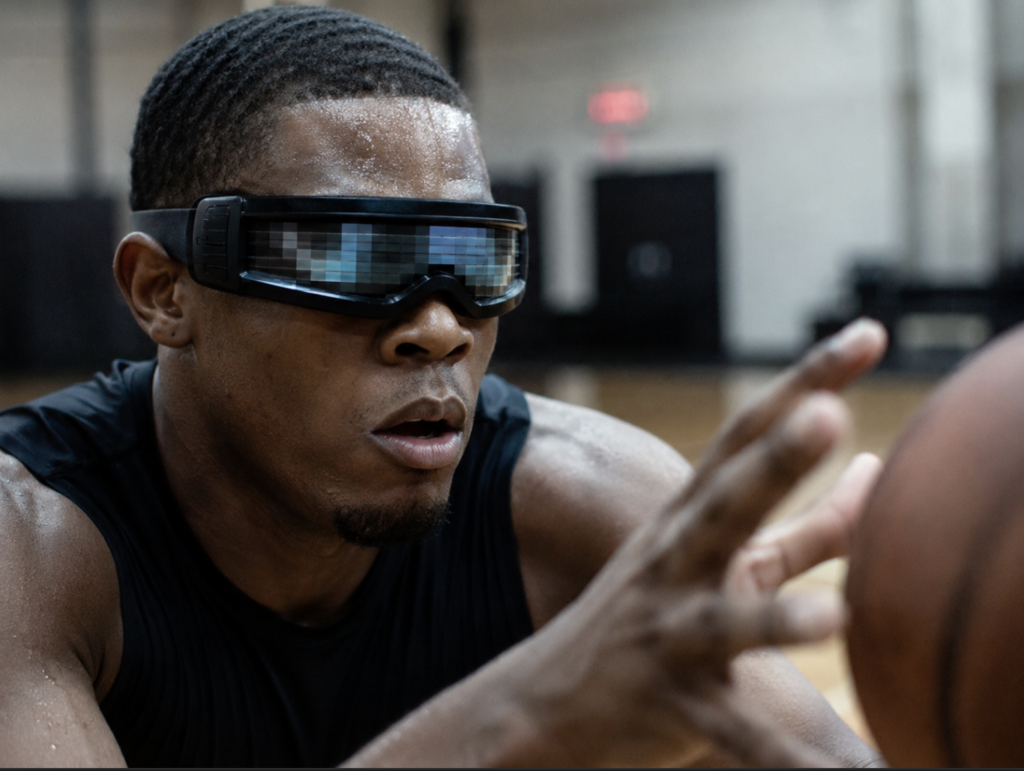
The Senaptec Strobe is the flickering goggle Steph Curry wears during ball-handling drills — and if you’ve seen the footage, you weren’t imagining things. The lenses cycle between transparent and opaque on purpose. What looks like a malfunctioning gadget is actually one of the more physiologically interesting training tools to hit professional sports in the last decade — and from where I sit as an otolaryngologist, the most compelling part of the science has nothing to do with basketball.
It has to do with your inner ear.
What Is the Senaptec Strobe?
The Senaptec Strobe is a pair of training goggles embedded with liquid crystal lenses. An electronic controller cycles the lenses between clear and opaque at adjustable frequencies — anywhere from several times per second to a slow, deliberate blink. The athlete trains, plays, or drills while wearing them, forcing the brain to operate on intermittent visual snapshots rather than a continuous stream.
The device is a direct descendant of the Nike Vapor Strobe, which was used in foundational stroboscopic training (SVT) research starting around 2011. Since then, SVT has accumulated a substantial body of peer-reviewed evidence, including multiple systematic reviews and meta-analyses published through 2025 [Appelbaum et al., 2011; Das et al., 2023].
The Three-Layer Mechanism
1. Visual Load
At its simplest, the flickering lens cuts off a fraction of incoming visual data. The brain, which is wired to predict and fill in gaps, is forced to work harder during each clear interval — extracting more information from less exposure time. This increased demand appears to sharpen motion sensitivity and short-term visual memory [Appelbaum et al., 2012].
2. Sensory Reweighting — This Is Where It Gets Interesting
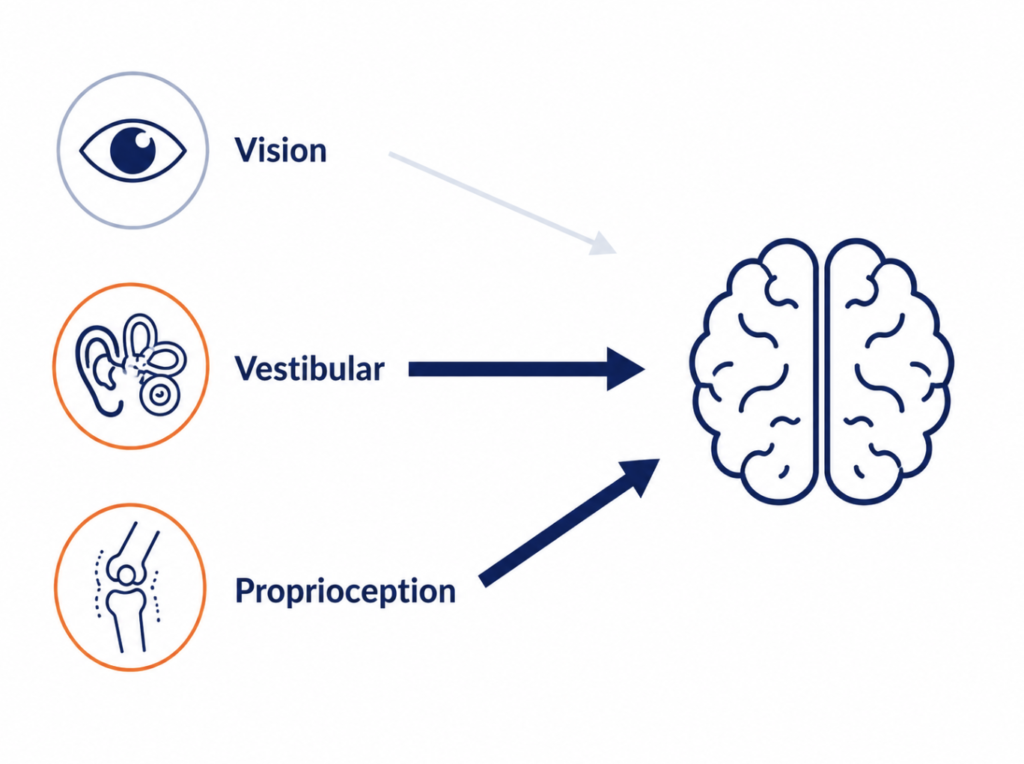
The human brain maintains balance and spatial awareness by integrating three sensory streams simultaneously: vision, the vestibular system (the inner ear), and proprioception (joint and muscle position sensors). Under normal conditions, vision is the dominant input — research commonly characterizes it as the leading contributor to spatial orientation in dynamic environments.
But dominance is not fixed.
When one sensory channel becomes unreliable, the brain dynamically redistributes its weighting across the other channels to compensate. This process, formally described as sensory reweighting, was characterized by Nashner and Berthoz as far back as 1978 and has since been rigorously modeled and quantified [Assländer and Peterka, 2014].
The Senaptec Strobe exploits this mechanism directly. When the lens goes dark, visual input drops to zero. The brain, in real time, up-weights the vestibular and proprioceptive signals to compensate. Repeat this across weeks of training, and the neural circuits responsible for vestibular and proprioceptive processing are getting a workout that normal vision-intact training simply does not provide.
The result is an athlete whose balance and spatial sense no longer collapse the moment vision is disrupted. In a sport like basketball, where bodies collide and sight lines are constantly broken, that is a meaningful adaptation.
3. Neural Rewiring After the Goggles Come Off
The adaptations are not confined to training time. Studies of elite youth badminton players found that stroboscopic training produced lasting acceleration of visuomotor reaction speed, with effects measured both immediately after a 10-week program and retained at a 6-week follow-up [Hülsdünker et al., 2021]. One leading explanation is that training under visual deprivation recalibrates how efficiently the brain samples and processes visual input — so when full vision returns, athletes perceive the visual scene as richer and, paradoxically, slower-moving than before.
Who Uses Senaptec Strobe Beyond the NBA?
Baseball hitters use strobe training to sharpen the brief window in which they identify pitch type and trajectory — a task that demands extraordinarily fast visual processing.
The U.S. Air Force has incorporated similar stroboscopic protocols for pilots and special operations personnel, targeting the same reaction-speed and situational awareness mechanisms.
Collegiate and elite soccer players training with stroboscopic goggles have shown significant improvements in vestibular reliance and balance indices, consistent with the sensory reweighting model (clinical reports; formal RCTs ongoing as of 2025).
An ENT Perspective: Senaptec Strobe Is Vestibular Training in Disguise
To explain Senaptec Strobe to patients or colleagues outside of sports medicine, I would frame it this way: it is a vestibular training device that happens to look like sports eyewear.
The vestibulo-ocular reflex (VOR) is one of the most clinically important circuits in otolaryngology. Its job is to stabilize the image on the retina while the head is moving — essentially, to move the eyes in the opposite direction of head rotation so that gaze remains fixed. A well-functioning VOR is what allows you to read a sign while walking, or for an athlete to track a moving ball while sprinting.
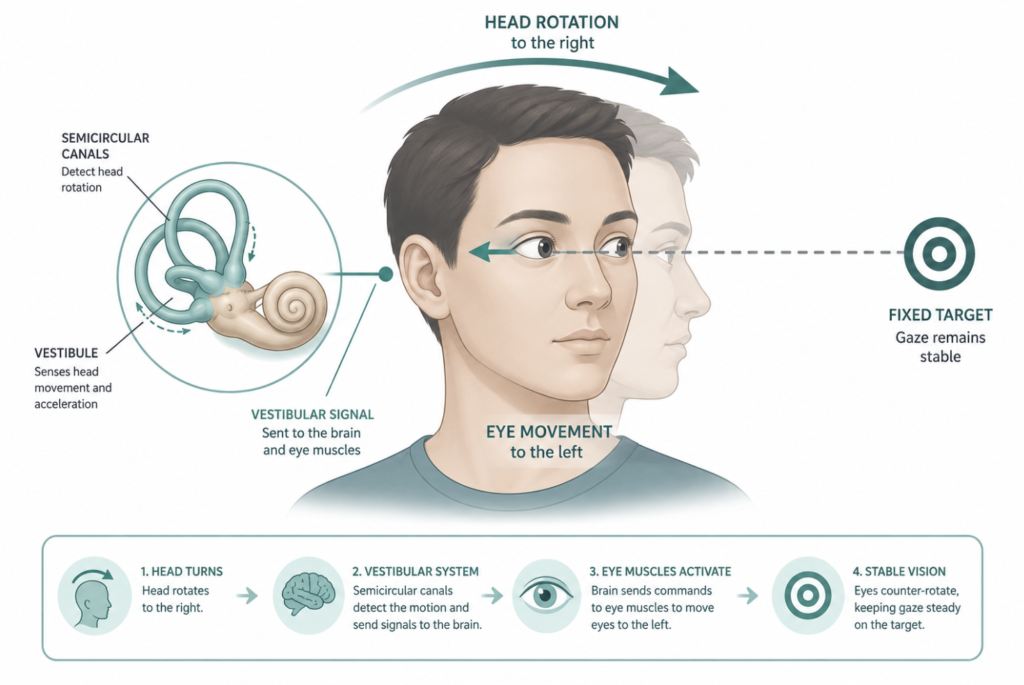
Stroboscopic training may place demand on this circuit. When the lens is dark and vestibular inputs become the primary available signal, the VOR is subject to a type of visual-vestibular stress that standard balance training does not replicate. Direct evidence of VOR gain changes from SVT remains limited, but indirect markers — including improvements in dynamic visual acuity — suggest the pathway is engaged. Over time, this is consistent with the broader principle of central compensation — the brain’s capacity to reorganize sensory processing pathways in response to altered input.
This matters clinically in at least two areas:
Concussion recovery. Visual and vestibular impairments are common after concussion and are associated with prolonged recovery. Standard vestibular rehabilitation works by progressively challenging the visual-vestibular integration system. A graded stroboscopic protocol — starting at slow flicker rates and increasing over weeks — is conceptually aligned with this approach, though direct randomized clinical trials remain limited [Das et al., 2023; Murray et al., 2017].
Fall prevention in older adults. The same sensory reweighting deficit that makes a young athlete stumble when blinded for a moment is, in exaggerated form, a major contributor to falls in older adults. Whether SVT directly translates to fall reduction in older populations has not yet been tested in clinical trials, but the mechanistic rationale — strengthening vestibular and proprioceptive circuits that visual dependency tends to underuse — is sound.
Key Takeaways
- The Senaptec Strobe uses liquid crystal lenses that flicker between transparent and opaque, forcing the brain to extract spatial information from intermittent visual snapshots.
- When visual input is intermittently blocked, the brain dynamically up-weights vestibular and proprioceptive signals — a process called sensory reweighting — strengthening circuits that are underused in normal training.
- Stroboscopic training has demonstrated improvements in visuomotor reaction time, short-term visual memory, and motion sensitivity across multiple peer-reviewed studies.
- From an ENT standpoint, the mechanism may engage the vestibulo-ocular reflex (VOR) and central sensory integration pathways — making it relevant not just to sports performance but to concussion rehabilitation and fall prevention.
- Long-term effects have been documented beyond the training period, suggesting genuine neural reorganization rather than a temporary arousal effect.
FAQ
Can the Senaptec Strobe be used during concussion recovery?
Graded stroboscopic training is conceptually consistent with concussion rehabilitation protocols, which progressively challenge visual-vestibular integration. However, direct randomized trial evidence is limited, and any use during acute concussion recovery should be supervised by a clinician experienced in vestibular rehabilitation. Starting at the lowest flicker frequency and monitoring symptom response is essential.
Is this relevant to patients with chronic dizziness or vestibular disorders?
Potentially, but the evidence is preliminary. The same sensory reweighting mechanisms that underlie athletic performance are, in principle, the same mechanisms targeted in vestibular therapy. Stroboscopic training as an adjunct to standard vestibular rehabilitation is an active area of investigation, particularly for neurological populations.
How is stroboscopic training different from standard balance exercises?
Standard balance exercises (foam pads, single-leg stance) reduce the reliability of proprioceptive input. Stroboscopic training specifically targets the visual channel, forcing a different reweighting pattern. The two approaches are complementary, not interchangeable.
Does the level of stroboscopic frequency matter?
Yes. Higher frequencies (more frequent darkness) impose greater cognitive and visuomotor load. Most training protocols begin at lower demand levels and progress over weeks, similar to progressive overload in strength training. Subgroup analyses in recent meta-analyses confirm that protocol parameters moderate training outcomes.
References
- Appelbaum LG, Schroeder JE, Cain MS, Mitroff SR. Improved visual cognition through stroboscopic training. Front Psychol. 2011;2:276.
- Appelbaum LG, Cain MS, Schroeder JE, Darling EF, Mitroff SR. Stroboscopic visual training improves information encoding in short-term memory. Atten Percept Psychophys. 2012;74(8):1681-1691.
- Hülsdünker T, Rentz C, Ruhnow D, Käsbauer H, Strüder HK, Mierau A. Short- and long-term stroboscopic training effects on visuomotor performance in elite youth sports. Part 1: reaction and behavior. Med Sci Sports Exerc. 2021;53(5):1073-1082.
- Das J, Walker R, Barry G, Vitório R, Stuart S, Morris R. Stroboscopic visual training: the potential for clinical application in neurological populations. PLOS Digit Health. 2023;2(8):e0000335.
- Assländer L, Peterka RJ. Sensory reweighting dynamics in human postural control. J Neurophysiol. 2014;111(9):1852-1864.
- Murray DA, Meldrum D, Lennon O. Can vestibular rehabilitation exercises help patients with concussion? A systematic review of efficacy, prescription and progression patterns. Br J Sports Med. 2017;51(5):442-451.
Joonpyo Hong, MD is a board-certified otolaryngologist practicing in Korea. This article reflects his clinical interpretation of published research and does not constitute individual medical advice.
For more interesting contents:
https://curiousmd.com/room-spins-when-youre-drunk/
https://curiousmd.com/motion-sickness-aftereffects/
Link out to:
https://senaptec.com/
https://journals.plos.org/digitalhealth/article?id=10.1371/journal.pdig.0000335
https://vestibular.org/article/diagnosis-treatment/treatments/vestibular-rehabilitation-therapy-vrt/