
Prolonged exposure to environmental noise above 85 dB is associated with increased risk of hearing loss, yet many people first reach for active noise cancellation (ANC) headphones rather than hearing protection. That instinct has quietly driven an entire field of engineering. What began as a niche tool for airline pilots now sits inside electric vehicles, refrigerators, and, experimentally, your mattress. Here’s how the physics works, where the technology actually lives today, and what’s still closer to a prototype than a product.
Sound and Noise Are the Same Thing — Until They’re Not
Before unpacking the engineering, it’s worth clearing up a persistent confusion: Physically, sound and noise are the same type of pressure wave; ‘noise’ is usually defined by context as unwanted or disruptive sound. A symphony orchestra and a jackhammer produce the same physical entity — oscillating air molecules.
The distinction is contextual and subjective. Noise, in everyday language, is unwanted sound. But for an active noise-cancellation (ANC) processor, “unwanted” is meaningless. The system does not “judge” annoyance; it only analyzes signal patterns.
What the processor can detect is pattern.
Think of it this way: ocean swells and ocean spray are both water. But a surfer can read a swell — it has a rhythm, a predictable shape — and time her drop accordingly. Spray, by contrast, is chaotic; it flies in every direction without warning. ANC works best on repetitive, predictable signals rather than irregular, broadband sounds. Engine hum, compressor noise, road vibration — these are acoustical swells: repetitive, low-frequency, and predictable. A child’s laugh, a car horn, a conversation — these are spray: irregular, broadband, and impossible to anticipate millisecond by millisecond.
This single distinction explains both the power and the limits of every noise-cancelling device on the market.
How Active Noise Cancellation Works: Destructive Interference
ANC is applied wave physics. Sound is a pressure wave; when two waves of equal amplitude but opposite phase meet, their peaks cancel their troughs. The result is silence — or close to it.
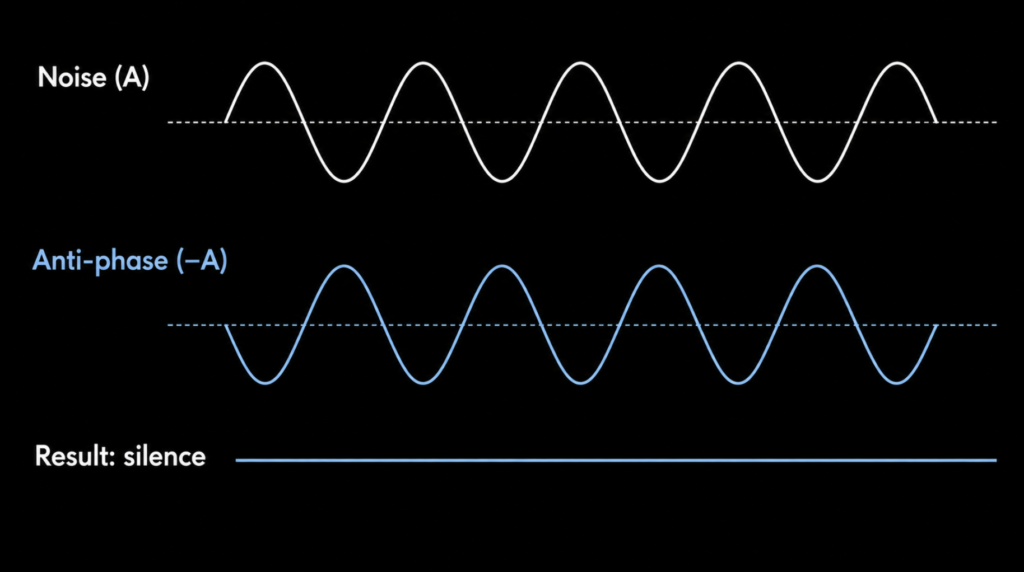
The process unfolds in three steps:
- Capture — A microphone on the device records incoming ambient noise in real time.
- Invert — An onboard processor generates an anti-phase waveform: a mathematical mirror image of the noise signal.
- Emit — The anti-phase wave exits the speaker, meets the original noise wave, and both are attenuated toward zero at the listener’s ear.
From an otolaryngology standpoint, what this achieves is a reduction in sound pressure level (SPL) before the wave reaches the tympanic membrane. Passive hearing protection (earplugs, acoustic foam) blocks transmission mechanically. ANC cancels it electronically. The two strategies are complementary, not interchangeable — a point worth returning to. The fundamental principles of ANC, including its real-time control requirements, low-frequency advantages, and spatial constraints, are well characterized in the foundational literature [Kuo & Morgan, Active noise control: a tutorial review, 1999].
What’s Actually Available Now
The following applications are commercially deployed and available to consumers or operators today.
Consumer Headphones and Earphones
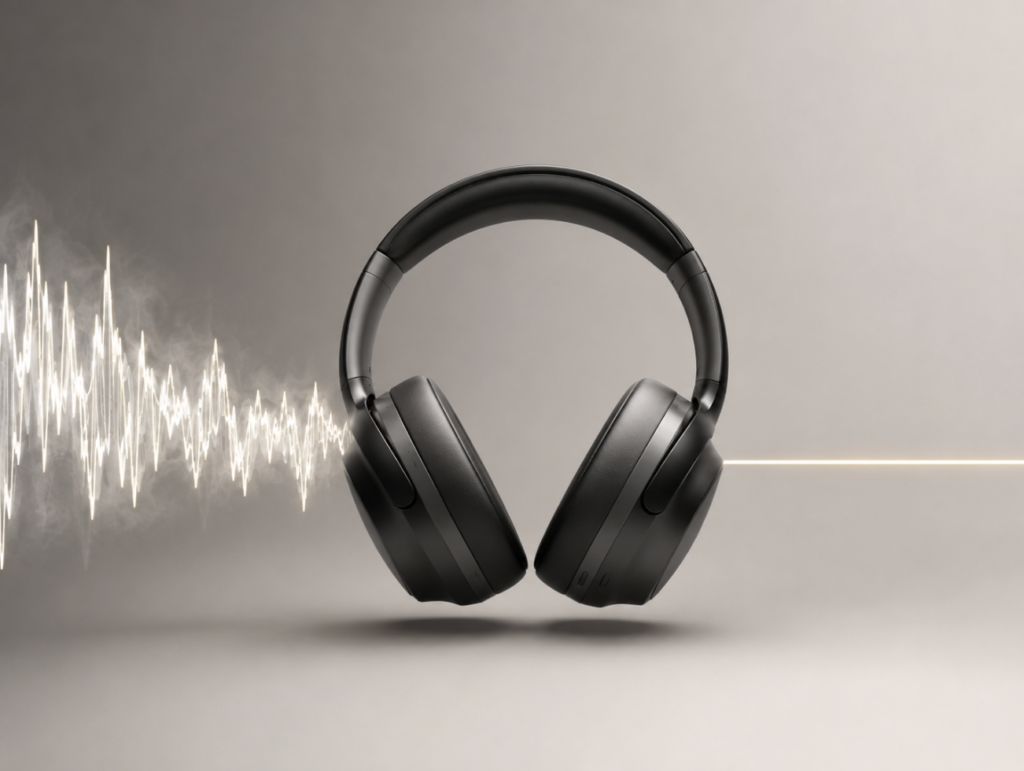
The most mature ANC application. Premium over-ear and in-ear headphones have offered active noise cancellation for years, with substantial attenuation primarily in low-frequency bands. Performance is consistently strong against steady-state noise: aircraft cabin rumble, train vibration, office HVAC. Against speech, results remain inconsistent — for reasons explained in the limitations section below.
Automotive Road Noise Cancellation (RNC)
Some premium and electric vehicle platforms embed active road-noise cancellation into the cabin audio system. Accelerometers mounted on the chassis detect road-induced vibrations; the vehicle’s speaker array emits counteracting waveforms in real time.
Electric vehicles present a specific challenge here. Remove the internal combustion engine, and the acoustic floor drops sharply — making previously masked noise (tire contact, wind buffeting) newly audible. RNC partially compensates. An added benefit: electronic attenuation can help reduce reliance on physical insulation, which may contribute to weight reduction and, in electric vehicles, marginal efficiency gains.
Aviation Headsets and Cabin Systems
ANC has been standard in professional aviation headsets since the 1990s. Cockpit application is straightforward: engine noise is high-amplitude and highly repetitive — an ideal ANC target. The practical payoff is improved radio communication clarity and reduced pilot fatigue on long-haul routes. Passenger cabin systems, installed in select wide-body aircraft, address the same low-frequency engine drone that makes transatlantic flights tiring.
Premium Appliances
Some refrigerators, HVAC units, and related appliance systems have been studied or prototyped with ANC for compressor or duct noise. Compressors generate a steady mechanical hum at a consistent frequency — structurally similar to an aircraft engine from the ANC processor’s perspective. The application is niche but growing among manufacturers targeting low-noise residential environments.
What’s Still Being Developed
The following applications exist in research literature, early-stage commercial products, or limited pilot deployments. They are not yet widely available, and clinical or real-world efficacy data remain limited.
Smart Windows
The concept: piezoelectric actuators attached to glass panes vibrate the surface itself to generate anti-phase waveforms, canceling incoming outdoor noise before it enters the room. Laboratory demonstrations show meaningful attenuation, particularly at low frequencies [Hu et al., Active Control of Sound Transmission Through Windows, 2020]. Consumer products are not yet widely available.
Sleep-Oriented ANC Devices
Sleep-oriented anti-noise products remain early-stage and are not yet supported by robust clinical validation. The appeal is obvious — snoring and environmental noise are among the most cited disruptors of sleep architecture. Some devices use localized speaker arrays to create a quiet zone around the user’s head rather than canceling noise room-wide. Independent clinical validation of sleep outcome improvements is limited.
Industrial Exhaust and Ductwork
Large-scale ANC for factory ventilation and exhaust stacks has been demonstrated in controlled settings: speakers positioned at duct openings emit anti-phase waveforms to reduce low-frequency noise propagating to surrounding neighborhoods [Snyder & Hansen, Active Noise Control in Ducts, 1994]. Cost and engineering complexity have slowed broad adoption. Pilots are ongoing at select industrial facilities. In a related application, laboratory testing of ANC for floor-impact noise in the 40–500 Hz band reported reductions of approximately 4 dB, illustrating both the potential and the current limits of low-frequency ANC in structural settings.
Clinical Perspective: What an ENT Notices
Here is the irony I keep coming back to: ANC is generally most effective at low frequencies, whereas noise-induced hearing loss often reflects broader occupational exposure that includes higher frequencies such as 3,000–6,000 Hz. NIHL concentrates its damage in the 4,000 Hz notch on an audiogram, a signature of chronic high-frequency exposure.
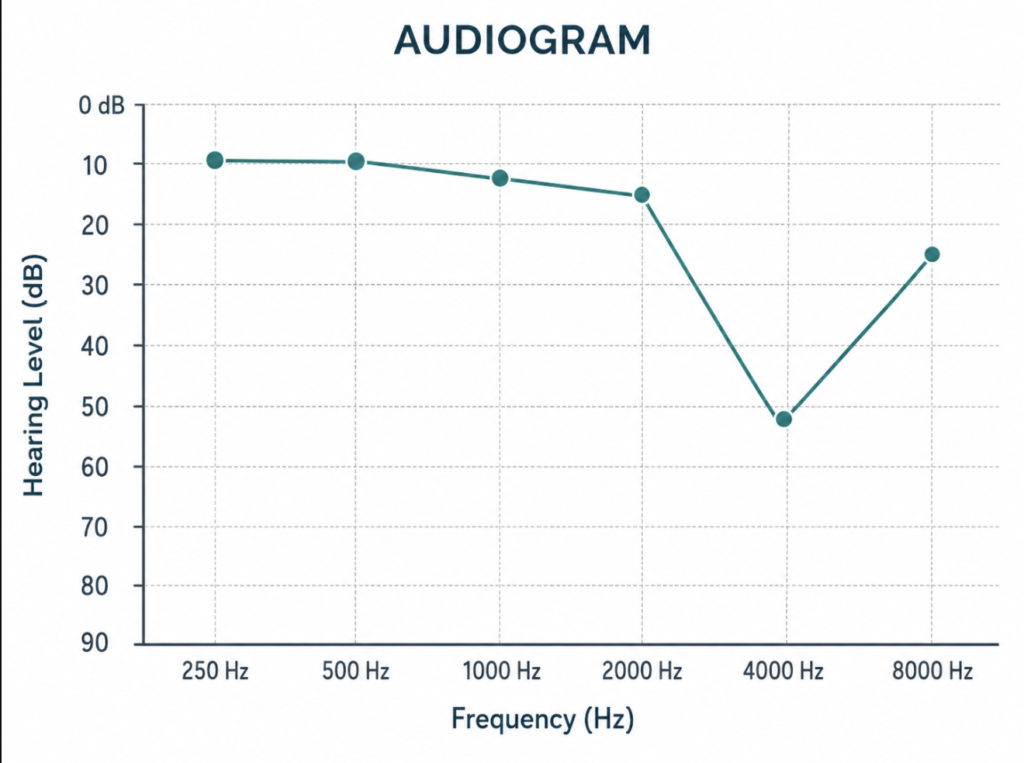
This means ANC headphones offer genuine comfort and concentration benefits, but they are not a substitute for hearing protection in genuinely hazardous acoustic environments. If you work near high-frequency industrial equipment, earplugs rated for that frequency range matter more than any electronic system. In hearing conservation, ANC may complement but does not replace passive hearing protection [Berger, The Noise Manual, 2003].
There is also a subtler clinical concern (clinical observation): several patients have reported that highly effective ANC devices make them uneasy — the sudden perceptual quiet triggers a kind of hypervigilance. The auditory system, shaped by evolution to flag silence as potentially threatening, occasionally interprets complete noise cancellation as a warning signal. It passes quickly, but it’s worth flagging for patients with anxiety or hyperacusis.
Key Takeaways
- Acoustically, sound and noise are identical — both are air pressure waves. ANC targets not “noisiness” but predictable, repetitive waveforms.
- Currently deployed at scale: consumer headphones, EV road noise cancellation, aviation headsets, and select premium appliances.
- Still in early development or limited pilots: smart windows, ANC sleep devices, and large-scale industrial exhaust systems.
- ANC’s core limitation is high-frequency and irregular sound — voices, alarms, and sudden impacts remain largely unaffected by current technology.
- For occupational hearing protection in high-frequency environments, passive ear protection remains clinically irreplaceable.
FAQ
How does noise-cancelling technology actually eliminate sound? A microphone captures incoming noise, a processor generates its mirror-image waveform (anti-phase), and a speaker emits that waveform simultaneously. Where the two waves overlap, their amplitudes cancel toward zero — reducing the sound pressure level that reaches your ear.
Why doesn’t noise-cancelling work on voices or sudden sounds? ANC relies on predicting the incoming waveform fast enough to generate a counter-signal. Repetitive, low-frequency sounds like engine hum give the processor enough time. Conversational speech and sudden noises change too rapidly — by the time the counter-signal is generated, the original sound has already changed shape.
Why do electric vehicles need road noise cancellation more than conventional cars? The internal combustion engine produces significant noise that acoustically masks road and tire sounds. Remove that engine, and the baseline cabin noise floor drops — making road noise that was always present suddenly noticeable. RNC electronically compensates for what the engine used to cover.
Are ANC sleep devices proven to improve sleep? Not yet at a clinically validated level. Early-stage commercial products exist, but large-scale studies on sleep architecture outcomes are lacking. The technology is promising; the evidence base is still thin.
Can noise-cancelling headphones replace earplugs for hearing protection? No. ANC performance typically declines as frequency increases, especially for rapidly varying or broadband noise. Occupational noise exposure typically spans a broad frequency range. For hearing conservation in industrial or high-risk environments, rated passive hearing protection is the appropriate standard.
Joonpyo Hong, MD is a board-certified otolaryngologist practicing in Korea. This article reflects his clinical interpretation of published research and does not constitute individual medical advice.
References
- Kuo SM, Morgan DR. Active noise control: a tutorial review. Proc IEEE. 1999;87(6):943-973.
- Hu Z, Chen X, Li X. Active Control of Sound Transmission Through Windows Using Piezoelectric Actuators. J Sound Vib. 2020.
- Snyder SD, Hansen CH. Active Noise Control in Ducts: Some Physical Insights. J Acoust Soc Am. 1994.
- Berger EH, Royster LH, Royster JD, Driscoll DP, Layne M, editors. The Noise Manual. 5th ed. Fairfax (VA): American Industrial Hygiene Association; 2003.
- Mušič M, Juričič V, Golob M. Active Noise Control of Low-Frequency Noise in Ventilation Ducts. Appl Acoust. 2016.
- Analysis of reduction effect of inter-floor noise using active noise control (ANC) technique. J Korean Soc Disaster Secur. 2023;16(3):45-56.
For more interesting contents:
https://curiousmd.com/earbud-hearing-loss-ent-guide/
https://curiousmd.com/music-genre-and-hearing-loss/
https://curiousmd.com/ai-hearing-aids-2026-ent-review/
Link out to:
https://ieeexplore.ieee.org/document/763310
https://www.cdc.gov/niosh/noise/prevent/understand.html
https://www.nidcd.nih.gov/health/noise-induced-hearing-loss
https://www.nidcd.nih.gov/health/hearing-protectors