
Most people who notice tonsil stones, the small white specks that lodge at the back of the throat, never need surgery for them, and many never need a doctor at all. These hard lumps, also called tonsilloliths, are common enough that physicians routinely spot small ones during unrelated throat exams [Smith, Tonsillitis and Tonsilloliths: Diagnosis and Management, 2023]. The harder question is the one that brings people into a clinic: if gargling and poking at them only goes so far, is removing the tonsils the only real fix? This article walks through what causes tonsil stones, what the evidence actually says about home remedies, and where tonsillectomy fits.
What Tonsil Stones Are and Why They Form
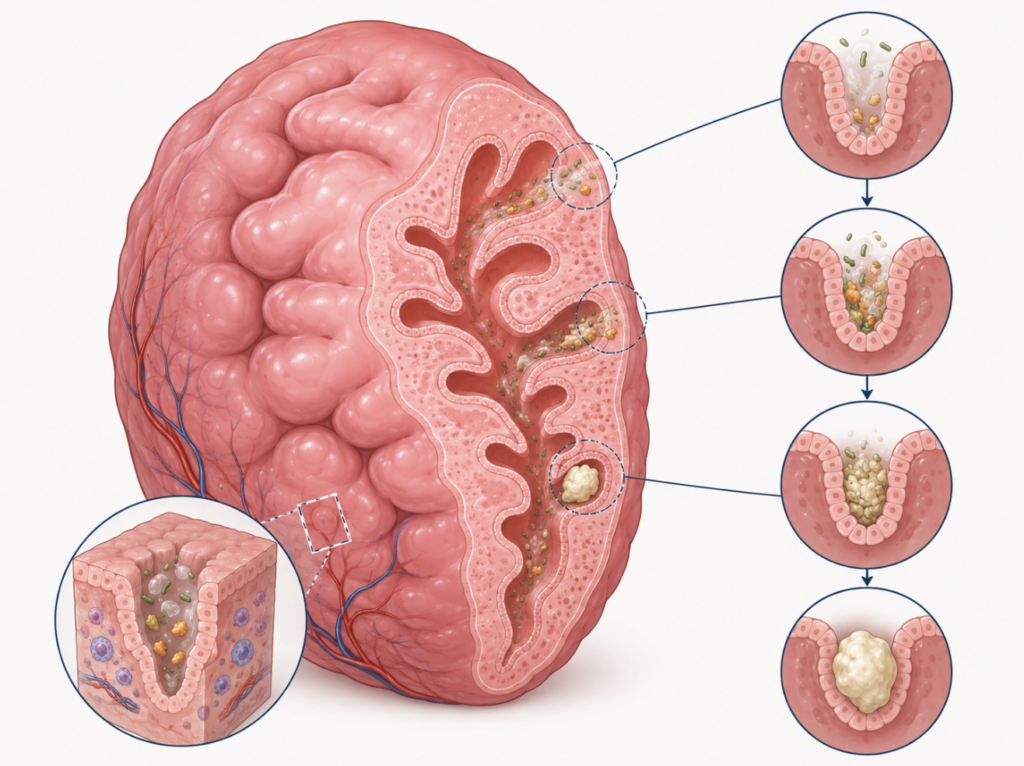
Your tonsils are not smooth. Their surface is folded into pockets called crypts, and those crypts trap food particles, dead cells, bacteria, and mucus. When that debris sits long enough, it can calcify into the firm, pale lumps people recognize as tonsil stones. The exact reason some people form them and others don’t is still not fully understood, though they are more common in people with repeated tonsil inflammation [Smith, Tonsillitis and Tonsilloliths: Diagnosis and Management, 2023].
Deeper, more numerous crypts give debris more places to collect, which is why the same person tends to grow stones in the same spots again and again. A useful mental image: the crypts act like the pockets of a catcher’s mitt, and anything that lands in them is hard to shake loose. That anatomical detail matters later, because it explains why surface-level remedies have a ceiling.
Do Gargling and Self-Massage Actually Work?
Here is the honest answer: salt-water gargling and gentle massage can dislodge small stones and ease symptoms, but high-quality trials proving they remove or prevent tonsil stones remain lacking. Management is mostly expectant, meaning watch, wait, and keep the mouth clean, because small stones are common and usually pass on their own [Smith, Tonsillitis and Tonsilloliths: Diagnosis and Management, 2023]. Gargling and manual tonsillar massage remain the standard conservative measures, but they are comfort tools, not cures [Chang, Coblation Cryptolysis to Treat Tonsil Stones, 2012].
The reason is structural. A gargle rinses the surface; it does not reach the bottom of a deep crypt or flatten the pocket that keeps refilling. So gargling can slow the cycle and reduce bad breath, yet the crypt itself is untouched.
One concrete caution: aggressive self-removal with sharp objects can backfire. Forcing a tool into a crypt risks injuring delicate tissue and can deepen the pocket, giving future stones an even better hiding place. Gentle is the operative word, and stones that keep coming back are a reason to see a clinician rather than dig harder.
Beyond Tonsillectomy: What Are the Options?
Tonsillectomy, removing the tonsils entirely, takes away the crypts where stones form, which makes it the only procedure that addresses the root cause [Chang, Coblation Cryptolysis to Treat Tonsil Stones, 2012]. Because the operation itself carries real burden, though, it is rarely the first step: guidelines lean toward conservative care, and removal is reserved for stubborn cases [Smith, Tonsillitis and Tonsilloliths: Diagnosis and Management, 2023].
Cryptolysis is the middle ground. Using a laser or a radiofrequency (coblation) probe, a surgeon smooths and seals the crypt openings so debris has fewer places to lodge. It is not a standard offering at every ENT clinic, though: it tends to be available at centers equipped for radiofrequency or laser procedures, and whether insurance covers it varies by clinic and country, so the details are worth confirming in advance.
The evidence is still early. In a single-center review of 500 in-office laser cryptolysis cases, patients averaged 1.16 sessions and recovered with less pain and bleeding than standard surgery, with good candidates needing small tonsils, a controllable gag reflex, and tolerance for an office procedure under local anesthesia [Krespi, Laser Tonsil Cryptolysis: In-Office 500 Cases Review, 2013]. Coblation cryptolysis showed similar early promise, but its published evidence is a small case series [Chang, Coblation Cryptolysis to Treat Tonsil Stones, 2012]. Both rest on retrospective, single-center data rather than large randomized trials, so cryptolysis is best read as a partial alternative still being studied, not an established standard treatment.
The trade-off is durability. Because cryptolysis reshapes rather than removes the tonsil, stones can return, which is the price of avoiding the heavier recovery of full tonsillectomy.
| Approach | What it does | Recovery | Cures it? |
|---|---|---|---|
| Watchful waiting + oral hygiene | Lets small stones pass; limits buildup | None | No |
| Gargling + gentle massage | Dislodges small stones, eases symptoms | None | No |
| In-office removal (suction/curette) | Physically extracts visible stones | Minimal | No, recurs |
| Cryptolysis (laser/coblation) | Reshapes and seals crypts | Days to ~1 week | Reduces; can recur |
| Tonsillectomy | Removes tonsils and crypts entirely | ~2 weeks | Yes, definitive |

Clinical Perspective
Most tonsil stones sit at the “leave it alone” end of the spectrum. The decision to escalate is not about the stones themselves but about symptoms, chiefly persistent bad breath and the nagging foreign-body sensation of something stuck in the throat. When those symptoms keep returning despite good oral hygiene and conservative care, and they genuinely interfere with daily life, that is when reshaping or removing the tonsil becomes a reasonable conversation.
Tonsillectomy is the only option that removes the root cause, but that benefit is weighed against real costs: it is the most invasive choice, with a recovery measured in weeks and a known risk of post-operative bleeding. The sensible sequence is conservative care first, an in-office procedure for selected candidates next, and full tonsillectomy reserved for stones that keep eroding quality of life despite everything else.
The Bottom Line
Tonsil stones are mostly a nuisance, not a danger, and the goal is to match effort to symptoms rather than to chase every stone. Gargling buys control; cryptolysis buys a lighter procedure with some recurrence risk; tonsillectomy buys a permanent fix at the highest cost. Surgery earns its place only when bad breath or foreign-body sensation persists despite conservative care and clearly undermines daily life.
Key Takeaways
- Small tonsil stones are common, usually harmless, and most pass on their own without any treatment.
- Salt-water gargling and gentle massage can relieve symptoms and dislodge small stones, but no strong trial shows they cure or prevent them.
- Sharp-tool self-removal can injure the tonsil and deepen the crypt, making future stones more likely.
- Cryptolysis (laser or coblation) reshapes the tonsil with a lighter recovery than surgery, but stones can recur and the evidence is limited.
- Tonsillectomy is the only option that removes the root cause, and it is reserved for persistent bad breath or foreign-body sensation that resists conservative care and impairs quality of life.
FAQ
Does gargling get rid of tonsil stones?
Not permanently. Salt-water gargling can dislodge small stones and freshen breath, but it cleans only the surface and leaves the deep crypt that keeps producing them. It is a reasonable daily habit for control, not a cure. Stones that keep returning are worth a clinician’s evaluation rather than more vigorous home treatment.
Is tonsillectomy the only way to cure tonsil stones?
It is the only treatment that removes the root cause, because taking out the tonsils takes out the crypts where stones form. Less invasive options exist, though: laser or coblation cryptolysis reshapes the tonsil surface with a faster recovery, but the evidence is limited and stones can come back. Most people never need any surgery at all.
When should I actually consider surgery?
Consider it when bad breath or a persistent foreign-body sensation, clearly caused by tonsil stones, keeps returning despite good oral hygiene and conservative care, and meaningfully affects daily life. The choice still weighs symptom relief against the pain, bleeding risk, and weeks-long recovery of tonsillectomy. An ENT can help match the procedure to your tonsil anatomy and symptoms.
References
- Smith KL, Hughes R, Myrex P. Tonsillitis and tonsilloliths: diagnosis and management. Am Fam Physician. 2023;107(1):35-41.
- Krespi YP, Kizhner V. Laser tonsil cryptolysis: in-office 500 cases review. Am J Otolaryngol. 2013;34(5):420-424.
- Chang CY, Thrasher R. Coblation cryptolysis to treat tonsil stones: a retrospective case series. Ear Nose Throat J. 2012;91(6):238-254.
Joonpyo Hong, MD is a board-certified otolaryngologist practicing in Korea. This article reflects his clinical interpretation of published research and does not constitute individual medical advice.
For more interesting contents:
https://curiousmd.com/hpv-vaccine-and-throat-cancer/
https://curiousmd.com/ai-de-escalation-in-hpv-throat-cancer/
https://curiousmd.com/prescription-vs-over-the-counter-mouthwash/
Link out to:
https://www.aafp.org/pubs/afp/issues/2023/0100/tonsillitis-tonsilloliths.html
https://my.clevelandclinic.org/health/diseases/21505-tonsil-stones
https://www.mayoclinichealthsystem.org/hometown-health/speaking-of-health/all-about-tonsil-stones
https://doi.org/10.1016/j.amjoto.2013.03.006