
Apple’s hearing study gave 84,970 people a clean audiogram, and roughly 1 in 6 of them still said their hearing was only “fair” or “poor.” That single number captures a well-documented clinical reality: a normal hearing test does not always mean normal hearing. The new AirPods hearing test now puts that same check in millions of pockets, so here is what the largest hearing study ever run actually found—and how to read it without either dismissing your AirPods or trusting them too much.
What the Apple Hearing Study actually found
The Apple Hearing Study, run with the University of Michigan since 2019, now includes more than 160,000 consented participants across the United States—one of the largest hearing datasets ever assembled. In an analysis released in 2026, researchers focused on about 85,000 people whose hearing tested within the traditional “normal” range—a four-frequency average of 25 decibels or better—a cutoff that current standards increasingly set even stricter, closer to 20 decibels.
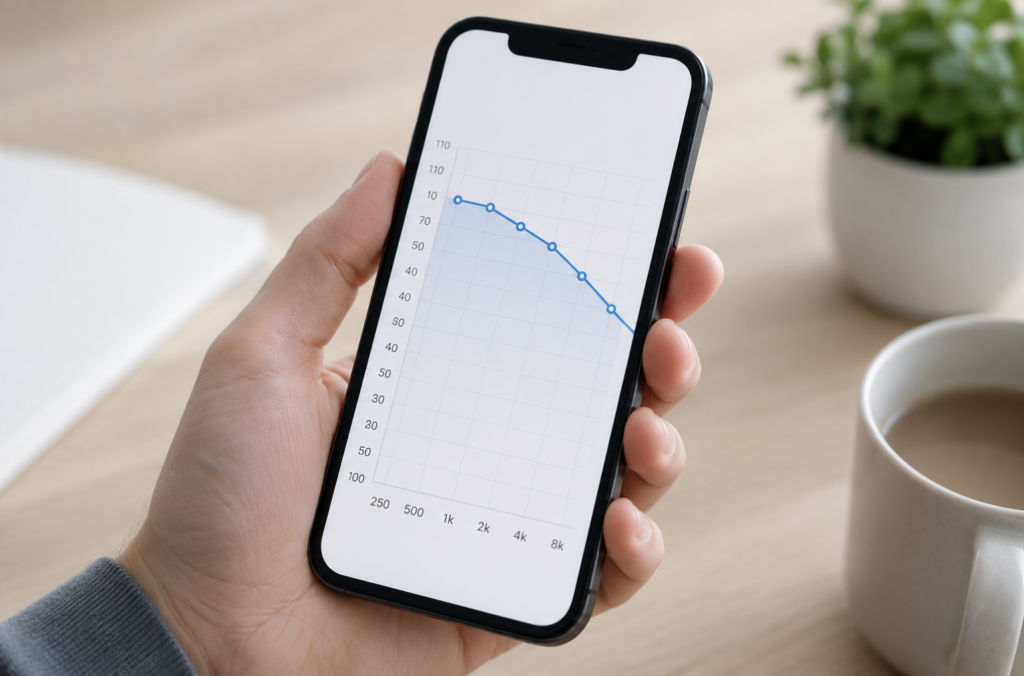
The headline result is the gap. Among those normal-hearing participants, 16% rated their own hearing as fair or poor, and more than 7% reported real difficulty following conversations, especially against background noise. These were not people with diagnosed hearing loss. On paper, their ears passed.
The gap between measured and perceived hearing
A standard audiogram measures the softest tones you can detect in a silent booth. Real listening almost never happens in a silent booth. It happens in restaurants, on video calls, and across crowded rooms, where the task is not detecting a beep but pulling one voice out of competing sound.
That skill—often called speech-in-noise ability—can lag well behind a clean audiogram. Two people with identical normal results can have very different real-world experiences, which is exactly what the Apple data shows at scale. A normal pure-tone audiogram paired with genuine trouble understanding speech in noisy rooms is a well-recognized clinical pattern, not a contradiction.
Why hearing connects to walking, balance, and the brain
The 2026 analysis surfaced a second, stranger pattern: people with poorer hearing tended to walk more slowly in daily life. Correlation is not causation, and slower walking does not prove that hearing caused it. But it fits a body of research linking hearing to far more than communication.
Untreated hearing loss in older adults is associated with a measurably higher risk of dementia, rising with severity [Lin, Hearing Loss and Incident Dementia, 2011]. It also tracks with a higher risk of falls [Lin, Hearing Loss and Falls Among Older Adults in the United States, 2012]—plausibly because the same signals that carry speech also help the brain stay oriented in space.
The natural next question is whether treating hearing protects the brain. The honest answer is that it is complicated. A large 2023 randomized trial (ACHIEVE) found that providing hearing aids did not slow cognitive decline across the whole study population, though it did appear to help a subgroup already at higher risk [Lin, Hearing Intervention Versus Health Education Control to Reduce Cognitive Decline, 2023]. Hearing care is worth pursuing for its own sake; the brain benefits are real for some, but not guaranteed for everyone.
AirPods vs real hearing aids: the price gap and the fine print
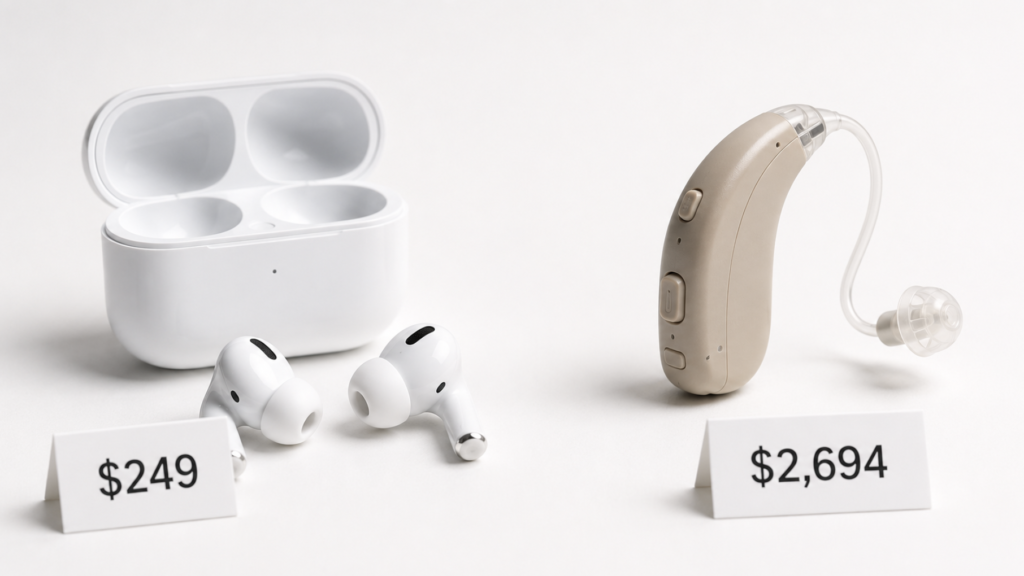
This is where Apple’s features become genuinely useful. AirPods Pro 3, at about $249, include an FDA-authorized over-the-counter hearing test and a hearing aid mode tuned to your results. A pair of prescription hearing aids averages around $2,694. For a device most people already own, that gap is hard to ignore, and the access problem it addresses is real.
But the fine print matters. The over-the-counter category—including the AirPods feature—is cleared only for perceived mild to moderate hearing loss in adults. Battery life and fit make earbuds better suited to a dinner or a meeting than to all-day wear. And independent testing rates their performance in noisy settings as workable but modest, not equal to a prescription device. As a screening tool, a first step, or a low-stakes way to find out whether you have a problem, they are a reasonable place to start. As a final answer for everyone, they are not.
A clinical perspective on when to skip the earbuds
Convenience has a failure mode: it can quiet an alarm that should stay loud. Some hearing symptoms are not candidates for a consumer earbud—they are reasons to see a doctor promptly.
Sudden hearing loss, especially in one ear, is a medical urgency. Clinical guidelines treat idiopathic sudden sensorineural hearing loss as time-sensitive, with the best chance of recovery when systemic corticosteroids are initiated within roughly two weeks and hearing is objectively tested within 14 days of onset [Chandrasekhar, Clinical Practice Guideline: Sudden Hearing Loss (Update), 2019]. Reaching for an amplification feature instead of a clinic can burn the very window when treatment works.
Two more patterns deserve a professional, not a gadget. Hearing that is clearly worse on one side warrants evaluation to rule out causes an earbud would simply mask. And pulsatile tinnitus—a rhythmic whooshing in time with your heartbeat—should be checked rather than tuned out. None of these are “turn up the volume” problems.
Key takeaways
- In Apple’s 160,000-person hearing study, 16% of participants with audiometrically normal hearing still rated their hearing as fair or poor.
- A normal audiogram measures tone detection in quiet and can miss real-world difficulty understanding speech in noise.
- Untreated hearing loss is linked to higher risks of dementia and falls, though treating it does not guarantee a cognitive benefit for everyone.
- AirPods Pro 3 (~$249) offer an FDA-authorized hearing test and hearing aid mode, but only for perceived mild-to-moderate loss.
- Sudden, one-sided, or pulsatile hearing symptoms need prompt medical evaluation, not a consumer earbud.
FAQ
Can AirPods replace a hearing aid?
For mild to moderate hearing difficulty, AirPods Pro can work as a basic over-the-counter hearing aid and may genuinely help in quiet settings. They are not suitable for moderately severe or severe loss, nor are they optimized for all-day wear or complex noisy environments, where professional prescription hearing aids perform significantly better.
My hearing test was normal, so why do I still struggle?
A standard audiogram checks the faintest tones you can hear in silence, not how well you separate speech from background noise. Many people with normal results still have real trouble in restaurants or meetings, which is the exact gap Apple’s data captured.
Are the AirPods hearing features FDA approved?
Apple’s over-the-counter hearing test and hearing aid feature are authorized by the FDA for adults with perceived mild to moderate hearing loss. That authorization does not cover severe hearing loss or replace a clinical evaluation when something seems wrong.
When should I see an ENT instead of using AirPods?
See a doctor promptly for hearing loss that comes on suddenly, affects mainly one ear, or arrives with pulsatile (heartbeat-like) tinnitus. These can signal conditions that are treatable when caught early and easy to miss when simply amplified.
References
Lin FR, Metter EJ, O’Brien RJ, Resnick SM, Zonderman AB, Ferrucci L. Hearing loss and incident dementia. Arch Neurol. 2011;68(2):214-220.
Lin FR, Ferrucci L. Hearing loss and falls among older adults in the United States. Arch Intern Med. 2012;172(4):369-371.
Lin FR, Pike JR, Albert MS, et al. Hearing intervention versus health education control to reduce cognitive decline in older adults with hearing loss in the USA (ACHIEVE): a multicentre, randomised controlled trial. Lancet. 2023;402(10404):786-797.
Chandrasekhar SS, Tsai Do BS, Schwartz SR, et al. Clinical practice guideline: sudden hearing loss (update). Otolaryngol Head Neck Surg. 2019;161(1_suppl):S1-S45.
Joonpyo Hong, MD is a board-certified otolaryngologist practicing in Korea. This article reflects his clinical interpretation of published research and does not constitute individual medical advice.
For more interesting contents:
https://curiousmd.com/bone-conduction-headphones-and-hearing-loss-15-years/
https://curiousmd.com/earbud-hearing-loss-ent-guide/
https://curiousmd.com/brain-controlled-hearing-aid-2026/
Link out to:
https://sph.umich.edu/applehearingstudy/study-updates/assess-and-assist-features.html
https://www.fda.gov/news-events/press-announcements/fda-authorizes-first-over-counter-hearing-aid-software