
A single soprano stands in front of a ninety-piece orchestra playing at full volume. She has no microphone, yet every listener in the back row hears her clearly. That is not a matter of raw loudness. The answer lives in one narrow band of sound near 3 kilohertz, a phenomenon acousticians call the singer’s formant, and it tells us something useful about how the human voice is built.
This article explains what the singer’s formant is, how the vocal tract produces it, what its acoustic signature looks like, and why a laryngologist finds it clinically revealing rather than just musically impressive.
What Is the Singer’s Formant?
The singer’s formant is a prominent peak of acoustic energy centered near 2.5 to 3.5 kHz, most strongly associated with trained classical voices. Johan Sundberg named and described it in his foundational acoustic work [Sundberg, Articulatory interpretation of the “singing formant”, 1974].
To understand it, separate two things that are easy to confuse. The vocal folds are the sound source: they chop airflow into a harmonic series set by pitch. The vocal tract is the filter: the throat and mouth selectively amplify certain frequencies. The singer’s formant is a filter phenomenon. The peak is created by the shape of the vocal tract, not by the vocal folds working harder. The same laryngeal source, shaped by a different tract, yields far more energy near 3 kHz.
How Is the Singer’s Formant Produced?
The peak comes from a clustering of the higher vocal-tract resonances. In ordinary speech, the third, fourth, and fifth formants (F3, F4, F5) are spread apart and each is modest. In trained classical singing, these three move close together in frequency and reinforce one another, producing a single broad, powerful band instead of three small separate peaks.
What tract configuration causes this clustering? Sundberg’s classic model proposed that when the pharynx is widened and the epilaryngeal tube (the narrow passage just above the vocal folds) is narrowed, the larynx tube begins to act as a semi-independent resonator, adding an extra formant near 2.8 kHz [Sundberg, Articulatory interpretation of the “singing formant”, 1974]. Titze and Story later described the mechanism as an impedance-matching effect, comparing the narrow epilarynx to the mouthpiece of a brass instrument that couples the high-impedance glottal source to the lower-impedance vocal tract [Titze, Acoustic interactions of the voice source with the lower vocal tract, 1997].
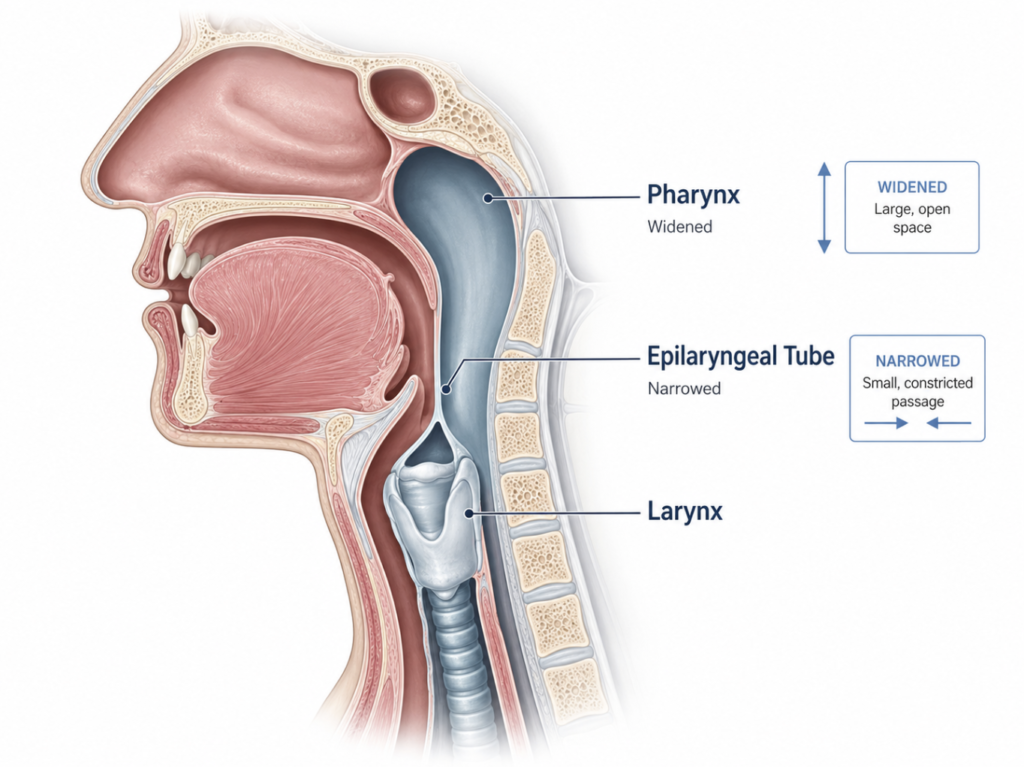
More recent in vivo imaging adds a useful correction. A magnetic resonance imaging study of male singers found that the most significant anatomical change when shifting from speech to classical singing was expansion of the hypopharynx and lowering of the larynx, while measured changes in the epilaryngeal portion were not statistically significant [Mainka, Lower Vocal Tract Morphologic Adjustments Are Relevant for Voice Timbre in Singing, 2015]. The clustering is real; the exact anatomical recipe is still being refined.
The Acoustics: Why the Voice Cuts Through
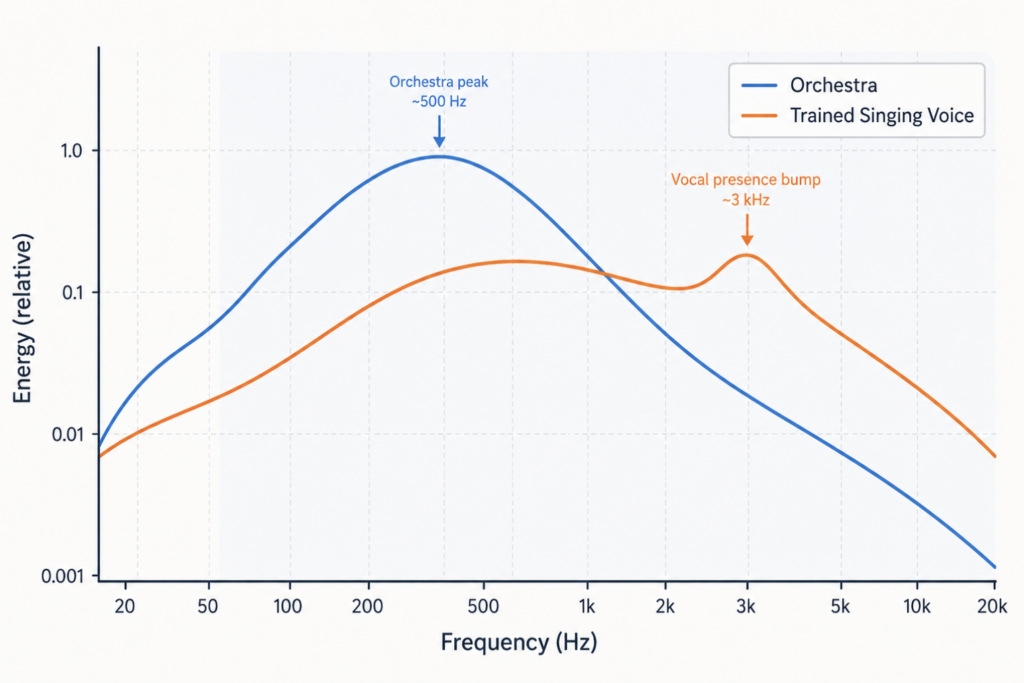
The singer’s formant works because it occupies an empty lane in the spectrum. Orchestral sound has its strongest energy near 500 Hz and falls off sharply by 3 kHz. By concentrating energy exactly where the orchestra is quiet, the voice avoids being masked and appears to “cut” through, without the singer needing to raise subglottal pressure or strain the vocal folds.
A useful way to see this is a long-term average spectrum, which averages energy across a passage of singing. A trained classical voice shows a distinct bump around 3 kHz that a conversational speaker does not. The same principle explains the “ring,” “squillo,” or “ping” that voice teachers describe: a bright, carrying quality that reflects extra energy in this band.
Clinical Perspective
For a laryngologist, the singer’s formant is interesting because it turns a subjective quality into something we can partly measure. Its presence and strength in an acoustic analysis reflect how well a person is shaping the vocal tract, which is separate information from what stroboscopy tells us about the vocal folds themselves.
That separation matters for the aging voice. Age-related changes at the vocal folds, such as thinning and softer closure, alter the sound source, and a loss of ring or carrying power is a common early complaint among singers. Reduced vocal power and quality is a recognized feature of the aging voice, and difficulty singing is among the symptoms reported by older adults with voice complaints [Pessin, Voice and ageing: clinical, endoscopic and acoustic investigation, 2017]. When someone reports that the voice no longer carries the way it did, the useful clinical question is whether the change sits at the source, at the resonator, or both, because those point toward different management paths.
Vocal-tract training is also measurable. In a study of singers and nonsingers with dysphonia, semi-occluded vocal tract exercises produced significant improvements in formant measures in the singer group but not in the nonsinger group, suggesting singers are better at translating this therapy into vocal-tract change [Kaneko, Effect of Voice Therapy Using Semioccluded Vocal Tract Exercises in Singers and Nonsingers With Dysphonia, 2019]. The broader clinical point is that acoustic measures and endoscopic findings answer different questions and are strongest when read together. One caution stands on its own: hoarseness lasting more than two to three weeks, or a sudden change in the voice, deserves laryngeal evaluation rather than being assumed to be normal aging.
Key Takeaways
- The singer’s formant is a spectral peak near 3 kHz produced by the clustering of vocal-tract formants F3, F4, and F5.
- It is a filter effect of vocal-tract shape, not the result of the vocal folds working harder.
- It lets a voice carry over an orchestra because orchestral energy is weakest in the 3 kHz region.
- Classic models emphasize epilaryngeal narrowing, while recent MRI points to hypopharyngeal expansion as a key anatomical correlate.
- Clinically, the peak is a measurable window into vocal-tract function that complements what endoscopy shows about the vocal folds.
FAQ
What frequency is the singer’s formant? It sits near 2.5 to 3.5 kHz, typically discussed as a peak around 3 kHz. The exact center varies with the individual voice and vowel, but the defining feature is a concentration of energy in this band above the vowel-defining formants.
Do all singers have a singer’s formant? It is most prominent in trained classical voices. Belting and some other styles produce a related bright “ring” through similar narrowing of the lower vocal tract, though the underlying strategy is not identical to classical singing.
Can the singer’s formant be measured? Yes. It is visible on spectrographic analysis and, more clearly, on a long-term average spectrum, which shows the 3 kHz peak that distinguishes trained singing from ordinary speech.
Does the singer’s formant weaken with age? It can. Age-related vocal-fold changes alter the sound source, and many singers notice reduced ring and carrying power as an early sign, which is one reason a loss of projection is worth evaluating rather than ignoring.
References
Kaneko M, Sugiyama Y, Mukudai S, Hirano S. Effect of Voice Therapy Using Semioccluded Vocal Tract Exercises in Singers and Nonsingers With Dysphonia. J Voice. 2019;34(6):963.e1-963.e9.
Mainka A, Poznyakovskiy A, Platzek I, Fleischer M, Sundberg J, Mürbe D. Lower Vocal Tract Morphologic Adjustments Are Relevant for Voice Timbre in Singing. PLoS One. 2015;10(7):e0132241.
Pessin ABB, Tavares ELM, Gramuglia ACJ, de Carvalho LR, Martins RHG. Voice and ageing: clinical, endoscopic and acoustic investigation. Clin Otolaryngol. 2017;42(2):330-335.
Sundberg J. Articulatory interpretation of the “singing formant”. J Acoust Soc Am. 1974;55(4):838-844.
Titze IR, Story BH. Acoustic interactions of the voice source with the lower vocal tract. J Acoust Soc Am. 1997;101(4):2234-2243.
For more interesting content:
https://curiousmd.com/ai-laryngeal-cancer-detection/
https://curiousmd.com/jon-bon-jovi-vocal-cord-surgery-medialization-thyroplasty/
Link out to:
- National Center for Voice and Speech — The Singer’s Formant tutorial: https://ncvs.org/tutorials/the-singers-formant/
- HyperPhysics (Georgia State University) — Sundberg’s Singing Formant: http://hyperphysics.phy-astr.gsu.edu/hbase/Music/singfor.html
- Sundberg J, 1974 (primary source, PubMed): https://pubmed.ncbi.nlm.nih.gov/4833080/
- Titze IR & Story BH, 1997 (primary source, PubMed): https://pubmed.ncbi.nlm.nih.gov/9104025/
Joonpyo Hong, MD is a board-certified otolaryngologist practicing in Korea. This article reflects his clinical interpretation of published research and does not constitute individual medical advice.