
“We’ve been talking to the bump — does the baby actually hear us?” It’s one of the most common questions expectant parents have on fetal hearing, and the answer is more nuanced than most pregnancy apps let on.
Here’s what the research actually shows — and where the gaps get filled with logic rather than data.
When Does a Fetus Start Hearing? A Week-by-Week Timeline of Fetal Hearing
Hearing develops gradually in layered stages, rather than switching on all at once.
The external and middle ear structures begin forming around weeks 6–8, but structural development and functional hearing are very different things [Graven SN, Auditory Development in the Fetus and Infant, 2008]. The inner ear — especially the cochlea — reaches near-adult size by around 20 weeks [Pujol R, Development of the Human Cochlea, 1991].
The first measurable fetal response to sound has been recorded as early as 19 weeks, including responses to a 500 Hz pure tone delivered through a loudspeaker placed on the maternal abdomen [Hepper PG, Development of Fetal Hearing, 1994]. But here, “response” refers to a body movement detected on ultrasound, not conscious hearing.
By 22–24 weeks, most fetuses begin responding more consistently to external sounds [Birnholz JC, The Development of Human Fetal Hearing, 1983]. This is the practical threshold most clinicians reference.
By 25–28 weeks, fetuses may show heart rate changes in response to their mother’s voice, suggesting that auditory processing is becoming more developed [Kisilevsky BS, Fetal Sensitivity to Properties of Maternal Speech and Language, 2009].
By 35 weeks, cochlear mechanics and frequency selectivity are close to term maturity [Rance G, Auditory Neuropathy/Dys-synchrony and Its Perceptual Consequences, 2005].
| Week | Milestone |
|---|---|
| 6–8 | External/middle ear structures begin forming |
| 18–20 | Inner ear structures complete; first responses possible |
| 22–24 | Consistent responses to external sounds |
| 25–28 | Heart rate responses to mother’s voice; auditory cortex engagement |
| 35 | Cochlear mechanical maturity |
The Womb Is Not Quiet
Before asking what the fetus can hear from outside, it helps to understand the sound environment already present inside.
The intrauterine environment is continuously filled with low-frequency sound: the mother’s heartbeat, arterial blood flow, bowel peristalsis, and diaphragmatic movement. Although these measurements come primarily from animal models, comparable levels have been confirmed in human recordings: intrauterine background noise is roughly 50–80 dB [Gerhardt KJ, Sound Environment of the Fetal Sheep, 1990; Abrams RM, Fetal Exposures to Sound and Vibroacoustic Stimulation, 2000].
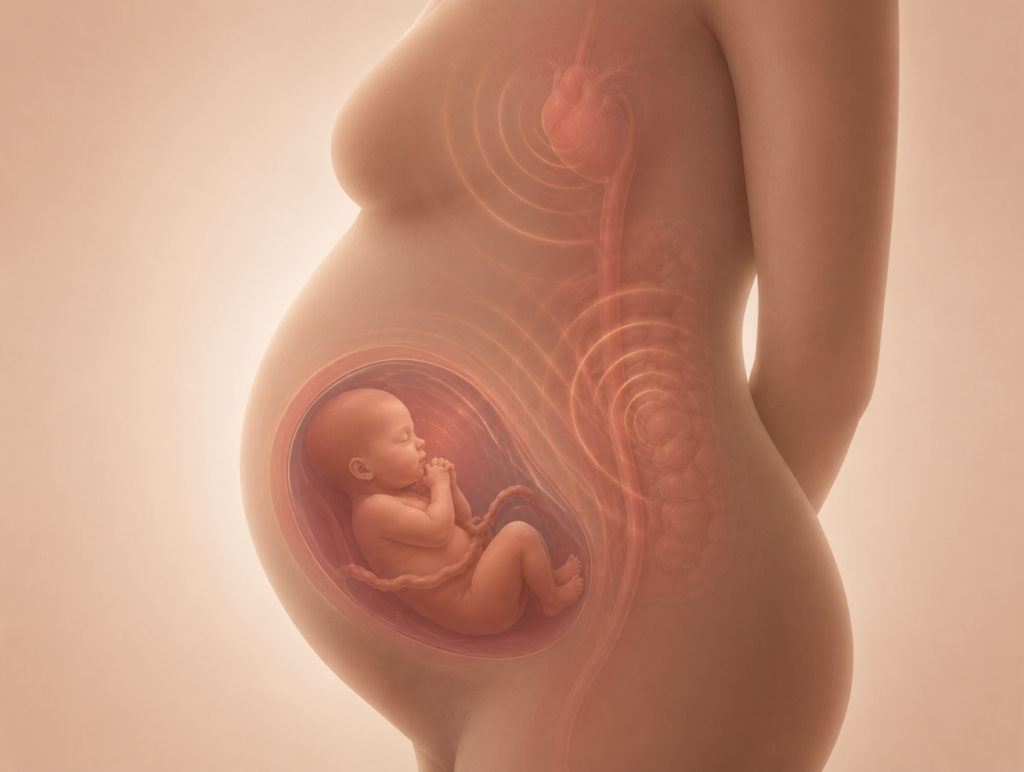
That is roughly the loudness of a normal conversation, present continuously inside the womb.
This background noise level matters a great deal when we ask whether outside voices can be heard. Any external sound has to compete with it.
How Sound Travels to the Fetus: It’s Not How You’d Expect
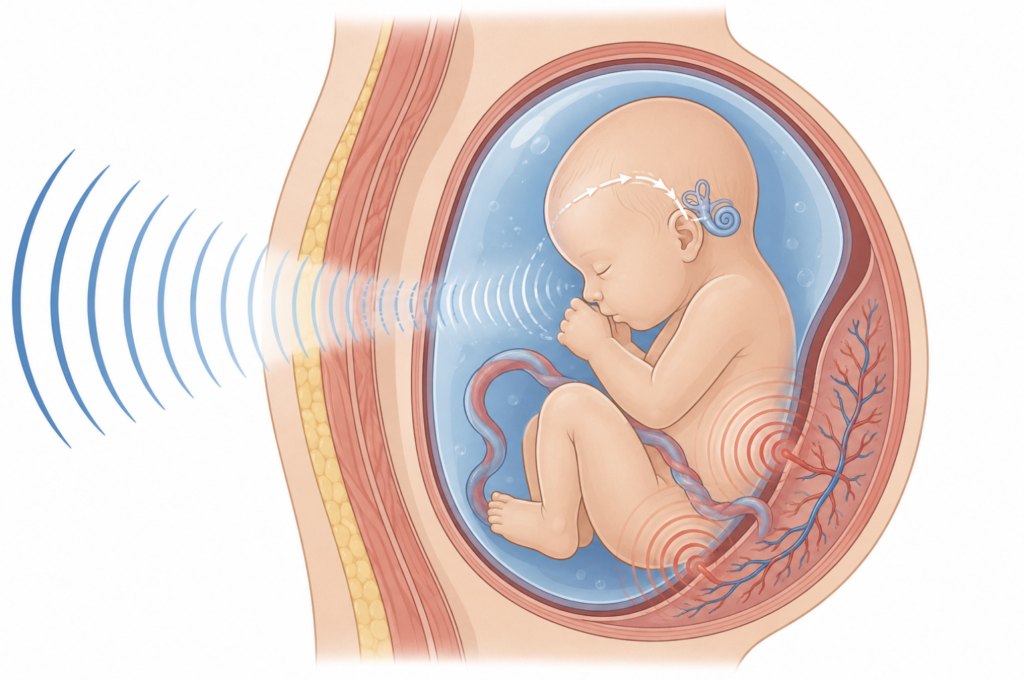
Sound does not reach the fetal inner ear the way it reaches yours. There is no air column. The fetus is surrounded by amniotic fluid, which means airborne sound waves must convert to pressure waves in fluid before they can stimulate the cochlea. Those pressure waves then stimulate hearing mainly through bone conduction, rather than the usual air-conduction pathway [Abrams RM, Fetal Exposures to Sound and Vibroacoustic Stimulation, 2000].
The amniotic fluid transmits pressure directly to the fetal skull, which vibrates and stimulates cochlear fluid. The outer ear and middle ear — including the eardrum and ossicles — play little role in fetal hearing in utero.
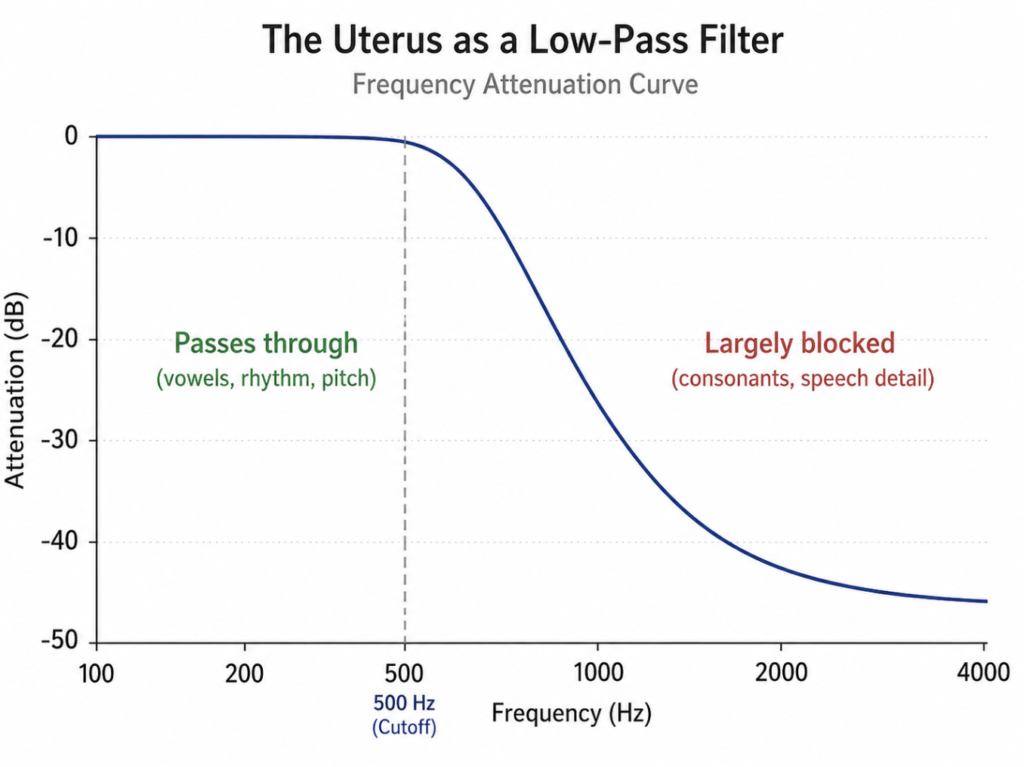
This has an important consequence: the uterus and surrounding tissues act as a low-pass filter. Low-frequency sounds (below 500 Hz) pass through with minimal attenuation — less than 5 dB of loss. Higher frequencies (above 500 Hz) are progressively attenuated, reaching 40–50 dB of reduction by 1–3 kHz [Abrams RM, Fetal Exposures to Sound and Vibroacoustic Stimulation, 2000].
In practical terms: the fetus receives low-frequency sounds, such as vowel-like components, more effectively than high-frequency consonant detail.
The Question Everyone Wants Answered: Can a Quiet Voice Outside the Belly Be Heard?
The following section separates what has been directly measured from what is inferred.
What the research shows:
The abdominal wall and amniotic fluid attenuate external airborne sound by about 25–35 dB overall [Benzaquen S, The Intrauterine Sound Environment of the Human Fetus During Labor, 1990]. This is well-documented from intrauterine hydrophone recordings in both animal and human studies.
A quiet conversational voice at close range is roughly 50–60 dB at the source [Pearsons KS, Speech Levels in Various Noise Environments, 1977].
Logical inference — not a measured outcome:
After 25–35 dB of attenuation, a 50–60 dB voice would arrive at roughly 15–35 dB inside the uterine environment. The cochlear threshold of a mature fetus at term is estimated at roughly 40 dB for low frequencies [Gerhardt KJ, Sound Environment of the Fetal Sheep, 1990; Gerhardt KJ, The Fetal Sound Environment, 1996; Abrams RM, Fetal Exposures to Sound and Vibroacoustic Stimulation, 2000], with significant variability and continued improvement as gestation progresses.
So a quiet external voice — particularly from a non-mother speaker reaching the fetus only through the abdominal wall — likely falls below or near the fetal hearing threshold, and in any case competes with a background noise floor of 50–80 dB inside the womb.
The most reasonable interpretation is that a soft voice directed at the belly by another person is unlikely to be perceived by the fetus in a meaningful acoustic sense, especially before 28 weeks. After 28–30 weeks, low-frequency pitch and rhythm components may reach threshold, but this remains a reasoned estimate rather than a controlled human measurement.
A gap in the literature: No published study appears to have directly measured fetal heart rate or movement responses to a quiet (≤60 dB) external voice from a non-mother speaker. If such data exists, it would meaningfully refine the inference above.
Why the Mother’s Voice Is Different
This contrast is well-established in the literature.
The mother’s voice is not purely an external sound. A significant component travels through the mother’s body tissues directly, bypassing much of the air-to-fluid conversion problem. This internal transmission pathway may amplify her voice by about 5 dB relative to the external reference, delivering it at roughly 60–75 dB inside the uterus [Querleu D, Fetal Hearing, 1988].
Newborns show a clear preference for their mother’s voice over strangers’ voices within the first hours of birth — a finding replicated across multiple studies and consistent with prenatal auditory learning [DeCasper AJ, Of Human Bonding: Newborns Prefer Their Mothers’ Voices, 1980]. Newborns also show recognition of specific stories read repeatedly during the third trimester [DeCasper AJ, Prenatal Maternal Speech Influences Newborns’ Perception of Speech Sounds, 1986; DeCasper AJ, Fetal Reactions to Recurrent Maternal Speech, 1994].
There is less direct evidence for the father’s voice at birth. One study did show that fetuses respond with heart rate changes to both parents’ voices, but newborns showed preference only for the mother [Kisilevsky BS, Fetuses Respond to Father’s Voice but Prefer Mother’s Voice After Birth, 2003].
What This Means in Practice
Talking to the bump — especially from the mother — is not just folk wisdom. There is genuine physiological logic behind it. The mother’s voice is the dominant sound in the fetal acoustic world from at least 25 weeks onward, and prenatal exposure shapes early auditory cortex organization.
For fathers and other family members: a soft voice directed at the belly is probably not reaching the fetus acoustically, at least before the third trimester. Speaking at a normal or slightly elevated volume — close to the belly and clearly audible — may deliver enough low-frequency energy to cross threshold by 28–30 weeks. The bonding benefit for the speaker is real regardless of whether the fetus registers it acoustically.
One firm caution: Do not place headphones or speakers directly against the abdomen. Each earphone delivers its full output, and the sounds can combine inside the uterus — potentially raising the total level enough to damage cochlear hair cells [Graven SN, Auditory Development in the Fetus and Infant, 2008].
Pregnant people working in occupationally noisy environments: routine exposure above 85 dB during extended shifts warrants a workplace assessment. Prolonged low-frequency noise above this level has been associated with delayed cochlear development in the third trimester [Gerhardt KJ, The Fetal Sound Environment, 1996; Occupational Safety and Health Administration, 29 CFR 1910.95; Grajewski B, Is Occupational Noise Exposure During Pregnancy a Risk Factor of Damage to the Auditory System of the Fetus, 1986].
Key Takeaways
- Fetuses begin consistently responding to external sounds at 22–24 weeks gestation; this is the evidence-based threshold.
- The uterus acts as a low-pass filter — low-frequency sound (pitch, rhythm, vowels) passes through; high-frequency sound (consonants, fine speech detail) is largely blocked.
- The mother’s voice reaches the fetus via internal body conduction, arriving 5 dB louder than external sounds and bypassing most of the attenuation barrier.
- A quiet external voice (~50–60 dB) after 25–35 dB attenuation likely falls at or below fetal hearing threshold, particularly before 28 weeks — this is a reasoned estimate, not a directly measured outcome.
- Placing headphones directly on the maternal abdomen is not recommended; it delivers combined sound levels that may exceed safe cochlear limits.
FAQ
When does a fetus start hearing in the womb? The first recorded response to sound occurs around 19–20 weeks, but consistent, reliable responses begin at 22–24 weeks. Hearing continues developing through 35 weeks and beyond.
Can a baby hear quiet voices outside the belly? Probably not in an acoustically meaningful way before 28 weeks, based on what we know about attenuation and fetal hearing thresholds. After 28–30 weeks, low-frequency elements of a close, clearly spoken voice may cross threshold — but this is a logical inference, not a measured result.
Does talking to the bump actually help? For the mother: yes. Her voice is transmitted internally at higher intensity and is the primary source of prenatal auditory learning. For others: the evidence for direct acoustic benefit is weaker, but there’s no harm, and the bonding benefit for the adult speaker is real.
Is the womb loud or silent? Loud — perpetually. Internal background noise from the cardiovascular and digestive systems runs 50–80 dB continuously. The fetus never experiences silence.
Can the fetus hear the father’s voice? Fetuses show heart rate responses to the father’s voice in at least one study. But the voice travels entirely through the external path, faces full attenuation, and newborns show no consistent preference for the father’s voice at birth — unlike the clear preference for the mother’s voice. Regular, close-proximity speaking at normal or slightly elevated volume remains reasonable.
References
- Graven SN, Browne JV. Auditory Development in the Fetus and Infant. Newborn Infant Nurs Rev. 2008;8(4):187-193.
- Pujol R, Lavigne-Rebillard M, Uziel A. Development of the Human Cochlea. Acta Otolaryngol Suppl. 1991;482:7-12.
- Hepper PG, Shahidullah BS. Development of Fetal Hearing. Arch Dis Child Fetal Neonatal Ed. 1994;71(2):F81-87.
- Birnholz JC, Benacerraf BR. The Development of Human Fetal Hearing. Science. 1983;222(4623):516-518.
- Kisilevsky BS, Hains SM, Brown CA, et al. Fetal Sensitivity to Properties of Maternal Speech and Language. Infant Behav Dev. 2009;32(1):59-71.
- Rance G. Auditory Neuropathy/Dys-synchrony and Its Perceptual Consequences. Trends Amplif. 2005;9(1):1-43.
- Gerhardt KJ, Abrams RM, Oliver CC. Sound Environment of the Fetal Sheep. Am J Obstet Gynecol. 1990;162(1):282-287.
- Gerhardt KJ. The Fetal Sound Environment. J Acoust Soc Am. 1996;100(4 Suppl):2710.
- Abrams RM, Gerhardt KJ. Fetal Exposures to Sound and Vibroacoustic Stimulation. J Perinatol. 2000;20(8 Pt 2):S21-S30.
- Querleu D, Renard X, Versyp F, Paris-Delrue L, Crèpin G. Fetal Hearing. Eur J Obstet Gynecol Reprod Biol. 1988;28(3):191-212.
- DeCasper AJ, Fifer WP. Of Human Bonding: Newborns Prefer Their Mothers’ Voices. Science. 1980;208(4448):1174-1176.
- DeCasper AJ, Spence MJ. Prenatal Maternal Speech Influences Newborns’ Perception of Speech Sounds. Infant Behav Dev. 1986;9(2):133-150.
- DeCasper AJ, Lecanuet JP, Busnel MC, Granier-Deferre C, Maugeais R. Fetal Reactions to Recurrent Maternal Speech. Infant Behav Dev. 1994;17(2):159-164.
- Kisilevsky BS, Hains SM, Lee K, et al. Fetuses Respond to Father’s Voice but Prefer Mother’s Voice After Birth. Dev Psychobiol. 2003;43(2):114-123.
- Benzaquen S, Gagnon R, Hunse C, Foreman J. The Intrauterine Sound Environment of the Human Fetus During Labor. Am J Obstet Gynecol. 1990;163(2):484-490.
- Pearsons KS, Bennett RL, Fidell S. Speech Levels in Various Noise Environments. EPA Report 600/1-77-025. 1977.
- Occupational Safety and Health Administration. Occupational Noise Exposure. 29 CFR 1910.95. Washington, DC: US Department of Labor.
- Grajewski B, Domagala-Dobrzanska M, Rachtan J. Is Occupational Noise Exposure During Pregnancy a Risk Factor of Damage to the Auditory System of the Fetus? Am J Ind Med. 1986;10(4):427-435.
Joonpyo Hong, MD is a board-certified otolaryngologist practicing in Korea. This article reflects his clinical interpretation of published research and does not constitute individual medical advice.
For more interesting contents:
https://curiousmd.com/ai-laryngeal-cancer-detection/
https://curiousmd.com/how-ai-voice-cloning-works/
Link out to:
https://www.nature.com/articles/7200447
https://pmc.ncbi.nlm.nih.gov/articles/PMC1061088/
https://www.ncbi.nlm.nih.gov/pmc/articles/PMC5944959/