
A single shot of gene therapy to restore hearing took a child born profoundly deaf from total silence to the sound of a whisper. That is not a metaphor. It is the headline result of the largest and longest trial of hearing gene therapy reported so far, and the effect is holding up years later.
If you are a parent who just read that a “single injection restored hearing in deaf children,” you deserve the full picture: what the science actually shows, who it can help, and where the limits are. Here is how I read it as an ENT.
What the study actually showed
In a trial published in Nature in April 2026, researchers from the Eye & ENT Hospital of Fudan University and Mass Eye and Ear treated 42 people — aged 10 months to 32 years — with a one-time inner-ear injection of a working OTOF gene, delivered by a harmless adeno-associated virus called AAV1-hOTOF [Jiang, Multicentre gene therapy for OTOF-related deafness followed up to 2.5 years, 2026].
It helps to understand how the trial was built. This was a single-arm, dose-escalation study run across eight medical centres — meaning everyone received the therapy (no placebo group), and the dose was raised in stages across three groups to find the safe ceiling. The first job of the trial was not to prove the treatment works, but to prove it does not harm: the primary endpoint was dose-limiting toxicity within six weeks. None occurred at any dose. The most notable adverse finding was a reduced count of a type of white blood cell called neutrophils, and the investigators reported no serious treatment-related side effects [Jiang, Multicentre gene therapy for OTOF-related deafness followed up to 2.5 years, 2026].
The efficacy numbers are where it becomes remarkable. Hearing recovered in about 90% of participants, and by 2.5 years roughly half had reached normal hearing levels. At the start, participants could not register sound below roughly 97 decibels — essentially nothing short of a shout right next to the ear. Over time, their average hearing thresholds dropped to about 54 decibels at one year and 42 decibels by 2.5 years on objective brainstem testing, with behavioural hearing tests improving even further, to around 37 decibels [Jiang, Multicentre gene therapy for OTOF-related deafness followed up to 2.5 years, 2026]. In plain terms, children who started in profound deafness moved into the mild-to-moderate range — within reach of ordinary conversation.
The “2.5 years” detail is the part clinicians care about most. A short-term hearing bump is interesting; durability is what makes a treatment real. This trial is the longest follow-up published to date, and the gains were gradual and stable rather than fading.
How the gene actually gets in
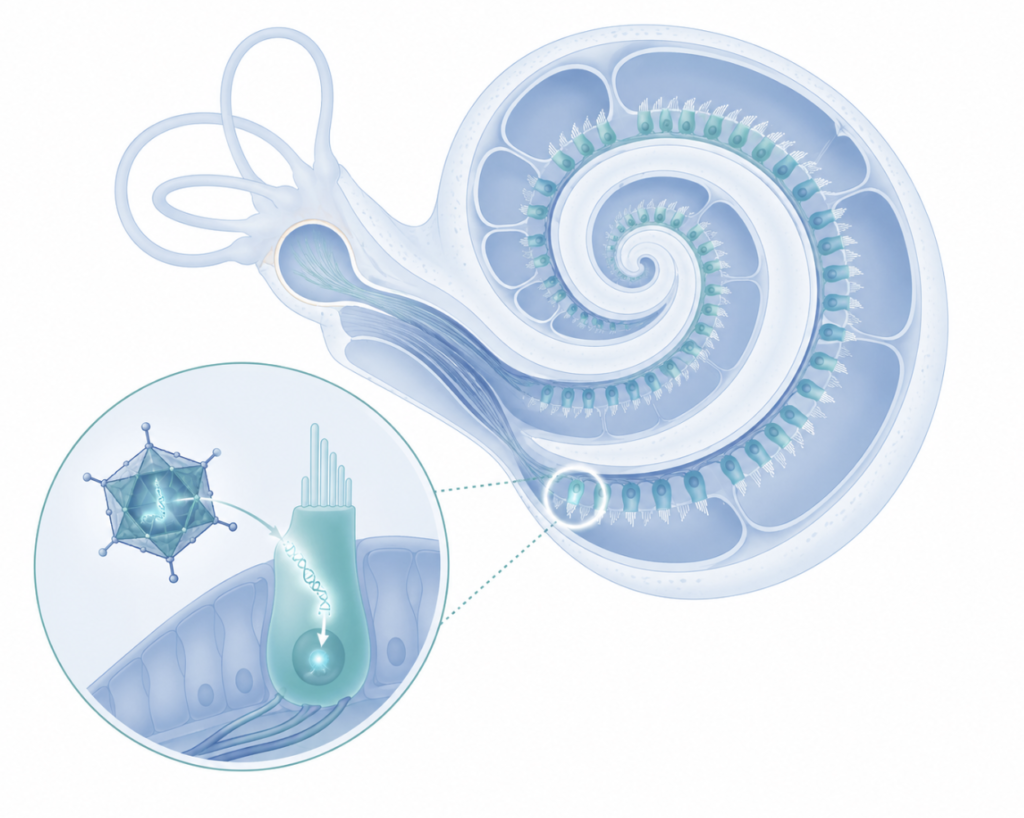
The mechanics are clever, and parents deserve to understand them. The OTOF gene is unusually large — too big to fit inside a single AAV, the gutted, harmless virus used as a delivery shell. The researchers solved this by splitting the gene across two AAV1 vectors that are injected together into the inner ear; once inside the hair cells, the two halves reassemble into a full, working OTOF instruction set, and the cell begins producing otoferlin [Jiang, Multicentre gene therapy for OTOF-related deafness followed up to 2.5 years, 2026].
This “dual-vector” trick had been tested in mice and nonhuman primates before any child was treated [Zhang, Preclinical evaluation of the efficacy and safety of AAV1-hOTOF in mice and nonhuman primates, 2023]. It matters because it explains both the promise and the boundary of the approach: it works precisely because the inner ear of an OTOF patient is structurally intact — the wiring is there, only the otoferlin protein is missing. Replace the protein, and the existing machinery starts working again.
Who can this treatment actually help?
This is where careful reading matters. The therapy targets one gene: OTOF. Mutations in OTOF cause a condition called autosomal recessive deafness 9, or DFNB9. In this disorder, the inner ear is structurally intact, but a missing protein — otoferlin — means sound signals never reach the auditory nerve.
OTOF mutations account for about 2 to 8% of hereditary nonsyndromic congenital hearing loss cases [Jiang, Multicentre gene therapy for OTOF-related deafness followed up to 2.5 years, 2026]. Roughly 200 different genes can cause deafness from birth, and more than half of childhood hearing loss has a genetic cause. So this is a precise key for a specific lock — not a universal cure for deafness.
Clinical Perspective: Before anyone gets excited about eligibility, the first step is genetic testing. A child has to have confirmed mutations in both copies of the OTOF gene to be a candidate. Without that confirmation, this therapy has nothing to act on — and most deaf children will fall outside it.
Why it works better in children
Younger participants saw the strongest gains in both hearing and speech recognition. Adults improved too, but the effect was smaller [Jiang, Multicentre gene therapy for OTOF-related deafness followed up to 2.5 years, 2026].
There is a logic to this. Hearing and the brain’s ability to interpret sound develop together in early life. Restoring the auditory signal while the brain is still wiring itself gives a child the best chance to turn raw hearing into real language. For an adult who has been deaf since birth, the ear may be repaired, but the brain has spent decades organized around silence.
Age was not the only predictor. Participants who still had some residual hair-cell activity at baseline (measured by a test called distortion product otoacoustic emissions), and those whose OTOF mutations were of a “non-truncated” type, tended to recover hearing better [Jiang, Multicentre gene therapy for OTOF-related deafness followed up to 2.5 years, 2026]. This is the clinical fingerprint behind the roughly 10% who did not respond — and a hint that the specific mutation a child carries, not just the diagnosis, helps shape the outcome.
Gene Therapy to Restore Hearing: Is It Available Now?
Yes — for a narrow group, and depending on where you live.
The therapy in the Nature study is pursuing regulatory approval starting in China. Separately, in April 2026 the U.S. FDA granted accelerated approval to Otarmeni (lunsotogene parvec-cwha), formerly known as DB-OTO, the first gene therapy approved for genetic hearing loss. It is built on the same idea — an AAV-delivered working copy of OTOF — and its approval was based on the Phase 1/2 CHORD trial, in which 11 of 12 children showed meaningful hearing improvement and three reached normal hearing [Valayannopoulos, DB-OTO Gene Therapy for Inherited Deafness, 2025].
The approved indication is narrow and worth reading closely. Otarmeni is for children and adults with severe-to-profound or profound sensorineural hearing loss — defined as a threshold above 90 dB HL at any frequency — caused by molecularly confirmed biallelic OTOF variants (a faulty copy inherited from each parent), with preserved outer hair cell function and no prior cochlear implant in the same ear. Each of those conditions is a real gate. A child must have the genetic confirmation, the right degree of hearing loss, an inner ear whose outer hair cells still function, and an untouched ear on the side being treated.
Two cautions worth stating plainly. First, the FDA approval is accelerated, meaning longer-term confirmatory data are still being gathered. Second, approval in the U.S. does not mean availability everywhere — where neither product is currently approved. In Europe, Otarmed, a treatment for hearing loss, is currently under review by the European medicines regulatory agency following its marketing authorization application.

The honest limits
- About 10% of treated patients did not recover hearing. This is a strong result, not a guarantee.
- It treats OTOF deafness only. The far more common genetic cause of childhood deafness, GJB2, is not addressed — though the same research team is now working to adapt the platform for it.
- The effect is weaker in adults, so age at treatment matters.
- Approval is early and geographically limited.
The promise here is genuine, and the honesty is part of why it matters. A treatment that works in 90% of a precisely selected group, lasts years, and causes no serious harm is a real foundation — and a template that may eventually extend to other genes.
Key Takeaways
- Gene therapy restored hearing in about 90% of patients with OTOF-related deafness, with half reaching normal levels at 2.5 years.
- The improvements lasted up to 2.5 years with no serious treatment-related side effects.
- It treats only OTOF (DFNB9) deafness, which causes roughly 2–8% of congenital hearing loss.
- Children benefit more than adults, and about 10% of patients do not respond.
- In April 2026, the FDA approved Otarmeni (formerly DB-OTO), the first gene therapy for genetic hearing loss — though it is not yet available in most countries.
FAQ
Can gene therapy cure deafness?
Only one specific genetic type so far. Current therapy works for OTOF-related deafness (DFNB9), which is a small fraction of all deafness. About 200 genes can cause congenital hearing loss, and most are not yet treatable this way.
Does the hearing improvement last?
Yes, based on current evidence. In the largest trial to date, gains remained stable for up to 2.5 years, the longest follow-up reported.
Will it work for my child’s hearing loss?
Only if the deafness is caused by mutations in both copies of the OTOF gene, confirmed by genetic testing. A child whose hearing loss comes from another gene or cause would not benefit from this specific therapy. Only a very small number of patients are eligible.
Is it available where I live?
A version is FDA-approved in the U.S. for a narrowly defined group as of 2026, and another is seeking approval in China. It is not yet approved in many countries. Genetic testing and a specialist consultation are the right first steps.
Joonpyo Hong, MD is a board-certified otolaryngologist practicing in Korea. This article reflects his clinical interpretation of published research and does not constitute individual medical advice.
References
- Jiang L, Cheng X, Lv J, et al. Multicentre gene therapy for OTOF-related deafness followed up to 2.5 years. Nature. 2026. Chinese Clinical Trial Registry: ChiCTR2200063181.
- Valayannopoulos V, Bance M, Carvalho DS, et al. DB-OTO gene therapy for inherited deafness. N Engl J Med. 2025.
- Zhang L, et al. Preclinical evaluation of the efficacy and safety of AAV1-hOTOF in mice and nonhuman primates. Mol Ther Methods Clin Dev. 2023;31:101154.
For more interesting contents:
https://curiousmd.com/airpods-hearing-test-ent-perspective/
https://curiousmd.com/airpods-hearing-test-what-it-can-and-cannot-do/
https://curiousmd.com/objective-hearing-tests-abr-assr-oae/
Link out to:
Nature – Multicentre gene therapy for OTOF-related deafness:
https://www.nature.com/articles/s41586-026-10393-y
U.S. FDA – Approval of Otarmeni, first gene therapy for genetic hearing loss:
https://www.fda.gov/news-events/press-announcements/fda-approves-first-ever-gene-therapy-treatment-genetic-hearing-loss-under-national-priority-voucher
NCBI GeneReviews – OTOF-Related Hearing Loss:
https://www.ncbi.nlm.nih.gov/books/NBK1251/