
On 19 August 2026, Merck and Moderna announced that intismeran autogene combined with pembrolizumab had met its primary endpoint in a Phase 3 trial of completely resected melanoma. Moderna closed that day at $174.38, up 176.97%, its market capitalization rising from roughly $25 billion to $69 billion. Merck gained 12.6% (Reuters, 2026).
The announcement contained no hazard ratio, no confidence interval, and no absolute event counts.
Both of those things are true, and the distance between them is what this article is about. A trial can be well designed, correctly conducted, and genuinely historic while the public still lacks the one number that would say how much the treatment helped. Nothing is being concealed here. Releasing topline results ahead of a medical meeting is ordinary practice. But it does mean that much of what has been written since 19 August describes a magnitude nobody outside the trial has seen.
Coverage has tended to merge three separate things: what intismeran autogene is, what the trial measured, and what has not been released.
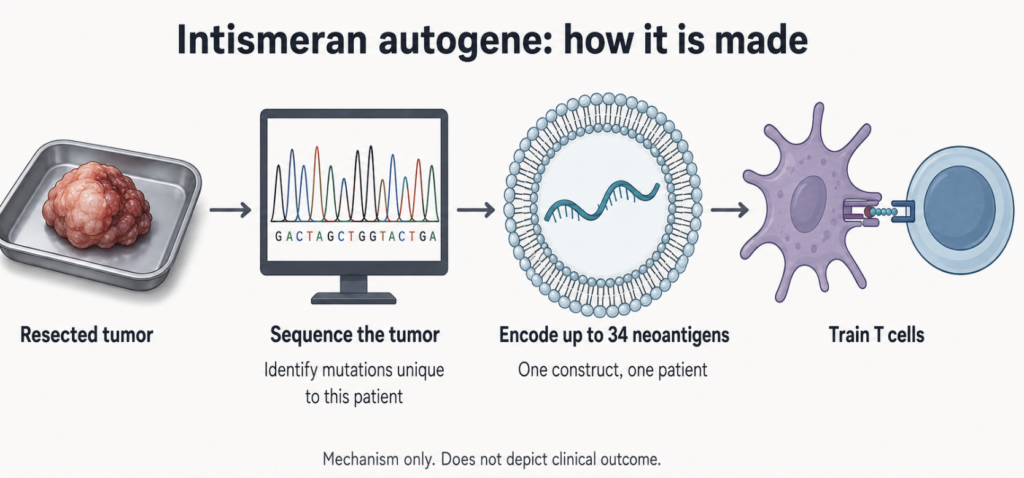
What intismeran autogene is, and how it is meant to work
Intismeran autogene, previously known as V940 or mRNA-4157, is not a vaccine in the preventive sense. It is a therapy manufactured individually for each patient after surgery.
The process begins with the resected tumor. Sequencing identifies the mutations unique to it, and up to 34 of the resulting neoantigens are encoded into a single synthetic messenger RNA construct. Neoantigens are protein fragments that exist in the cancer and nowhere else in the body. Once injected, the construct is translated and presented to the immune system, which generates T cells specific to that patient’s cancer (Merck and Moderna, 2026).
The underlying immunology is well established. Neoantigen presentation drives T-cell responses, and that is not a contested claim. The five-year follow-up of the mid-stage trial also reported increased T-cell receptor clonality and new clonotypes in patients who received the combination, with greater expansion of new clones among those who did not recur [Khattak, 5-Year Update of KEYNOTE-942, 2026].
None of that settles the clinical question. A pathway can exist and can be engaged without any of that telling us whether engaging it keeps patients cancer free. That is what the trial was for.
Clinical Perspective. The word “vaccine” does more harm than good here. It invites patients and families to picture prevention: something given to healthy people to stop a disease from starting. This is a post-surgical treatment given to people who have had cancer and currently have none detectable, with the aim of keeping it that way. That distinction determines who could ever be a candidate.
Why resected melanoma remains a hard problem
Melanoma is unusual among solid tumors in how favorable its early numbers look and how quickly they deteriorate.
In the United States, 77% of melanomas are diagnosed while still confined to the primary site, and five-year relative survival for that group is 100.0%. For disease that has reached regional lymph nodes, survival falls to 75.7%, and for distant disease to 34.6% (SEER Cancer Stat Facts, 2026). Surgery cures the large majority of patients, and the clinical problem sits entirely with the minority it does not cure.
That minority is not small in absolute terms, and its recurrence risk is well characterized. In a double-blind trial of 976 patients with resected stage IIB or IIC melanoma, 63.4% of those receiving placebo remained recurrence-free at 36 months. More than one in three recurred within three years despite complete surgical removal. Pembrolizumab raised the recurrence-free figure to 76.2% (hazard ratio 0.62; 95% CI, 0.49 to 0.79) [Luke, Final Analysis of DMFS in KEYNOTE-716, 2024].
Stage III is harder still. Among 1,019 patients with resected stage III disease followed for a median of 6.9 years, 36% of the placebo group were recurrence-free at seven years. Pembrolizumab improved that to 50% (hazard ratio 0.63; 95% CI, 0.53 to 0.74) [Eggermont, Seven-Year Analysis of KEYNOTE-054, 2024]. Which is worth sitting with for a moment: after a full year of the current standard of care, half of stage III patients had still recurred within seven years. That half is the gap intismeran autogene was built to close.
Clinical Perspective. Adjuvant therapy occupies an uncomfortable position in oncology. It is given to people who feel well, who have no measurable disease, and who cannot be told individually whether they needed it. Every patient accepts real toxicity for a benefit that is visible only statistically, across a population. Which is why the size of the benefit, and not merely its existence, governs whether the trade is worth making.
What “completely resected stage IIB-IV” actually describes
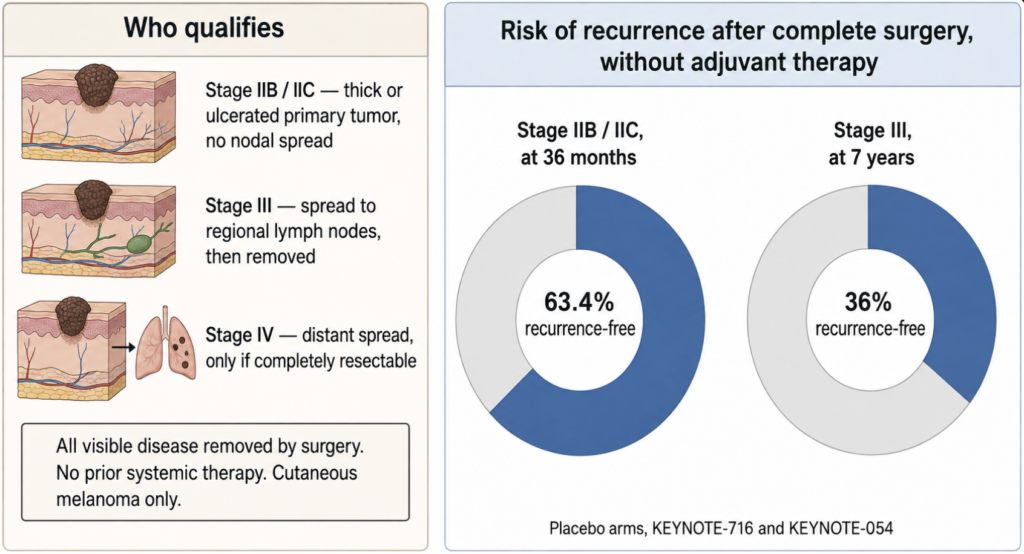
The eligibility criteria for this trial are narrower than most coverage has conveyed.
Completely resected means that surgery has removed all visible and detectable disease. Patients entering this trial had no measurable cancer at the time of treatment. This is not a therapy for advanced or metastatic melanoma.
Stage IIB and IIC describe primary tumors that are thick or ulcerated but have not reached the lymph nodes. Stage III describes disease that reached regional lymph nodes and was then removed. Stage IV describes disease that had spread to distant sites, and here the qualifier matters most: only the minority of stage IV patients whose metastases could be completely removed surgically were eligible.
Two further restrictions apply. Patients must not have received prior systemic therapy, and the trial enrolled cutaneous melanoma only (Merck and Moderna, 2026). Melanoma arising from mucosal surfaces or the eye was not studied.
Pembrolizumab’s role, and why the comparator matters
Pembrolizumab is a humanized monoclonal antibody that blocks the interaction between PD-1 and its ligands, releasing an inhibitory signal that tumors exploit to restrain T cells (Merck, 2026). It is already approved as adjuvant treatment for resected stage IIB, IIC, and III melanoma.
The division of labor between the two agents is reasonably clean. Pembrolizumab releases the brake on the immune response. Intismeran autogene supplies the direction, meaning the specific targets that response should pursue. Neither substitutes for the other.
This design choice carries a consequence that is easy to miss. The control arm in this trial received pembrolizumab, not placebo. Whatever advantage was demonstrated is an advantage on top of an effective standard of care rather than against nothing. Adding a second agent to an active comparator is among the least forgiving designs in oncology, because the control arm already works, and most such attempts fail. It also means the absolute gap between arms will necessarily be narrower than either drug shows against placebo.
What the trial measured, and what “met its endpoint” means
INTerpath-001 enrolled 1,137 patients, randomized 2:1 after complete surgical resection. The combination arm received intismeran autogene 1 mg every three weeks for up to nine doses alongside pembrolizumab 400 mg every six weeks for up to nine cycles. The comparator arm received pembrolizumab alone. Treatment ran approximately one year, up to a maximum of about 56 weeks (Merck and Moderna, 2026).
At a pre-specified interim analysis, the trial met its primary endpoint of recurrence-free survival and its key secondary endpoint of distant metastasis-free survival. Per protocol, the study continues in order to evaluate overall survival and other secondary endpoints.
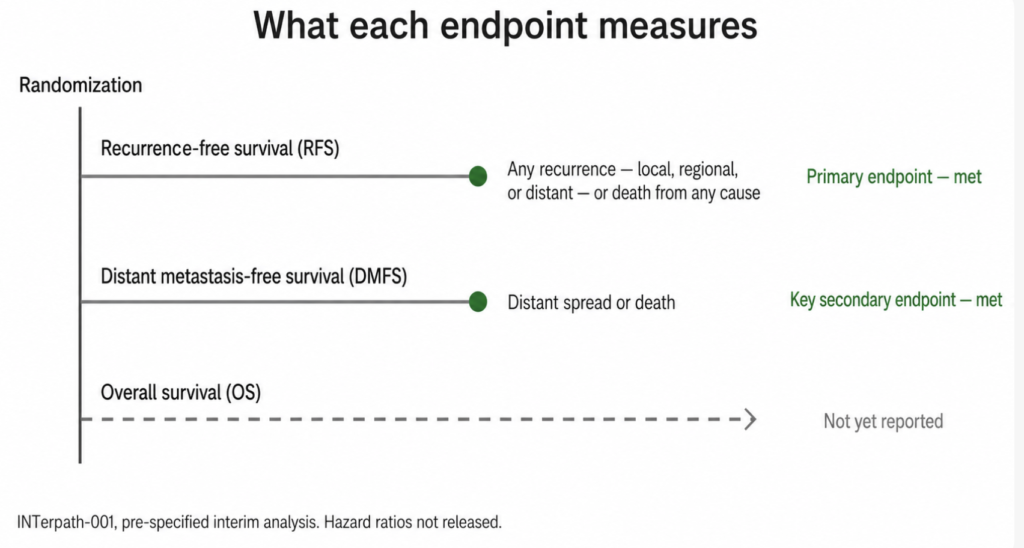
| Endpoint | What it counts | The question it answers | Status in INTerpath-001 |
|---|---|---|---|
| Recurrence-free survival (RFS) | Time from randomization to any recurrence (local, regional, or distant) or death from any cause | Did the cancer stay away longer? | Primary endpoint, met |
| Distant metastasis-free survival (DMFS) | Time from randomization to distant spread or death | Was the dangerous kind of recurrence prevented? | Key secondary endpoint, met |
| Overall survival (OS) | Time from randomization to death | Did patients live longer? | Still being followed, not reported |
RFS and DMFS are surrogate endpoints, measures that stand in for survival because they can be observed years earlier. In resected melanoma this substitution is defensible but imperfect. A correlation meta-analysis across 30 randomized trials in stage II/III melanoma found the relationship between treatment effects on RFS and on overall survival to be moderate: 0.68 (95% CI, 0.45 to 0.82) by one model and 0.71 (95% CI, 0.42 to 0.87) by another. The authors themselves cautioned that nearly half the evidence base consisted of interferon trials, a therapy no longer in routine use [Leung, Predicting Overall Survival Benefit from Improvements to Recurrence-Free Survival, 2025].
Delaying recurrence and extending life are related, but they are not the same claim, and only the first has been made here.
This limitation is not unique to intismeran autogene, and it would be unfair to treat it as though it were. A review of adjuvant immunotherapy in stage IIB/IIC melanoma notes that no definitive overall survival benefit has yet been demonstrated for adjuvant PD-1 blockade in that setting either [Prkačin, Adjuvant Immunotherapy in Stage IIB/IIC Melanoma, 2025]. The same gap applies to the standard of care.
What the announcement does not yet say
Statistical significance is a statement about probability, not magnitude. It tells you the observed difference is unlikely to be an accident of sampling. It tells you nothing about whether that difference is large enough to change a treatment decision.
As of this writing, the hazard ratios for RFS and DMFS, their confidence intervals, absolute recurrence rates in each arm, subgroup consistency, graded adverse event rates, discontinuation rates, and quality-of-life data all remain unpublished. The companies have stated that the safety profile was consistent with previous reports and that no new safety signals were observed (Merck and Moderna, 2026). That statement is worth accepting at face value, while noting that the supporting detail has not been released.
One further consideration belongs here, with its limits stated plainly. Across medicine, treatment effects estimated at an early look tend to run larger than effects estimated at the end. A systematic review comparing 91 randomized trials stopped early for benefit against 424 comparable trials that ran to completion found the early-stopped trials produced systematically larger effect estimates, with a pooled ratio of relative risks of 0.71 (95% CI, 0.65 to 0.77), and the discrepancy was greatest in smaller studies [Bassler, Stopping Randomized Trials Early for Benefit, 2010].
That analysis studied trials that were terminated early. INTerpath-001 was not terminated. It reported at a planned interim analysis and continues. So the finding is not an indictment of this trial. It is a reason to treat an interim estimate as a first reading rather than a final one.
Clinical Perspective. When reading a topline release, ask what question the sentence actually answers. “Met its primary endpoint” answers whether. It does not answer how much, for whom, or at what cost, and those are the answers that determine whether a therapy enters practice.
Reading the Phase 2b record carefully
Nearly every account of this announcement has referenced a 49% reduction in the risk of recurrence or death from the earlier mid-stage trial. That figure is real, and its provenance deserves precision.
KEYNOTE-942 randomized 157 patients with resected stage IIIB-IV cutaneous melanoma 2:1 to the combination or to pembrolizumab alone. It was an open-label study. At the primary analysis, with median follow-up of 23 and 24 months in the two arms, recurrence-free survival favored the combination with a hazard ratio of 0.561 (95% CI, 0.309 to 1.017) and a two-sided p value of 0.053, narrowly short of the conventional threshold. Recurrence-free survival at 18 months was 79% versus 62% [Weber, Individualised Neoantigen Therapy mRNA-4157 plus Pembrolizumab, 2024].
The 49% figure comes from a later analysis. At a median follow-up of 60.3 months, the combination showed a hazard ratio of 0.510 for recurrence-free survival (95% CI, 0.294 to 0.887) and 0.411 for distant metastasis-free survival (95% CI, 0.200 to 0.843). Overall survival showed a hazard ratio of 0.471, with a confidence interval of 0.165 to 1.345, which crosses 1 and was described by the investigators as a favorable trend. The publication states directly that the five-year analyses were descriptive [Khattak, 5-Year Update of KEYNOTE-942, 2026].
Descriptive means the analysis was not a pre-specified hypothesis test with controlled type I error. It characterizes what happened over time. It does not establish significance.
None of this was hidden. The Merck and Moderna release identified the figure as five-year follow-up data presented at a 2026 medical meeting and printed the confidence intervals alongside it. The compression happened downstream, in secondary coverage that quoted the point estimate without its context.
Three structural differences between the two trials deserve weight. The mid-stage study was open-label, while the Phase 3 is double-blind, placebo- and active-comparator-controlled, a genuine methodological upgrade. The mid-stage study enrolled 157 patients against 1,137 in the Phase 3. And the mid-stage study was restricted to stage IIIB-IV, while the Phase 3 extended eligibility down to stage IIB.
That last difference cuts in a specific direction. Broadening a trial to include patients at lower baseline risk of recurrence generally compresses the observable difference between arms, because there are fewer events to separate. The Phase 3 effect size may reasonably be expected to look more modest than 0.510, not because anything went wrong, but because it is a different and more demanding population.
Clinical Perspective. The achievement of INTerpath-001 is not that it confirmed the mid-stage numbers. It is that a blinded, adequately powered trial cleared a statistical threshold that the open-label study missed at its primary analysis. That is a stronger result than repetition would have been.
How large is the eligible population?
Global melanoma incidence is substantial: 331,722 new cases and 58,667 deaths worldwide in 2022 [Wang, Recent Global Patterns in Skin Cancer, 2025]. The United States alone accounted for an estimated 104,960 new cases and 8,430 deaths in 2025 (SEER Cancer Stat Facts, 2026).
The eligible fraction is considerably smaller, and it cannot be calculated precisely from published data.
Cancer registries classify melanoma as localized, regional, or distant rather than by AJCC stage. The 77% figure for localized disease bundles stage 0 through stage II together, so the stage IIB and IIC patients who qualify sit somewhere inside that bundle, undifferentiated from the far larger group of thin, early tumors that will never need adjuvant therapy. Add regional disease at 10% and the surgically resectable minority of the 5% with distant disease, and the shape of the eligible population is clear even though its size is not.
No public dataset supports a specific percentage. Any figure offered would be an estimate presented as a measurement.
Two forces could move this arithmetic. Indications may broaden, since nine Phase 2 and Phase 3 studies are underway across melanoma, non-small cell lung cancer, bladder cancer, and renal cell carcinoma (Merck and Moderna, 2026), and success in any of them would change the calculation entirely. Trials in progress are hypotheses, though, not outcomes. Manufacturing also constrains the ceiling in a way conventional drugs do not, because each dose requires sequencing an individual tumor, designing a construct, and producing it for one person.
A question that matters outside sun-exposed populations
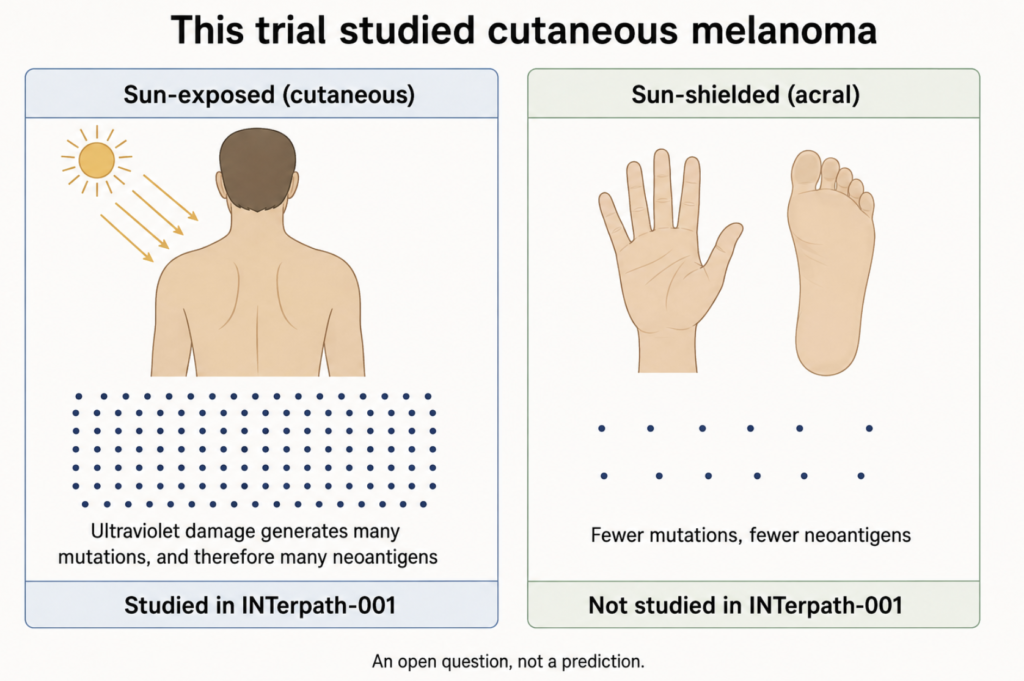
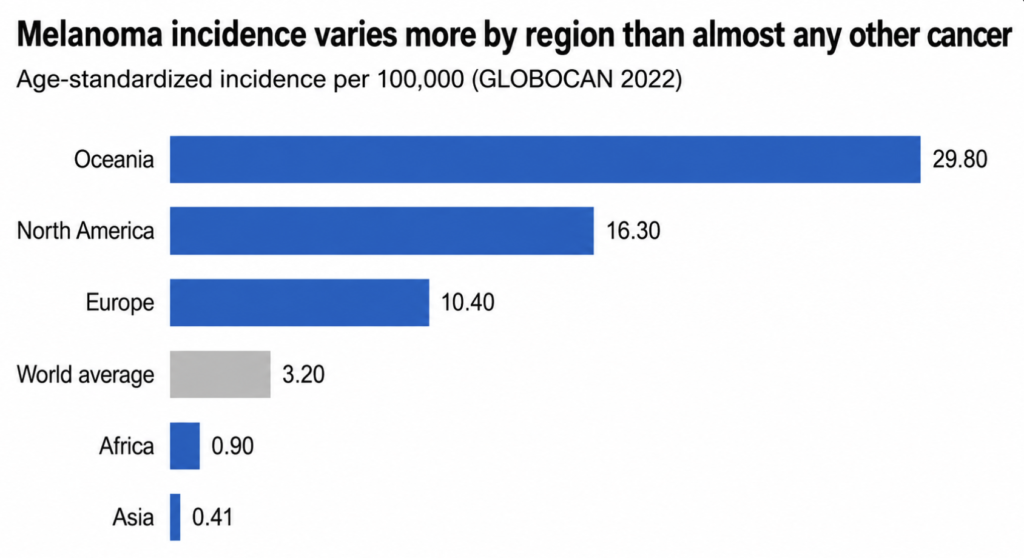
Melanoma incidence varies by region more dramatically than almost any other cancer. Age-standardized incidence per 100,000 runs 29.80 in Oceania, 16.30 in North America, and 10.40 in Europe, against a world figure of 3.20 and 0.41 in Asia [Wang, Recent Global Patterns in Skin Cancer, 2025]. Asia’s rate is roughly forty times lower than North America’s.
Biology differs alongside epidemiology. Acral melanoma, arising on palms, soles, and nail units, is the most common subtype of cutaneous melanoma in Asian populations [Moon, Genetic Alterations in Primary Acral Melanoma in Korea, 2018], a pattern also observed in Korean surgical cohorts [Yoo, Nodular Type Predominance of Head and Neck Melanoma in Asian Populations, 2023].
This raises a question the trial does not answer. Checkpoint inhibitors are thought to work well in sun-exposed melanoma partly because ultraviolet damage generates a large burden of somatic mutations, and therefore a large supply of neoantigens. Melanomas arising at sun-shielded sites carry fewer. In a single-institution retrospective series of 428 patients with metastatic melanoma, median overall survival after checkpoint inhibitor therapy was 45 months for cutaneous primaries against 17 months for acral, 18 months for mucosal, and 12 months for uveal disease [Klemen, Survival After Checkpoint Inhibitors for Metastatic Acral, Mucosal and Uveal Melanoma, 2020].
Those findings come from retrospective observation at one center, in metastatic rather than adjuvant disease. They describe checkpoint inhibitors, not neoantigen therapy. They cannot be extended into a prediction.
The narrower statement is the firm one. INTerpath-001 enrolled cutaneous melanoma, and how a neoantigen-directed therapy performs in acral disease after complete resection has not been tested. It is an open question, and it is the right one to ask before assuming these results transfer across populations.
Clinical Perspective. The most consequential figure in this entire result may be one that has gone unmentioned: the trial studied cutaneous melanoma. For a therapy whose entire premise is the number of mutations a tumor carries, tumor biology is the mechanism itself rather than a footnote to generalizability. Extending these findings to sun-shielded melanoma requires evidence that does not yet exist, and the absence of that evidence is worth stating clearly rather than quietly assuming it away.
Key takeaways
- Intismeran autogene is a therapy manufactured individually from a patient’s own tumor, encoding up to 34 neoantigens, and it is given after surgery to prevent recurrence rather than to treat existing cancer.
- INTerpath-001 met its primary endpoint of recurrence-free survival and key secondary endpoint of distant metastasis-free survival at a pre-specified interim analysis, in 1,137 patients with completely resected stage IIB-IV cutaneous melanoma.
- No hazard ratio, confidence interval, or absolute recurrence rate has been released, so the direction of benefit is established while its magnitude is not.
- Both endpoints met are surrogates for survival. Overall survival data remain immature, a limitation shared by adjuvant PD-1 blockade generally.
- The comparator arm received pembrolizumab, meaning the demonstrated benefit is additive to an effective standard of care rather than measured against no treatment.
- The frequently quoted 49% risk reduction comes from a descriptive five-year analysis of an open-label 157-patient trial whose primary analysis reported a p value of 0.053.
FAQ
Is intismeran autogene approved? No. The companies have stated they will present the data at a medical meeting and engage regulators regarding filing submissions. It remains investigational, and no regulatory decision has been announced (Merck and Moderna, 2026).
Does this mean melanoma can now be cured? No. The trial measured whether recurrence was delayed in patients who were already cancer-free after surgery. Overall survival is still being followed and has not been reported. Even the current standard of care has not yet demonstrated a definitive survival benefit in resected stage IIB/IIC disease [Prkačin, Adjuvant Immunotherapy in Stage IIB/IIC Melanoma, 2025].
What does recurrence-free survival actually mean? It measures the time from randomization until cancer returns anywhere, locally, regionally, or at a distant site, or until death from any cause. It answers whether disease stayed away longer, not whether patients lived longer. Correlation between the two in melanoma trials has been moderate [Leung, Predicting Overall Survival Benefit from Improvements to Recurrence-Free Survival, 2025].
Will this work for other cancers? Unknown. Nine Phase 2 and Phase 3 studies are underway across non-small cell lung cancer, bladder cancer, and renal cell carcinoma (Merck and Moderna, 2026). Ongoing trials establish that the question is being asked, not that it has been answered.
References
- Weber JS, Carlino MS, Khattak A, et al. Individualised neoantigen therapy mRNA-4157 (V940) plus pembrolizumab versus pembrolizumab monotherapy in resected melanoma (KEYNOTE-942): a randomised, phase 2b study. Lancet. 2024;403(10427):632-644.
- Khattak A, Carlino MS, Meniawy T, et al. Intismeran Autogene Plus Pembrolizumab Versus Pembrolizumab Alone in High-Risk Resected Melanoma: 5-Year Update of the Randomized Phase IIb KEYNOTE-942 Study. J Clin Oncol. 2026.
- Luke JJ, Ascierto PA, Khattak MA, et al. Pembrolizumab Versus Placebo as Adjuvant Therapy in Resected Stage IIB or IIC Melanoma: Final Analysis of Distant Metastasis-Free Survival in the Phase III KEYNOTE-716 Study. J Clin Oncol. 2024;42(14):1619-1624.
- Eggermont AMM, Kicinski M, Blank CU, et al. Seven-year analysis of adjuvant pembrolizumab versus placebo in stage III melanoma in the EORTC1325/KEYNOTE-054 trial. Eur J Cancer. 2024;211:114327.
- Leung L, Kirkwood JM, Srinivasan S, et al. Challenges and opportunities of predicting overall survival benefit from improvements to recurrence-free survival in stage II/III melanoma: a correlation meta-analysis. Immunooncol Technol. 2025;25:101042.
- Bassler D, Briel M, Montori VM, et al. Stopping randomized trials early for benefit and estimation of treatment effects: systematic review and meta-regression analysis. JAMA. 2010;303(12):1180-1187.
- Prkačin I, Brkić A, Pondeljak N, et al. Adjuvant Immunotherapy in Stage IIB/IIC Melanoma: Current Evidence and Future Directions. Biomedicines. 2025;13(8):1894.
- Wang M, Gao X, Zhang L, et al. Recent global patterns in skin cancer incidence, mortality, and prevalence. Chin Med J (Engl). 2025;138(2):185-192.
- Klemen ND, Wang M, Rubinstein JC, et al. Survival after checkpoint inhibitors for metastatic acral, mucosal and uveal melanoma. J Immunother Cancer. 2020;8(1):e000341.
- Moon KR, Choi YD, Kim JM, et al. Genetic Alterations in Primary Acral Melanoma and Acral Melanocytic Nevus in Korea: Common Mutated Genes Show Distinct Cytomorphological Features. J Invest Dermatol. 2018;138(4):933-945.
- Yoo H, Park S, Kim SW. Nodular type predominance of head and neck cutaneous malignant melanoma in Asian populations leads to poor outcome and low survival. Melanoma Res. 2023;33(4):326-331.
Joonpyo Hong, MD is a board-certified otolaryngologist practicing in Korea. This article reflects his clinical interpretation of published research and does not constitute individual medical advice.
This article is not intended to advertise or promote any specific company or product.
Primary and non-indexed sources
- Merck and Moderna. Phase 3 INTerpath-001 Trial of Intismeran Autogene Plus KEYTRUDA Met Endpoints of Recurrence-Free Survival and Distant Metastasis-Free Survival in Patients With Completely Resected Stage IIB-IV Melanoma. 19 August 2026.
- National Cancer Institute. SEER Cancer Stat Facts: Melanoma of the Skin. Bethesda, MD.
- ClinicalTrials.gov. NCT05933577 (INTerpath-001).
- Reuters. Wall St rises as yields ease, Moderna lifts healthcare stocks. 19 August 2026.
For more articles:
https://curiousmd.com/why-small-cap-biotech-investing-is-hard/
https://curiousmd.com/monthly-injection-for-hot-flashes-abcl635/
https://curiousmd.com/global-aging-and-ai-medicine/
Link out to:
- SEER Cancer Stat Facts: Melanoma of the Skin
- ClinicalTrials.gov — NCT05933577
- Merck news release, 19 August 2026
- Global Cancer Observatory — Melanoma of skin fact sheet
Pingback: First Approved CRISPR Therapy in 2026: What Casgevy Shows