
Laryngomalacia in infants is the most common cause of noisy breathing in the first months of life, and in the large majority of cases it resolves without any treatment at all. In one series of 120 consecutive infants, the stridor that alarmed their parents ended at an average age of 7.6 months, and only 4.2% ever needed an operation [Wright, Congenital Laryngomalacia: Symptom Duration and Need for Surgical Intervention, 2012]. That statistic explains why most pediatricians offer reassurance first. It also hides the harder clinical question: which infants are in the small group that needs something more, and how would a parent know?
This article covers what laryngomalacia is, why it happens, how common it is, the specific signs that separate a benign course from a serious one, how the diagnosis is made, what treatment involves, whether the condition runs in families, and what happens long-term when it is managed properly.
What Is Laryngomalacia?
Laryngomalacia is the inward collapse of the tissues above the vocal cords during inspiration. The epiglottis, the aryepiglottic folds, and the tissue over the arytenoid cartilages fall toward the airway each time the infant breathes in, and air forced through that narrowed opening produces a high-pitched sound called inspiratory stridor.
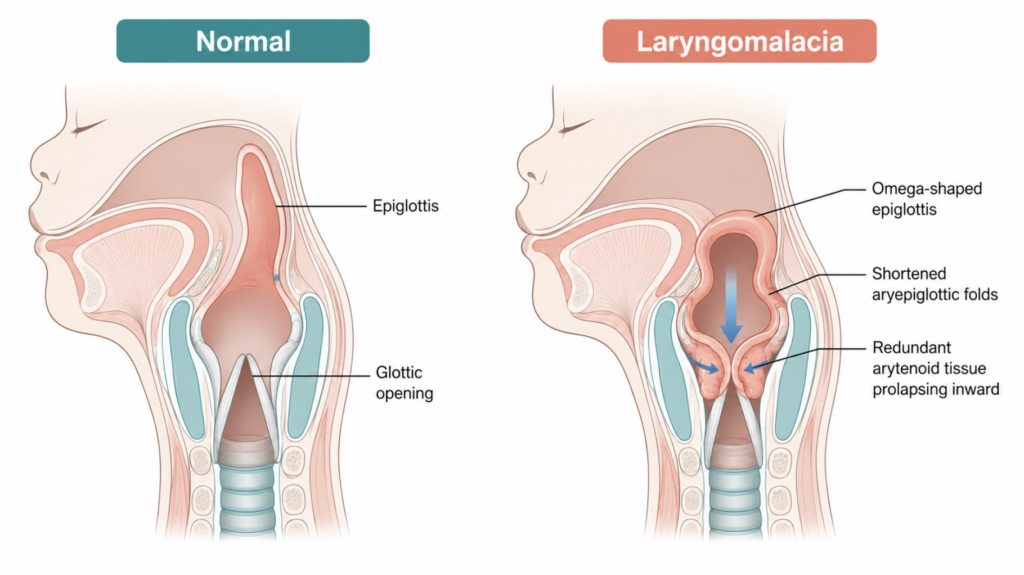
The word “malacia” means softness, and the distinction matters: the airway is not blocked by a mass or a scar. It is a problem of floppiness that appears only during the dynamic act of breathing in. When the infant exhales, positive pressure pushes the tissue back out of the way and the sound disappears. This is why laryngomalacia produces noise on the way in but not on the way out, and it is the feature that separates it clinically from tracheomalacia, a lower-airway condition that is far less common and typically noisier on exhalation.
Laryngomalacia is the most common cause of stridor in newborns, accounting for 45% to 75% of all infants with congenital stridor [Landry, Laryngomalacia: Disease Presentation, Spectrum, and Management, 2012].
What Causes Laryngomalacia?
There is no single confirmed cause, but the leading explanation has shifted over the past two decades from “soft cartilage” toward a problem of neurologic control.
The pivotal work came from a study of 201 infants in which laryngeal sensory thresholds were measured directly. Infants with moderate and severe disease required significantly stronger stimuli to trigger the protective laryngeal adductor reflex than infants with mild disease, and that sensory function improved as their symptoms resolved [Thompson, Abnormal Sensorimotor Integrative Function of the Larynx in Congenital Laryngomalacia: A New Theory of Etiology, 2007]. The tissue may be floppy because the nerve circuits that keep it toned have not fully matured, not simply because the cartilage is weak. The same study found that reflux, neurologic disease, and low Apgar scores all influenced how severe the disease became.
Gastroesophageal reflux deserves its own paragraph, because it is the part of this topic where the evidence has moved the furthest. Reflux and laryngomalacia are observed together frequently, but a systematic review found no clear causal association between them [Hartl, A Systematic Review of Laryngomalacia and Acid Reflux, 2012]. The direction of the arrow remains genuinely unresolved: acid exposure may inflame and desensitize supraglottic tissue, or the increased negative pressure generated by an obstructed inspiration may itself draw stomach contents upward. What is clearer is that coexistence alone has not proven sufficient grounds for treating every infant, a point examined in the treatment section below.
How Common Is Laryngomalacia in Infants?
Laryngomalacia is common as a proportion of infants who present with stridor, and that figure is well established at 45% to 75% [Landry, Laryngomalacia: Disease Presentation, Spectrum, and Management, 2012]. The true population-level incidence is much less certain, and the reason is worth stating plainly: mild cases resolve without anyone consulting a specialist, so nearly every published cohort is drawn from referral clinics. Figures on the order of a few cases per 10,000 live births circulate in clinical reference texts, but they describe clinically significant, referred disease rather than everyone who has the condition.
The severity distribution is better documented, though it also comes from referral populations. Among 279 children at a tertiary aerodigestive center whose severity was formally categorized, 62.7% were mild, 28.7% moderate, and 8.6% severe [Simons, Laryngomalacia and Swallowing Function in Children, 2016]. Roughly six in ten infants in that setting had the version that simply needs time.
Symptoms: When Should You Suspect Laryngomalacia?
The typical pattern is recognizable. Inspiratory stridor begins within the first few weeks of life, worsens over the following months, and then gradually fades. The sound is louder when the infant cries, feeds, lies on the back, or flexes the neck, and quieter when calm, prone, or with the neck extended.

Stridor is nearly universal, present in 92.9% of one large cohort. Other presenting features were considerably less common: apnea in 18.8%, cyanotic episodes in 13.0%, and chest retractions in 17.9% [Simons, Laryngomalacia and Swallowing Function in Children, 2016]. Those less common symptoms are exactly the ones that matter.
Stridor is also not always the complaint that brings a child in. In a consecutive series of 88 children with endoscopically confirmed laryngomalacia, 64% presented primarily with stridor, but 25% presented with snoring or sleep-disordered breathing and 11% with swallowing dysfunction. Nearly a quarter of the children had no stridor at all, then or in their history [Cooper, Primary Presentations of Laryngomalacia, 2014]. The timing of these presentations differed sharply: children whose main problem was sleep-related breathing were diagnosed at a mean age of 46 months, compared with 3.5 months for the stridor group. Laryngomalacia is usually a newborn diagnosis, but it is not exclusively one, and a snoring preschooler is a context where it still deserves consideration.
| Typically managed with observation | Features that prompt further evaluation |
|---|---|
| Noise only; feeding well | Repeatedly stopping to breathe mid-feed; choking |
| Weight tracking along the growth curve | Faltering weight gain or crossing percentiles downward |
| No chest retractions | Sternal or intercostal retractions, nasal flaring |
| Quiet during sleep | Cyanosis, apnea, or heavy obstruction while asleep |
One clue about which infants end up needing surgery: in the Wright series, 80% of the children who required an operation had first presented emergently to hospital. Those children were also younger at presentation, at a mean of 45 days versus 95 days, although that age difference did not reach statistical significance in a cohort of this size [Wright, Congenital Laryngomalacia: Symptom Duration and Need for Surgical Intervention, 2012]. Severe disease tends to announce itself early and urgently.

How Is Laryngomalacia Diagnosed?
Diagnosis rests on flexible laryngoscopy performed while the infant is awake. This is the essential technical point: because the collapse is dynamic and happens only during spontaneous inspiration, an airway examined under general anesthesia with controlled ventilation can look deceptively normal. The scope is passed through the nose in the office and the study takes a few minutes.

Further testing is selective rather than routine. Direct laryngoscopy and bronchoscopy under anesthesia is reserved for severe or atypical presentations, and the reason is the frequency of a second problem lower down. The classic study of 233 infants established that a meaningful minority of children carry synchronous airway lesions alongside their laryngomalacia [Mancuso, Laryngomalacia: The Search for the Second Lesion, 1996], a finding confirmed in later cohorts [Dickson, Secondary Airway Lesions in Infants with Laryngomalacia, 2009]. This is not a technicality. An additional level of airway obstruction carries a 4.5-fold increased risk of needing surgery [Landry, Laryngomalacia: Disease Presentation, Spectrum, and Management, 2012], and an unrecognized second lesion is a common reason an operation fails to deliver the expected result.
Polysomnography is added when sleep-disordered breathing is suspected, and a swallow study when aspiration is a concern. Swallowing dysfunction in this population is both common and easy to miss. In the tertiary cohort described above, 75.7% of children who underwent a baseline swallowing assessment had at least one abnormal result, including 66.2% of those whose parents reported no feeding symptoms at all. Notably, abnormal swallowing did not correlate with how severe the laryngomalacia looked on endoscopy, although failure to thrive did [Simons, Laryngomalacia and Swallowing Function in Children, 2016]. A quiet-looking airway does not guarantee a safe swallow.
Treatment: From Watchful Waiting to Surgery
Management follows severity. A widely used framework sorts infants into three groups [Landry, Laryngomalacia: Disease Presentation, Spectrum, and Management, 2012]: stridor without significant feeding symptoms, managed expectantly with scheduled weight checks; stridor with feeding-related symptoms, managed with feeding modifications and, historically, acid suppression; and aspiration, failure to thrive, or the consequences of obstruction and hypoxia, which call for surgery.
The reflux medication question has changed
Prescribing acid suppression to infants with laryngomalacia has been standard practice for years, and international consensus recommendations have supported it [Carter, International Pediatric ORL Group (IPOG) Laryngomalacia Consensus Recommendations, 2016]. More recent evidence has not been kind to that practice. A retrospective cohort of 236 infants found that acid suppression did not reduce the risk of supraglottoplasty or of hospitalization, while thickening of feeds was associated with fewer respiratory hospitalizations and a longer time to surgery [Duncan, Acid Suppression Does Not Improve Laryngomalacia Outcomes but Treatment for Oropharyngeal Dysphagia Might Be Protective, 2021]. A subsequent randomized trial in infants with mild to moderate laryngomalacia and without significant reflux found that adding famotidine to feeding modifications produced no greater improvement in airway symptom scores than feeding modifications alone [Shaffer, Acid Suppression in Mild-Moderate Laryngomalacia Without GERD: A Randomized Controlled Trial, 2026].
The trial was small, and it deliberately excluded infants with severe laryngomalacia or significant reflux, so it does not settle what to do for those groups. What it does suggest is that the feeding intervention, rather than the medication, may be carrying most of the benefit in mild and moderate disease. This is an area where practice is actively shifting, and current management should be discussed with the treating otolaryngologist rather than assumed from older sources.
Surgery
For severe disease, the operation is supraglottoplasty, in which the aryepiglottic folds are divided and redundant supraglottic tissue is trimmed endoscopically.
The objective results are good when it is indicated. In a meta-analysis of children with congenital laryngomalacia and obstructive sleep apnea, the apnea-hypopnea index fell from a mean of 20.4 to 4.0 events per hour, and the lowest oxygen saturation improved from 74.5% to 88.4% [Camacho, Supraglottoplasty for Laryngomalacia with Obstructive Sleep Apnea: A Systematic Review and Meta-analysis, 2016].
Two caveats belong with those numbers. The variation between patients was wide, with a standard deviation on the preoperative apnea-hypopnea index larger than the mean itself. And substantial improvement is more common than complete normalization: among the subset with individual data available, 26.5% reached an apnea-hypopnea index below 1 [Camacho, 2016], with a separate meta-analysis reaching similar conclusions about residual disease [Farhood, Objective Outcomes of Supraglottoplasty for Children with Laryngomalacia and Obstructive Sleep Apnea, 2016]. Results are consistently less favorable in children with neurologic, cardiac, or genetic comorbidities.
Is Laryngomalacia Genetic?
Most cases are sporadic, and no clear pattern of inheritance applies to the typical infant. The exception is a small number of familial reports, the most cited being a family in which congenital stridor appeared in nine members across three generations, a pattern the authors considered consistent with autosomal dominant transmission [Shohat, Autosomal Dominant Congenital Laryngomalacia, 1992]. Such families are rare in the literature.
Laryngomalacia can also appear as one feature of a broader syndrome. For a parent, the practical distinction is this: isolated laryngomalacia in an otherwise healthy infant carries no well-defined recurrence risk for a future sibling, while laryngomalacia accompanied by other congenital anomalies is a reasonable prompt to discuss genetic evaluation.
Are There Long-Term Complications If It Is Treated in Time?
For mild and moderate disease managed appropriately, the expected outcome is resolution without sequelae. Most infants follow a benign course that resolves between 12 and 24 months of age [Landry, Laryngomalacia: Disease Presentation, Spectrum, and Management, 2012], and stridor resolved at a mean of 7.6 months in the non-surgical group of the Wright cohort [Wright, Congenital Laryngomalacia: Symptom Duration and Need for Surgical Intervention, 2012].
The complications described in the literature belong to severe disease that goes unaddressed: failure to thrive, driven both by the caloric cost of increased work of breathing and by impaired feeding; aspiration with recurrent respiratory illness; obstructive sleep apnea; and, in prolonged severe obstruction, the cardiopulmonary consequences of chronic hypoxia [Landry, Laryngomalacia: Disease Presentation, Spectrum, and Management, 2012].
The pattern across all of these is that harm follows delayed recognition rather than the diagnosis itself.
Key Takeaways
- Laryngomalacia accounts for 45% to 75% of infants presenting with congenital stridor, making it the single most common cause.
- In one tertiary referral cohort, 62.7% of cases were mild, 28.7% moderate, and 8.6% severe.
- Stridor resolved at an average age of 7.6 months in infants managed without surgery, and fewer than 5% required an operation in one consecutive series.
- Awake flexible laryngoscopy is the diagnostic standard, because the collapse is dynamic and can be missed under general anesthesia.
- An additional level of airway obstruction raises the risk of needing surgery 4.5-fold, which is why a second lesion must be excluded in severe cases.
- Abnormal swallowing was found in 66.2% of infants whose parents reported no feeding symptoms, and it did not track with endoscopic severity.
- In one consecutive series, 25% of children with laryngomalacia presented primarily with snoring or sleep-disordered breathing rather than stridor, and that group was diagnosed at a mean age of 46 months.
- Recent evidence, including a randomized trial, has not shown a benefit of acid suppression over feeding modifications alone in mild to moderate disease.
- Supraglottoplasty substantially improves obstructive sleep apnea but normalizes it in only about a quarter of patients.
- Most cases are sporadic; familial autosomal dominant laryngomalacia has been reported but is rare.
Frequently Asked Questions
At what age does laryngomalacia go away?
Most cases resolve between 12 and 24 months [Landry, 2012], with stridor ending at a mean of 7.6 months in one cohort managed conservatively [Wright, 2012]. Symptoms usually worsen before they improve, often peaking somewhere in the middle of the first year, which can be unsettling for parents who expect steady progress from the start.
Is laryngomalacia dangerous?
For the large majority of infants with mild or moderate disease, no. The concern applies to the smaller severe group, 8.6% in one referral cohort [Simons, 2016], where airway obstruction can interfere with feeding, growth, and oxygenation. Severity is judged by feeding, growth, and work of breathing rather than by how loud the stridor is.
Is laryngomalacia hereditary?
In the great majority of infants it is not. Familial cases with an autosomal dominant pattern have been described [Shohat, 1992], but they are rare, and isolated laryngomalacia in an otherwise healthy child carries no well-defined recurrence risk for siblings.
Does my baby need surgery?
Most infants do not. Only 4.2% required supraglottoplasty in one consecutive series [Wright, 2012], and surgery is generally reserved for aspiration, failure to thrive, or significant obstruction and hypoxia [Landry, 2012] rather than for noisy breathing alone. Whether an individual child meets those criteria is a decision for the treating otolaryngologist.
Does reflux cause laryngomalacia?
The two occur together often, but a systematic review found no clear causal association [Hartl, 2012]. More recent work, including a randomized trial, has not demonstrated that acid suppression improves airway outcomes in mild to moderate disease [Duncan, 2021; Shaffer, 2026], which is why feeding modification has moved to the center of medical management.
Will laryngomalacia affect my child’s voice or speech?
Voice problems are not a typical feature of this condition. The collapse involves tissue above the vocal cords rather than the cords themselves. Long-term voice outcomes are not well characterized in the published literature, so persistent hoarseness in a child with laryngomalacia is worth raising with an otolaryngologist rather than assuming it is part of the diagnosis.
References
- Camacho M, Dunn B, Torre C, Sasaki J, Gonzales R, Liu SY, Chan DK, Certal V, Cable BB. Supraglottoplasty for laryngomalacia with obstructive sleep apnea: a systematic review and meta-analysis. Laryngoscope. 2016;126(5):1246-1255.
- Carter J, Rahbar R, Brigger M, Chan K, Cheng A, Daniel SJ, et al. International Pediatric ORL Group (IPOG) laryngomalacia consensus recommendations. Int J Pediatr Otorhinolaryngol. 2016;86:256-261.
- Cooper T, Benoit M, Erickson B, El-Hakim H. Primary presentations of laryngomalacia. JAMA Otolaryngol Head Neck Surg. 2014;140(6):521-526.
- Dickson JM, Richter GT, Meinzen-Derr J, Rutter MJ, Thompson DM. Secondary airway lesions in infants with laryngomalacia. Ann Otol Rhinol Laryngol. 2009;118(1):37-43.
- Duncan DR, Larson K, Davidson K, Williams N, Liu E, Watters K, Rahbar R, Rosen RL. Acid suppression does not improve laryngomalacia outcomes but treatment for oropharyngeal dysphagia might be protective. J Pediatr. 2021;238:42-49.e2.
- Farhood Z, Ong AA, Nguyen SA, Gillespie MB, Discolo CM, White DR. Objective outcomes of supraglottoplasty for children with laryngomalacia and obstructive sleep apnea: a meta-analysis. JAMA Otolaryngol Head Neck Surg. 2016;142(7):665-671.
- Hartl TT, Chadha NK. A systematic review of laryngomalacia and acid reflux. Otolaryngol Head Neck Surg. 2012;147(4):619-626.
- Landry AM, Thompson DM. Laryngomalacia: disease presentation, spectrum, and management. Int J Pediatr. 2012;2012:753526.
- Mancuso RF, Choi SS, Zalzal GH, Grundfast KM. Laryngomalacia. The search for the second lesion. Arch Otolaryngol Head Neck Surg. 1996;122(3):302-306.
- Shaffer AD, Balogun Z, Tobey ABJ, Maguire RC, Simons JP, Dohar JE, McCoy JL, Rushchak MV, Padia R. Acid suppression in mild-moderate laryngomalacia without GERD: a randomized controlled trial. Laryngoscope. 2026;136(1):471-478.
- Shohat M, Sivan Y, Taub E, Davidson S. Autosomal dominant congenital laryngomalacia. Am J Med Genet. 1992;42(6):813-814.
- Simons JP, Greenberg LL, Mehta DK, Fabio A, Maguire RC, Mandell DL. Laryngomalacia and swallowing function in children. Laryngoscope. 2016;126(2):478-484.
- Thompson DM. Abnormal sensorimotor integrative function of the larynx in congenital laryngomalacia: a new theory of etiology. Laryngoscope. 2007;117(6 Pt 2 Suppl 114):1-33.
- Wright CT, Goudy SL. Congenital laryngomalacia: symptom duration and need for surgical intervention. Ann Otol Rhinol Laryngol. 2012;121(1):57-60.
For more interesting content:
https://curiousmd.com/child-snoring-not-normal-by-age/
https://curiousmd.com/sleep-cycles-by-age/
Link out to:
- Laryngomalacia — StatPearls, National Library of Medicine: a continually updated clinical overview covering etiology, evaluation, and management.
- Laryngomalacia: Disease Presentation, Spectrum, and Management (Landry & Thompson): the open-access review underlying much of the severity framework described above.
- International Pediatric ORL Group (IPOG) Laryngomalacia Consensus Recommendations: the multi-institutional consensus statement on evaluation and treatment.
- Acid Suppression Does Not Improve Laryngomalacia Outcomes (Duncan et al., J Pediatr): the cohort study that reframed the role of reflux medication.
Joonpyo Hong, MD is a board-certified otolaryngologist practicing in Korea. This article reflects his clinical interpretation of published research and does not constitute individual medical advice.