
A soft, occasional snore during a cold is one of the most ordinary sounds of childhood, and most child snoring is harmless. But some child snoring is not normal, and telling the two apart is the hard part. In a population-based study of more than 3,000 five-year-olds, a quarter of them had symptoms of sleep-disordered breathing, and those children were more than twice as likely to show daytime sleepiness, inattention, or hyperactivity by parent report [Gottlieb, Symptoms of sleep-disordered breathing in 5-year-old children are associated with sleepiness and problem behaviors, 2003]. What counts as a red flag also shifts as a child grows. This guide walks through the warning signs stage by stage, from infancy to adolescence.
Normal vs. Abnormal Snoring: The Core Distinction
Not all snoring means the same thing. Primary (benign) snoring is soft, occasional, usually tied to a cold or stuffy nose, and comes without pauses or visible effort. It does not fragment sleep or starve the body of oxygen.
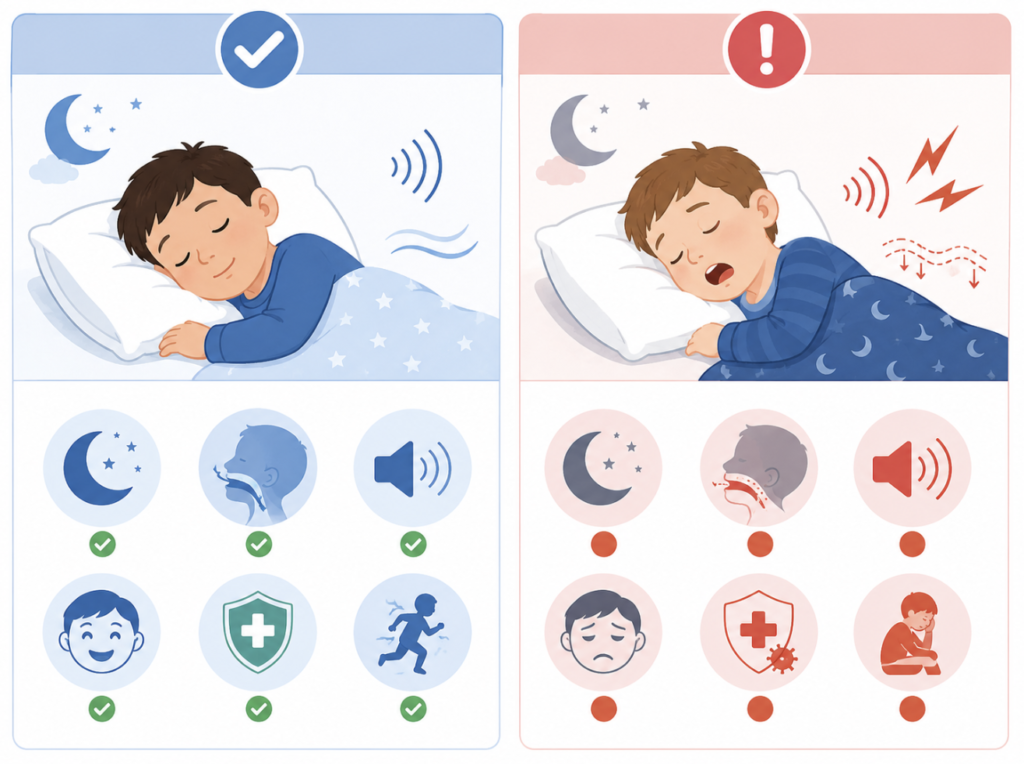
The concerning pattern is habitual snoring: loud snoring on most nights, especially when paired with pauses, gasps, snorts, or visible struggle to breathe. This is the type linked to obstructive sleep apnea (OSA), where the upper airway repeatedly narrows or closes during sleep. The prevalence of pediatric OSA is estimated at roughly 1–5% of children, with obesity an independent risk factor [Marcus, Diagnosis and management of childhood obstructive sleep apnea syndrome, 2012].
| Feature | Usually normal | Red flag |
|---|---|---|
| Frequency | Occasional, with colds | Most nights (habitual) |
| Volume | Soft | Loud |
| Breathing | Smooth | Pauses, gasps, snorts |
| Effort | None visible | Chest retractions, struggle |
| Daytime | Rested, alert | Sleepy, irritable, inattentive |
Infants (0–12 Months)
Babies are noisy breathers by design. Their nasal passages are tiny, they breathe mainly through the nose, and a little congestion can produce snore-like sounds that mean nothing serious.
The signals that deserve attention are different from those in older children. Watch for snoring that persists even when the baby is well, noisy breathing that worsens when lying on the back, pauses in breathing, chest retractions (skin pulling in around the ribs or neck), pauses or distress during feeding, and poor weight gain. In infants, these can point to structural causes such as laryngomalacia, where soft tissue above the vocal cord collapses inward during breathing. When it is severe, surgical treatment can meaningfully improve the obstruction, which is why a noisy infant who is also struggling to feed or grow deserves prompt evaluation rather than reassurance [Powitzky, Changes in sleep apnea after supraglottoplasty in infants with laryngomalacia, 2011].
Clinical Perspective: Any blue spells, breathing pauses, or feeding difficulty in an infant are urgent. These are not “wait and see” symptoms, and they warrant same-week medical attention.
Toddlers (1–3 Years)
This is when the adenoids and tonsils begin their growth spurt, and the airway behind the nose can get crowded. Mild snoring during an illness is still common and usually harmless.
The shift toward concern happens when snoring becomes a nightly fixture. Red flags in toddlers include mouth breathing every night, witnessed pauses or gasps, very restless sleep, sweating heavily during sleep, and unusual sleeping positions, such as the neck thrown back to keep the airway open. Persistent, every-night mouth breathing is worth flagging on its own, because chronic obstruction in these early years can influence facial and dental growth over time.
Children (3–8 Years)
This is the peak window for pediatric OSA, driven mainly by enlarged tonsils and adenoids in a face and airway that are still small [Bitners, Evaluation and Management of Children with Obstructive Sleep Apnea Syndrome, 2020].
The red flags here are the classic ones, and they extend well beyond the bedroom. Look for loud snoring on most nights, witnessed pauses in breathing, and gasping or choking sounds. Equally important are the daytime and indirect clues: new-onset bedwetting after a child was previously dry, morning headaches, poor growth, and behavior that looks like hyperactivity, inattention, or irritability. The bedwetting link is real; sleep-disordered breathing and nighttime wetting frequently travel together, and treating the breathing problem can resolve the wetting [Zaffanello, Obstructive sleep-disordered breathing, enuresis and combined disorders in children, 2017].
Clinical Perspective: A snoring child who seems “hyper” is easy to mislabel. In children, sleep deprivation often looks like overactivity and poor focus rather than the yawning sleepiness adults show. Some children carrying an attention-problem label are actually not sleeping well at night.
Adolescents (9–18 Years)
In the teen years the cause often changes. Tonsils and adenoids matter less, while obesity, allergic rhinitis, and structural issues like a deviated septum become more prominent drivers, and the picture starts to resemble adult OSA [Kaditis, Obstructive sleep disordered breathing in 2- to 18-year-old children: diagnosis and management, 2016].
The warning signs also look more “adult.” Watch for loud habitual snoring combined with genuine daytime sleepiness, falling grades, morning fatigue despite adequate hours in bed, and mood changes. Because teenagers are often sleep-deprived for ordinary reasons, the distinguishing clue is the combination of loud nightly snoring with daytime impairment, not tiredness alone.
When to See a Doctor
The practical rule is simple: habitual snoring — loud snoring on most nights (three or more a week) — plus any of the red flags above is reason to see a pediatric ENT or sleep specialist. A definitive diagnosis comes from an overnight sleep study (polysomnography), which distinguishes simple snoring from true obstructive sleep apnea [Bitners, Evaluation and Management of Children with Obstructive Sleep Apnea Syndrome, 2020].
Clinical Perspective: The single most useful thing a parent can bring to that visit is a one-minute phone recording of the child asleep. Audible pauses followed by a gasp tell a clinician far more than a description ever can.
Treatment, Briefly
Treatment is cause-dependent and beyond the scope of this article, but in broad strokes: for most children the first-line treatment is removal of the tonsils and adenoids (adenotonsillectomy), while allergy management, weight management, and positive airway pressure are used in selected cases [Marcus, Diagnosis and management of childhood obstructive sleep apnea syndrome, 2012]. The point here is recognition, not the fix. Spotting the pattern early is what gets a child to the right care.
Key Takeaways
- Soft, occasional snoring during a cold is usually normal; loud snoring on most nights with pauses or gasps is not.
- Red flags differ by age: feeding and breathing effort in infants, every-night mouth breathing in toddlers, bedwetting and “hyperactive” behavior in young children, and daytime sleepiness in teens.
- In children, untreated sleep-disordered breathing often shows up as hyperactivity and inattention rather than obvious sleepiness.
- Habitual snoring — loud snoring on most nights (three or more a week) — plus any red flag warrants evaluation by a pediatric ENT or sleep specialist.
- A one-minute phone recording of your child asleep is one of the most useful things to bring to that appointment.
FAQ
When is snoring not normal in a child? Snoring is concerning when it happens on most nights and comes with pauses, gasping, visible breathing effort, or daytime symptoms like sleepiness or behavior problems. Occasional soft snoring during a cold is generally harmless.
Can a baby have sleep apnea? Yes. Infants can have obstructive sleep apnea, often from structural causes such as laryngomalacia. Persistent snoring when well, breathing pauses, feeding difficulty, or poor weight gain in a baby should be evaluated promptly.
Does my snoring child have ADHD or a sleep problem? It can be hard to tell, because poor sleep in children frequently looks like hyperactivity and inattention. If a child with attention concerns also snores loudly most nights, a sleep evaluation is worth doing before assuming the behavior is the whole story.
Will my child outgrow snoring? Some children do, particularly when snoring is mild and tied to colds. But habitual loud snoring with red flags should not simply be waited out, since untreated obstruction can affect growth, learning, and behavior.
References
- Gottlieb DJ, Vezina RM, Chase C, Lesko SM, Heeren TC, Weese-Mayer DE, et al. Symptoms of sleep-disordered breathing in 5-year-old children are associated with sleepiness and problem behaviors. Pediatrics. 2003;112(4):870-7.
- Marcus CL, Brooks LJ, Draper KA, Gozal D, Halbower AC, Jones J, et al. Diagnosis and management of childhood obstructive sleep apnea syndrome. Pediatrics. 2012;130(3):e714-55.
- Bitners AC, Arens R. Evaluation and Management of Children with Obstructive Sleep Apnea Syndrome. Lung. 2020;198(2):257-70.
- Kaditis AG, Alonso Alvarez ML, Boudewyns A, Alexopoulos EI, Ersu R, Joosten K, et al. Obstructive sleep disordered breathing in 2- to 18-year-old children: diagnosis and management. Eur Respir J. 2016;47(1):69-94.
- Zaffanello M, Piacentini G, Lippi G, Fanos V, Gasperi E, Nosetti L. Obstructive sleep-disordered breathing, enuresis and combined disorders in children: chance or related association? Swiss Med Wkly. 2017;147:w14400.
- Powitzky R, Stoner J, Fisher T, Digoy GP. Changes in sleep apnea after supraglottoplasty in infants with laryngomalacia. Int J Pediatr Otorhinolaryngol. 2011;75(10):1234-9.
Further Reading (Link out to)
- Snoring in Young Children — Children’s Hospital of Philadelphia (CHOP)
- Obstructive Sleep Apnea in Children — Stanford Medicine Children’s Health
- Obstructive Sleep Apnea in Children — Cleveland Clinic
Joonpyo Hong, MD is a board-certified otolaryngologist practicing in Korea. This article reflects his clinical interpretation of published research and does not constitute individual medical advice.
For more interesting contents:
https://curiousmd.com/sleep-cycles-by-age/
https://curiousmd.com/apple-watch-sleep-apnea-accuracy/
https://curiousmd.com/wearable-ai-for-sleep-apnea-2026/