
Ask why BPPV keeps coming back and the honest answer is that nobody fully knows. Picture a typical presentation — a composite, not any individual case. Someone arrives with the world spinning every time she rolls over in bed. A Dix-Hallpike test confirms posterior canal BPPV, a repositioning maneuver takes about ninety seconds, and she leaves symptom-free. Seven months later, she’s back — same complaint, different ear.
This is the strange shape of benign paroxysmal positional vertigo: one of the most satisfyingly treatable conditions in medicine, and one of the most stubbornly repetitive. Medicine is excellent at ending an episode and far weaker at preventing the next one.
This article is about that gap — what the evidence actually establishes about recurrence, what it merely suggests, and what remains genuinely unknown.
How Often Does BPPV Actually Come Back?
Here the literature gives an unhelpfully wide answer. Across thirty studies covering more than 13,000 patients, recurrence ranged from 13.7% to 48% in studies following patients less than a year, and 13.3% to 65% in studies following them two years or longer [Sfakianaki, Risk Factors for Recurrence of Benign Paroxysmal Positional Vertigo. A Clinical Review, 2021]. Longer-horizon estimates put the ten-year figure near half of all patients.
A range that wide isn’t a fact about the disease. It’s a fact about the studies.
Consider what has to be decided before anyone can count a “recurrence.” Does a new episode in the opposite ear count, or only the same canal? Is the cutoff one week after resolution, or one month? Did investigators actively call patients and re-examine them, or simply count whoever came back through the door? Each choice moves the number substantially. A study that waits passively for patients to return will always find fewer recurrences than one that actively hunts for them.
So the honest version is this: recurrence is common, most of it happens in the first year, and beyond that the precision implied by any single percentage is largely an illusion. When a patient asks “what are my odds,” the truthful answer is a range, not a number.
Who Relapses More Often?
This part we know reasonably well — with one large caveat I’ll come to.
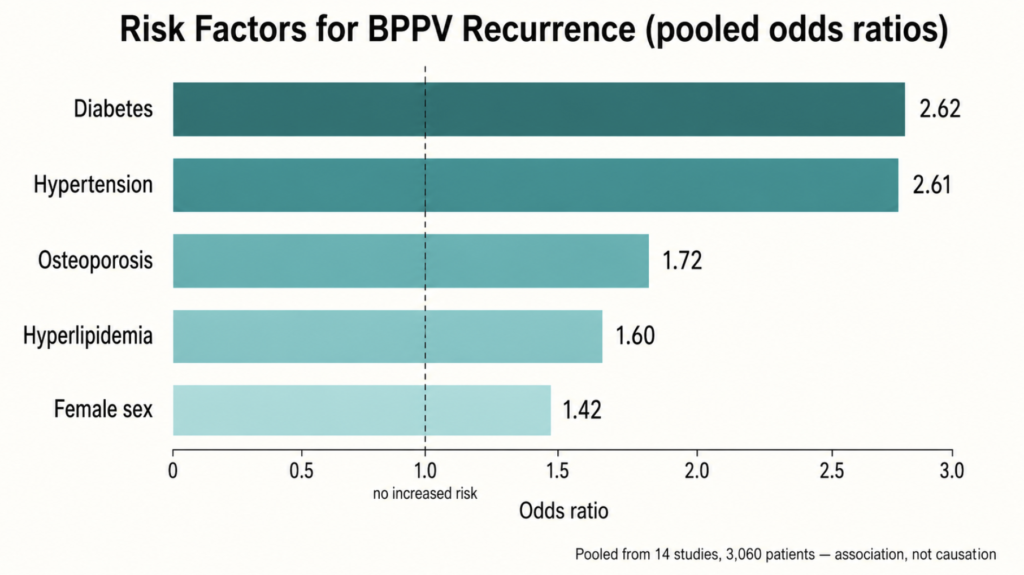
A meta-analysis pooling 14 studies and 3,060 patients found consistent associations between recurrence and several patient characteristics [Chen, Risk factors for benign paroxysmal positional vertigo recurrence: a systematic review and meta-analysis, 2021]:
| Factor | Odds ratio for recurrence |
|---|---|
| Female sex | 1.42 |
| Hypertension | 2.61 |
| Diabetes mellitus | 2.62 |
| Hyperlipidemia | 1.60 |
| Osteoporosis | 1.72 |
| Vitamin D deficiency | mean difference −3.29 ng/mL |
Clinical reviews add further associations: advancing age, head trauma, coexisting Ménière’s disease, migraine, and BPPV involving multiple canals or both sides [Sfakianaki, Risk Factors for Recurrence of Benign Paroxysmal Positional Vertigo. A Clinical Review, 2021]. A second independent meta-analysis reached broadly compatible conclusions [Li, Risk factors for the recurrence of benign paroxysmal positional vertigo: a systematic review and meta-analysis, 2022].
Notice what dominates that list: vascular and metabolic conditions, plus bone and calcium metabolism. That pattern is suggestive, and I’ll return to why.
The caveat: every one of these findings comes from observational data. Patients with hypertension recur more often than patients without it. That is not the same as hypertension causing recurrence. People with hypertension are older, take more medications, see doctors more frequently, and are therefore more likely to have a recurrence detected at all. Not one of these risk factors has been tested by taking a group of patients, treating the factor, and seeing whether recurrence falls.
Why BPPV Keeps Coming Back: The Mechanistic Guesses
BPPV happens when otoconia — calcium carbonate crystals normally embedded in the utricular macula — break loose and drift into a semicircular canal, where they make the canal wrongly sensitive to gravity [Kim, Benign paroxysmal positional vertigo, 2014]. Repositioning maneuvers work by walking those crystals back out.
So the recurrence question is really: why do the crystals keep coming loose? Several hypotheses compete, and it’s worth being explicit that these are hypotheses.
The calcium metabolism hypothesis. Otoconia are calcium carbonate structures that undergo continuous turnover, and vitamin D regulates the calcium availability that turnover depends on. If vitamin D is chronically low, the argument goes, otoconia may be poorly mineralized, more fragile, and less efficiently reabsorbed once detached. This is the most developed of the mechanistic accounts and the only one to have generated an interventional trial.
The vascular hypothesis. The labyrinth is supplied by a single terminal artery with essentially no collateral circulation. Hypertension, diabetes, and hyperlipidemia all damage small vessels. If chronic microvascular compromise degrades the utricular macula, crystals might detach more readily. This would elegantly explain why vascular comorbidities dominate the risk-factor table — but the reasoning currently runs backward, from the epidemiology to the mechanism, rather than being demonstrated directly in human inner ears.
Age-related degeneration. Otoconia demineralize and fragment with age, and the mechanisms that clear loose debris likely become less efficient. This fits the age gradient well, though it explains a population trend better than it explains why one 70-year-old relapses monthly and another never does.
Each of these is plausible. None has been shown to cause recurrence in humans. The temptation — and I see it in a lot of patient-facing writing — is to slide from “hypertension is associated with recurrence” through “microvascular damage may weaken the macula” to “control your blood pressure and your vertigo won’t come back.” That last step has never been tested. It may well be good advice for a dozen other reasons. It is not established vertigo prevention.
The One Thing That Has Actually Been Tested
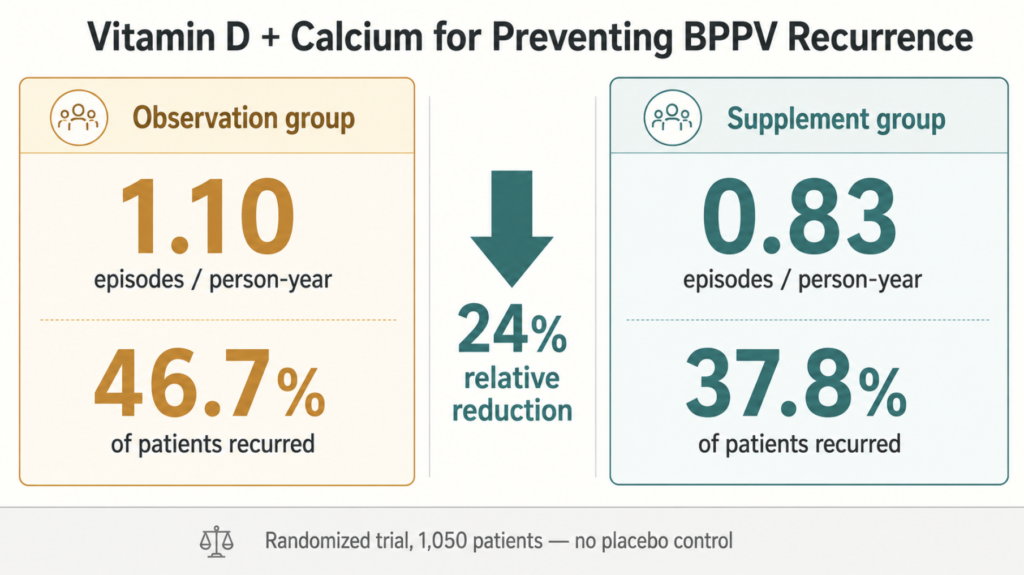
In 2020, a multicenter Korean trial randomized 1,050 patients who had just been successfully treated for BPPV. The intervention group received vitamin D 400 IU plus calcium carbonate 500 mg twice daily for a year, given when serum vitamin D was below 20 ng/mL; the comparison group was simply followed [Jeong, Prevention of benign paroxysmal positional vertigo with vitamin D supplementation: a randomized trial, 2020].
The results:
- Annual recurrence rate fell from 1.10 to 0.83 episodes per person-year — a relative reduction of about 24% (incidence rate ratio 0.76)
- The proportion of patients experiencing any recurrence fell from 46.7% to 37.8%, an absolute difference of just under 9 percentage points
- The benefit was most pronounced in patients whose baseline vitamin D was low
Those two numbers describe different things, and the distinction is worth holding onto. The rate reduction counts episodes: roughly one attack prevented for every four person-years of supplementation. The 9-point difference counts people: about one additional patient kept episode-free for every eleven treated. The first figure sounds far more impressive than the second, and both are correct.
A subsequent meta-analysis pooling this and related studies reached the same direction of effect [Jeong, Prevention of recurrent benign paroxysmal positional vertigo with vitamin D supplementation: a meta-analysis, 2022], and a 2024 review reaffirmed the association between low vitamin D and recurrent — though notably not first-time — BPPV [Rhim, Vitamin D Supplementation and Recurrence of Benign Paroxysmal Positional Vertigo, 2024].
Now the limitations, because they matter. The comparison group received no placebo — they were observed, not blinded, which leaves room for expectation effects on a symptom as subjective as dizziness. The trial was graded as providing Class III evidence on the journal’s four-level scale, well short of the Class I standard a definitive therapeutic trial would meet. And the journal appended a note that the study had been registered retrospectively rather than prospectively.
So: promising, directionally consistent across studies, biologically coherent, and not definitive. That is also, at present, the strongest preventive evidence we have for anything in BPPV. Everything else on offer is weaker.
When Frequent “BPPV” Isn’t BPPV
Before accepting that a patient simply has bad luck with otoconia, one question deserves asking: is this actually the same disease each time?
Vestibular migraine can produce short, position-triggered vertigo that closely mimics BPPV — a presentation sometimes labeled pseudo-BPPV. The clues are recurrent atypical positional vertigo, a personal or family migraine history, accompanying photophobia or nausea out of proportion to the spin, and — most tellingly — repositioning maneuvers that don’t reliably work. One study of patients meeting criteria for recurrent BPPV found migraine features to be common in this population [Bruss, Migraine Features in Patients With Recurrent Benign Paroxysmal Positional Vertigo, 2021].
Ménière’s disease is the other frequent confounder, particularly when hearing changes or ear fullness accompany the attacks. And after a genuinely successful maneuver, some patients experience weeks of lingering lightheadedness or unsteadiness — a recognized phenomenon called residual dizziness, which is not a recurrence at all and does not respond to another maneuver.
The practical distinction: true recurrent BPPV means discrete episodes with a clean interval between them, each responding to repositioning. Continuous imbalance, attacks lasting hours, new hearing loss or tinnitus, headache with the vertigo, or maneuvers that stop working — those patterns warrant a fresh diagnostic look rather than a fourth Epley.
How Well Do We Really Understand This?
Less well than the risk-factor tables imply.
Prediction models built from those factors — combining hypertension, hyperglycemia, migraine, anxiety scores, and vitamin D — achieve an area under the ROC curve of roughly 0.72 [Pan, Risk factors and a nomogram model for recurrence of benign paroxysmal positional vertigo: a multicenter cross-sectional study, 2025]. That’s respectable for describing a population and inadequate for telling an individual patient what will happen to her. It means the model does meaningfully better than a coin flip and nowhere near well enough to justify a confident personal forecast.
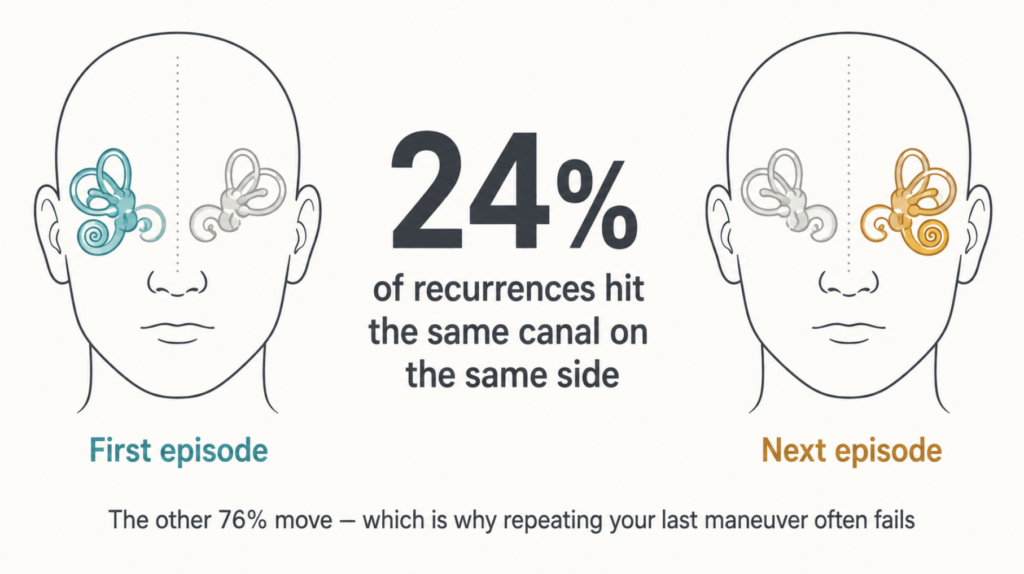
Then there’s a finding I think deserves far more attention than it gets. When researchers examined 224 consecutive pairs of BPPV attacks in the same patients, only 24% recurred in the same canal on the same side [Kim, The Patterns of Recurrences in Idiopathic Benign Paroxysmal Positional Vertigo and Self-treatment Evaluation, 2017]. The canal and side involved in the next episode were essentially independent of the last one.
Think about what that implies. If recurrence were driven mainly by a locally weakened macula on one side, we’d expect the same ear to fail repeatedly. It doesn’t. Whatever drives recurrence appears to be systemic — a whole-person state rather than a damaged spot — which is at least consistent with the metabolic and vascular hypotheses, and which also means a patient’s last episode tells you remarkably little about the shape of the next one.
The largest unknown remains the simplest question. Some people have one episode in a lifetime. Others have several in a year. Known risk factors do not come close to explaining that difference — plenty of frequent relapsers have normal blood pressure, normal glucose, normal vitamin D, and no head trauma. As one review signaled in its title, this remains a disease where what we do and do not know sit uncomfortably close together [Nuti, Benign paroxysmal positional vertigo: what we do and do not know, 2020].
Clinical Perspective
Recurrent BPPV tends to generate two distinct questions, and separating them matters, because the answers are very different.
“Can it be stopped from coming back?” Mostly, no — and stating that plainly serves patients better than implying otherwise. What can honestly be offered is narrower: checking serum vitamin D and correcting a documented deficiency, since that is the one intervention with randomized support; managing vascular and metabolic conditions, which is worth doing regardless of whether it moves vertigo; and assessing fall risk, particularly in older patients, where the consequences of a spinning episode on the stairs far exceed the consequences of the spinning itself.
“What do I do when it happens again?” Here we can do considerably more. A randomized trial of 585 patients tested whether people could manage their own recurrences at home using a web-guided system that first identified which canal was involved and then instructed the appropriate maneuver. Resolution after a single self-attempt was 72.4% in the guided group versus 42.9% in controls, who simply repeated the maneuver for whichever subtype they’d had last time [Kim, Effect of Self-treatment of Recurrent Benign Paroxysmal Positional Vertigo: A Randomized Clinical Trial, 2023].
Two things follow from that trial. First, self-treatment genuinely works — a motivated patient can handle most recurrences without a clinic visit. Second, and this is the part that matters, guidance about which canal is involved is what makes it work. Simply repeating last time’s maneuver from memory succeeded less than half the time, exactly as the 24% concordance figure would predict. Which is an argument against the common shortcut of handing a patient a generic maneuver video and calling that a plan. The maneuver has to match the episode in front of you, not the one from last spring.
Worth noting too: in that same trial, recurrence rates themselves were no different between groups (19.9% vs 23.9%). Self-treatment changes how well you handle recurrence. It does not reduce it.
Perhaps the most underrated intervention is simply telling patients this will likely happen again. The clinical practice guideline explicitly recommends educating patients about the potential for recurrence [Bhattacharyya, Clinical practice guideline: benign paroxysmal positional vertigo (update), 2017] — and in a condition where the vertigo itself feels like a stroke to the person experiencing it, knowing that a second episode is expected rather than ominous is not a small thing.
Key Takeaways
- Published BPPV recurrence rates range from about 14% to 65% depending on follow-up length and study design, and that spread reflects inconsistent definitions of “recurrence” more than genuine variation in the disease.
- Female sex, hypertension, diabetes, hyperlipidemia, osteoporosis, and vitamin D deficiency are all associated with higher recurrence, but every one of these findings is observational rather than causal.
- Vitamin D and calcium supplementation is the only intervention shown in a randomized trial to reduce BPPV recurrence, lowering the annual episode rate by roughly 24% in relative terms and the share of patients who recur by about 9 percentage points.
- Only 24% of BPPV recurrences involve the same canal on the same side as the previous episode, meaning the next attack is largely unpredictable from the last one.
- Self-treatment at home resolves most recurrences when patients are guided to identify which canal is involved (72.4% success) but performs poorly when they simply repeat their previous maneuver (42.9%).
FAQ
How often does BPPV come back? Roughly 15–30% of patients experience a recurrence within the first year, with cumulative figures approaching 50% over a decade. Most recurrences cluster in the first year after treatment. The wide variation across published studies stems largely from differing definitions and follow-up intensity rather than differences in the disease itself.
Does taking vitamin D prevent BPPV recurrence? It appears to help in patients who are deficient, though it does not eliminate recurrence. In a randomized trial, vitamin D plus calcium reduced annual episodes from 1.10 to 0.83 per person-year, and the share of patients who recurred at all fell from 46.7% to 37.8% — a real but partial effect, strongest in those whose serum vitamin D was below 20 ng/mL. The trial had methodological limitations, so this is worth discussing with your doctor rather than treating as settled.
Is frequent BPPV a sign of something serious? Recurrence by itself is not a red flag — it’s the expected natural history. What warrants re-evaluation is a change in pattern: attacks lasting hours instead of seconds, continuous imbalance between episodes, new hearing loss or tinnitus, headache accompanying the vertigo, or maneuvers that stop working. Those suggest a different or additional diagnosis.
Should I change how I sleep to prevent recurrence? There’s no good evidence that sleeping position prevents recurrence. Post-maneuver postural restrictions were once routinely advised, and current guidelines specifically recommend against them for posterior canal BPPV because trials showed no added benefit [Bhattacharyya, Clinical practice guideline: benign paroxysmal positional vertigo (update), 2017]. Sleeping propped up or avoiding one side may reduce how often you trigger symptoms during an active episode, but it isn’t preventing crystals from detaching.
Can I just treat it myself at home each time? Many patients can, and the evidence supports it — but only if the maneuver matches the canal actually involved. Since only about a quarter of recurrences hit the same canal and side as before, repeating your last maneuver from memory succeeds less than half the time. Getting the diagnosis right each episode is the part that matters, which is worth discussing with your clinician before relying on self-treatment.
References
- Bhattacharyya N, Gubbels SP, Schwartz SR, et al. Clinical practice guideline: benign paroxysmal positional vertigo (update). Otolaryngol Head Neck Surg. 2017;156(3_suppl):S1-S47.
- Bruss D, Abouzari M, Sarna B, Goshtasbi K, Lee A, Birkenbeuel J, Djalilian HR. Migraine features in patients with recurrent benign paroxysmal positional vertigo. Otol Neurotol. 2021;42(3):461-465.
- Chen J, Zhang S, Cui K, Liu C. Risk factors for benign paroxysmal positional vertigo recurrence: a systematic review and meta-analysis. J Neurol. 2021;268(11):4117-4127.
- Jeong SH, Kim JS, Kim HJ, et al. Prevention of benign paroxysmal positional vertigo with vitamin D supplementation: a randomized trial. Neurology. 2020;95(9):e1117-e1125.
- Jeong SH, Lee SU, Kim JS. Prevention of recurrent benign paroxysmal positional vertigo with vitamin D supplementation: a meta-analysis. J Neurol. 2022;269(2):619-626.
- Kim HJ, Kim JS. The patterns of recurrences in idiopathic benign paroxysmal positional vertigo and self-treatment evaluation. Front Neurol. 2017;8:690.
- Kim HJ, Kim JS, Choi KD, Choi SY, Lee SH, Jung I, Park JH. Effect of self-treatment of recurrent benign paroxysmal positional vertigo: a randomized clinical trial. JAMA Neurol. 2023;80(3):244-250.
- Kim JS, Zee DS. Clinical practice. Benign paroxysmal positional vertigo. N Engl J Med. 2014;370(12):1138-1147.
- Li S, Wang Z, Liu Y, et al. Risk factors for the recurrence of benign paroxysmal positional vertigo: a systematic review and meta-analysis. Ear Nose Throat J. 2022;101(3):NP112-NP134.
- Nuti D, Zee DS, Mandalà M. Benign paroxysmal positional vertigo: what we do and do not know. Semin Neurol. 2020;40(1):49-58.
- Pan Q, Li B, Zou K, Zhang J, Wang Y, Tang X. Risk factors and a nomogram model for recurrence of benign paroxysmal positional vertigo: a multicenter cross-sectional study. Front Neurol. 2025;16:1542090.
- Rhim G, Kim MJ. Vitamin D supplementation and recurrence of benign paroxysmal positional vertigo. Nutrients. 2024;16(5):689.
- Sfakianaki I, Binos P, Karkos P, Dimas GG, Psillas G. Risk factors for recurrence of benign paroxysmal positional vertigo. A clinical review. J Clin Med. 2021;10(19):4372.
Joonpyo Hong, MD is a board-certified otolaryngologist practicing in Korea. This article reflects his clinical interpretation of published research and does not constitute individual medical advice.
For more interesting content:
https://curiousmd.com/smartphone-bppv-nystagmus-detection/
https://curiousmd.com/vestibular-neuritis/
https://curiousmd.com/room-spins-when-youre-drunk/
Link out to:
- AAO-HNS Clinical Practice Guideline: Benign Paroxysmal Positional Vertigo (Update) — the full guideline, plain-language summary, and patient handouts
- ENThealth: Benign Paroxysmal Positional Vertigo — AAO-HNS patient-facing overview of BPPV
- The Patterns of Recurrences in Idiopathic BPPV (Frontiers in Neurology, open access) — the study behind the 24% concordance figure
- Effect of Self-treatment of Recurrent BPPV (JAMA Neurology) — the randomized trial of web-guided home treatment
- Prevention of BPPV with Vitamin D Supplementation (Neurology) — the only randomized prevention trial to date