
The 2015 American Thyroid Association guidelines put the malignancy risk of a purely cystic thyroid nodule at 1% or less, low enough that they recommend against biopsying one for diagnostic purposes at all [Haugen, 2015 American Thyroid Association Management Guidelines, 2016]. That is about as reassuring as thyroid imaging ever gets. Patients still walk out of the ultrasound room with the word “cyst” on their report and no clear sense of whether they have been cleared or only deferred.
The thyroid cyst vs nodule confusion is understandable, because the word is doing two different jobs at once. It describes what a nodule contains, and it gets read as a verdict on what that nodule is.
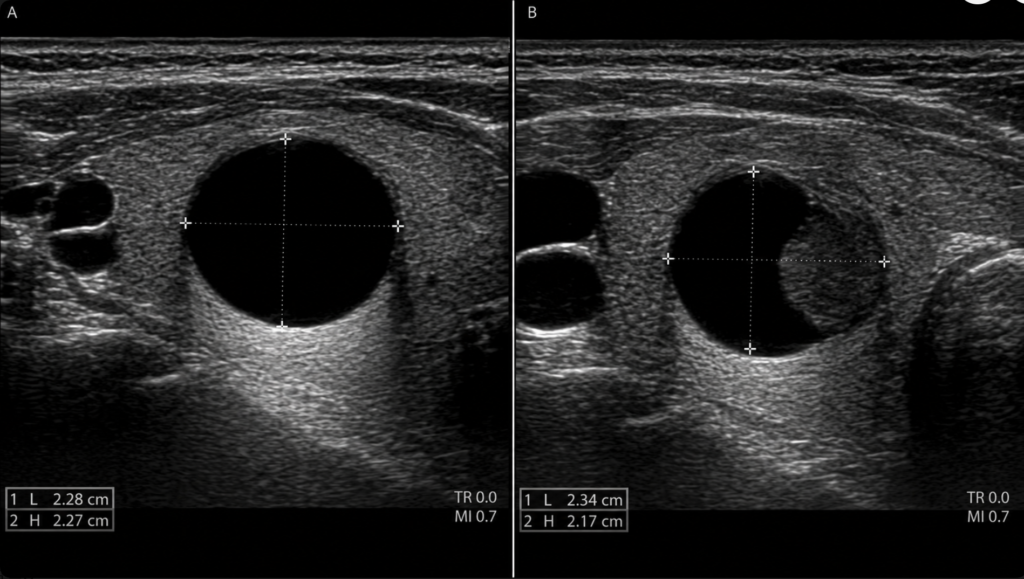
What Is a Thyroid Cyst? (It’s Not a Separate Disease)
A thyroid cyst is not a distinct diagnosis sitting alongside “thyroid nodule.” It is a description of what a nodule contains.
Much of what gets called a thyroid cyst is an ordinary nodule that has partly broken down. Degenerating nodules develop internal hemorrhage, their blood supply becomes impaired, and the affected tissue shrinks and undergoes infarction [Ren, Degenerating Thyroid Nodules, 2019]. The fluid seen on ultrasound is often the residue of that process rather than a cavity that formed on its own.
The practical consequence is this. If cysts were their own species of lesion, “it’s a cyst” would settle the question. Because they are a stage that many different nodules pass through, the question stays open until you know what the rest of the nodule looks like.
Why They Form, and Who Gets Them
Cystic change is common. In a prospective series of 1,360 nodules undergoing ultrasound-guided fine needle aspiration, 281, about 21%, were partially cystic [Li, Partially cystic thyroid nodules in ultrasound-guided fine needle aspiration, 2017]. Older figures for solitary nodules run in a similar range, with 15% to 25% described as cystic or predominantly cystic [Bennedbaek, Treatment of recurrent thyroid cysts with ethanol, 2003].
Cystic change is common largely because thyroid nodules are. Nodules are detectable in up to 65% of the general population, mostly because we image the neck so often for unrelated reasons [Durante, The Diagnosis and Management of Thyroid Nodules, 2018]. Prevalence rises with age and is higher in women. A cyst is usually an old nodule becoming noticeable rather than something new.
Thyroid Cyst vs Nodule: The Difference That Actually Matters
The relevant question is not whether a lesion is a cyst or a nodule. It is how much solid tissue is in there.
| Ultrasound composition | Estimated malignancy risk | Biopsy |
|---|---|---|
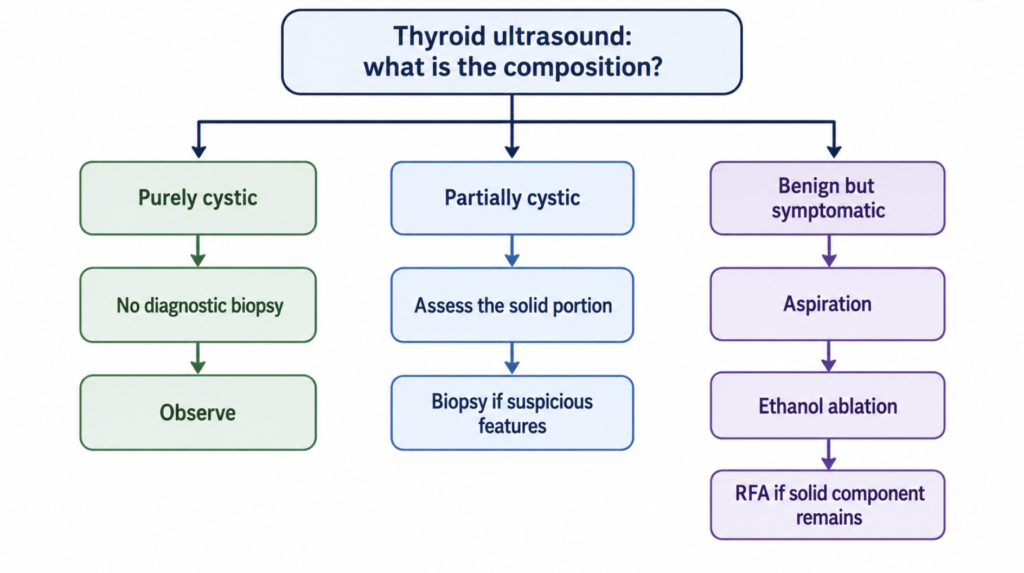
| Purely cystic (anechoic) | ≤1% [Haugen, 2016] | Not indicated for diagnosis |
| Partially cystic | 3.3–17.6% across studies [Shi, 2021]; 4.6% in one large FNA series [Li, 2017] | Depends on features of the solid portion |
| Solid | Higher; risk stratified by ultrasound pattern | Per size and pattern |
Two things stand out. First, the reassurance attached to “cyst” applies specifically to purely cystic nodules, meaning a fully anechoic lesion with no solid component. Second, the partially cystic category is genuinely wide. A meta-analysis pooling eight studies and 2,004 partially cystic nodules found reported malignancy rates spanning 3.3% to 17.6% [Shi, Diagnostic Value of Sonographic Features in Distinguishing Malignant Partially Cystic Thyroid Nodules, 2021]. That is a fivefold spread, and it is why “partially cystic” on a report is a prompt for a closer look rather than an answer.
A large meta-analysis of ultrasound accuracy reached a related conclusion from the other direction. Across fourteen individual sonographic features, the authors found that individual features are generally poor predictors of cancer; in a threshold model, cystic content and spongiform appearance were the only two whose presence could have avoided biopsy, though the authors note both occur infrequently, which limits how far this can be applied in practice [Brito, The accuracy of thyroid nodule ultrasound to predict thyroid cancer, 2014]. Cystic content is a strong signal for benignity and not much of a signal for anything else.
The Features That Change the Answer
When a nodule is partially cystic, the diagnostic information lives in the solid part: where it sits, how it is shaped, and what it contains.
The Shi meta-analysis found that an eccentric internal solid portion had the strongest discriminatory performance of any single feature (AUC 0.9592), followed by microcalcification (0.8504) and hypoechogenicity (0.8092). Several features showed specificity above 0.9, including a taller-than-wide shape, a spiculated, microlobulated or ill-defined margin, microcalcification, and a non-smooth rim. When those are present they carry real weight, even though their absence proves less. The authors recommend combining eccentric configuration, hypoechogenicity and microcalcification rather than relying on any one of them [Shi, 2021].
Taller-than-wide shape carries the highest diagnostic odds ratio for malignancy among all sonographic features in the broader literature as well (11.14; 95% CI 6.6–18.9) [Brito, 2014].
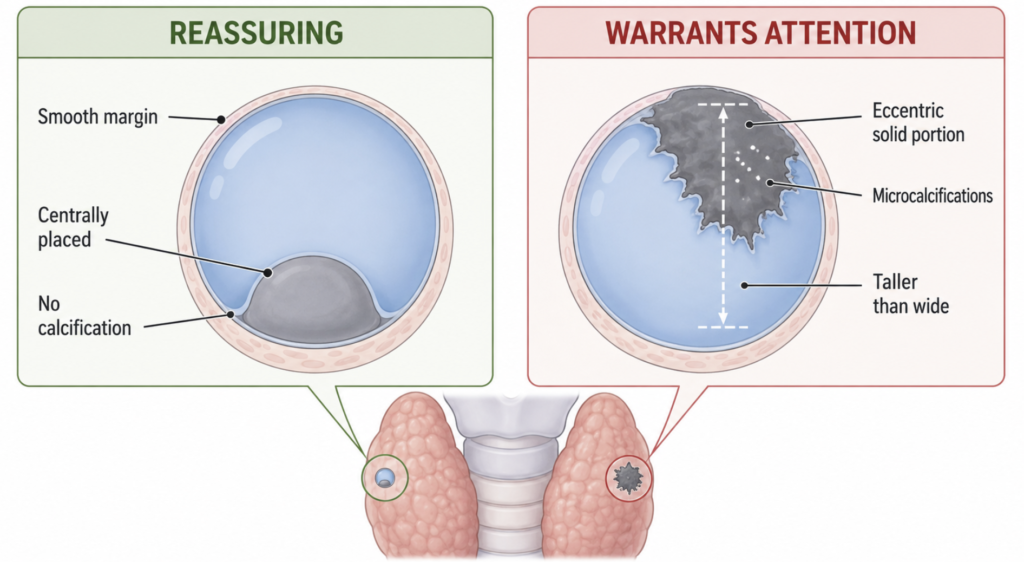
Benign degeneration creates a mirror-image problem. Degenerating nodules — the benign ones, mid-breakdown — can acquire irregular margins, a taller-than-wide shape from asymmetric scarring, and internal echogenic foci from dystrophic calcification. They can imitate the exact features we look for in cancer, which is a recognized cause of discordance between imaging and cytology [Ren, 2019].
Clinical Perspective
Partially cystic nodules are where thyroid ultrasound is weakest, and that weakness is inherited by the software built on top of it. Ultrasound-based AI models perform well overall, with a meta-analysis of 28 studies covering more than 158,000 nodules reporting pooled sensitivity of 0.89 and specificity of 0.84 [Zhan, Diagnostic performance of ultrasound characteristics-based artificial intelligence models for thyroid nodules, 2025]. But the TIRADS frameworks these models learned from were built primarily around solid nodules, and the partially cystic category has been comparatively neglected [Shi, 2021]. A category left underspecified in the source rules stays underspecified in the models trained on them. When a report says “partially cystic,” ask where the solid component sits rather than deferring to a score.
When a Benign Cyst Still Needs Treatment
Benign does not mean irrelevant. Roughly 5% of thyroid nodules cause compressive symptoms such as difficulty swallowing, a sensation of pressure, or a visible neck contour [Durante, 2018]. Cysts are disproportionately represented here because fluid accumulates, and a cyst can reach a size a solid nodule of the same age would not.
Treatment in these cases is aimed at volume and symptoms, not at cancer risk. That distinction should be explicit in the conversation with the patient, because the two get conflated easily.
What the Treatment Evidence Shows
Simple aspiration is a poor standalone answer. Draining a cyst relieves it temporarily, but reported recurrence runs from 10% to 80%, varying with cyst volume and how many aspirations have already been done [Bennedbaek, 2003]. The randomized data are blunter still: in a double-blind trial of 66 patients with recurrent benign cysts, aspiration plus saline flushing cured 48%, while aspiration plus ethanol cured 82% (p = 0.006). After a single session the gap was wider, 64% versus 18% [Bennedbaek, 2003].
Ethanol ablation is the evidence-supported first-line option for fluid-dominant nodules. A prospective randomized trial comparing single-session ethanol ablation with radiofrequency ablation in 50 patients found mean volume reduction of 96.9% versus 93.3% at six months, with ethanol non-inferior and statistically superior, and no major complications in either arm [Sung, Single-session treatment of benign cystic thyroid nodules with ethanol versus radiofrequency ablation, 2013]. A larger series of 217 nodules reported mean volume reduction of 85.2% and a therapeutic success rate of 90.3%, with efficacy significantly higher in purely cystic than in predominantly cystic nodules [Kim, Cystic versus predominantly cystic thyroid nodules, 2012]. The Korean Society of Thyroid Radiology issued a dedicated consensus statement on the technique in 2018 [Hahn, Ethanol Ablation of the Thyroid Nodules, 2019].
Composition determines which ablation to use. A network meta-analysis of randomized trials found ethanol ablation ranked first for cystic and predominantly cystic nodules (SUCRA 81.1), while two-session radiofrequency ablation ranked first for solid and predominantly solid nodules (SUCRA 77.9) [He, Comparative efficacy of different ultrasound-guided ablation for the treatment of benign thyroid nodules, 2021]. This is the diagnostic principle applied to treatment: the solid fraction drives the decision. Worth noting that the cystic subgroup in that analysis rested on only three randomized trials, so the ranking is directionally useful rather than definitive.
Results are good but not permanent. In a cohort of 107 predominantly cystic nodules treated with ethanol ablation, 18.7% had recurred by one month. Among those that had not, a further 24.1% recurred later, bringing the total to 38.3%. Most of those responded to a repeat ethanol session or to radiofrequency ablation [Suh, Ethanol ablation of predominantly cystic thyroid nodules, 2015]. That argues for follow-up rather than against the procedure.
Pain deserves a mention. In the randomized trial, 21% of ethanol-treated patients had moderate to severe pain, though it was brief, with a median duration of five minutes, and one patient had transient hoarseness that resolved [Bennedbaek, 2003]. Pain is subjective, and a discomfort one person shrugs off is a genuine deterrent to another. Whether a brief, self-limited procedure is worth it depends on how much the cyst is actually bothering you, which is a trade-off best weighed individually rather than settled by an average.
The ATA guidelines endorse this pathway directly: aspiration, with or without ethanol ablation, may be considered as a therapeutic intervention for a large symptomatic cyst, and cytology should be sent whenever aspiration is performed [Haugen, 2016].
Key Takeaways
A thyroid cyst is not a separate disease; it is a thyroid nodule whose contents are partly or wholly fluid.
A purely cystic nodule carries a malignancy risk of 1% or less, and guidelines advise against biopsying it for diagnostic purposes.
Reported malignancy risk for partially cystic nodules ranges from 3.3% to 17.6%, so the label alone settles nothing.
The risk lives in the solid component: its eccentric position, hypoechogenicity and microcalcification are the features that discriminate best.
Simple aspiration recurs in 10% to 80% of cases; in randomized comparison, adding ethanol raised the cure rate from 48% to 82%.
FAQ
Is a thyroid cyst the same as a nodule? Yes. A cyst is a nodule that contains fluid. Ultrasound reports classify nodules by composition as solid, partially cystic, or purely cystic. Because the fluid usually comes from a nodule that has partly degenerated, the two terms describe the same lesion at different stages rather than two different conditions.
Can a thyroid cyst turn into cancer? The more accurate concern is not transformation but misclassification. Any nodule type can undergo cystic degeneration, so a nodule that looks cystic may have contained something else from the start. This is why the solid portion, not the fluid, determines whether biopsy is warranted.
Why did my cyst come back after it was drained? Because drainage alone does not close the cavity. Recurrence after simple aspiration has been reported in 10% to 80% of cases, more often with larger cysts and with repeat aspirations. Randomized data show ethanol ablation cures a substantially higher proportion, 82% versus 48% for aspiration with saline flushing.
Is surgery the standard treatment for a thyroid cyst? No, it is not the usual first step. For benign symptomatic cysts, ethanol ablation achieves volume reduction above 85% in reported series and appears in the ATA guidelines as a therapeutic option. Surgery is generally reserved for suspicious cytology, very large or recurrent lesions, or cases where less invasive options have not worked. Which pathway fits a given nodule is a decision for the treating clinician.
What size thyroid cyst is concerning? Size alone is a weak signal. A large purely cystic nodule can be entirely benign, while a small nodule with an eccentric, hypoechoic, microcalcified solid component warrants attention. Size mainly determines whether treatment is offered for symptoms, not whether cancer is suspected.
References
- Haugen BR, Alexander EK, Bible KC, et al. 2015 American Thyroid Association Management Guidelines for Adult Patients with Thyroid Nodules and Differentiated Thyroid Cancer. Thyroid. 2016;26(1):1-133.
- Shi X, Liu R, Gao L, Xia Y, Jiang Y. Diagnostic Value of Sonographic Features in Distinguishing Malignant Partially Cystic Thyroid Nodules: A Systematic Review and Meta-Analysis. Front Endocrinol (Lausanne). 2021;12:624409.
- Li W, Zhu Q, Jiang Y, et al. Partially cystic thyroid nodules in ultrasound-guided fine needle aspiration: Prevalence of thyroid carcinoma and ultrasound features. Medicine (Baltimore). 2017;96(46):e8689.
- Bennedbaek FN, Hegedüs L. Treatment of recurrent thyroid cysts with ethanol: a randomized double-blind controlled trial. J Clin Endocrinol Metab. 2003;88(12):5773-5777.
- Sung JY, Baek JH, Kim KS, et al. Single-session treatment of benign cystic thyroid nodules with ethanol versus radiofrequency ablation: a prospective randomized study. Radiology. 2013;269(1):293-300.
- Kim YJ, Baek JH, Ha EJ, et al. Cystic versus predominantly cystic thyroid nodules: efficacy of ethanol ablation and analysis of related factors. Eur Radiol. 2012;22(7):1573-1578.
- Suh CH, Baek JH, Ha EJ, et al. Ethanol ablation of predominantly cystic thyroid nodules: evaluation of recurrence rate and factors related to recurrence. Clin Radiol. 2015;70(1):42-47.
- He L, Zhao W, Xia Z, Su A, Li Z, Zhu J. Comparative efficacy of different ultrasound-guided ablation for the treatment of benign thyroid nodules: Systematic review and network meta-analysis of randomized controlled trials. PLoS One. 2021;16(1):e0243864.
- Hahn SY, Shin JH, Na DG, et al. Ethanol Ablation of the Thyroid Nodules: 2018 Consensus Statement by the Korean Society of Thyroid Radiology. Korean J Radiol. 2019;20(4):609-620.
- Durante C, Grani G, Lamartina L, Filetti S, Mandel SJ, Cooper DS. The Diagnosis and Management of Thyroid Nodules: A Review. JAMA. 2018;319(9):914-924.
- Ren J, Baek JH, Chung SR, Choi YJ, Jung CK, Lee JH. Degenerating Thyroid Nodules: Ultrasound Diagnosis, Clinical Significance, and Management. Korean J Radiol. 2019;20(6):947-955.
- Brito JP, Gionfriddo MR, Al Nofal A, et al. The accuracy of thyroid nodule ultrasound to predict thyroid cancer: systematic review and meta-analysis. J Clin Endocrinol Metab. 2014;99(4):1253-1263.
- Zhan J, Zhang J, Zhu S, Ni L, Zhang C, Hu J. Diagnostic performance of ultrasound characteristics-based artificial intelligence models for thyroid nodules: a systematic review and meta-analysis. Front Oncol. 2025;15:1614603.
Joonpyo Hong, MD is a board-certified otolaryngologist practicing in Korea. This article reflects his clinical interpretation of published research and does not constitute individual medical advice.
For more articles:
https://curiousmd.com/fine-needle-aspiration-core-needle-biopsy/
https://curiousmd.com/jon-bon-jovi-vocal-cord-surgery-medialization-thyroplasty/
Link out to:
- 2015 American Thyroid Association Management Guidelines — the primary guideline document, including the sonographic risk patterns and biopsy thresholds referenced here.
- Diagnostic Value of Sonographic Features in Distinguishing Malignant Partially Cystic Thyroid Nodules (Frontiers in Endocrinology) — open-access meta-analysis behind the feature AUC figures.
- Comparative efficacy of different ultrasound-guided ablation for benign thyroid nodules (PLOS One) — open-access network meta-analysis comparing ethanol and radiofrequency ablation.
- Thyroid nodules — Mayo Clinic — plain-language patient overview of thyroid nodules and cysts.
- Thyroid nodule — Cleveland Clinic — patient-facing summary of nodule types and management.