
Some patients cannot tolerate a CPAP mask. They are claustrophobic, or they cannot sleep with the hose running across the bed, or they give up after a few nights of trying. Since 2014, those patients have had exactly one implantable alternative: hypoglossal nerve stimulation. A small device sits under the collarbone, a lead runs to a cuff around the nerve that controls the tongue, and with every breath the device nudges the tongue forward just enough to keep the airway from collapsing. For a decade, one company, Inspire Medical Systems, owned that market outright.
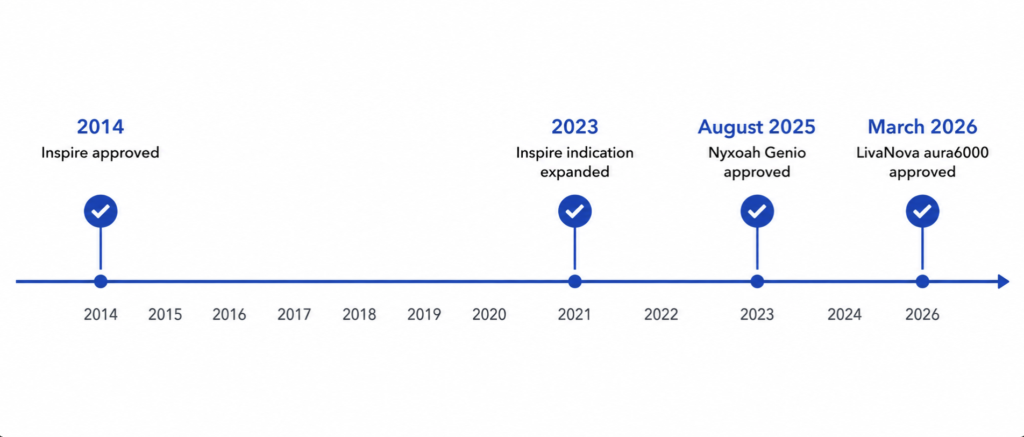
That changed within the past year. Nyxoah’s Genio system won FDA approval in August 2025, and LivaNova’s aura6000 followed in March 2026, so a patient turned away from Inspire’s implant, or simply shopping around, now has somewhere else to look. In the same quarter that the field went from one company to three, Inspire posted the first revenue decline in its history: sales fell 7.6 percent year over year (Inspire Medical Systems, Q2 2026 Earnings, 2026).
The obvious reading is that competition, or the weight-loss drugs approved for sleep apnea the year before, finally caught up with a decade-long monopoly. The numbers fit that reading badly. They point instead to a narrower and less comfortable question: whether the market this therapy was built to serve was ever as large as its inventor said it was.
What hypoglossal nerve stimulation actually does
The therapy is mechanical rather than pharmacological. A sensing lead detects the start of each breath; a pulse generator implanted below the collarbone fires a signal timed to inspiration; a cuff electrode around the hypoglossal nerve, which controls tongue movement, contracts the genioglossus muscle and pulls the tongue slightly forward. The airway, which would otherwise narrow or close as the surrounding muscles relax during sleep, stays open.
The pivotal STAR trial enrolled 126 patients who had failed or refused continuous positive airway pressure (CPAP) therapy. At twelve months, the median number of breathing disruptions per hour of sleep, the apnea-hypopnea index or AHI, fell from 29.3 to 9.0, a reduction of roughly two-thirds. In a randomized substudy, patients whose devices were switched off relapsed toward their original severity, while those who stayed on therapy did not [Strollo, Upper-Airway Stimulation for OSA, 2014]. That withdrawal arm matters more than it looks. Without it, a trial with no comparison group would have real trouble arguing that the device rather than chance produced the improvement.
Longer follow-up tells a similar but less complete story. At five years, 75 percent of the patients who returned for a formal sleep study were still classified as responders. Using a more conservative method that counts every patient lost to follow-up as a failure, the figure drops to 63 percent. Only 71 of the original 126 patients completed that five-year sleep study, and the paper itself notes that the people who stayed were not identical to those who left [Woodson, 5-Year Outcomes, 2018].
The therapy exists because an older solution has a stubborn problem. Across dozens of studies over two decades, average nightly CPAP use has stayed essentially flat, at a level long described as a chronic shortfall of roughly a third of the recommended nightly dose [Rotenberg, CPAP Adherence Twenty Years, 2016]. That plateau, more than any single trial result, is why this therapy has a market at all.
Not every CPAP-intolerant patient qualifies. Before implantation, surgeons perform a sedated endoscopic exam of the airway. Patients whose soft palate collapses in a complete circular pattern, a finding called complete concentric collapse, respond poorly to the device and are excluded, and limits on body mass and apnea severity apply as well [Van de Heyning, Feasibility Study, 2012]. The label covers most CPAP-intolerant patients, not all of them.
The market one company built, and its slowing growth
Inspire’s revenue history reads like a textbook growth curve, at least at first glance: $407.9 million in 2022, up 75 percent; $624.8 million in 2023, up 53 percent; $802.8 million in 2024, up 28 percent; roughly $912 million in 2025, up 14 percent (Inspire Medical Systems, Annual Earnings Releases, 2023 to 2026). The dollar figure grew every year, and the growth rate roughly halved every year.
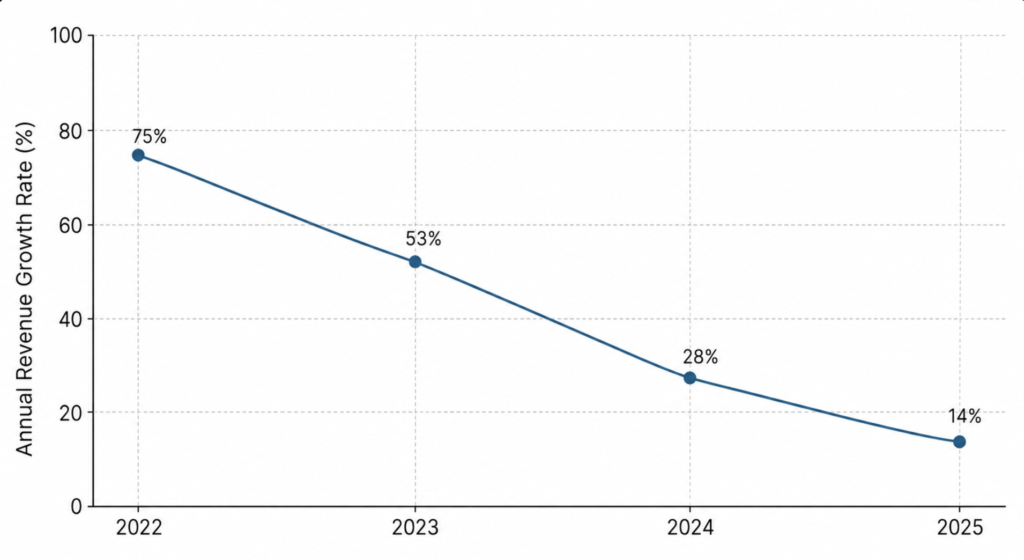
Some of that expansion came from widening who could receive the device. In June 2023, the FDA broadened Inspire’s approved indication to include patients with an AHI up to 100 events per hour and a body mass index up to 40, both considerably looser than the original trial’s criteria (FDA, PMA P130008/S090, 2023). A bigger label should mechanically support more new patients each year.
It did not stop the deceleration. Growth fell in every one of the four years the company has reported, a trend that starts in 2022, well before Nyxoah’s or LivaNova’s devices existed and well before any drug won approval for sleep apnea in December 2024. A four-year slide that began before any of its supposed causes cannot have been caused by them.
Two rivals arrive, and one turns out not to be selling
The arrivals came fast, once they came. Nyxoah’s Genio, a leadless system with an external battery pack and bilateral rather than one-sided stimulation, won FDA approval in August 2025 for patients with an AHI between 15 and 65 (Nyxoah, FDA Approval Announcement, 2025). LivaNova’s aura6000 followed in March 2026 with the same AHI range. The manufacturer describes it as the first hypoglossal nerve stimulator approved without a contraindication for complete concentric collapse and without a mandatory pre-operative sedated endoscopy, a claim repeated in sleep-medicine trade coverage but not yet independently tested at scale (LivaNova, aura6000 FDA Approval, 2026).
Then came the second quarter of 2026. Inspire’s revenue fell to $200.6 million, down 7.6 percent from a year earlier, and full-year guidance was cut to $835 to $875 million. The company attributed the decline largely to a billing-code disruption: two Medicare administrative contractors began requiring claims under a different procedure code paired with a reduced-service modifier, which slowed prior authorizations, with an estimated full-year revenue impact of $120 to $130 million (Inspire Medical Systems, Q2 2026 Earnings Call, 2026). That explanation comes from the company itself, and no independent breakdown of the decline has been published.
Nyxoah moved the other way over the same quarter, with global revenue of €7.7 million, €5.2 million of it from the United States, up 22 percent sequentially, along with 180 active accounts and 262 trained surgeons (Nyxoah, Q2 2026 Earnings, 2026). On paper that looks like a clean handoff: incumbent stumbles, challenger gains.
LivaNova’s own disclosures complicate the three-company framing. In its second-quarter 2026 investor materials, the company describes the approved aura6000 as a non-commercial system, meaning the version the FDA cleared is not the one intended for sale. A commercial, MRI-compatible version is still pending a separate regulatory submission, with limited and full launch both targeted for the first half of 2027, a timeline that has already slipped once (LivaNova, Q2 2026 Investor Update, 2026). Three devices carry FDA approval as of this writing; two of them are for sale.
A patent dispute runs alongside all of this. Inspire sued Nyxoah in May 2025, Nyxoah countersued in September, and the two cases were consolidated in Delaware in May 2026 (Nyxoah, Form 6-K, 2026). LivaNova is not a party to that litigation.
The drug that was supposed to shrink the market
In December 2024, tirzepatide became the first drug the FDA approved specifically for obstructive sleep apnea, in patients with obesity. Two 52-week, double-blind, placebo-controlled trials enrolling 469 patients combined showed statistically significant reductions in AHI on the drug [Malhotra, Tirzepatide for OSA and Obesity, 2024]. That is a real and well-tested effect, though only in patients with comorbid obesity, a narrower group than everyone eligible for hypoglossal nerve stimulation.
The inference is easy to draw: a drug that treats the same underlying condition should eventually shrink the market for an implanted device. Two pieces of evidence complicate it.
The first is a long-range modeling study that built rising GLP-1 use into its assumptions and still projected US sleep apnea prevalence climbing from 34.3 percent of adults in 2020 to 46.2 percent by 2050, some 76 million cases [Boers, 30-Year OSA Burden Projection, 2025]. That is one projection rather than a certainty, and it comes with a caveat: most of its authors are affiliated with ResMed, a CPAP-machine manufacturer with its own reasons to want the GLP-1 threat downplayed. The finding is worth reporting, and so are the incentives behind it.
The second is more circumstantial but harder to dismiss. On its own first-quarter 2026 earnings call, LivaNova’s management characterized the long-term effect of GLP-1 drugs on the hypoglossal nerve stimulation market as net positive, and this from a company about to compete for the very patients those drugs were supposed to take away. It is hard to pin Inspire’s slowdown on a threat that its incoming rival treats as a tailwind.
The ceiling nobody has checked
If neither competition nor GLP-1 drugs explain the slowdown, the more useful question is what the addressable market was assumed to be in the first place, and whether that assumption holds.
Inspire’s own investor materials, largely unchanged since its 2018 IPO prospectus, put the US opportunity at roughly 500,000 new eligible patients a year and more than $10 billion annually. The company reaches that figure by multiplying three numbers: about 2 million annual CPAP prescriptions, a non-adherence rate of roughly 35 percent, and an anatomical eligibility rate of roughly 70 percent among the non-adherent. Inspire labels this an “internal estimate” (Inspire Medical Systems, Form S-1, 2018).
Three devices, three evidence standards
| Device | Manufacturer | US approval | Trial design | Enrolled |
|---|---|---|---|---|
| Inspire (current generation) | Inspire Medical Systems | 2014, expanded 2023 | Single-arm cohort with randomized therapy-withdrawal substudy | 126 |
| Genio | Nyxoah | August 2025 | Non-randomized single-arm cohort | 115 |
| aura6000 | LivaNova | March 2026 (not yet commercially available) | Randomized, controlled, 2:1 allocation | 104 |
The table has no response-rate column, and that is deliberate. The three trials used different populations, different follow-up windows, and different definitions of response, and lining those numbers up side by side would flatter the comparison more than inform it. What the table does show is that only one trial, LivaNova’s OSPREY, randomized patients to a control arm. Participants who were implanted but had the device left inactive still showed a 13.5 percent response rate, against 58.2 percent for the active-therapy group [Malhotra, OSPREY Study, 2026]. That gap is a reminder of why single-arm designs, however well conducted, tend to run warmer than controlled ones.
Check Inspire’s two headline assumptions against the independent literature and both hold up, which is the surprising part. Patient-level CPAP non-adherence, defined as under four hours of nightly use, has long been reported in the 46-to-83-percent range across studies [Weaver, CPAP Adherence Challenge, 2008], so 35 percent sits at the conservative end rather than the inflated one. Anatomical eligibility fares similarly well. Across independent screening cohorts using sedated endoscopy, the exclusion rate for complete concentric collapse consistently lands near 20 to 25 percent, which implies an eligibility rate near 75 to 80 percent [Vanderveken, DISE Patient Selection, 2013; Ong, Collapse Patterns and UAS Outcomes, 2016; Op de Beeck, Airflow Shapes and Site of Collapse, 2024], squarely matching Inspire’s 70 percent figure and, if anything, running slightly above it.
So the two inputs that invite the most scrutiny are not the problem. The missing step sits somewhere else in the funnel.
In the same screening cohort that produced that 70 percent eligibility figure, 222 patients screened for the original pivotal trial across 22 institutions, 52 were excluded by endoscopy for complete concentric collapse, leaving 170 anatomically eligible patients. Of those 170, only 126 went on to receive an implant [Ong, Collapse Patterns and UAS Outcomes, 2016]. Roughly a quarter of the patients who cleared the anatomical bar still did not get the device, for reasons the market-sizing math never counts: narrower severity and body-mass windows specific to that trial, and the patient’s own decision not to proceed.
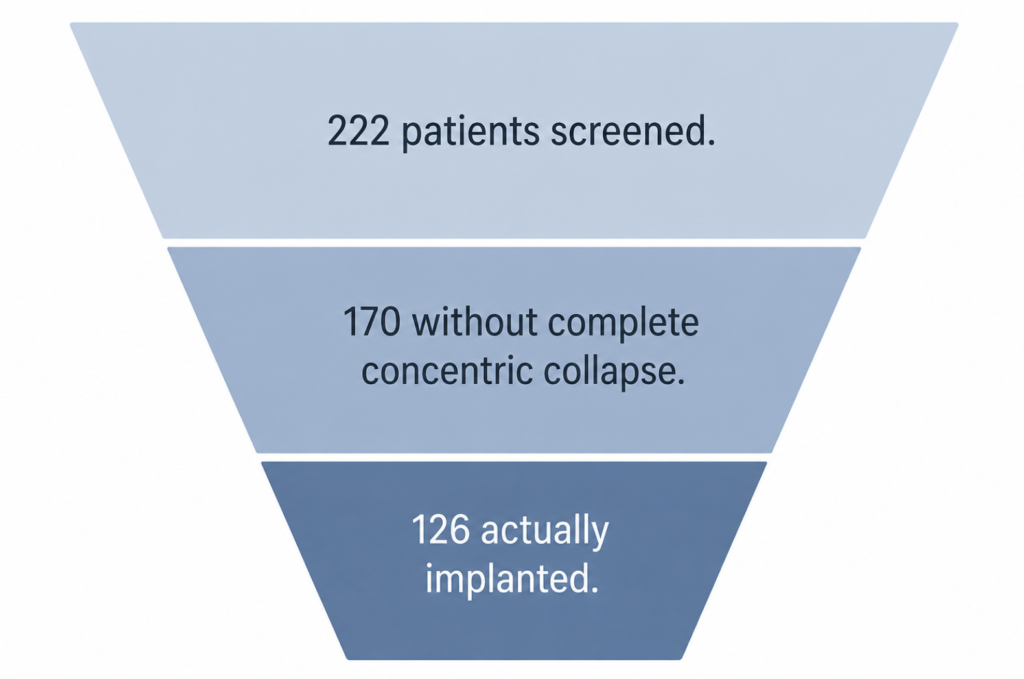
Two caveats belong next to that number rather than below it in fine print. The trial’s criteria were narrower than today’s expanded label, so a similar screen run now would probably lose fewer than a quarter at this final stage. And the 222 patients were already a trial-selected population, one step removed from the broad pool of CPAP-intolerant patients the annual market estimate is meant to describe. Both of those shrink the drop-off. Neither makes it disappear.
Set two of Inspire’s own disclosed figures side by side and no further arithmetic is needed: the company estimates roughly 500,000 newly eligible patients every year, and after twelve years in the market it has treated just over 140,000 patients in total (Inspire Medical Systems, Q2 2026 Earnings Call, 2026). Twelve years of selling have not yet added up to a single year of the opportunity the company describes.
The forecasting industry offers little check on any of this. Independent market-research estimates for the global hypoglossal nerve stimulation market, for roughly the same recent year, range from under half a billion dollars to more than $1.8 billion, a nearly fourfold spread whose low end sits below Inspire’s own disclosed revenue. Whatever the true number is, nobody has yet measured it with enough consistency for an outsider to check.
One tailwind sits outside this debate entirely. The Centers for Medicare & Medicaid Services has proposed raising 2027 reimbursement for the procedure by roughly 12 percent in the hospital-outpatient setting and 15 percent in ambulatory surgery centers, an increase that would benefit all three companies equally, since it changes what each patient is worth rather than how many patients exist (Inspire Medical Systems and Nyxoah, 2027 CMS Rate Commentary, 2026). Better pay per procedure tells you nothing about how many patients there are, and only the first of those problems shows up on a quarterly earnings call.
Key takeaways
- Hypoglossal nerve stimulation reduces the apnea-hypopnea index by roughly two-thirds in patients who cannot tolerate CPAP, based on a single-arm trial strengthened by a randomized withdrawal substudy. That is solid evidence, though not a head-to-head comparison against any alternative.
- Inspire’s revenue growth decelerated every year from 2022 through 2025, well before any competing device or drug existed, which undercuts the idea that either one caused the 2026 decline.
- Two new devices won FDA approval within the past year, but as of mid-2026 LivaNova’s aura6000 is still not commercially available. This remains a two-seller market with a third approval waiting in the wings.
- The widely feared narrative that GLP-1 drugs would shrink the sleep apnea device market is not supported by long-range prevalence modeling, nor by a competing manufacturer’s own public comments.
- Inspire’s roughly $10 billion annual market estimate survives scrutiny on its two most scrutinized assumptions: both patient non-adherence and anatomical eligibility land within or below published literature ranges.
- The estimate leaves out a documented drop-off between anatomical clearance and actual implantation, and the company’s own twelve-year cumulative patient count remains a fraction of the opportunity it claims exists in a single year.
FAQ
Does hypoglossal nerve stimulation work as well as CPAP? No. Continuous positive airway pressure remains the recommended first-line therapy and produces a larger average reduction in breathing disruptions when used consistently. Hypoglossal nerve stimulation exists for patients who cannot or will not use CPAP reliably, not as a stronger substitute for everyone [Figard, OSA Interventions Umbrella Review, 2025].
Is every patient with sleep apnea a candidate for hypoglossal nerve stimulation? No. Candidacy requires a sedated endoscopic exam of the airway, and patients whose soft palate collapses in a full circular pattern are excluded because outcomes are poor in that group. Body-mass and apnea-severity limits apply as well [Van de Heyning, Feasibility Study, 2012].
Are three companies now actively selling hypoglossal nerve stimulation devices in the US? Not yet. Three devices carry FDA approval, but LivaNova has described its aura6000 as a non-commercial system as of its most recent investor update, with a full launch targeted for 2027. Inspire and Nyxoah are the two currently selling implants (LivaNova, Q2 2026 Investor Update, 2026).
Will GLP-1 weight-loss drugs replace hypoglossal nerve stimulation? It depends on the patient. Tirzepatide is FDA-approved for sleep apnea only in people with comorbid obesity, and it meaningfully reduces breathing disruptions in that group. At least one long-range model projects rising US sleep apnea prevalence even with wide GLP-1 uptake, though its authors’ ties to a CPAP manufacturer are worth noting [Boers, 30-Year OSA Burden Projection, 2025].
References
- Strollo PJ Jr, Soose RJ, Maurer JT, et al. Upper-airway stimulation for obstructive sleep apnea. N Engl J Med. 2014;370(2):139-149. PMID: 24401051.
- Woodson BT, Strohl KP, Soose RJ, et al. Upper airway stimulation for obstructive sleep apnea: 5-year outcomes. Otolaryngol Head Neck Surg. 2018;159(1):194-202. PMID: 29582703.
- Woodson BT, Kent DT, Huntley C, et al. Bilateral hypoglossal nerve stimulation for obstructive sleep apnea: a nonrandomized clinical trial. J Clin Sleep Med. 2025;21(11):1883-1891. PMID: 40702817.
- Malhotra A, Schwartz AR, Lovett E, et al. Proximal hypoglossal nerve stimulation for obstructive sleep apnea in the OSPREY study: a randomized controlled trial. Ann Intern Med. 2026;179(6):812-822. PMID: 42008810.
- Boers E, Barrett M, Benjafield AV, et al. Projecting the 30-year burden of obstructive sleep apnoea in the USA: a prospective modelling study. Lancet Respir Med. 2025. PMID: 40882656.
- Benjafield AV, Ayas NT, Eastwood PR, et al. Estimation of the global prevalence and burden of obstructive sleep apnoea: a literature-based analysis. Lancet Respir Med. 2019;7(8):687-698. PMID: 31300334.
- Malhotra A, Grunstein RR, Fietze I, et al. Tirzepatide for the treatment of obstructive sleep apnea and obesity. N Engl J Med. 2024;391(13):1193-1205. PMID: 38912654.
- Figard C, Ben Messaoud R, Baillieul S, et al. Effect of sleep apnoea interventions on multiple health outcomes: an umbrella review of meta-analyses of randomised controlled trials. eClinicalMedicine. 2025;89:103529. DOI: 10.1016/j.eclinm.2025.103529.
- Rotenberg BW, Murariu D, Pang KP. Trends in CPAP adherence over twenty years of data collection: a flattened curve. J Otolaryngol Head Neck Surg. 2016;45(1):43. PMID: 27542595.
- Weaver TE, Grunstein RR. Adherence to continuous positive airway pressure therapy: the challenge to effective treatment. Proc Am Thorac Soc. 2008;5(2):173-178. PMID: 18250209.
- Ong AA, Murphy C, Nguyen SA, et al. Efficacy of upper airway stimulation on collapse patterns of the upper airway in patients with obstructive sleep apnea. Otolaryngol Head Neck Surg. 2016;155(3):514-519. PMID: 26980916.
- Vanderveken OM, Maurer JT, Hohenhorst W, et al. Evaluation of drug-induced sleep endoscopy as a patient selection tool for implanted upper airway stimulation for obstructive sleep apnea. J Clin Sleep Med. 2013;9(5):433-438. PMID: 23674933.
- Op de Beeck S, Vena D, Mann D, et al. Polysomnographic airflow shapes and site of collapse during drug-induced sleep endoscopy. Eur Respir J. 2024;63:2400261. PMID: 38548291.
- Van de Heyning PH, Badr MS, Baskin JZ, et al. Implanted upper airway stimulation device for obstructive sleep apnea. Laryngoscope. 2012;122(7):1626-1633.
- Inspire Medical Systems, Inc. Form S-1 registration statement. U.S. Securities and Exchange Commission; 2018.
- Inspire Medical Systems, Inc. Annual earnings releases, fiscal years 2022–2025. Company press releases; 2023–2026.
- Inspire Medical Systems, Inc. Second-quarter 2026 earnings release and call. Company press release; August 3, 2026.
- Nyxoah SA. Second-quarter 2026 earnings release. Company press release; August 5, 2026.
- Nyxoah SA. Form 6-K, litigation update. U.S. Securities and Exchange Commission; 2026.
- LivaNova PLC. aura6000 System FDA approval announcement. Company press release; March 19, 2026.
- LivaNova PLC. Second-quarter 2026 investor update. 2026.
- U.S. Food and Drug Administration. Premarket approval P130008/S090, indication expansion. 2023.
Joonpyo Hong, MD is a board-certified otolaryngologist practicing in Korea. This article reflects his clinical interpretation of published research and does not constitute individual medical advice. This article is not intended to advertise or promote any specific company or product.
For more articles:
https://curiousmd.com/tirzepatide-for-sleep-apnea/
https://curiousmd.com/apple-watch-sleep-apnea-accuracy/
Link out to:
- Upper-airway stimulation for obstructive sleep apnea — STAR trial, NEJM
- Proximal hypoglossal nerve stimulation — OSPREY study, Annals of Internal Medicine
- Projecting the 30-year burden of obstructive sleep apnoea in the USA, Lancet Respiratory Medicine
- Effect of sleep apnoea interventions on multiple health outcomes, eClinicalMedicine
- Adherence to continuous positive airway pressure therapy, Proceedings of the American Thoracic Society