
Is COVID over? Whether COVID is over in 2026 has two correct answers, depending on which document you read.
On 7 July 2026 the Korea Disease Control and Prevention Agency lifted the last remaining COVID-19 disaster alert level. The emergency footing had stood since 3 January 2020, a span of 2,378 days, and it ended with an administrative notice rather than an announcement. Seven weeks earlier, on 17 May 2026, the Director-General of the World Health Organization determined that an outbreak of Ebola disease caused by Bundibugyo virus in the Democratic Republic of the Congo and Uganda constituted a public health emergency of international concern. One agency was standing down while the other was standing up, and both were reading their evidence correctly.
That gap is the subject here. The more useful question is not whether one pandemic ended but what exactly was defeated, and how much of that defeat carries over to whatever comes next. The last six years taught the world how to beat one virus. Whether that is the same as knowing how to beat a pandemic has not been tested.
Why the fifth coronavirus behaved differently
Coronaviruses were unremarkable before 2019. Four of them circulate endemically in humans and cause ordinary colds: runny nose, sore throat, a week of malaise, nothing lasting. SARS-CoV-2 was the fifth human coronavirus to establish itself, and what set it apart was never exotic virulence. It was where the virus went in the airway and when it left.
Entry requires two host proteins, the ACE2 receptor and the enzyme TMPRSS2. Both are abundant in the olfactory epithelium, the sheet of tissue high in the nasal cavity that carries the sense of smell, but they concentrate in its non-neuronal support cells rather than in the olfactory neurons themselves [Las Casas Lima, Pathophysiological relationship between COVID-19 and olfactory dysfunction, 2021].
The most likely explanation for pandemic anosmia follows from that: the virus damaged the scaffolding rather than the wiring [Bilinska, Anosmia in COVID-19: A Bumpy Road to Establishing a Cellular Mechanism, 2020]. Support cells regenerate and neurons largely do not, which is why most patients got their sense of smell back within weeks, and why the minority who did not were dealing with something more serious, inflammation that had reached past the scaffolding. Sudden smell loss was a direct readout of which cells the virus had targeted.
The symptom profile carried a stranger signature. Pooling the early-pandemic literature, sore throat appeared in roughly 12% of COVID-19 cases and runny nose in about 4%, against 84% and 91% in influenza and 84% and 81% in the common cold [Czubak, Comparison of the clinical differences between COVID-19, SARS, influenza, and the common cold, 2021]. The symptoms that make a person self-diagnose a cold were largely missing. Fever appeared in roughly 45% of cases and cough in about 70%.
| Common cold | Influenza | COVID-19 (early variants) | |
|---|---|---|---|
| Sore throat | ~84% | ~84% | ~12% |
| Runny nose | ~81% | ~91% | ~4% |
| Headache | ~89% | ~91% | ~21% |
| Muscle pain | ~94% | ~94% | ~29% |
| Cough | n/a | n/a | ~70% |
| Fever | n/a | n/a | ~45% |
Symptom frequencies pooled from early-pandemic literature [Czubak, 2021]. Later Omicron-lineage variants shifted this profile substantially.
That table has an expiry date, and saying so is more useful than hiding it. By the Omicron era, sore throat had become one of the more prominent complaints rather than one of the rarest. The clinical picture was never a fixed property of coronaviruses in general. It belonged to a particular variant meeting a particular population’s immunity, and both kept moving.
Sequelae proved just as hard to pin down. One meta-analysis pooling symptoms at 28 days or more after infection estimated that about 43% of patients had at least one persisting symptom [Chen, Global Prevalence of Post-COVID-19 Condition or Long COVID, 2022]. A later analysis looking three years out estimated roughly 20%, with a confidence interval running from 8% to 43% [Rahmati, Long-Term Sequelae of COVID-19, 2025].
Those two figures are not a before-and-after pair and should not be read as a decline, because they used different definitions, different time points and different study pools. What they establish jointly is narrower and firmer: a substantial minority of infections did not resolve cleanly, and the field has not converged on how large that minority is.
Clinical Perspective. In an otolaryngology clinic the pandemic arrived as a receptor map made visible. Anosmia, the relative absence of classic nasal symptoms and the later shift toward pharyngitis were not a random symptom list. They tracked which cells in the upper airway the circulating variant happened to prefer. Knowing which tissue a respiratory virus infects predicts its clinical behaviour better than knowing which family it belongs to.
Spread that ran ahead of symptoms
The transmissibility of SARS-CoV-2 is usually explained by how contagious it was. When it was contagious mattered more.
A meta-analysis of published transmission data estimated that between 45.9% and 69.1% of transmission occurred before the infector developed symptoms [Casey-Bryars, Presymptomatic transmission of SARS-CoV-2 infection, 2021]. A separate modelling analysis assigned about 59% of all transmission to people without symptoms at the time, roughly 35% from those who would later develop them and 24% from those who never would [Johansson, SARS-CoV-2 Transmission From People Without COVID-19 Symptoms, 2021]. Around one in five infected people stayed asymptomatic throughout [Buitrago-Garcia, Occurrence and transmission potential of asymptomatic and presymptomatic SARS-CoV-2 infections, 2020]. Out of percentages: at least half of the chains of transmission were built by people who had no reason to believe they were sick.
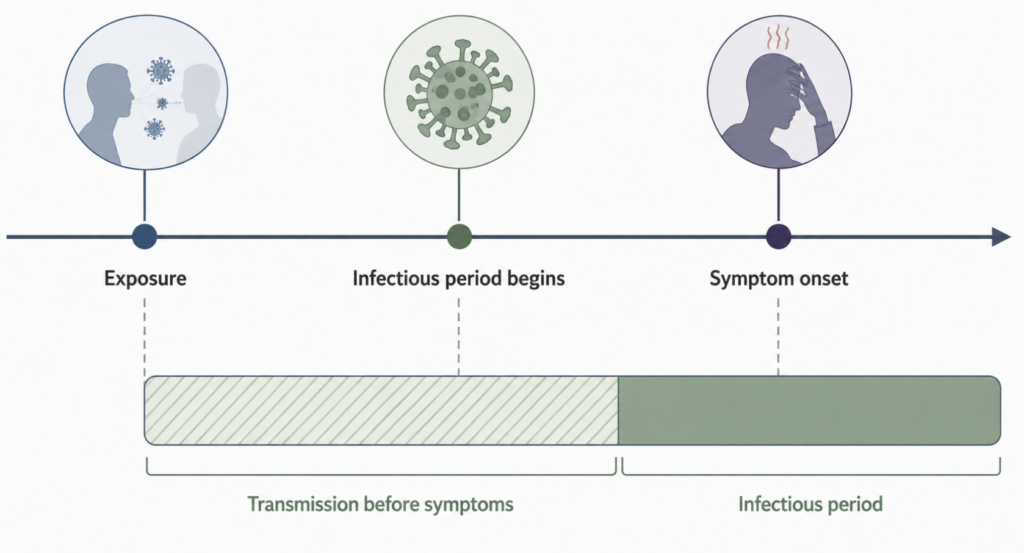
Set that beside the symptom data and the control problem resolves itself. The symptoms did not look like the disease and transmission preceded the symptoms, so every containment strategy built on “stay home when unwell” was aiming at a target that had already left.
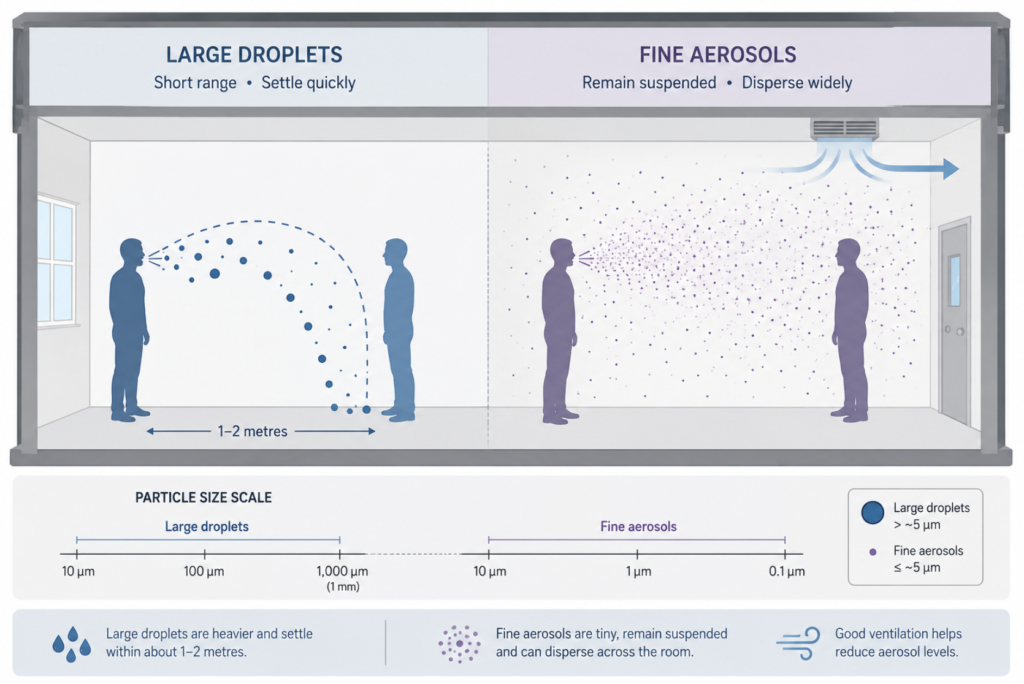
The route itself took time to establish. Early guidance emphasised surfaces and droplets, then the evidence accumulated toward aerosols, virus-laden particles small enough to remain suspended and be inhaled at a distance, and by 2021 that reassessment extended beyond SARS-CoV-2 to respiratory viruses generally [Wang, Airborne transmission of respiratory viruses, 2021]. Public guidance changed several times, and the changes were widely read as institutional failure. A recommendation that never updates is not a recommendation grounded in evidence.
Transmissibility then climbed. Pooled estimates put the effective reproduction number of the Omicron variant at about 4.2, roughly 2.7 times that of Delta, though the estimates ranged widely enough (about 2.1 to 6.4) that the figure describes a direction more reliably than a magnitude [Du, Reproduction Number of the Omicron Variant Triples That of the Delta Variant, 2022]. Reproduction numbers are properties of a virus meeting a society, not constants belonging to the virus alone.
How it was won, and what carries over
The response worked. Vaccines developed within a year of the genome’s publication demonstrated substantial protection against disease in large randomised trials, and the surveillance, testing and clinical infrastructure built alongside them shortened the interval between a variant appearing and the world knowing about it. Dismissing that would be dishonest. The narrower question is which parts of that success were reproducible, and which depended on conditions that happened to hold.
The messenger RNA platform is the clearest reproducible asset. Its advantage is architectural: the delivery system stays fixed while the genetic instructions for the target antigen are swapped out, which is why design could proceed at the speed of sequencing rather than the speed of culturing. That is a mechanism, and it is well established. It is not a clinical outcome for any future pathogen. A platform that designs quickly still requires a suitable target, a manufacturing chain, a trial population and a regulatory pathway. Fast design is a precondition for a fast vaccine, not a promise of one.
Pre-existing immunity was not among the assets. Prior exposure to the endemic cold-causing coronaviruses did generate antibodies that recognised SARS-CoV-2 proteins, but recognition came without neutralisation, meaning the antibodies bound without disabling the virus [Miyara, Pre-COVID-19 Immunity to Common Cold Human Coronaviruses Induces a Recall-Type IgG Response Without Cross-Neutralisation, 2022]. The evidence points consistently in that direction, though it rests on a single cohort. Membership in the coronavirus family conferred familiarity, not protection.
| Reproducible next time | Dependent on this virus’s conditions |
|---|---|
| mRNA and related rapid-design platforms | A single, well-exposed target antigen |
| Genomic surveillance networks | Respiratory transmission, which existing measures address |
| Distributed diagnostic capacity | A pathogen detectable by widely deployed assays |
| Regulatory pathways for emergency review | Case fatality low enough to sustain a functioning workforce |
Clinical Perspective. The left column is genuine institutional memory and will still be there when the next pathogen arrives. The right column is not a capability at all. It describes conditions that happened to be favourable, and treating it as capability produces a confidence that has never been tested.
Is COVID over in 2026?
Administratively, in Korea, yes. Biologically, the question is malformed.
Lifting an alert level is a statement about the relationship between a disease and a health system, not about the existence of a virus. What the 7 July decision recorded was that SARS-CoV-2 had become manageable within routine disease control programmes rather than through emergency structures. The virus continues to circulate and continues to evolve.
WHO tracking illustrates the distinction precisely. As of the classification current in mid-2026, no variant is designated a variant of concern. JN.1 remains the sole variant of interest, and four lineages, PQ.16.1.1, NB.1.8.1, XFG and BA.3.2, sit in the lowest tier, under monitoring, as of 27 July 2026. Evolution continues, and no current variant is judged to pose elevated risk. Neither half of that should be read without the other.
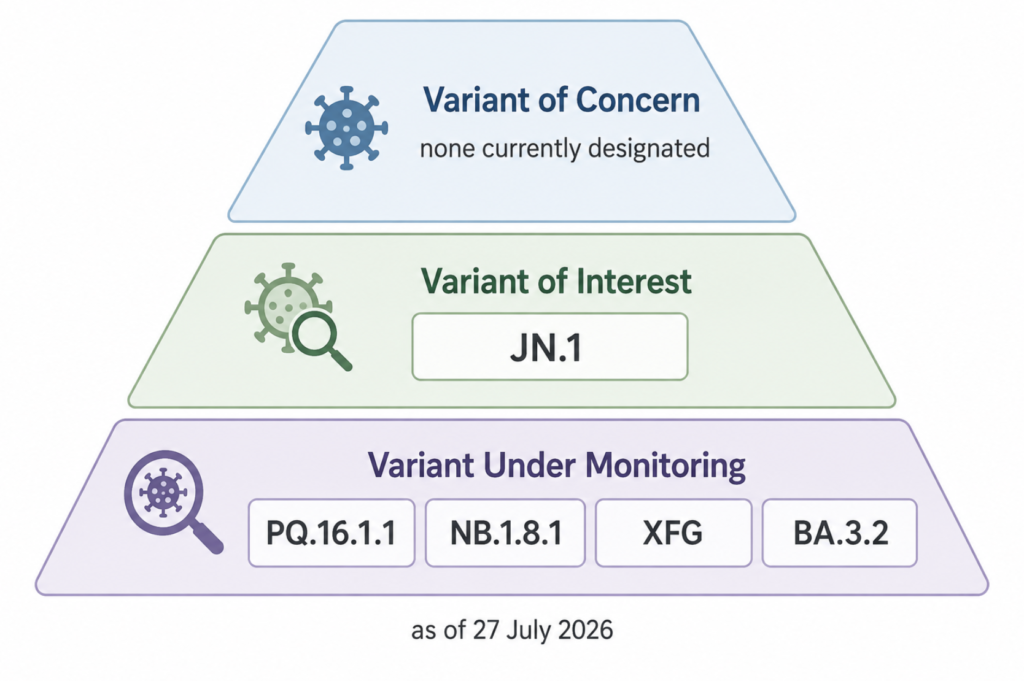
BA.3.2 is the instructive case, because it behaved in a way that contradicts how variant news is usually read. It carries 53 spike protein mutations relative to its BA.3 ancestor and shows marked antigenic drift with substantial antibody escape, which on the standard narrative is the profile of a dangerous variant. It did not become one. Phenotypic data indicated reduced intrinsic infectivity, lower fusogenicity and weaker ACE2 binding than the JN.1-descendant lineages circulating alongside it, and it never achieved a sustained growth advantage. WHO assessed its overall additional public health risk as low [WHO TAG-VE, Initial Risk Evaluation for BA.3.2, 2025].
In early November 2025, the sampling window for that evaluation, BA.3.2 accounted for about 1.7% of submitted sequences from seven countries, while XFG accounted for roughly 68%. Escaping antibodies and infecting cells efficiently are separate traits. A variant needs both, and BA.3.2 had only the first.
The vaccine question deserves the same separation. Sera from people vaccinated with LP.8.1-based formulations did neutralise BA.3.2, but at lower titres than against the matched vaccine antigen [WHO TAG-VE, 2025]. That is a laboratory measurement of antibody activity. It is a reasonable input to a decision about vaccine composition, and it is not on its own a measurement of who gets hospitalised.
Clinical Perspective. Reading “new variant escapes vaccine antibodies” as “new wave coming” is an understandable reflex and, on the BA.3.2 evidence, an unreliable one. Immune escape without replicative fitness goes nowhere. For patients, the practical stratification has not changed since 2023: age and comorbidity determine who needs to think carefully about this virus, not the name of the variant.
When the conditions do not hold
Which returns to the other date. The outbreak declared in Ituri Province on 15 May 2026 and designated a public health emergency two days later is caused by Bundibugyo virus, one of the ebolavirus species that infects humans, and it exposed something more uncomfortable than an absence of countermeasures.
There is no licensed vaccine and no approved therapeutic specific to Bundibugyo virus. The one licensed Ebola vaccine, Ervebo, is indicated for Zaire ebolavirus, a different species, and the evidence for cross-protection has been judged limited and inconclusive. That much is a familiar kind of gap.
The diagnostic failure is the part worth sitting with. GeneXpert, the frontline molecular assay deployed across the response, detects Zaire ebolavirus but not Bundibugyo virus. Samples from the earliest cases tested negative. Confirmation required shipping specimens to a national reference laboratory in Kinshasa, and case detection and isolation were substantially delayed as a result. Test, trace, isolate, the strategy that anchored the COVID response, failed at its first step because the species was wrong.
The narrowness is not unique to filoviruses. Highly pathogenic avian influenza H5N1 of clade 2.3.4.4b has expanded its host range across multiple mammalian species including dairy cattle, and while no sustained human-to-human transmission has been observed, each additional zoonotic infection is an additional opportunity for adaptive mutation or reassortment [Krammer, Highly pathogenic avian influenza H5N1: history, current situation, and outlook, 2025]. That is a statement about risk structure, not a prediction.
The optimistic reading of the last six years is defensible and should not be surrendered. The platforms are real, the surveillance networks are real, and the institutional knowledge of how to run a mass vaccination campaign did not evaporate when the alerts were lifted. A world facing a novel respiratory virus with a well-exposed surface antigen in 2027 would move faster than the world of 2020.
The caution that belongs beside it is more specific than general pessimism. Every asset in that optimistic list was built against a respiratory virus with an obvious target, and Bundibugyo virus met a response system that could not see it. The optimism is warranted; its scope is not general.
Clinical Perspective. What most countries now possess is preparedness for the last pathogen, and it is worth a great deal provided the next one resembles it. The honest position is conditional confidence: the tools are better than they were, and they are still built to a particular specification. Six years of work defeated one virus, and that is not the same as building a general defence against pandemics.
Key takeaways
- SARS-CoV-2 was the fifth human coronavirus, and what distinguished it was tissue targeting and transmission timing rather than unusual virulence.
- Sudden smell loss reflected damage to the support cells of the olfactory epithelium rather than to olfactory neurons, which is why most cases resolved within weeks.
- At least half of transmission occurred before the infector had symptoms, which is why isolation triggered by feeling unwell could not contain spread.
- Lifting a national alert level is a statement about health system capacity, not about viral extinction. SARS-CoV-2 continues to circulate and evolve.
- A variant that escapes antibodies is not automatically dangerous. BA.3.2 combined marked immune escape with reduced infectivity and never spread widely.
- In the 2026 Bundibugyo outbreak the frontline diagnostic assay could not detect the virus, which shows that pandemic tools are built to species-level specifications.
FAQ
Is COVID over in 2026? It depends on the meaning. Korea lifted its final COVID-19 alert level on 7 July 2026, ending 2,378 days of emergency designation, because the disease had become manageable through routine programmes. The virus itself continues to circulate and mutate. No lineage currently holds variant-of-concern status, though four sit under active monitoring as of 27 July 2026.
Why was COVID-19 worse than other upper respiratory infections? Timing and targeting. Sore throat and runny nose, the symptoms that signal a cold, appeared in roughly 12% and 4% of early cases respectively, far below influenza rates [Czubak, 2021], while a large share of transmission occurred before any symptoms appeared [Casey-Bryars, 2021]. The disease spread while it was invisible.
Should new variants like BA.3.2 be a concern? Not on current evidence. BA.3.2 shows substantial antibody escape but also reduced infectivity and weaker receptor binding, and it has not achieved a sustained growth advantage. WHO assessed its additional public health risk as low [WHO TAG-VE, 2025].
Will existing vaccines work against the next pandemic? Only if the next pathogen resembles this one. Vaccines are species-specific and often antigen-specific. The 2026 Bundibugyo outbreak illustrates the limit sharply: no licensed vaccine exists for that species, and the standard field diagnostic could not detect it.
References
- Czubak J, Stolarczyk K, Orzeł A, Frączek M, Zatoński T. Comparison of the clinical differences between COVID-19, SARS, influenza, and the common cold: a systematic literature review. Adv Clin Exp Med. 2021;30(1):109-114.
- Las Casas Lima MH, Cavalcante ALB, Leão SC. Pathophysiological relationship between COVID-19 and olfactory dysfunction: a systematic review. Braz J Otorhinolaryngol. 2022;88(5):794-802.
- Bilinska K, Butowt R. Anosmia in COVID-19: a bumpy road to establishing a cellular mechanism. ACS Chem Neurosci. 2020;11(15):2152-2155.
- Chen C, Haupert SR, Zimmermann L, Shi X, Fritsche LG, Mukherjee B. Global prevalence of post-coronavirus disease 2019 (COVID-19) condition or long COVID: a meta-analysis and systematic review. J Infect Dis. 2022;226(9):1593-1607.
- Rahmati M, Udeh R, Kang J, et al. Long-term sequelae of COVID-19: a systematic review and meta-analysis of symptoms 3 years post-SARS-CoV-2 infection. J Med Virol. 2025;97(6):e70429.
- Casey-Bryars M, Griffin J, McAloon C, et al. Presymptomatic transmission of SARS-CoV-2 infection: a secondary analysis using published data. BMJ Open. 2021;11(6):e041240.
- Johansson MA, Quandelacy TM, Kada S, et al. SARS-CoV-2 transmission from people without COVID-19 symptoms. JAMA Netw Open. 2021;4(1):e2035057.
- Buitrago-Garcia D, Egli-Gany D, Counotte MJ, et al. Occurrence and transmission potential of asymptomatic and presymptomatic SARS-CoV-2 infections: a living systematic review and meta-analysis. PLoS Med. 2020;17(9):e1003346.
- Wang CC, Prather KA, Sznitman J, et al. Airborne transmission of respiratory viruses. Science. 2021;373(6558):eabd9149.
- Du Z, Hong H, Wang S, et al. Reproduction number of the Omicron variant triples that of the Delta variant. Viruses. 2022;14(4):821.
- Miyara M, Saichi M, Sterlin D, et al. Pre-COVID-19 immunity to common cold human coronaviruses induces a recall-type IgG response to SARS-CoV-2 antigens without cross-neutralisation. Front Immunol. 2022;13:790334.
- Krammer F, Hermann E, Rasmussen AL. Highly pathogenic avian influenza H5N1: history, current situation, and outlook. J Virol. 2025;99(4):e0220924.
- World Health Organization Technical Advisory Group on Virus Evolution. Initial risk evaluation of BA.3.2, 5 December 2025. Geneva: WHO; 2025.
- World Health Organization. Tracking SARS-CoV-2 variants. Geneva: WHO; updated 28 July 2026.
Joonpyo Hong, MD is a board-certified otolaryngologist practicing in Korea. This article reflects his clinical interpretation of published research and does not constitute individual medical advice.
This article is not intended to advertise or promote any specific company or product.
For more articles:
https://curiousmd.com/antivirals-vs-antibiotics-why-so-few/
https://curiousmd.com/rsv-vaccine-effectiveness-adults-infants/
https://curiousmd.com/antibiotics-vs-antivirals-why-antivirals-are-rare/
Link out to:
https://www.who.int/activities/tracking-SARS-CoV-2-variants/ – current variant classifications and risk evaluations
https://www.afro.who.int/health-topics/ebola-disease/outbreak-drc-26 – situation reports and countermeasure status
https://www.kdca.go.kr/ – national alert level decisions and surveillance data
https://www.who.int/news-room/questions-and-answers/item/sars-cov-2-evolution – how and why SARS-CoV-2 continues to change