
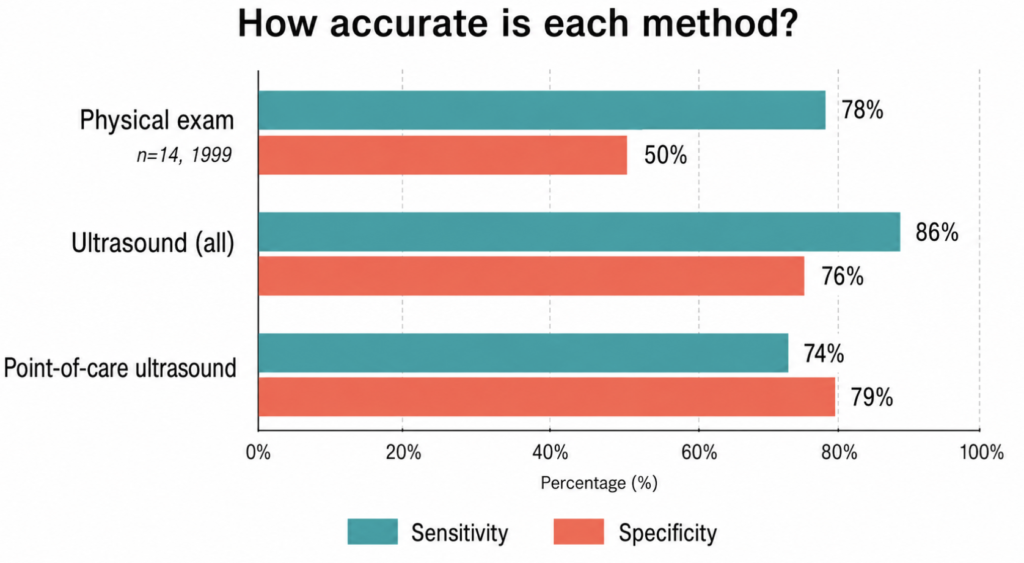
A sore throat on one side is one of the few throat complaints that can turn into an emergency overnight. The condition behind that pattern, peritonsillar abscess, is also one that examination alone identifies poorly. Clinical impression is widely quoted at roughly 75% sensitivity and 50% specificity [Scott PM, Diagnosis of peritonsillar infections, 1999, as cited in Kim DJ, Test characteristics of ultrasound for the diagnosis of peritonsillar abscess, 2023]. This is a condition doctors are supposed to recognize by looking, and looking is not enough.
That gap explains how the illness actually unfolds. Patients get sent home with antibiotics, then return two days later unable to swallow their own saliva.
What a Peritonsillar Abscess Actually Is
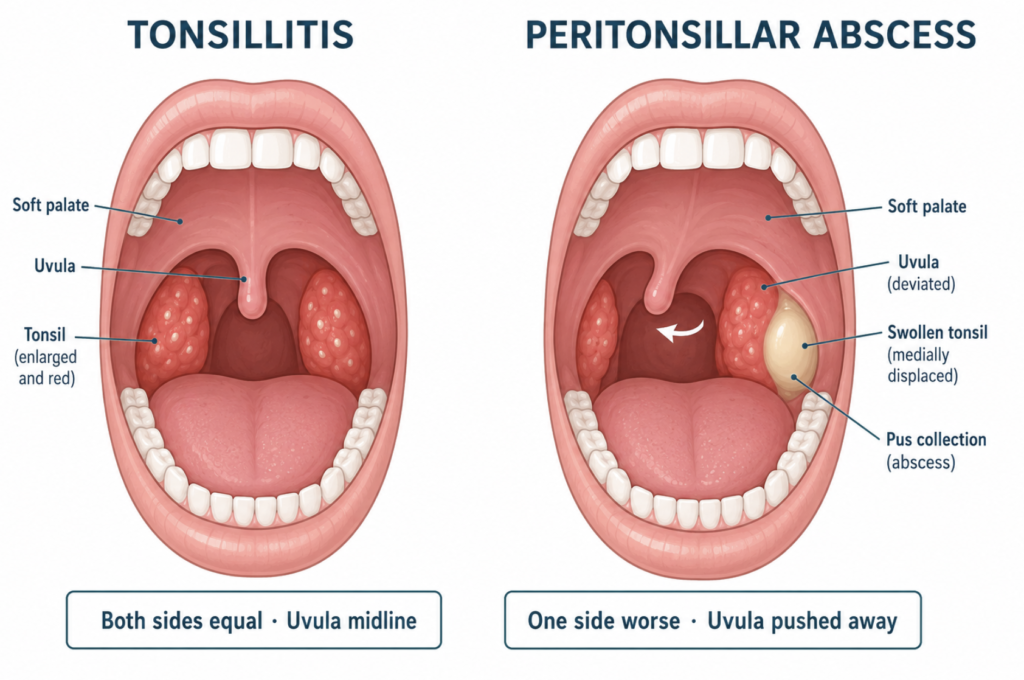
A peritonsillar abscess, called quinsy in older writing, is a collection of pus in the space between the tonsil and the muscle wall behind it. It usually begins as tonsillitis, then escapes the tonsil and settles in the loose tissue alongside it, where there is room to expand and nothing to drain it.
That anatomy produces the entire symptom picture. Pus on one side pushes the tonsil toward the midline and shoves the uvula away. It irritates the medial pterygoid muscle, so the jaw stops opening fully. It changes the resonating space above the larynx, which is why the voice takes on the muffled quality clinicians call a “hot potato voice.” The sound is someone talking around a mouthful of food too hot to swallow.
The classic cluster: one-sided pain, a jaw that will not open, a muffled voice, trouble managing saliva. Not every patient shows all four. That is precisely the problem.
Sore Throat on One Side vs. Both Sides: A Self-Check
Tonsillitis is generally symmetric. An abscess is generally not.
| Feature | Tonsillitis | Peritonsillar abscess |
|---|---|---|
| Pain location | Both sides, roughly equal | Clearly worse on one side |
| Progression | Peaks and plateaus | Keeps worsening, often after initial improvement |
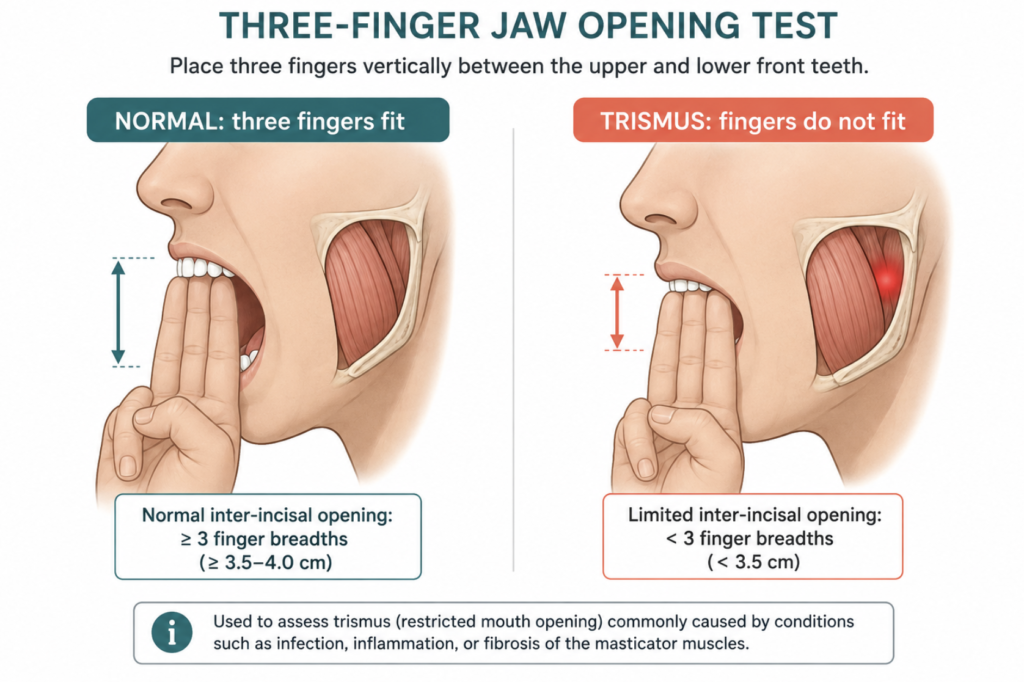
| Jaw opening | Normal | Restricted (three fingers may not fit between the teeth) |
| Voice | Hoarse or scratchy | Muffled, thick, “hot potato” |
| Saliva | Swallowed normally | Pooling, drooling, spitting into a cup |
| Uvula | Midline | Pushed toward the unaffected side |
| Referred ear pain | Uncommon | Common, same side as the throat pain |
A sore throat worse on one side, with a jaw that will not open fully and a muffled voice, should be evaluated the same day. Those three findings together are far more suggestive of an abscess than any one alone.
The most useful item is the jaw. Ordinary tonsillitis, however painful, does not usually stop the mouth from opening. Trismus is the sign that something has moved beyond the tonsil into the muscle beside it.
Why This Diagnosis Is Harder Than It Looks
The 75%/50% figure deserves a caveat, because it is repeated far more often than its origins justify. It traces to a 1999 prospective study of just 14 patients, which found clinical impression alone 78% sensitive and 50% specific for distinguishing abscess from cellulitis [Scott PM, Diagnosis of peritonsillar infections, 1999]. Fourteen patients is a thin foundation for a number that now appears in review after review.
The underlying point survives the caveat, though, and rests on better evidence. Peritonsillar abscess and peritonsillar cellulitis, which is inflammation without a drainable pocket, look remarkably alike. Both produce a swollen, angry, asymmetric throat. Only one contains pus, and pus is what a needle can remove.
This is why emergency departments increasingly reach for ultrasound. Pooled across 17 studies and 812 patients, ultrasound achieved 86% sensitivity and 76% specificity, with point-of-care scanning at 74% and 79% [Kim DJ, Test characteristics of ultrasound for the diagnosis of peritonsillar abscess, 2023]. That is a tool good at ruling the diagnosis out and only moderate at ruling it in: an improvement on the naked eye, not a solution.
The same difficulty shows up from an unexpected direction. Machine learning models trained on symptom data from 916 patients who underwent attempted needle aspiration reached 72.3% accuracy at predicting whether pus would actually be found [Wilson MB, Machine learning diagnosis of peritonsillar abscess, 2019].
It is tempting to read that as algorithms outperforming clinicians. The comparison is less flattering to both: 72.3% is not a number anyone should be proud of. Human and model are stuck on the same problem. Abscess symptoms and severe inflammation overlap almost completely, and pattern-matching cannot create information that was never there. What settles the question is aspiration, imaging, or time.
Clinical Perspective
The practical consequence of diagnostic uncertainty is not observation without a plan. It is observation with defined return criteria.
When a one-sided sore throat does not yet meet the threshold for drainage, the safety of watchful waiting depends on how precisely those criteria are specified. Four findings are concrete enough to act on: difficulty handling saliva, reduced jaw opening compared with earlier the same day, any change in breathing, and fever that climbs rather than falls after antibiotics are started.
Vague thresholds perform poorly here. A throat that hurts on day two also hurts on day four, so “worse” carries no usable boundary. By the time an infection is unmistakably worse, it has usually been worse for some time. Precision in the instruction is what separates watchful waiting from delay.
Symptom-checking tools can be judged on the same standard. A tool that directs a user with trismus and a muffled voice toward same-day evaluation performs the triage function correctly. What no current tool can establish, and what the 72.3% figure demonstrates, is whether pus is present. That question is settled by aspiration, imaging, or time.
How It’s Treated
The standard approach pairs antibiotics with drainage. Which drainage method is better has been argued for decades, and the adult and pediatric evidence answer somewhat different questions, so they are worth separating.
In adults
The adult debate is less about whether to drain than about how. A retrospective comparison of 182 adults (mean age 36) treated at two tertiary centres found that needle aspiration required a repeat procedure in 46.3% of patients, compared with 10% after incision and drainage under local anaesthesia [Mansour C, Comparison of needle aspiration versus incision and drainage under local anaesthesia for the initial treatment of peritonsillar abscess, 2019].
Patients in the aspiration group also stayed in hospital a median of three days versus two, and 14% needed further drainage under general anaesthesia compared with 4% in the incision group [Mansour C, Comparison of needle aspiration versus incision and drainage under local anaesthesia for the initial treatment of peritonsillar abscess, 2019]. Safety was comparable between the two. The authors are explicit that this was retrospective and that a randomised trial is still needed, so it is a signal rather than a settled answer. But it is a reason a clinician may favour incision over aspiration in an adult, and a reason a patient may be told they need a second procedure.
In children
The pediatric literature gives a clearer picture of how often each option is actually used. In a systematic review covering 2,211 pediatric cases, antibiotics with incision and drainage accounted for 69% of treatment, needle aspiration 7.6%, and immediate tonsillectomy 7% [Galluzzi F, Treatment of peritonsillar abscess in children, 2024].
Less widely known: antibiotics alone were used in 16.4% of those children [Galluzzi F, Treatment of peritonsillar abscess in children, 2024]. Drainage is the mainstay, but it is not automatic. Small collections, early presentations, and children who cannot tolerate an awake bedside procedure are all situations where medical management alone may be reasonable. Immediate tonsillectomy, meanwhile, is reserved for a small number of higher-risk patients rather than used routinely.
Whether that 16.4% figure transfers to adults is genuinely unclear. It comes from pediatric cohorts, and adults present later, with larger collections, and tolerate bedside drainage better. Antibiotics alone is therefore an established option in children and a less well-characterised one in adults.
When Is It an Emergency?
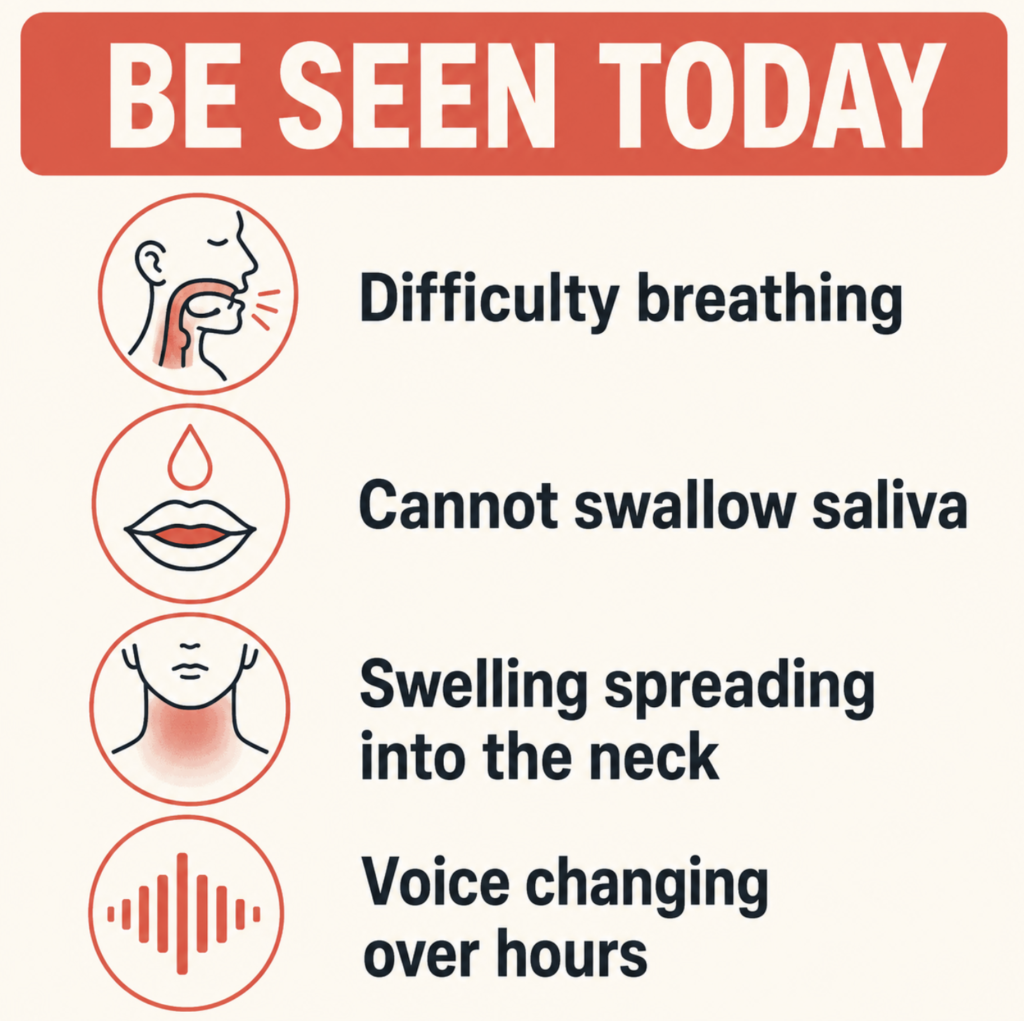
The concerning features are mechanical rather than subjective. Trouble breathing, inability to swallow saliva, swelling spreading into the neck, a voice change progressing over hours, or neck stiffness are reasons to be seen immediately rather than the following day.
Documented complications in children include prolonged fever, torticollis, dyspnea, sepsis, and parapharyngeal spread [Galluzzi F, Treatment of peritonsillar abscess in children, 2024]. Infections extending into the deep neck can involve mediastinitis and Lemierre’s syndrome, a septic thrombophlebitis of the internal jugular vein [Charlton A, Deep neck space infections: a UK centre, two-year, retrospective review of 53 cases, 2024], though that series describes deep neck space infections as a group, not peritonsillar abscess specifically. These outcomes are uncommon. They explain why the condition is treated urgently; they are not a forecast for any individual patient.
Do You Need Your Tonsils Out Afterward?
Usually not. In a prospective cohort of 181 adults treated for a first episode and followed two years, the cumulative recurrence rate was 9.9% (95% CI 6.4 to 15.2%) [Portillo-Medina A, Recurrent peritonsillar abscess in adults, 2024]. Roughly nine in ten adults never have a second one.
Predicting the remaining tenth is where the evidence runs out. In that cohort the only factor associated with recurrence on multivariate analysis was a lower plasma glucose level at the time of emergency presentation, a finding without an obvious clinical interpretation, and the authors concluded that predictive risk factors remain unclear [Portillo-Medina A, Recurrent peritonsillar abscess in adults, 2024].
Smoking is an interesting loose end. Smokers are well represented among patients with deep neck space abscesses, at 42% in one ten-year series [Buckley J, Ten years of deep neck space abscesses, 2019]. But when investigators tested the obvious mechanistic explanation, it did not hold: neither smoking nor poor oral hygiene changed the total quantity of salivary bacteria in patients with throat infections [Sanmark E, Smoking or poor oral hygiene do not predispose to peritonsillar abscesses, 2019]. The association appears real; the reason is not the one everybody assumed.
Key Takeaways
- Physical examination is an unreliable way to distinguish a peritonsillar abscess from peritonsillar cellulitis, which is why the diagnosis is frequently delayed.
- A sore throat worse on one side, combined with restricted jaw opening and a muffled voice, warrants same-day evaluation.
- Ultrasound is better at ruling out a peritonsillar abscess than ruling one in, with pooled sensitivity of 86% and specificity of 76%.
- In adults, needle aspiration required a repeat procedure in 46.3% of cases compared with 10% after incision and drainage in one two-centre comparison.
- In children, antibiotics alone were used in 16.4% of cases, making non-surgical management an established option in that age group.
- About 90% of adults treated for a first peritonsillar abscess have no recurrence within two years, so tonsillectomy is not automatically indicated.
FAQ
When should I go to the ER for a sore throat on one side? Go immediately if you cannot swallow saliva, cannot open your jaw normally, have difficulty breathing, or notice swelling spreading into your neck. Go the same day if pain is clearly one-sided and worsening, your voice sounds muffled, or fever climbs after starting antibiotics. One-sided pain that keeps escalating, especially after a period of apparent improvement, is the pattern most associated with an abscess forming.
Why can’t I open my mouth all the way? Restricted jaw opening, called trismus, happens when infection irritates the medial pterygoid muscle sitting just behind the tonsil. It is one of the more useful distinguishing signs, because ordinary tonsillitis rarely limits jaw opening no matter how painful it gets. If you cannot fit three fingers vertically between your teeth, that finding should be evaluated.
Can a peritonsillar abscess be treated with antibiotics alone? In children, sometimes. A systematic review of pediatric cases found antibiotics alone were used in 16.4% of patients [Galluzzi F, Treatment of peritonsillar abscess in children, 2024]. In adults the evidence is thinner, and the discussion centres more on which drainage method to use than on avoiding drainage. Either way the decision depends on the size of the collection and how early the presentation is, and it is made in person.
Is needle aspiration or incision and drainage better for adults? Incision and drainage performed better in the largest direct adult comparison available, though the evidence is not conclusive. Among 182 adults, aspiration required a repeat procedure in 46.3% of cases versus 10% after incision, with a longer median hospital stay and more frequent recourse to general anaesthesia [Mansour C, Comparison of needle aspiration versus incision and drainage under local anaesthesia for the initial treatment of peritonsillar abscess, 2019]. Safety was comparable. The study was retrospective, and its authors call for a randomised trial.
Do I need a tonsillectomy after having one? Usually not. The two-year recurrence rate after a first adult episode was 9.9% in a prospective cohort [Portillo-Medina A, Recurrent peritonsillar abscess in adults, 2024], meaning the large majority never have another. Tonsillectomy is more often considered after repeated episodes, or in patients with a separate indication such as frequent tonsillitis.
Can an AI symptom checker diagnose this? No, and neither can inspection alone. Models trained on symptom data reached 72.3% accuracy at predicting whether pus would be found [Wilson MB, Machine learning diagnosis of peritonsillar abscess, 2019], reflecting how much abscess and severe inflammation resemble each other rather than any flaw unique to software. A symptom checker can appropriately tell you to be seen urgently. Confirming a drainable collection requires examination, imaging, or aspiration.
References
- Scott PM, Loftus WK, Kew J, Ahuja A, Yue V, van Hasselt CA. Diagnosis of peritonsillar infections: a prospective study of ultrasound, computerized tomography and clinical diagnosis. J Laryngol Otol. 1999;113(3):229-232.
- Kim DJ, Burton JE, Hammad A, Sabhaney V, Freder J, Bone JN, Ahn JS. Test characteristics of ultrasound for the diagnosis of peritonsillar abscess: a systematic review and meta-analysis. Acad Emerg Med. 2023;30(8):859-869.
- Wilson MB, Ali SA, Kovatch KJ, Smith JD, Hoff PT. Machine learning diagnosis of peritonsillar abscess. Otolaryngol Head Neck Surg. 2019;161(5):796-799.
- Mansour C, De Bonnecaze G, Mouchon E, Gallini A, Vergez S, Serrano E. Comparison of needle aspiration versus incision and drainage under local anaesthesia for the initial treatment of peritonsillar abscess. Eur Arch Otorhinolaryngol. 2019;276(9):2595-2601.
- Galluzzi F, Garavello W. Treatment of peritonsillar abscess in children: a systematic review. J Clin Med. 2024;13(23):7361.
- Portillo-Medina A, Golet Fors M, Penella Prat A, Manos M, Videla S, González-Compta X. Recurrent peritonsillar abscess in adults: incidence and risk factors in a prospective longitudinal cohort. Acta Otorrinolaringol Esp (Engl Ed). 2024;75(6):361-366.
- Buckley J, Harris AS, Addams-Williams J. Ten years of deep neck space abscesses. J Laryngol Otol. 2019;133(4):324-328.
- Sanmark E, Wikstén J, Välimaa H, Blomgren K. Smoking or poor oral hygiene do not predispose to peritonsillar abscesses – changes in oral flora. Acta Otolaryngol. 2019;139(9):798-802.
- Charlton A, Simon R, Shanthakunalan K, Simons A. Deep neck space infections: a UK centre, two-year, retrospective review of 53 cases. J Laryngol Otol. 2024;138(12):1161-1169.
Joonpyo Hong, MD is a board-certified otolaryngologist practicing in Korea. This article reflects his clinical interpretation of published research and does not constitute individual medical advice.
For more articles:
https://curiousmd.com/injectable-analgesics/
https://curiousmd.com/tonsil-stones-do-you-need-surgery/
https://curiousmd.com/aphthous-ulcer-treatment-ent-guide/
https://curiousmd.com/chatgpt-medical-triage-ent-review/
Link out to:
https://www.ncbi.nlm.nih.gov/books/NBK519520/
https://www.aafp.org/pubs/afp/issues/2017/0415/p501.html
https://www.merckmanuals.com/professional/ear-nose-and-throat-disorders/oral-and-pharyngeal-disorders/peritonsillar-abscess-and-cellulitis
https://pubmed.ncbi.nlm.nih.gov/36625850/
Pingback: Tooth Infection Spread to Neck: Timeline and Risk