
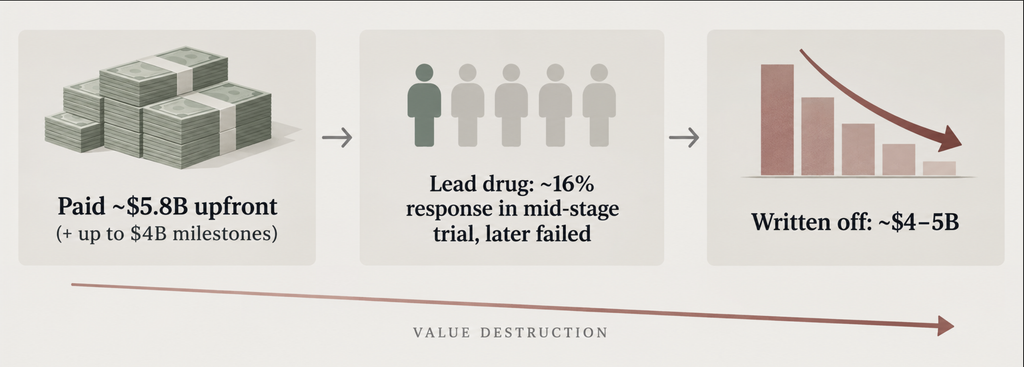
In 2016, AbbVie paid roughly $5.8 billion, with up to $4 billion more promised in milestones, for a single biotech company called Stemcentrx and its lead cancer drug. The investor who had backed that company, Peter Thiel, held a specific theory of biotech R&D productivity: most of the industry, he argued, deployed capital in ways that were essentially random, and so most of that capital was wasted. Stemcentrx was meant to be the antidote: a concentrated, deliberate bet against the randomness he described.
Its lead drug, an antibody-drug conjugate for small-cell lung cancer, returned a response rate near 16% in a mid-stage trial, then failed to extend survival in the studies that followed. AbbVie ended the program and wrote off most of the purchase, a charge of roughly $4 billion to $5 billion. The man who called biotech investment random had made a large, deliberate bet that failed in a thoroughly ordinary way.
One anecdote settles nothing. A decade has passed since Thiel framed the problem [MIT Technology Review, 2015], and the useful question is not whether a single bet went wrong, but whether the structure he criticized still stands. Three bodies of evidence now allow a verdict: the long-run productivity of drug research, the record of artificial intelligence (AI) as the promised cure for randomness, and the pattern of where money actually flows.
Thiel named randomness as the disease. A decade of data suggests the disease was real, though the diagnosis may have been wrong.
What Thiel Claimed, and What He Bet On
Thiel’s argument, made in a 2015 interview, was an analogy to software. A company like a large technology platform can turn each dollar into predictable, compounding value; a biotech company, on his account, invests in ways that are closer to lottery tickets, doing things without knowing whether they will work. If the process is random, he reasoned, waste is not an accident of the field: it is the field [MIT Technology Review, 2015].
Stemcentrx was the wager that flowed from that view. The pitch was that better biology could remove the guesswork and make a concentrated bet safer than a diffuse one. That framing matters, because it converts a slogan into a testable claim: deliberate, capital-intensive selection should beat the scattershot norm. The subsequent failures of that lead program, and AbbVie’s multi-billion-dollar write-down [AbbVie, Form 10-Q, 2016], are not proof that Thiel was wrong about the industry. But they are a caution that removing randomness is easier to assert than to achieve.
The charitable reading is that Thiel was pointing at something real. Drug research is expensive, slow, and mostly ends in failure. The uncharitable reading is that he mistook a structural feature of biology for a failure of discipline. Both readings can be tested against numbers.
Clinical Perspective.
A concentrated bet is not a de-risked bet. Confidence in the underlying biology and the odds of a clinical readout are different quantities, and the history of oncology is a long record of the two being confused.
Test 1: The R&D productivity scoreboard
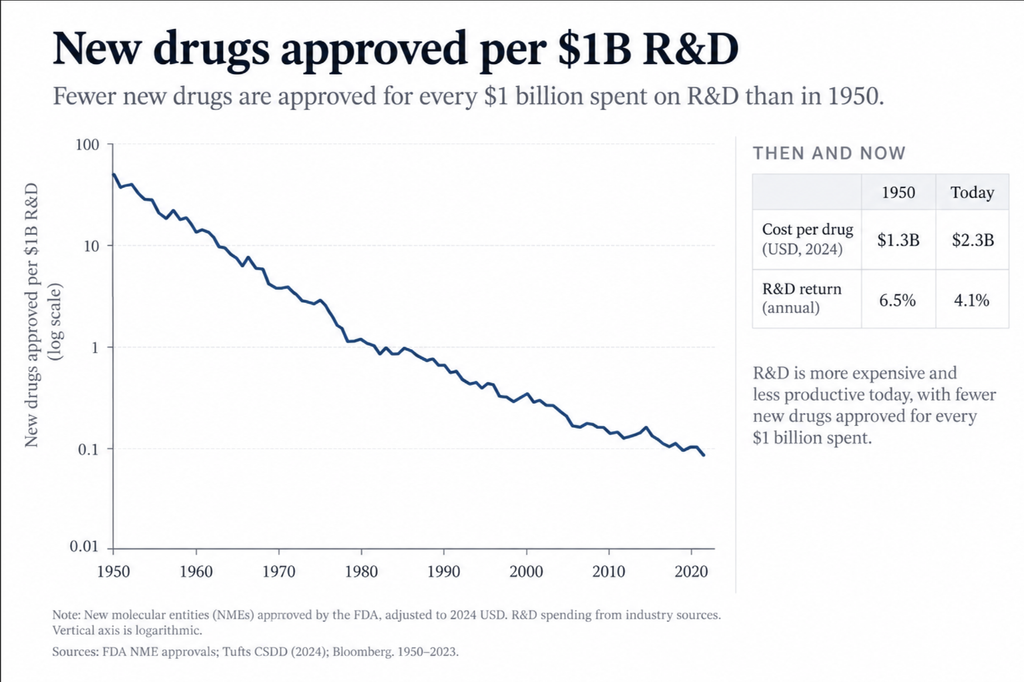
The most durable measure of biotech R&D productivity is unforgiving. Since 1950, the number of new drugs approved per billion dollars of research spending has roughly halved every nine years, an inflation-adjusted decline of about 80-fold [Scannell, Diagnosing the Decline, 2012]. Read plainly: a research dollar in 1950 bought something like eighty times as much approved medicine as the same dollar six decades later. The trend earned a nickname: Eroom’s Law, Moore’s Law spelled backward, because it runs in the opposite direction from computing.
The money side tells the same story. By one widely cited industry estimate, the cost to develop a single drug rose from about $1.3 billion to $2.3 billion between 2013 and 2024, while the average return on that research fell from 6.5% to 4.1% [Deloitte, Measuring Return, 2024]. A separate figure from the same source put the internal rate of return on late-stage discovery near 1.2% in 2022, a different metric from the return figure above and best read on its own terms rather than stitched into a single line. These are modeled estimates from an interested industry, not audited constants, and should be read as direction rather than precision.
| Indicator | Then | Now | Direction |
|---|---|---|---|
| Approvals per $1B R&D | 1950 baseline | ~80-fold lower | Falling (halves ~every 9 yrs) |
| Cost per new drug | ~$1.3B (2013) | ~$2.3B (2024) | Rising |
| Return on R&D | ~6.5% (2013) | ~4.1% (2024) | Falling |
There is a genuine counter-current. Recent years have brought record numbers of drug approvals, which has prompted some to argue that the decline has finally reversed. A 2025 analysis is more cautious: the uptick in approvals sits alongside rising investment and other pressures, so the underlying productivity problem has not clearly resolved [Schuhmacher, R&D Productivity Challenge, 2025]. On the first of Thiel’s points, then, the scoreboard is on his side. The industry does struggle to turn money into medicine.
Clinical Perspective.
Falling productivity is not the same as random productivity. A cost curve that bends the wrong way for seventy years looks less like undisciplined gambling and more like a hard ceiling in the biology itself.
Test 2: Did AI remove the randomness?
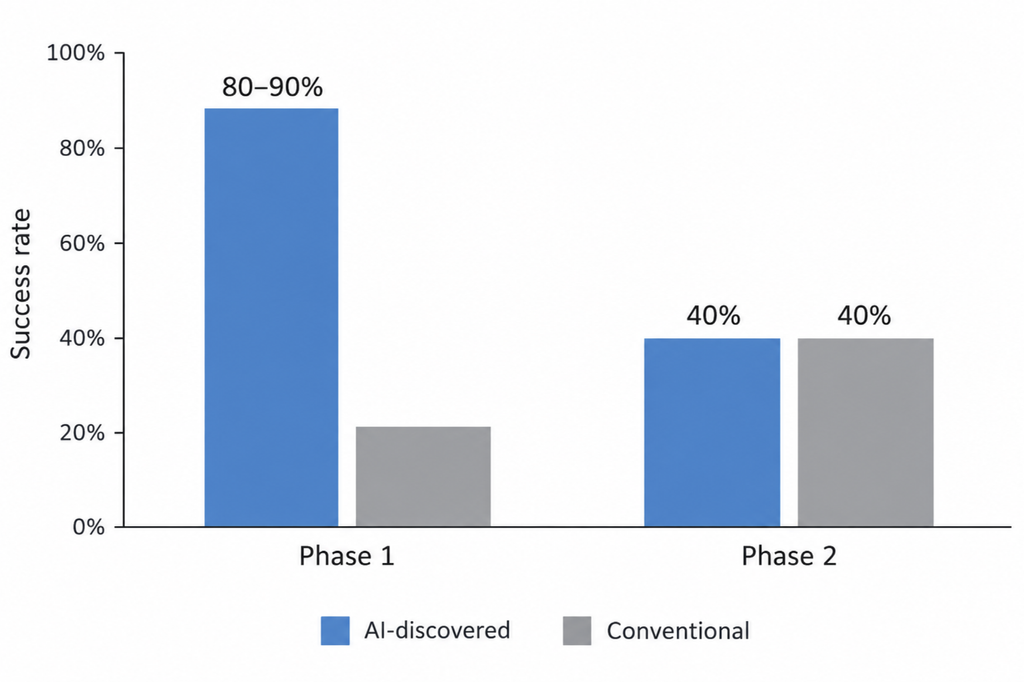
If randomness were the problem, then a technology that predicts which molecules will work should fix it. That is the promise attached to AI drug discovery, and the early clinical record is real. AI-native biotech companies have moved candidates through Phase 1 safety trials at a rate of about 80 to 90%, well above the historic norm [Jayatunga, AI-Discovered Drugs, 2024]. In plain terms, molecules that a model designed or selected are unusually good at clearing the first human hurdle.
Then the curve flattens. In Phase 2, where a drug must show it actually helps patients, the success rate for the same AI-discovered molecules is about 40%, in line with the long-run average for conventional drugs [Jayatunga, AI-Discovered Drugs, 2024]. The advantage that was striking in Phase 1 disappears at the stage that matters most. This figure rests on a small sample and on an analysis authored by an industry consultancy, so it is an early reading rather than a settled one; but the shape is consistent.
| Trial stage | AI-discovered | Conventional | Gap |
|---|---|---|---|
| Phase 1 (safety) | ~80-90% | Historic norm, lower | Large advantage |
| Phase 2 (efficacy) | ~40% | ~40% | Advantage gone |
No fully AI-designed drug has yet cleared the final regulatory gate. The most advanced example, an AI-generated inhibitor for idiopathic pulmonary fibrosis, a progressive scarring of the lungs, reached a randomized Phase 2a trial in 2025. Its highest-dose group showed a lung-function change of +98.4 mL against -20.3 mL for placebo, an encouraging signal [Xu, AI-Discovered TNIK Inhibitor, 2025]. That result should be read carefully: the trial’s primary goal was safety, the efficacy figure came from a secondary measure in a small group, and one study is a beginning, not a verdict.
The honest summary is a distinction. AI has plainly reduced randomness at the front end: choosing and designing molecules that behave like drugs. It has not closed the translation gap, the space between a molecule that looks right and a molecule that works in a human body. A smarter way to pick candidates is not the same as a cure for why they fail.
Clinical Perspective.
The stage that breaks drugs is Phase 2, and that is exactly where the AI advantage vanishes so far. A model can learn what a drug-like molecule looks like far more easily than it can learn what a sick human body will do with one.
Random, or herded?
Here the diagnosis ages worst. Thiel described capital scattered at random: arrows loosed blindly in the dark. The dominant pattern in 2025 is closer to the opposite: not scatter, but a stampede toward the same door.
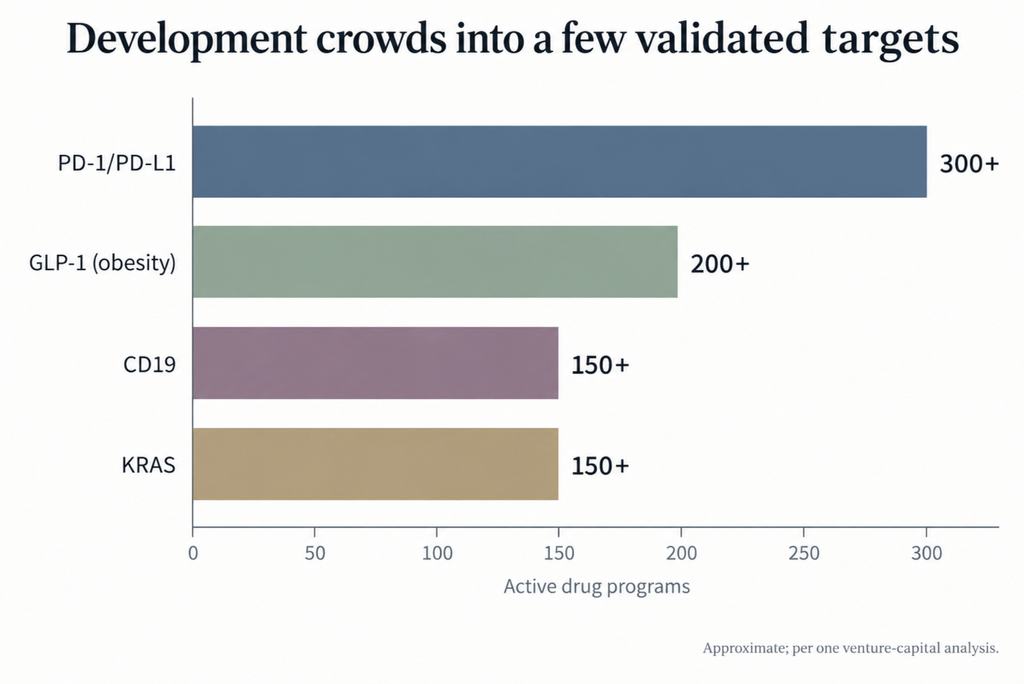
By one venture-capital analysis, development has piled into a handful of validated targets: on the order of 200 or more programs aimed at GLP-1 for obesity, 300 or more at the PD-1/PD-L1 pathway in cancer, and 150 or more each at the CD19 and KRAS targets [Booth, Wisdom of the Crowds, 2025]. Capital has followed the same grooves: licensing deals in obesity and related metabolic disease reached a headline value near $18.2 billion in the first half of 2025 alone, by industry tallies. Both figures come from single sources and depend on how a “program” or a “deal” is counted, so the exact numbers are softer than the pattern they describe, though the pattern is corroborated across the field.
This is a different failure from the one Thiel named. Random investment wastes money by spreading it thinly across long odds. Herded investment wastes money by crowding it into the same few bets, so that a dozen companies race toward one target and most arrive too late to matter. The first is a problem of too little direction; the second, of too much sameness. A field can be disciplined and still be inefficient, if the discipline points everyone the same way.
Clinical Perspective.
For patients, herding has a specific cost: the tenth drug for a crowded target rarely changes care, while whole categories of disease attract almost no programs at all. The waste is not that the bets are random. It is that they rhyme.
Verdict: A split decision
Thiel’s claim breaks into three parts, and they do not share a fate.
| Thiel’s claim | Verdict | Why |
|---|---|---|
| Biotech turns money into medicine inefficiently | Holds | Productivity per dollar has fallen for decades and has not clearly recovered |
| The inefficiency is randomness | Does not hold | The visible 2025 pattern is herding into shared targets, not scatter |
| A deliberate bet beats the random norm | Not shown | AI improves early selection but not late efficacy; concentrated bets still fail ordinarily |
The part of the argument that survives is the least contrarian part: that drug research is hard and expensive. The distinctive claim, that the waste comes from randomness and can be engineered away, is the part the decade has not supported. AI removed some of the guesswork at the front door and left the harder room untouched. Capital grew more disciplined and, in growing disciplined, grew more alike.
Clinical Perspective.
The most useful correction to Thiel’s diagnosis is not that he was too harsh on biotech, but that he was too optimistic about the fix. The bottleneck was never mainly a shortage of discipline. It is that human biology remains the one system that refuses to be predicted in advance, and that is a wall no allocation strategy has yet walked through.
Key takeaways
- Peter Thiel’s 2015 claim that biotech invests “randomly” and wastes money holds up on productivity but fails on its central mechanism.
- Biotech R&D productivity has fallen for decades: approvals per research dollar have dropped roughly 80-fold since 1950, and recent record approvals have not clearly reversed it.
- AI-discovered drugs clear Phase 1 at about 80 to 90%, but their Phase 2 success falls back to the conventional ~40%, and none has yet been approved.
- AI has reduced randomness in picking molecules, not in predicting whether they work in patients.
- The dominant 2025 inefficiency is herding, not randomness: hundreds of programs crowd a few validated targets while capital concentrates in obesity and metabolic disease.
- A concentrated, deliberate bet, the strategy Thiel favored, has proven no guarantee against ordinary failure.
FAQ
Was Peter Thiel right that biotech wastes money? Partly. The productivity data support his claim that drug research turns money into approved medicine inefficiently and has done so for decades [Scannell, Diagnosing the Decline, 2012]. His more specific claim, that the waste comes from randomness, fits the current evidence less well.
Has AI made drug discovery more efficient? At the start, yes. AI-native companies clear Phase 1 at roughly 80 to 90%, above the historic norm, but their Phase 2 success returns to about 40%, matching conventional drugs [Jayatunga, AI-Discovered Drugs, 2024]. The early-stage gain has not yet become a late-stage one.
Has any AI-designed drug been approved? No. The most advanced candidate reached a randomized Phase 2a trial in 2025 with an encouraging but preliminary lung-function signal [Xu, AI-Discovered TNIK Inhibitor, 2025]. Approval, if it comes, is still years away.
What is Eroom’s Law? It is the observation that new drugs approved per billion dollars of research spending have fallen for decades: Moore’s Law in reverse. The original analysis found a halving roughly every nine years since 1950 [Scannell, Diagnosing the Decline, 2012].
References
- Peter Thiel explains his biotech investing rationale. MIT Technology Review. 2015.
- AbbVie Inc. Form 10-Q, acquisition of Stemcentrx. U.S. Securities and Exchange Commission. 2016.
- Scannell JW, Blanckley A, Boldon H, Warrington B. Diagnosing the decline in pharmaceutical R&D efficiency. Nat Rev Drug Discov. 2012;11(3):191-200.
- Deloitte Centre for Health Solutions. Measuring the return from pharmaceutical innovation. 2024.
- Schuhmacher A, Gassmann O, Kwisda S, Kremer M, Hinder M, Hartl D. The R&D productivity challenge: transforming the pharmaceutical ecosystem. Drug Discov Today. 2025;30(11):104494.
- Kp Jayatunga M, Ayers M, Bruens L, Jayanth D, Meier C. How successful are AI-discovered drugs in clinical trials? A first analysis and emerging lessons. Drug Discov Today. 2024;29(6):104009.
- Wong CH, Siah KW, Lo AW. Estimation of clinical trial success rates and related parameters. Biostatistics. 2019;20(2):273-286.
- Xu Z, Ren F, Wang P, et al. A generative AI-discovered TNIK inhibitor for idiopathic pulmonary fibrosis: a randomized phase 2a trial. Nat Med. 2025;31(8):2602-2610.
- Booth B. Biotech wisdom of the crowds: competition and capitalism. LifeSciVC. 2025.
Joonpyo Hong, MD is a board-certified otolaryngologist practicing in Korea. This article reflects his clinical interpretation of published research and does not constitute individual medical advice. This article is not intended to advertise or promote any specific company or product.
For more articles:
https://curiousmd.com/why-small-cap-biotech-investing-is-hard/
https://curiousmd.com/antibiotics-vs-antivirals-why-antivirals-are-rare/
https://curiousmd.com/future-of-clinical-decision-support/
Link out to:
Peter Thiel Explains Biotech Investing Rationale: Get Rid of Randomness — MIT Technology Review — The 2015 interview where Thiel frames biotech investment as random and wasteful, the claim this article tests.
AbbVie to Acquire Stemcentrx — AbbVie (investor press release) — AbbVie’s official announcement of the ~$5.8B acquisition plus up to $4B in milestones.
U.S. drug development needs its own SpaceX moment — STAT — A 2025 analysis citing Deloitte data on rising development costs and falling R&D returns under Eroom’s Law.
A generative AI-discovered TNIK inhibitor for IPF: a randomized phase 2a trial — Nature Medicine — The first generative-AI-discovered drug to reach a randomized Phase 2a trial.
Biotech Wisdom of the Crowds: Competition and Capitalism — LifeSciVC — A venture-capital analysis documenting therapeutic crowding into a few validated targets.