
A four-year-old with a fever is carried into a district hospital, limp, her hands cold. The doctor on duty opens a sepsis protocol on her phone. AI clinical decision support promises that the best available answer to a moment like this could reach every clinician on Earth. The case is a composite, but the problem is real. The protocol assumes continuous monitoring, rapid lab results, and an intensive care unit down the hall, and her hospital has none of them.
Missing facts are the smaller part of the gap in that room. By one widely cited estimate (a model, not a head count), health care could have averted about 8.6 million deaths in low- and middle-income countries in 2016. Of those, 5.0 million were among people who reached care and received poor-quality care, and 3.6 million among people who never used care at all [Kruk, Mortality Due to Low-Quality Health Systems, 2018]. So nearly six in ten of those deaths happened after the patient had already arrived.
On September 22, 2026, Anthropic and OpenEvidence announced a free, specialized version of OpenEvidence’s clinical decision tool for clinicians in dozens of low- and middle-income countries, tailored to local health infrastructure [Lapid, Anthropic and OpenEvidence Partner to Bring Medical AI Worldwide, 2026]. Underneath that ambition sits an older problem: much of medicine’s knowledge was written for a hospital that most of the world’s doctors do not work in. AI could be the first tool that translates evidence into a particular place. It can only do that if it can see the place, and it will only be as good as the evidence it is translating.
A note on scope: this essay sets aside legal and ethical responsibility for AI-assisted decisions, along with the regulatory barriers to deployment. Accuracy, bias, and fit to local conditions are clinical-quality questions, so they stay in. For decades medicine has handed the world maps drawn for someone else’s terrain. The open question is whether AI can redraw them for the ground each doctor is actually standing on, and what doctors still need to know to read them.
The Gap, Measured: Access, Resources, and Quality
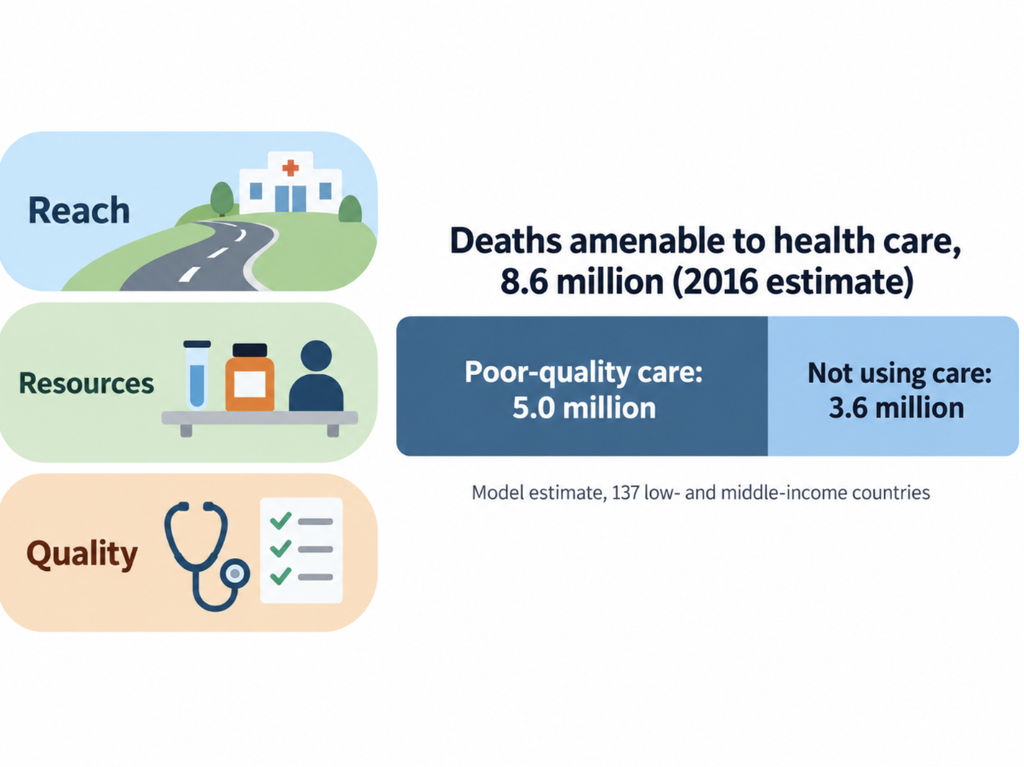
The global health gap has three layers: whether people can reach care, whether the facility has what care requires, and whether the care they get is correct.
Start with reach. The 2025 monitoring report from the World Health Organization (WHO) and the World Bank estimated that 4.6 billion people, more than half the world, lack access to essential health services [WHO & World Bank, Tracking Universal Health Coverage, 2025]. WHO puts its European Region at about 43 doctors per 10,000 people and its African Region at about 2, a gap of roughly twentyfold. The African Region carries more than 22% of the global disease burden with 3% of the world’s health workers [WHO, Global Health Observatory, 2026]. WHO also projects a shortfall of 11.1 million health workers by 2030, mostly in low- and lower-middle-income countries [WHO, Health Workforce, 2026].
The second layer is what is inside the building. In 2021 the Lancet Commission on diagnostics estimated that 47% of the world’s population, nearly half, has little or no access to diagnostic tests. In low- and lower-middle-income countries, only about 19% of people, roughly one in five, can get the simplest tests at the primary care level [Fleming, Lancet Commission on Diagnostics, 2021]. Surgery looks similar. A 2015 estimate put the number of people without safe, affordable surgical care at 5 billion, including nine in ten people in low- and lower-middle-income countries [Meara, Global Surgery 2030, 2015].
| Layer | The question | One measurement |
|---|---|---|
| Reach | Can people get to care? | 4.6 billion people lack essential services; about 2 doctors per 10,000 people in WHO’s African Region vs about 43 in its European Region |
| Resources | Does the facility have what care requires? | 47% of the world has little or no access to diagnostics; 5 billion without safe, affordable surgery (2015 estimate) |
| Quality | Is the care that is delivered correct? | An estimated 5.0 of 8.6 million preventable deaths attributed to poor-quality care; correct diagnosis in 64% of standardized cases across 10 African countries |
The third layer is the hardest to see. In the estimate above, poor-quality care, which reflects both what clinicians know and what they have to work with, accounted for more deaths than non-use of care did. The World Bank’s Service Delivery Indicators surveys tested 22,746 health workers in 10 African countries using standardized case scenarios.
These measure what clinicians know, which is not always what they do. The workers reached the correct diagnosis in 64% of cases, about two in three, and chose a treatment matching that diagnosis in only 45%, fewer than half [Di Giorgio, Clinical Knowledge, Absenteeism and Availability of Resources, 2020]. Only 14% of facilities, about one in seven, had at least one staff member on hand with both the knowledge and the supplies to meet minimum quality standards. The authors concluded that gaps in clinical knowledge held care back more than missing drugs or absent staff did.
That last finding is where decision support comes in. An AI tool cannot build a road or stock a pharmacy. What it can plausibly do is shrink the distance between what a clinician knows and what the evidence says, much as a well-read colleague standing in the room might. The room itself stays the same.
Written for a Hospital That Isn’t There
Evidence-based medicine presents itself as universal, but its evidence has an address. A 2026 systematic review looked at randomized trials published from 2019 to 2024 in five leading general medical journals and found that only 83 of 2,138, or 3.9% (fewer than 1 in 25), were run solely in Africa. In three leading cardiovascular journals the share was 0.6% [Gaye, African Representation in Randomized Controlled Trials, 2026].
By WHO’s accounting, meanwhile, its African Region carries more than a fifth of the disease burden. Genetic research leans the same way. Studies have drawn overwhelmingly on people of European ancestry, so tools such as polygenic risk scores tend to work best in those populations [Martin, Clinical Use of Current Polygenic Risk Scores, 2019].
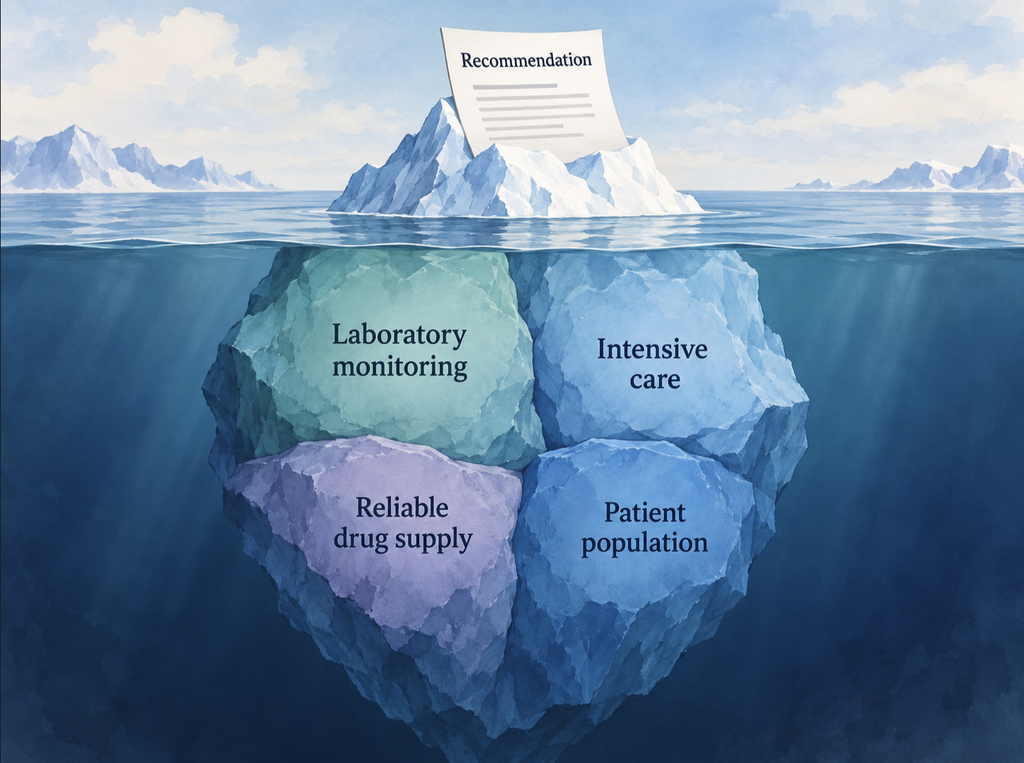
None of this requires bad intent. A trial run with round-the-clock monitoring produces a recommendation that quietly assumes round-the-clock monitoring, much as a road map assumes the bridges are still standing without ever saying so. Where the guidance was tested, it may be perfectly sound. The trouble starts when it travels and its assumptions stay behind.
Pediatric sepsis gave the clearest demonstration. Rapid fluid boluses for children in shock were standard practice in high-income settings when the FEAST trial tested them in 3,141 children with severe febrile illness and poor perfusion, in hospitals in Uganda, Kenya, and Tanzania. The boluses increased deaths. Mortality at 48 hours was 10.6% and 10.5% in the two bolus groups against 7.3% without a bolus: a relative risk of 1.45, or about 3 extra deaths per 100 children [Maitland, Mortality After Fluid Bolus in African Children, 2011].
A separate trial in 212 Zambian adults with sepsis and low blood pressure, most of them living with HIV, pointed the same way. In-hospital mortality was 48.1% under an early-resuscitation protocol and 33.0% with usual care, close to half against one in three [Andrews, Early Resuscitation Protocol in Adults With Sepsis, 2017].
Why did the answer flip? Researchers expected the extra deaths to come from fluid overload. A follow-up analysis found instead that they came mainly from cardiovascular collapse, with terminal events of that kind in 4.6% of children in the bolus groups and 2.6% of controls [Maitland, Exploring Mechanisms of Excess Mortality, 2013]. The full explanation is still debated. That the setting changed the answer is not.
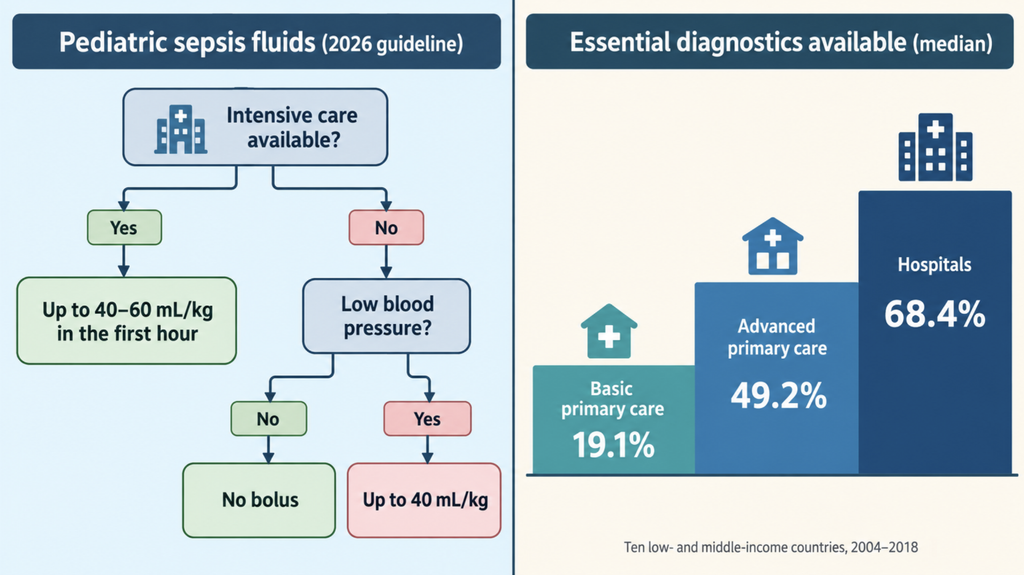
The guideline eventually took the lesson on board. The 2026 international pediatric sepsis guideline gives different fluid advice depending on whether intensive care is available. Where it is, the guideline allows up to 40 to 60 mL/kg in the first hour. Where it is not, it advises no bolus for children without low blood pressure and up to 40 mL/kg for those who are hypotensive [Weiss, Surviving Sepsis Campaign Pediatric Guidelines, 2026]. In fairness, one more detail matters here. The guideline rates the evidence for boluses in settings with intensive care as weak, and the evidence against them in settings without it as strong. Its firmest fluid recommendation rests on trials like FEAST, run where intensive care was scarce.
A map, in other words, is only as good as the ground it was surveyed on.
Can AI Clinical Decision Support Fit the Answer to the Room?
Context-adaptive AI rests on a hope: that the translation guidelines did slowly, one branch at a time, could happen for every clinic at once. This is different from personalized medicine in the genomic sense. A better name might be precision to place, meaning advice fitted to what a particular facility can actually see, test, and treat. The sepsis guideline shows the idea on paper, and AI promises to do it at scale.
One of the best-documented attempts so far comes from Penda Health, a network of primary care clinics in Nairobi, Kenya. Its tool, AI Consult, ran in the background of the electronic record and flagged potential errors. It was tailored to Kenyan disease patterns, national guidelines, and the clinics’ own protocols, and during rollout it was adjusted to stop requesting tests the clinics could not perform [Korom, AI-Based Clinical Decision Support for Primary Care, 2025].
A quality-improvement study covered 39,849 visits across 15 clinics; OpenAI, whose model powered the tool, funded it. Independent physician reviewers judged that clinicians with access made 16% fewer diagnostic errors and 13% fewer treatment errors, roughly one in six and one in eight fewer. An earlier rule-based system at the same clinics had already raised guideline adherence from 40% to over 90%. Penda is also an unusually digitally mature, urban network, which limits how far these results can be generalized.
Fewer documented errors do not necessarily mean healthier patients. A separate pragmatic, cluster-randomized trial in the same network enrolled 9,691 patients across 16 clinics and tracked what happened to them. Treatment failure within 14 days occurred in 2.2% of patients seen by clinicians with AI support and 2.0% of those seen without it. That is about 2 in 100 in both groups, with no significant difference [Agweyu, Generative AI-Enabled Clinical Decision Support in Primary Care, 2026]. No safety signal emerged either. The authors concluded that any benefit to patients is probably modest.
To adapt to a place, you have to know the place. National facility surveys in ten low- and middle-income countries, conducted between 2004 and 2018, found median availability of essential diagnostics of 19.1% in basic primary care clinics (about one in five) and 68.4% in hospitals (about two in three). Ultrasound was available in 1.2% of primary care facilities, roughly one in a hundred [Yadav, Availability of Essential Diagnostics, 2021].
The right answer depends on which of those tiers a doctor is working in. And in most places, nothing tells a doctor, or an AI, what is actually on the shelf today. That last claim is an inference rather than a measurement, but it is the quiet bottleneck of precision to place.
The other half of the problem is the model. AfriMed-QA is a benchmark of 15,000 questions drawn from more than 60 medical schools in 16 African countries. On its multiple-choice questions, 30 AI models performed worse overall than they did on the US licensing-exam benchmark, with wide variation by specialty and region [Olatunji, AfriMed-QA, 2025].
This is early evidence, based on exam-style questions rather than live care. Still, it lines up with the concern critics raised when the Anthropic and OpenEvidence initiative was announced: systems trained mostly on high-income data may not reflect local practice conditions [Lapid, Anthropic and OpenEvidence Partner to Bring Medical AI Worldwide, 2026]. Some of Penda’s own clinicians asked for the tool to keep learning which drugs were locally available.
Put simply, an AI can fit its answer to the room only if someone tells it what is in the room.
When Every Doctor Has the Same Oracle
In the American Medical Association’s 2026 survey of 1,692 US physicians, 72%, about seven in ten, said they had worked at least one AI use into their practice. Summaries of research and standards of care were among the most common [AMA, 2026 Physician Survey on Augmented Intelligence, 2026]. OpenEvidence’s founder told Reuters that US clinicians consulted the platform 42 million times in August alone, a company figure that has not been independently verified [Lapid, Anthropic and OpenEvidence Partner to Bring Medical AI Worldwide, 2026]. Once the same evidence engine is in pockets from Boston to Kampala, recalling the evidence no longer sets one clinician apart from another.
Having an answer engine does not automatically make someone a better doctor. In a randomized trial, 50 physicians worked through written cases. Those given a large language model scored a median of 76% on diagnostic reasoning, and those using conventional resources scored 74%, which is no meaningful difference.
In an exploratory analysis, the model working alone scored 16 points higher than the conventional group [Goh, Large Language Model Influence on Diagnostic Reasoning, 2024]. A second trial of 92 physicians found a modest gain in management reasoning, with scores 6.5% higher when GPT-4 was available [Goh, GPT-4 Assistance for Physician Performance, 2025]. Both used written vignettes rather than real patients. Working well with the tool seems to be something doctors have to learn.
The partnership also fails in a specific, predictable way. In one experiment, 27 radiologists read mammograms alongside what they were told was an AI. When its suggestion was wrong, accuracy among the least experienced fell from 79.7% to 19.8%, from about four in five to one in five. Even the most experienced readers dropped from 82.3% to 45.5%, roughly half [Dratsch, Automation Bias in Mammography, 2023]. These readers knew enough to get it right. They went wrong because they deferred to the machine.
Repeated often enough, deference may harden into dependence. In a multicentre observational study in Poland, the adenoma detection rate in colonoscopies done without AI fell from 28.4% before routine AI use to 22.4% afterward, a relative drop of about one in five [Budzyń, Endoscopist Deskilling Risk, 2025].
That is an early warning sign, not proof. The Kenyan data point the other way. Over the study, the share of visits that started with a red alert fell from 45% to 35% among clinicians using AI Consult, which suggests the tool was teaching as well as catching [Korom, AI-Based Clinical Decision Support for Primary Care, 2025]. Physicians sense what is at stake. In the AMA survey, 88% of respondents, nearly nine in ten, were at least mildly concerned about losing skills, and 70% worried about it in trainees.
Whether AI ends up a tutor or a crutch will depend on how it is designed, not on anything built into the technology.
The Skills That Keep Their Value
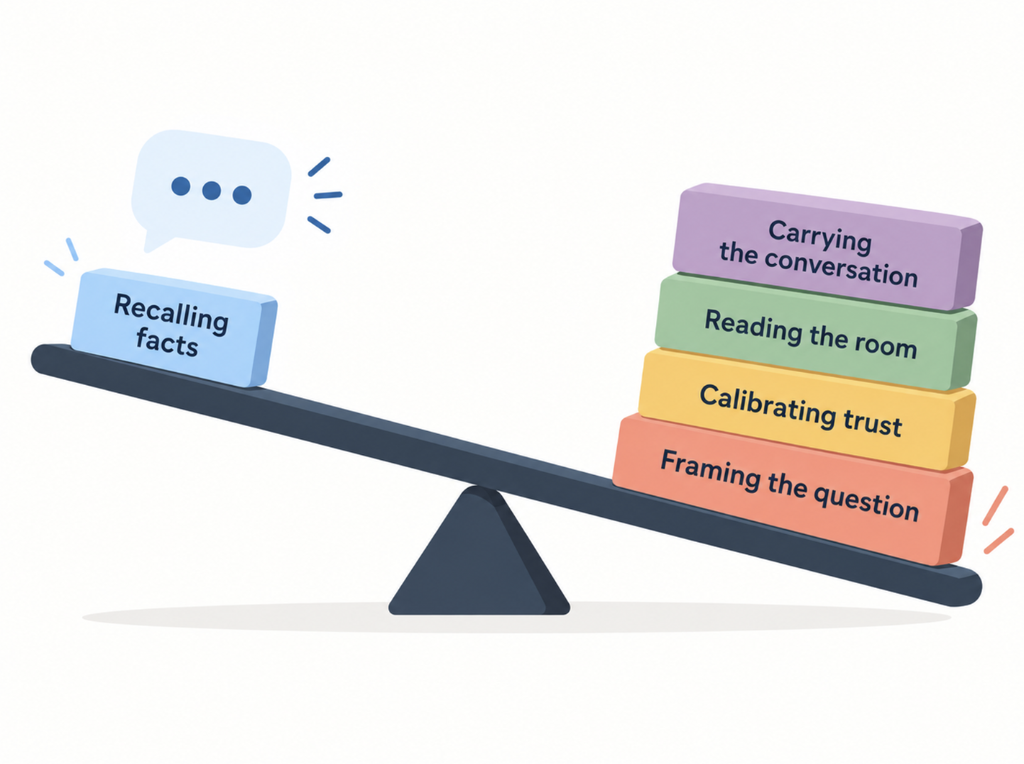
If recall becomes a commodity, the scarce skills shift to what happens before the answer and after it. One expert consensus framework for clinicians using AI lists six competency domains. Among them are evaluating a tool’s accuracy, safety, biases, and contextual appropriateness, and integrating its output into patient-centered care plans [Russell, Competencies for the Use of AI-Based Tools, 2023]. Read alongside the evidence above, four capabilities stand out.
Framing the question
An answer engine responds to the question it is given. The clinician who notices that a feverish child has also been losing weight, or that a patient cannot afford a second drug, will ask a better one. In Penda’s safety reviews, the tool could not help in visits where the necessary clinical details never made it into the record.
Calibrating trust
The skill that lasts is knowing when the tool’s training data are thin, or when its suggestion contradicts what the clinician is looking at. What counts here is calibrated trust, which is a different thing from compliance.
Reading the room
In a low-resource clinic, context means what is on the shelf and whether intensive care exists. In a well-resourced one, it means the patient’s values, finances, and tolerance for risk, which rarely sit in any database. Either way the skill is the same: adapting a general recommendation to a specific situation. Clinicians working with scarce resources practice it every working day, and once answer engines are shared by everyone, it may turn out to be the most transferable skill in medicine. That last point is an interpretation rather than a finding.
Carrying the conversation
Someone still has to explain the recommendation, weigh it with the patient, and own the plan. In the AMA survey, 92% of respondents wanted more AI training. The skill involved is less about operating software than about translating its output for a worried person in a real room.
Evidence now moves at the speed of light. Context still moves on foot, and clinicians are the ones carrying it.
Key Takeaways
- By one major estimate, most preventable deaths in low- and middle-income countries happen after patients reach care, which makes the quality of decisions a central target.
- Much medical evidence carries unstated assumptions about monitoring, laboratories, and intensive care. Guidance that travels without those assumptions can reverse its effect.
- The pediatric sepsis guideline now branches on whether intensive care exists, a working model of “precision to place” that came before AI.
- In Kenya, an AI decision-support tool reduced documented clinician errors, but a randomized trial found no clear improvement in patient outcomes. The decisive test is still ahead.
- Answer engines narrow the knowledge gap. Automation bias and possible deskilling open a new one, between clinicians who calibrate their trust and clinicians who simply defer.
- The skills most likely to hold their value are framing the question, calibrating trust, adapting advice to context, and carrying the conversation with the patient.
FAQ
Can AI clinical decision support close the global health gap?
Only in part. It targets the quality of decisions, the layer where an estimated 5.0 million of 8.6 million preventable deaths were attributed to poor-quality care [Kruk, Mortality Due to Low-Quality Health Systems, 2018]. The gaps in reach and resources remain.
Did the Kenyan AI tool improve patient outcomes?
Not so far. A pragmatic, cluster-randomized trial of 9,691 patients found treatment failure within 14 days in 2.2% of those with AI support and 2.0% of those without, with no significant difference [Agweyu, Generative AI-Enabled Clinical Decision Support in Primary Care, 2026]. The tool changed the process of care more clearly than it changed results.
Why can’t a guideline from a high-income hospital simply be followed everywhere?
Some of it can. Some advice transfers well, while other advice quietly assumes monitoring or intensive care. In resource-limited African hospitals, rapid fluid boluses for children in shock raised 48-hour mortality from 7.3% to about 10.5% [Maitland, Mortality After Fluid Bolus in African Children, 2011].
Will AI make doctors worse at medicine?
It might, though the evidence runs both ways. One observational study found that adenoma detection without AI fell from 28.4% to 22.4% after routine AI use, an early warning rather than proof [Budzyń, Endoscopist Deskilling Risk, 2025]. A Kenyan study suggested the opposite effect is possible too.
References
- Kruk ME, Gage AD, Joseph NT, Danaei G, García-Saisó S, Salomon JA. Mortality due to low-quality health systems in the universal health coverage era: a systematic analysis of amenable deaths in 137 countries. Lancet. 2018;392(10160):2203-12.
- Lapid N. Exclusive: Anthropic, OpenEvidence partner to bring medical AI worldwide. Reuters. 2026 Sep 22.
- World Health Organization (WHO), World Bank. Tracking universal health coverage: 2025 global monitoring report. Geneva: WHO; 2025.
- World Health Organization (WHO). Global Health Observatory: health workforce [Internet]. Geneva: WHO; 2026 [cited 2026 Sep 23].
- World Health Organization (WHO). Health workforce [Internet]. Geneva: WHO; 2026 [cited 2026 Sep 23].
- Fleming KA, Horton S, Wilson ML, et al. The Lancet Commission on diagnostics: transforming access to diagnostics. Lancet. 2021;398(10315):1997-2050.
- Meara JG, Leather AJM, Hagander L, et al. Global Surgery 2030: evidence and solutions for achieving health, welfare, and economic development. Lancet. 2015;386(9993):569-624.
- Di Giorgio L, Evans DK, Lindelow M, et al. Analysis of clinical knowledge, absenteeism and availability of resources for maternal and child health: a cross-sectional quality of care study in 10 African countries. BMJ Glob Health. 2020;5(12):e003377.
- Gaye B, Morsy MI, Kitara DL, et al. African representation in randomized controlled trials published in leading medical and cardiovascular journals, 2019-2024. J Am Coll Cardiol. 2026.
- Martin AR, Kanai M, Kamatani Y, Okada Y, Neale BM, Daly MJ. Clinical use of current polygenic risk scores may exacerbate health disparities. Nat Genet. 2019;51(4):584-91.
- Maitland K, Kiguli S, Opoka RO, et al. Mortality after fluid bolus in African children with severe infection. N Engl J Med. 2011;364(26):2483-95.
- Andrews B, Semler MW, Muchemwa L, et al. Effect of an early resuscitation protocol on in-hospital mortality among adults with sepsis and hypotension: a randomized clinical trial. JAMA. 2017;318(13):1233-40.
- Maitland K, George EC, Evans JA, et al. Exploring mechanisms of excess mortality with early fluid resuscitation: insights from the FEAST trial. BMC Med. 2013;11:68.
- Weiss S, Peters MJ, Oczkowski SJ, et al. Surviving Sepsis Campaign international guidelines for the management of sepsis and septic shock in children 2026. Pediatr Crit Care Med. 2026.
- Korom R, Kiptinness S, Adan N, et al. AI-based clinical decision support for primary care: a real-world study. arXiv [Preprint]. 2025. arXiv:2507.16947.
- Agweyu A, Mwaniki P, Menon V, et al. Generative AI-enabled clinical decision support system in primary care: a pragmatic, cluster-randomized trial. Nat Med. 2026;32(8):3032-9.
- Yadav H, Shah D, Sayed S, Horton S, Schroeder LF. Availability of essential diagnostics in ten low-income and middle-income countries: results from national health facility surveys. Lancet Glob Health. 2021;9(11):e1553-60.
- Olatunji T, Nimo C, Owodunni A, et al. AfriMed-QA: a pan-African, multi-specialty, medical question-answering benchmark dataset. In: Proceedings of the 63rd Annual Meeting of the Association for Computational Linguistics (Volume 1: Long Papers). 2025. p. 1948-73.
- American Medical Association (AMA). 2026 Physician Survey on Augmented Intelligence. Chicago: AMA Center for Digital Health and AI; 2026.
- Goh E, Gallo R, Hom J, et al. Large language model influence on diagnostic reasoning: a randomized clinical trial. JAMA Netw Open. 2024;7(10):e2440969.
- Goh E, Gallo RJ, Strong E, et al. GPT-4 assistance for improvement of physician performance on patient care tasks: a randomized controlled trial. Nat Med. 2025;31(4):1233-8.
- Dratsch T, Chen X, Rezazade Mehrizi M, et al. Automation bias in mammography: the impact of artificial intelligence BI-RADS suggestions on reader performance. Radiology. 2023;307(4):e222176.
- Budzyń K, Romańczyk M, Kitala D, et al. Endoscopist deskilling risk after exposure to artificial intelligence in colonoscopy: a multicentre, observational study. Lancet Gastroenterol Hepatol. 2025;10(10):896-903.
- Russell RG, Lovett Novak L, Patel M, et al. Competencies for the use of artificial intelligence-based tools by health care professionals. Acad Med. 2023;98(3):348-56.
Joonpyo Hong, MD is a board-certified otolaryngologist practicing in Korea. This article reflects his clinical interpretation of published research and does not constitute individual medical advice. This article is not intended to advertise or promote any specific company or product.
For more articles:
https://curiousmd.com/global-aging-and-ai-medicine/
https://curiousmd.com/polypharmacy-in-older-adults/
https://curiousmd.com/ai-ent-referral/
Link out to:
Reuters report on the Anthropic–OpenEvidence initiative for low- and middle-income countries: https://www.ksl.com/article/51627326/exclusive-anthropic-openevidence-partner-to-bring-medical-ai-worldwide
WHO–World Bank 2025 report on global access to essential health services: https://www.who.int/news/item/06-12-2025-most-countries-make-progress-towards-universal-health-coverage-but-major-challenges-remain-who-world-bank-report-finds
WHO data on the global distribution of doctors and nurses: https://www.who.int/data/gho/data/themes/health-workforce
Society of Critical Care Medicine: 2026 pediatric sepsis guideline, with recommendations that branch on intensive-care availability: https://www.sccm.org/clinical-resources/guidelines/guidelines/surviving-sepsis-campaign-international-guidelines-for-the-management-of-sepsis-and-septic-shock-in
American Medical Association 2026 survey on how US physicians use and worry about AI: https://www.ama-assn.org/system/files/physician-ai-sentiment-report.pdf