
A 2026 meta-analysis put xerostomia at 21% of adults aged 50 and older, but measurable salivary gland hypofunction (SGH) at about 12% [Kamnoedboon, Dry Mouth Prevalence, 2026]. The complaint and the flow rate are different findings, and most dry mouths are not caused by Sjögren’s, so xerostomia diagnosis and treatment should start from that gap.
What Xerostomia Is, and What It Is Not
Xerostomia is the subjective complaint of oral dryness; hyposalivation, or SGH, is a measured reduction in flow [Villa, Xerostomia and Hyposalivation, 2014]. Normal unstimulated whole saliva runs at approximately 0.3–0.4 mL/min, and stimulated flow at 1.5–2.0 mL/min. Hyposalivation is generally defined as unstimulated flow ≤0.1 mL/min, with stimulated thresholds commonly cited at ≤0.5–0.7 mL/min.
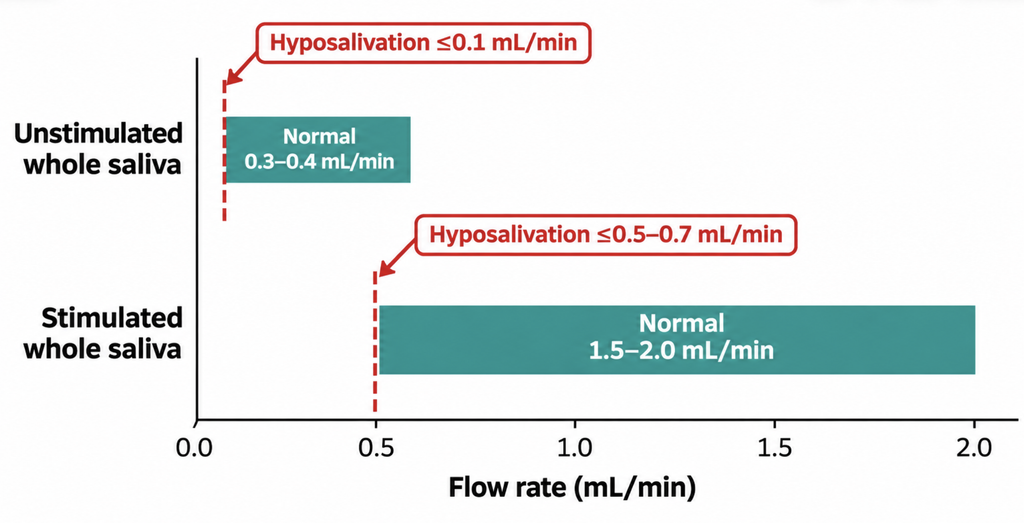
The two findings overlap less than expected. In older South Australians, 20.5% reported xerostomia and 22.1% had unstimulated flow below 0.1 mL/min, but only 5.7% had both [Thomson, Xerostomia and SGH, 1999], so the complaint alone appears to predict little about flow.
Why the Mouth Goes Dry: Medications First, Sjögren’s Rarely
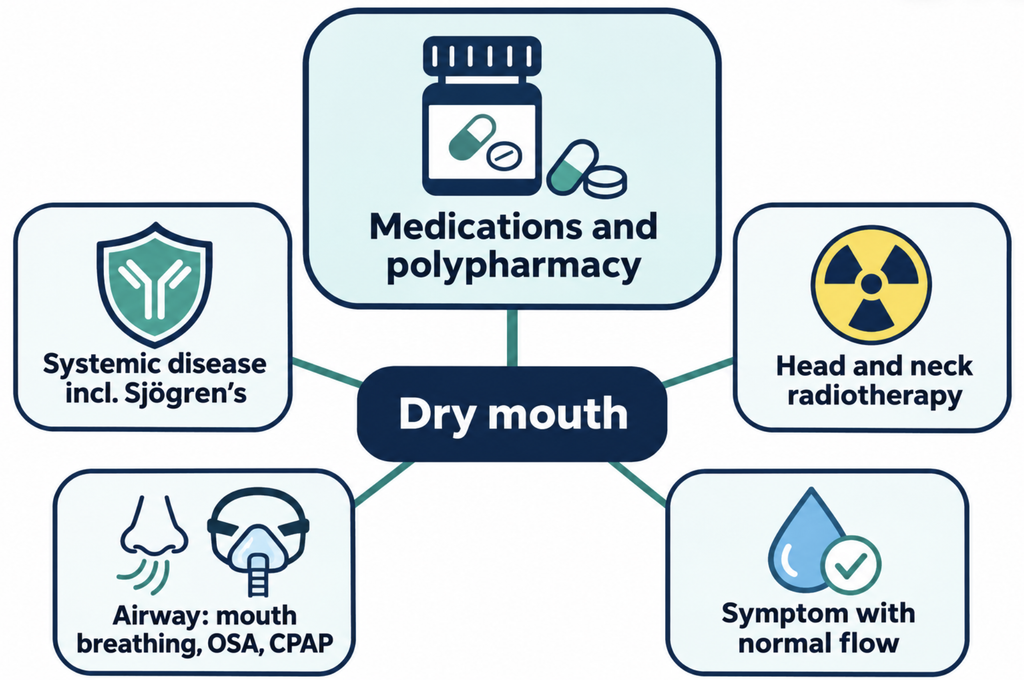
Medications and polypharmacy
A World Workshop on Oral Medicine review found 56 substances with higher-level and 50 with moderate-level evidence of inducing salivary gland dysfunction, xerostomia, or subjective sialorrhea [Wolff, Medication-Induced Salivary Dysfunction, 2017]. Among Swedes aged 50 to 80, medication use was associated with xerostomia at an odds ratio of 3.9 [Johansson, Dry Mouth in Swedes, 2020]. In an older patient taking an antidepressant, an antihypertensive, and a bladder antimuscarinic, drug effect is a more probable explanation than autoimmune disease.
Systemic disease, including Sjögren’s
Primary Sjögren’s is uncommon, with a pooled incidence of 6.92 per 100,000 person-years and a prevalence of 60.82 per 100,000, with wide regional variation [Qin, Epidemiology of Primary Sjögren’s, 2015]. It can also occur together with another systemic autoimmune disease [Ramos-Casals, EULAR Sjögren’s Recommendations, 2020]. Diabetes, thyroid disease, and psychiatric illness are also linked to dry mouth [Villa, Xerostomia and Hyposalivation, 2014], and xerostomia is the most common late effect of head and neck radiotherapy [Nutting, PARSPORT, 2011].
Airway factors: mouth breathing, OSA, and CPAP
Dryness that is worst at night or on waking can point to an airway cause. A scoping review of 48 studies found xerostomia consistently associated with obstructive sleep apnea (OSA) and frequently reported as a CPAP side effect [Raoof, Oral Moistening Disorders in OSA, 2024]. Among 1484 long-term CPAP users, dry mouth was independently associated with non-adherence [Rotty, CPAP Mask Side-Effects, 2021].
Who Is at Risk, and How Common Is It?
In the 2026 meta-analysis of 37 population-based studies, SGH prevalence was 12% (95% CI 4%–24%) by unstimulated flow and 13% (95% CI 3%–28%) by stimulated flow, compared with 21% for xerostomia [Kamnoedboon, Dry Mouth Prevalence, 2026].
Among 1451 adults aged 60 and older in southern Brazil, prevalence was 36.7%. It was higher in women (PR 1.44) and in those with polypharmacy (PR 1.22) or depressive symptoms (PR 1.45) [Mascarenhas, Xerostomia in Southern Brazil, 2025]. Patients treated with head and neck radiotherapy and those with Sjögren’s are the other high-risk groups.
The symptom also tends to persist. In the Swedish cohort, 61.4%–77.5% reported persistent xerostomia, and yearly incidence was 0.99%–3.28% [Johansson, Dry Mouth in Swedes, 2020].
Xerostomia Diagnosis and Treatment Start With Ruling Things Out
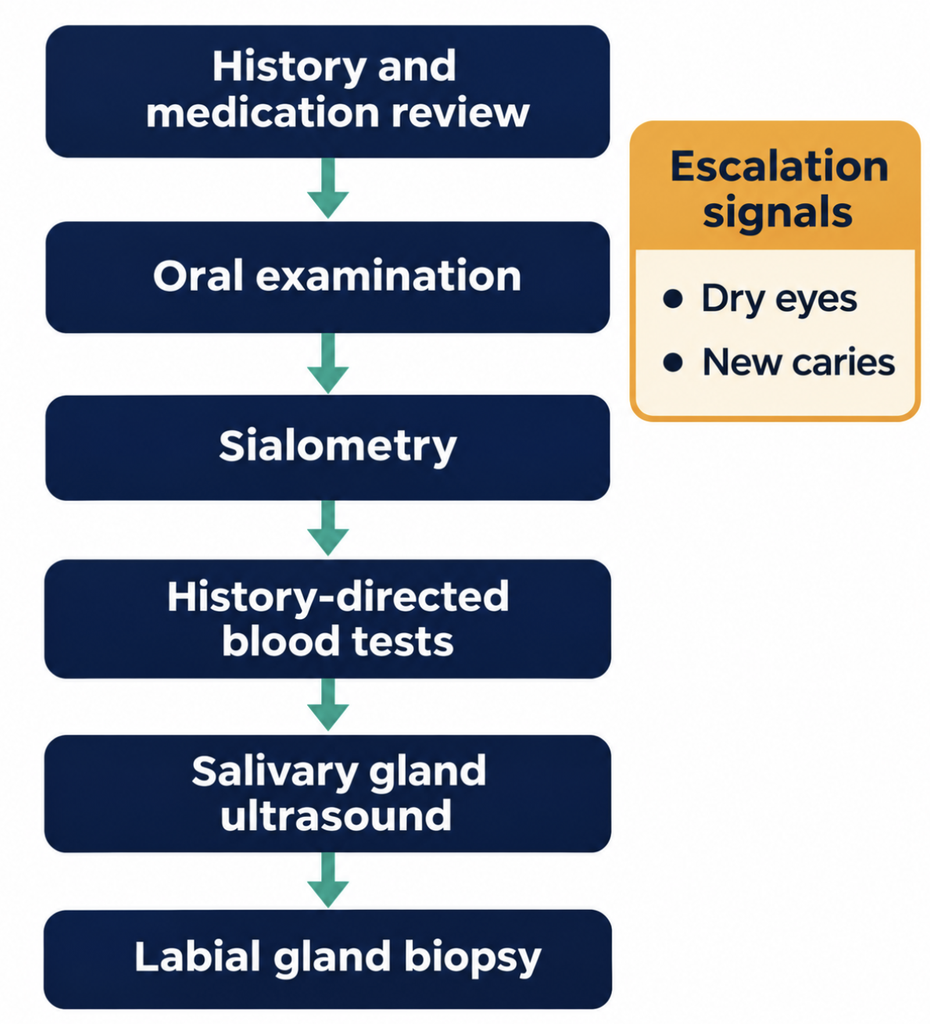
The workup proceeds from common causes to specific ones [Mayo Clinic Staff, Dry Mouth Diagnosis and Treatment, 2023].
| Step | What to do | What it separates |
|---|---|---|
| History | Medication list, day versus night pattern, snoring, CPAP | Drug effect, airway causes |
| Examination | Mucosa, saliva pooling, caries, candidiasis | Severity, complications |
| Sialometry | Unstimulated and stimulated whole saliva | Symptom only versus true SGH |
| Blood tests | Directed by history: glycemic status, thyroid function, anti-SSA/Ro | Diabetes, thyroid disease, Sjögren’s |
| Ultrasound | Major salivary glands | Sjögren’s-pattern change |
| Biopsy | Labial minor salivary gland | Focal lymphocytic sialadenitis |
Sialometry separates symptom-only dryness from true SGH. Normal flow with a burning or altered sensation may point more to a sensory disorder than to gland failure. In the Swedish cohort, burning mouth carried an odds ratio of 12.0 for xerostomia, although flow was not measured [Johansson, Dry Mouth in Swedes, 2020].
For suspected Sjögren’s, the 2016 ACR/EULAR criteria give 3 points each to anti-SSA/Ro and a focus score ≥1, and 1 point to unstimulated flow ≤0.1 mL/min; a total ≥4 classifies disease with 96% sensitivity and 95% specificity [Shiboski, ACR/EULAR Sjögren’s Criteria, 2017]. In expert-panel analyses, adding salivary gland ultrasound raised sensitivity from 90.2% to 95.6% with similar specificity [Jousse-Joulin, Salivary Gland Ultrasonography, 2020].
What Actually Works: Treatment Evidence and Patient Satisfaction
Remove the cause, then substitute or stimulate
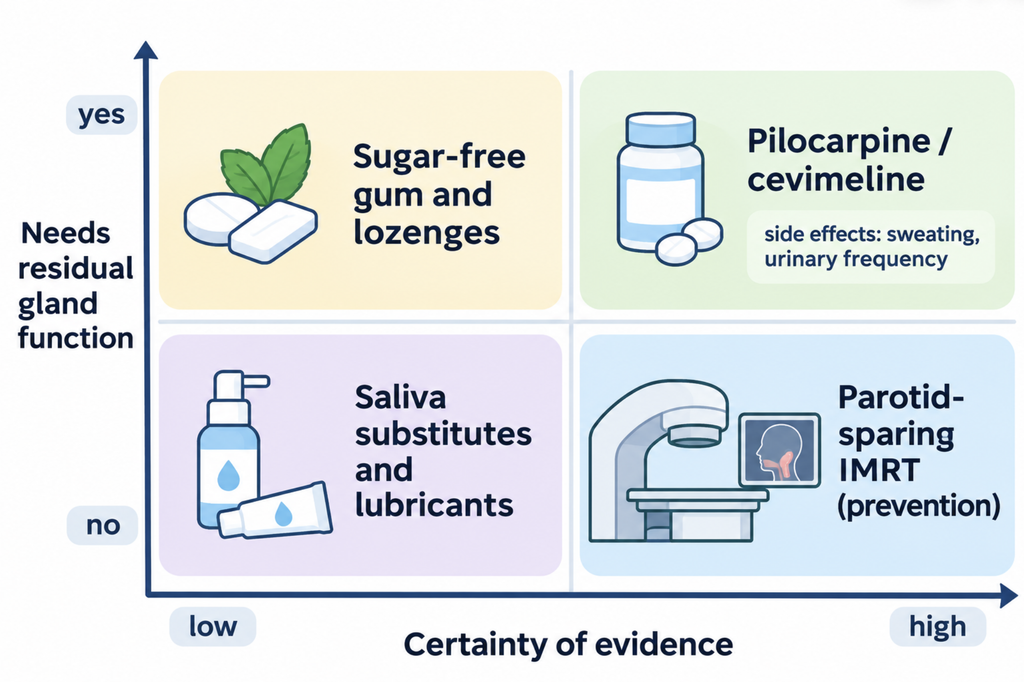
The World Workshop review lists drug substitution or discontinuation as the first strategy, although its source studies rarely measured flow [Wolff, Medication-Induced Salivary Dysfunction, 2017]. A Cochrane review of 36 RCTs with 1597 participants found no strong evidence that any topical therapy relieves dry mouth; only 1 trial was at low risk of bias, and an oxygenated glycerol triester spray outperformed an electrolyte spray by about 2 points on a 10-point VAS [Furness, Topical Therapies for Dry Mouth, 2011]. Chewing gum increased flow when residual gland capacity remained. The 2021 ISOO/MASCC/ASCO guideline rates the evidence for lubricants, substitutes, and sugar-free lozenges or gum after cancer therapy as intermediate quality [Mercadante, ISOO/MASCC/ASCO Guideline, 2021].
Systemic sialogogues
Pilocarpine and cevimeline are FDA-approved muscarinic agonists, and their effect depends on functioning glandular tissue [Villa, Xerostomia and Hyposalivation, 2014]. In a 12-week Sjögren’s RCT of 373 patients, pilocarpine 5 mg four times daily improved global dry-mouth ratings and raised salivary flow 2- to 3-fold [Vivino, Pilocarpine in Sjögren Syndrome, 1999], and the EULAR evidence review counted 5 RCTs supporting both agents [Brito-Zerón, EULAR Systematic Literature Review, 2019]. Evidence after radiotherapy is weaker. Roughly 42%–51% of patients respond, response can take up to 12 weeks, and at 5 mg three times daily, side effects such as sweating and urinary frequency lead 6%–15% to withdraw [Davies, Parasympathomimetics After Radiotherapy, 2007].
Direct data on patient satisfaction appear sparse. A Cochrane review of non-pharmacological interventions found that most trials did not report dry-mouth symptoms and noted that symptoms can persist even when flow rises [Furness, Non-Pharmacological Interventions for Dry Mouth, 2013].
After head and neck radiotherapy
Prevention has stronger evidence than treatment of established dryness. In PARSPORT, grade 2 or worse xerostomia at 12 months was 74% with conventional radiotherapy versus 38% with parotid-sparing IMRT, and 83% versus 29% at 24 months [Nutting, PARSPORT, 2011]; the guideline recommends tissue-sparing techniques when possible [Mercadante, ISOO/MASCC/ASCO Guideline, 2021]. For preventive and therapeutic interventions other than tissue-sparing radiotherapy, a meta-analysis of 31 RCTs found no consistent reduction in severity [Shrateh, Radiation-Induced Xerostomia Treatments, 2025].
Living With Dry Mouth: A Realistic Plan
Management aims at symptom control and protection of the dentition. NIDCR advises fluoride toothpaste, prescription fluoride when needed, sugar-free gum or candy, and a bedroom humidifier, and recommends avoiding caffeine, alcohol, and tobacco [National Institute of Dental and Craniofacial Research, Dry Mouth, 2022]. Mayo Clinic adds nasal breathing and avoiding alcohol-based mouthwashes and over-the-counter antihistamines [Mayo Clinic Staff, Dry Mouth Diagnosis and Treatment, 2023]. For dentate patients after cancer therapy, the guideline summary calls for discussing prescription fluoride [The ASCO Post, Joint Xerostomia Guideline, 2021].
For an older patient on several drugs with normal unstimulated flow, a reasonable sequence is to review the medication list with the prescriber, address nocturnal mouth breathing, start fluoride and sugar-free stimulation, and reserve a sialogogue for documented hypofunction with residual gland function.
Key Takeaways
- Xerostomia is a symptom and salivary gland hypofunction is a measurement; the two often do not coincide.
- A 2026 meta-analysis estimated xerostomia at 21% of adults aged 50 and older, with objective hypofunction less common.
- Medications likely explain far more cases of dry mouth than Sjögren’s, which is uncommon.
- Topical products give modest relief, sialogogues need residual gland function, and parotid-sparing radiotherapy has the strongest preventive evidence.
FAQ
What causes dry mouth if it is not Sjögren’s?
Medications are the usual cause; others include systemic disease, radiotherapy, and nocturnal mouth breathing. OSA is consistently associated with xerostomia, which is also a frequent CPAP side effect [Raoof, Oral Moistening Disorders in OSA, 2024].
How is xerostomia diagnosed?
From the history, with hypofunction confirmed by sialometry, usually at unstimulated flow ≤0.1 mL/min [Villa, Xerostomia and Hyposalivation, 2014]. Blood tests, ultrasound, and labial biopsy follow when Sjögren’s or another systemic cause is suspected.
Can xerostomia be cured?
Usually not, unless the cause is reversible, such as a drug that can be changed or a treatable airway problem. When gland tissue is lost, management focuses on symptom relief and caries prevention [Mercadante, ISOO/MASCC/ASCO Guideline, 2021].
References
- Kamnoedboon P, Spyraki F, Thomson WM, Srinivasan M. A Systematic Review and Meta-Analysis of the Global Prevalence of Dry Mouth in Older Adults. Gerodontology. 2026;43(3):383-402.
- Villa A, Connell CL, Abati S. Diagnosis and management of xerostomia and hyposalivation. Ther Clin Risk Manag. 2014 Dec 22;11:45-51.
- Thomson WM, Chalmers JM, Spencer AJ, Ketabi M. The occurrence of xerostomia and salivary gland hypofunction in a population-based sample of older South Australians. Spec Care Dentist. 1999;19(1):20-3.
- Wolff A, Joshi RK, Ekström J, et al. A Guide to Medications Inducing Salivary Gland Dysfunction, Xerostomia, and Subjective Sialorrhea: A Systematic Review Sponsored by the World Workshop on Oral Medicine VI. Drugs R D. 2017 Mar;17(1):1-28.
- Johansson AK, Johansson A, Unell L, Ekbäck G, Ordell S, Carlsson GE. Self-reported dry mouth in 50- to 80-year-old Swedes: Longitudinal and cross-sectional population studies. J Oral Rehabil. 2020 Feb;47(2):246-254.
- Qin B, Wang J, Yang Z, et al. Epidemiology of primary Sjögren’s syndrome: a systematic review and meta-analysis. Ann Rheum Dis. 2015 Nov;74(11):1983-9.
- Ramos-Casals M, Brito-Zerón P, Bombardieri S, et al. EULAR recommendations for the management of Sjögren’s syndrome with topical and systemic therapies. Ann Rheum Dis. 2020 Jan;79(1):3-18.
- Nutting CM, Morden JP, Harrington KJ, et al. Parotid-sparing intensity modulated versus conventional radiotherapy in head and neck cancer (PARSPORT): a phase 3 multicentre randomised controlled trial. Lancet Oncol. 2011 Feb;12(2):127-36.
- Raoof M, Verhoeff MC, Kooshki R, Aarab G, Lobbezoo F. Self-reported oral moistening disorders in obstructive sleep apnoea: A scoping review. J Oral Rehabil. 2024 Jan;51(1):226-239.
- Rotty MC, Suehs CM, Mallet JP, et al. Mask side-effects in long-term CPAP-patients impact adherence and sleepiness: the InterfaceVent real-life study. Respir Res. 2021 Jan 15;22(1):17.
- Mascarenhas MK, Cademartori MG, Borges RDC, et al. Prevalence and Associations of Xerostomia in Older Adults in Southern Brazil. Gerodontology. 2025;42(3):405-415.
- Mayo Clinic Staff. Dry mouth – Diagnosis and treatment. Mayo Clinic; 2023 Dec 19.
- Shiboski CH, Shiboski SC, Seror R, et al. 2016 American College of Rheumatology/European League Against Rheumatism Classification Criteria for Primary Sjögren’s Syndrome: A Consensus and Data-Driven Methodology Involving Three International Patient Cohorts. Arthritis Rheumatol. 2017 Jan;69(1):35-45.
- Jousse-Joulin S, Gatineau F, Baldini C, et al. Weight of salivary gland ultrasonography compared to other items of the 2016 ACR/EULAR classification criteria for Primary Sjögren’s syndrome. J Intern Med. 2020 Feb;287(2):180-188.
- Furness S, Worthington HV, Bryan G, Birchenough S, McMillan R. Interventions for the management of dry mouth: topical therapies. Cochrane Database Syst Rev. 2011 Dec 7;(12):CD008934.
- Mercadante V, Jensen SB, Smith DK, et al. Salivary Gland Hypofunction and/or Xerostomia Induced by Nonsurgical Cancer Therapies: ISOO/MASCC/ASCO Guideline. J Clin Oncol. 2021 Sep 1;39(25):2825-2843.
- Vivino FB, Al-Hashimi I, Khan Z, et al. Pilocarpine tablets for the treatment of dry mouth and dry eye symptoms in patients with Sjögren syndrome: a randomized, placebo-controlled, fixed-dose, multicenter trial. P92-01 Study Group. Arch Intern Med. 1999 Jan 25;159(2):174-81.
- Brito-Zerón P, Retamozo S, Kostov B, et al. Efficacy and safety of topical and systemic medications: a systematic literature review informing the EULAR recommendations for the management of Sjögren’s syndrome. RMD Open. 2019;5(2):e001064.
- Davies AN, Shorthose K. Parasympathomimetic drugs for the treatment of salivary gland dysfunction due to radiotherapy. Cochrane Database Syst Rev. 2007 Jul 18;(3):CD003782.
- Furness S, Bryan G, McMillan R, Birchenough S, Worthington HV. Interventions for the management of dry mouth: non-pharmacological interventions. Cochrane Database Syst Rev. 2013 Sep 5;(9):CD009603.
- Shrateh ON, Habib A, Ur Rehman Shamsi H, et al. Treatment options for radiation-induced xerostomia in patients with head and neck cancer: a systematic review and meta-analysis. Br J Oral Maxillofac Surg. 2025;64(1):24-32.
- National Institute of Dental and Craniofacial Research. Dry Mouth (Questions and Answers). NIH Publication No. 22-3174. Bethesda (MD): National Institutes of Health; 2022 Aug.
- The ASCO Post. ASCO and MASCC/ISOO Publish Joint Guideline on Prevention, Treatment of Salivary Gland Hypofunction and Xerostomia. 2021 Aug 25.
Joonpyo Hong, MD is a board-certified otolaryngologist practicing in Korea. This article reflects his clinical interpretation of published research and does not constitute individual medical advice.
For more articles:
https://curiousmd.com/morning-dry-mouth-causes-and-treatment/
https://curiousmd.com/leukoplakia-white-patches-cancer-risk/
https://curiousmd.com/aphthous-ulcer-treatment-ent-guide/
Link out to:
https://www.nidcr.nih.gov/sites/default/files/2022-09/Dry-Mouth-QA.pdf — NIH’s National Institute of Dental and Craniofacial Research Q&A on the causes of dry mouth and practical measures, including fluoride and night-time humidification.
https://www.mayoclinic.org/diseases-conditions/dry-mouth/diagnosis-treatment/drc-20356052 — Mayo Clinic overview of the dry mouth workup, from medication review and saliva measurement to lip biopsy, and the main treatment options.
https://ascopost.com/issues/august-25-2021/asco-and-masccisoo-publish-joint-guideline-on-prevention-treatment-of-salivary-gland-hypofunction-and-xerostomia — The ASCO Post summary of the joint ISOO/MASCC/ASCO guideline on preventing and treating xerostomia after cancer therapy.
https://www.mouthhealthy.org/all-topics-a-z/dry-mouth/ — American Dental Association consumer page on dry mouth, caries risk, and saliva-stimulating options.