
The source-filter theory of speech explains how a free browser instrument called CHIMERA can sing without any recorded samples (https://www.chimera.audio/). CHIMERA builds each sound by simulating air as it moves from the lungs, past the vocal folds, and out through the throat, mouth and nose [jamesondh, CHIMERA vocal synth, 2026]. In CHIMERA, the vocal tract runs on simulated airflow, while the vocal folds follow a programmed waveform.
The same split underlies dictation, voice cloning, pitch correction, cochlear implants and voice biomarker research. Each of these builds on the anatomy of the vocal tract, on how the cochlea reads a waveform, or on both.
What Is the Vocal Tract?
The vocal tract is the airway above the vocal folds, running through the pharynx and mouth to the lips. The vocal folds lie below it and are not part of it: they are the source, and the tract is the filter [Mannell, Source-Filter Theory, 2024].
| Part | Role in voice |
|---|---|
| Lungs | Power: air pressure |
| Vocal folds (glottis) | Source: the buzz; not part of the tract |
| Epilarynx and pharynx | Start of the tract; the tongue root forms the front wall of the pharynx |
| Oral cavity | Tongue, hard palate, teeth and lips shape vowels and most consonants |
| Nasal cavity | Side branch that joins when the soft palate lowers |
| Lips and nostrils | Exits where the sound leaves the body |
The tongue, soft palate, jaw and lips form moving walls that reshape the tract. When the soft palate lowers, the nasal cavity joins the filter and gives /m/ and /n/ their nasal quality [Mannell, Source-Filter Theory, 2024].
Tract length tracks body size, and the male-female difference in tract shape appears at puberty [Fitch, Morphology and development of the human vocal tract, 1999]. In a static MRI study of 41 speakers, oral and pharyngeal length accounted for almost three-quarters of the between-speaker variance in tract shape [Serrurier, Modeling of the vocal tract, 2023]. In the same study’s acoustic simulation, adding 1 cm to the tract lowered formants by 7% to 8%.

The Source-Filter Theory of Speech, Simply Explained
The source-filter theory of speech describes a voice as a source that makes a sound and a vocal tract that filters it. The idea goes back to Chiba and Kajiyama’s 1941 book The Vowel, and Fant set it out as modern acoustic theory in 1960 [Arai, Source-filter theory, 1998].
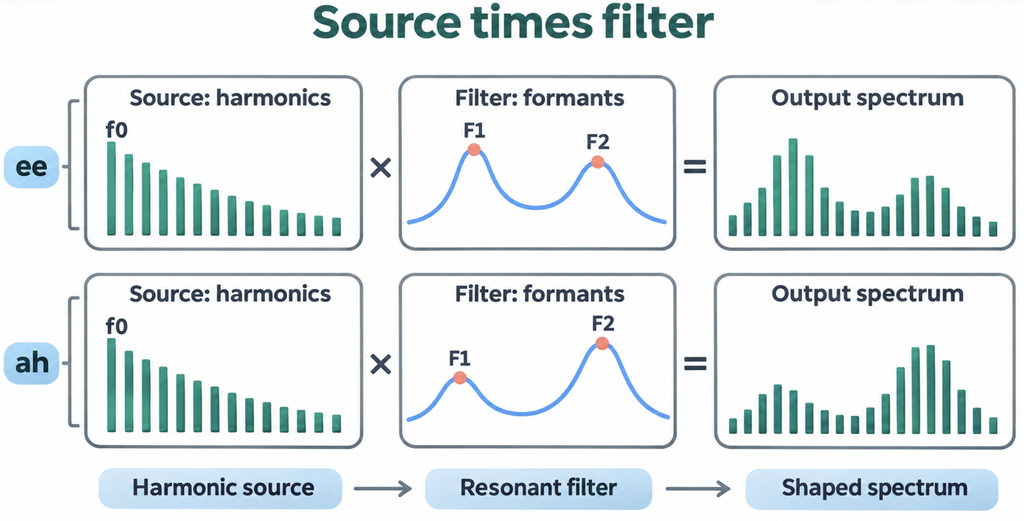
For vowels, the source is the vibrating vocal folds, which produce a fundamental frequency (heard as pitch) and a series of harmonics. The source sets pitch, while vowel identity depends on the filter [Mannell, Source-Filter Theory, 2024].
The filter’s resonances, called formants, boost some harmonics and weaken others, and each vowel has its own typical formant pattern. In measurements of American English vowels, formant values alone only partly separated neighboring vowels. Adding vowel duration and change across the vowel separated them with high accuracy [Hillenbrand, American English vowels, 1995].
Consonants add a second kind of source: noise from air forced through a narrow gap. The gap can be at the glottis, as in /h/ and whispering, or higher in the tract, as in /s/ [Mannell, Source-Filter Theory, 2024]. The part of the tract in front of the gap filters that noise.
The linear theory is an approximation, because in real speech the tract feeds back on the folds and changes glottal airflow. A narrow epilarynx strengthens this coupling [Titze, Nonlinear source-filter coupling, 2008]. Much of speech technology still runs on the linear version [Arai, Source-filter theory, 1998].
What the Split Means in the Clinic
The split also helps sort voice complaints. Hoarseness (dysphonia) is often a source problem, and the AAO-HNSF guideline lists benign vocal fold lesions and glottic insufficiency among the causes that may need surgery [Stachler, Hoarseness guideline update, 2018]. Hypernasality is a filter problem: in velopharyngeal dysfunction, the velopharynx fails to close during speech and air escapes through the nose [MacIsaac, Velopharyngeal dysfunction primer, 2025].
How Does the Ear Turn Sound Waves Into Speech?
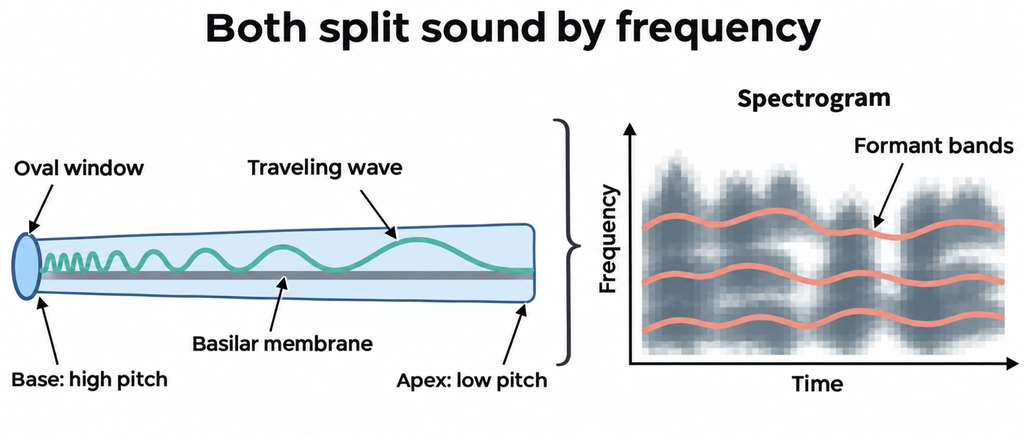
Sound reaches the ear as a waveform, a rapid series of pressure changes in the air. When fluid in the cochlea moves, a traveling wave runs along the basilar membrane. Hair cells near the base respond to high pitches, and hair cells near the apex respond to low pitches [NIDCD, How Do We Hear?, 2022].
Along its length, the cochlea splits the waveform into its component frequencies and works as a spectrum analyzer. In human cadaver ears, a single function describes this place-to-frequency map well [Greenwood, Cochlear frequency-position function, 1990].
Machines do the same job with a spectrogram, which plots frequency against time and shows energy as shading. Formants appear as dark bands that move as the tongue and lips move.
Everyday Technologies That Read the Voice
Voice Assistants and Dictation
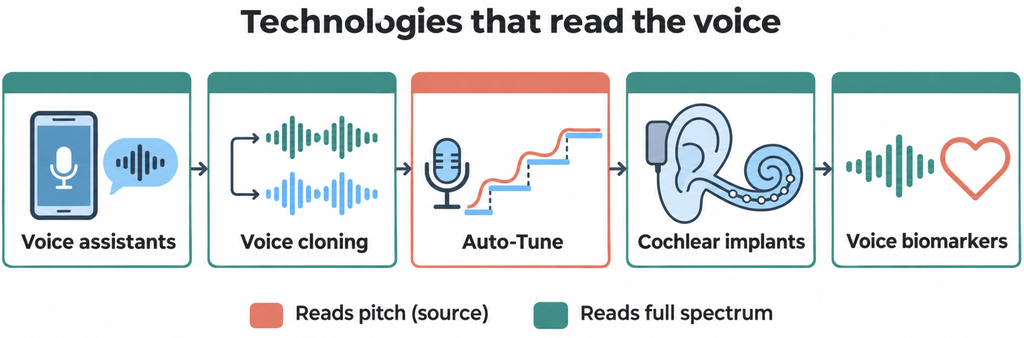
OpenAI’s Whisper, a speech recognition model trained on 680,000 hours of audio, cuts input into 30-second chunks. It converts each chunk into a log-Mel spectrogram before the model processes it [OpenAI, Introducing Whisper, 2022].
Voice Cloning and AI Narration
Voice cloning copies how a person sounds and makes that voice say new words. The US Federal Trade Commission warns that scammers can clone a relative’s voice from a short clip posted online [Puig, AI family emergency scams, 2023]. The FTC advises against trusting the voice alone and recommends calling back on a known number.
Auto-Tune
Pitch correction acts on the source. Auto-Tune’s inventor, Andy Hildebrand, had built autocorrelation methods to read seismic signals in oil exploration [Antares, Congratulations Dr. Andy, 2023]. Autocorrelation finds the interval at which a signal repeats, and in a voice that interval gives the pitch. Auto-Tune was introduced at the 1997 NAMM show.
Cochlear Implants
A cochlear implant reproduces the cochlear place map: its processor splits sound into frequency bands and assigns each band to an electrode along the cochlea. Anatomy, array length and insertion depth can shift electrodes away from the places that normally respond to their assigned frequencies, which may make music harder to hear [Lewis, Cochlear implant frequency-to-place maps, 2025]. More than 1,000,000 implants had been placed worldwide by July 2022 [NIDCD, Quick Statistics About Hearing, 2024].
Voice Biomarkers
Disorders of the heart, lungs, brain, muscles and vocal folds can all change the voice, which makes voice biomarkers plausible [Fagherazzi, Voice for Health, 2021]. In a Mayo Clinic cohort of 101 patients, 2 voice features were associated with coronary artery disease after adjustment for cardiovascular risk [Maor, Voice and coronary artery disease, 2018].
A systematic review of 264 Parkinson disease machine-learning studies, covering voice and other biomarker types, found a median best-model accuracy of 95.3%. However, 98.1% of the studies were at high risk of bias, and only 7.6% met the definition of external validation [Pinto Neto, Parkinson’s disease biomarkers review, 2026]. An otolaryngology review names small datasets and non-standard recording methods as the main limits of AI research in voice disorders [Kutler, Artificial Intelligence in Voice Disorders, 2026].
Key Takeaways
- The vocal tract runs from just above the vocal folds to the lips; the nasal cavity is a side branch that the soft palate opens.
- The source-filter theory of speech splits a voice into a source, the vibrating vocal folds, and a filter, the vocal tract.
- Pitch comes from the source, while vowel identity comes mostly from the formants of the filter.
- The cochlea and a spectrogram do the same job: they split sound into its frequencies over time.
- Speech recognition, Auto-Tune, cochlear implants and voice biomarker research all build on this split.
FAQ
What is the source-filter theory of speech?
A model that describes speech as a sound source shaped by a filter. The vocal folds, or a narrow point in the tract, make the sound, and the resonances of the vocal tract shape it [Mannell, Source-Filter Theory, 2024].
Does the vocal tract include the vocal folds?
No. In the standard model, the vocal folds are the source. The vocal tract is the airway above them, from the epilarynx to the lips, plus the nose when the soft palate is open [Mannell, Source-Filter Theory, 2024].
Can AI detect disease from the voice?
Not reliably yet. Voice features have been linked to coronary artery disease [Maor, Voice and coronary artery disease, 2018]. In a review of Parkinson disease machine-learning studies that included voice data, most had a high risk of bias and few had external validation [Pinto Neto, Parkinson’s disease biomarkers review, 2026].
References
- Arai Laboratory, Sophia University. Source-filter theory [Internet]. Tokyo: Sophia University; 1998 [cited 2026 Nov 15]. Available from: https://splab.net/apd/g500
- Antares Audio Technologies. Congratulations Dr. Andy: 2023 GRAMMYs [Internet]. Antares; 2023 Jan 28 [cited 2026 Nov 15]. Available from: https://www.antarestech.com/blog/congratulations-dr-andy-2023-grammys
- Fagherazzi G, Fischer A, Ismael M, Despotovic V. Voice for health: the use of vocal biomarkers from research to clinical practice. Digit Biomark. 2021;5(1):78-88.
- Fitch WT, Giedd J. Morphology and development of the human vocal tract: a study using magnetic resonance imaging. J Acoust Soc Am. 1999;106(3 Pt 1):1511-22.
- Greenwood DD. A cochlear frequency-position function for several species–29 years later. J Acoust Soc Am. 1990;87(6):2592-605.
- Hillenbrand J, Getty LA, Clark MJ, Wheeler K. Acoustic characteristics of American English vowels. J Acoust Soc Am. 1995;97(5 Pt 1):3099-111.
- jamesondh. CHIMERA vocal synth [Internet]. GitHub; 2026 [cited 2026 Nov 15]. Available from: https://github.com/jamesondh/chimera-vocal-synth
- Kutler RB, Rameau A. Artificial intelligence in voice disorders: current landscape, emerging applications and future directions. World J Otorhinolaryngol Head Neck Surg. 2026;12(5):523-531.
- Lewis RM, Gilbert ML, Beim JA, Oxenham AJ, Limb CJ. Using musical pitch interval comparisons to assess cochlear implant frequency-to-place maps. Front Audiol Otol. 2025;3:1565883.
- MacIsaac MF, Elsamna SL, Quintana JF, Rottgers SA, Halsey JN. MRI assessment of velopharyngeal dysfunction: a comprehensive primer for radiologists. Pediatr Radiol. 2025;55(6):1088-1104.
- Mannell R. Source-filter theory [Internet]. Sydney: Macquarie University; 2024 [cited 2026 Nov 15]. Available from: https://www.mq.edu.au/faculty-of-medicine-health-and-human-sciences/departments-and-schools/department-of-linguistics/our-research/phonetics-and-phonology/speech/acoustics/acoustic-theory-of-speech-production/source-filter-theory
- Maor E, Sara JD, Orbelo DM, Lerman LO, Levanon Y, Lerman A. Voice signal characteristics are independently associated with coronary artery disease. Mayo Clin Proc. 2018;93(7):840-847.
- National Institute on Deafness and Other Communication Disorders (NIDCD). How do we hear? [Internet]. Bethesda (MD): NIDCD; 2022 [cited 2026 Nov 15]. Available from: https://www.nidcd.nih.gov/health/how-do-we-hear
- National Institute on Deafness and Other Communication Disorders (NIDCD). Quick statistics about hearing [Internet]. Bethesda (MD): NIDCD; 2024 [cited 2026 Nov 15]. Available from: https://www.nidcd.nih.gov/health/statistics/quick-statistics-hearing
- OpenAI. Introducing Whisper [Internet]. OpenAI; 2022 [cited 2026 Nov 15]. Available from: https://openai.com/research/whisper
- Pinto Neto O, Pinho TOR. Machine learning for Parkinson’s disease biomarkers: a systematic review of diagnostic performance, risk of bias, and clinical translation readiness. Brain Sci. 2026;16(10):1027.
- Puig A. Scammers use AI to enhance their family emergency schemes [Internet]. Washington (DC): Federal Trade Commission; 2023 Mar 20 [cited 2026 Nov 15]. Available from: https://consumer.ftc.gov/consumer-alerts/2023/03/scammers-use-ai-enhance-their-family-emergency-schemes
- Serrurier A, Neuschaefer-Rube C. Morphological and acoustic modeling of the vocal tract. J Acoust Soc Am. 2023;153(3):1867.
- Stachler RJ, Francis DO, Schwartz SR, Damask CC, Digoy GP, Krouse HJ, et al. Clinical practice guideline: hoarseness (dysphonia) (update). Otolaryngol Head Neck Surg. 2018;158(1_suppl):S1-S42.
- Titze IR. Nonlinear source-filter coupling in phonation: theory. J Acoust Soc Am. 2008;123(5):2733-49.
Joonpyo Hong, MD is a board-certified otolaryngologist practicing in Korea. This article reflects his clinical interpretation of published research and does not constitute individual medical advice.
For more articles:
https://curiousmd.com/singers-formant-ent-guide/
https://curiousmd.com/mdvp-voice-analysis-interpretation/
https://curiousmd.com/ai-laryngeal-cancer-detection/
https://curiousmd.com/how-ai-voice-cloning-works/
https://curiousmd.com/injection-laryngoplasty-materials/
Link out to:
https://www.chimera.audio/ – you can try the program.
https://www.nidcd.nih.gov/health/how-do-we-hear — NIDCD explains how the cochlea turns sound waves into nerve signals, with high pitches sensed near the base and low pitches near the apex.
https://www.mq.edu.au/faculty-of-medicine-health-and-human-sciences/departments-and-schools/department-of-linguistics/our-research/phonetics-and-phonology/speech/acoustics/acoustic-theory-of-speech-production/source-filter-theory — A Macquarie University phonetics primer on the source-filter theory and what the vocal tract filter includes.
https://openai.com/research/whisper — OpenAI describes how its Whisper model turns audio into a log-Mel spectrogram before transcribing it.
https://consumer.ftc.gov/consumer-alerts/2023/03/scammers-use-ai-enhance-their-family-emergency-schemes — The US Federal Trade Commission warns about voice-cloning scam calls and how to check a caller.