
A hospital committee is reviewing an AI tool that flags urgent findings on chest X-rays. The sales slides show three marks of AI medical device approval: US FDA clearance, a European CE mark, and approval from Korea’s Ministry of Food and Drug Safety (MFDS). One member asks whether those marks mean the tool will work on the hospital’s own patients, and nobody in the room can answer with confidence.
Approval and real-world performance can differ. In a study of 950 AI devices on FDA’s list, 60 (6.3%) were linked to recalls, a measure of device problems rather than of patient harm [Lee, Early Recalls and Clinical Validation Gaps, 2025]. Recalls were uncommon, but 43.4% of the 182 recall events came within 12 months of clearance, and recalls were concentrated in devices with no reported clinical testing. A 2026 study of 903 devices found a similar link, though the size of that link was uncertain [Ren, Clinical Evidence and FDA Recalls, 2026]. Both studies are observational, so they cannot show that missing tests cause recalls.
Each region’s label reflects a real review, but the US, the EU, and Korea check different things, and none of them tests the tool on a given hospital’s patients.
What AI medical device approval means in each region
In all three regions, software meant to diagnose or treat patients can be regulated as a medical device. Regulators then sort devices into groups, called risk classes, by how much harm a mistake could cause. A higher class usually means a closer review.
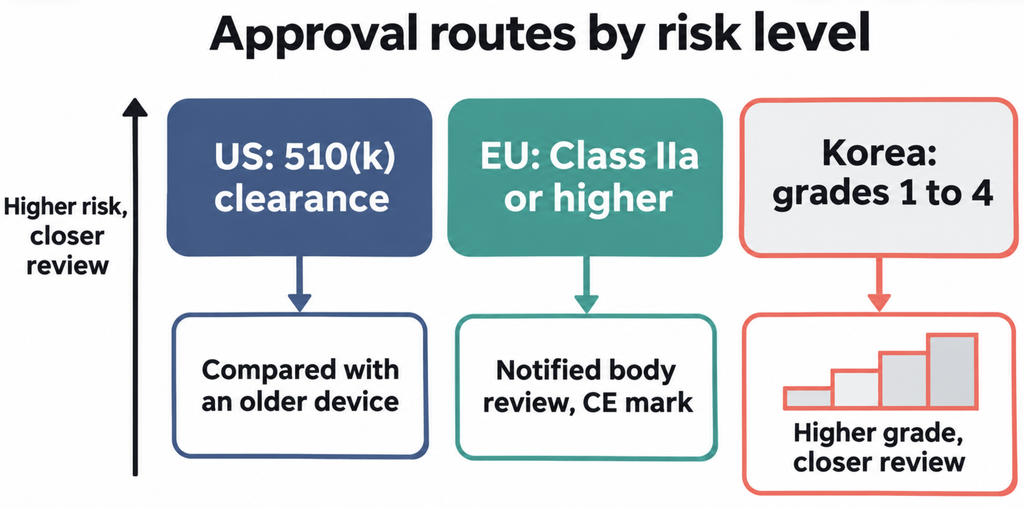
In the US, FDA regulates medical devices that contain AI rather than AI itself. Its public list counted more than 1,600 AI-enabled devices as of September 2026 [FDA, AI-Enabled Medical Devices, 2026]. Nearly all of them reached the market through a route called 510(k), by showing that they were as safe and effective as a similar device already sold [Lee, Early Recalls and Clinical Validation Gaps, 2025] [FDA, Premarket Notification 510(k)]. FDA calls the result a clearance, which is not a direct finding of safety and effectiveness [CRS, FDA Regulation of Medical Devices, 2016].
In the EU, most diagnostic AI software falls in Class IIa or higher. At these classes, the maker cannot certify the product alone. An independent auditing organization, called a notified body, must review it first, and a product that passes carries the CE mark [DQS, Medical Device Software MDR Guide, 2026]. AI in these devices is also treated as high-risk under a separate law, the EU AI Act [Taylor Wessing, AI-Enabled Devices Confirmed as High-Risk, 2026].
Korea passed a dedicated law for digital medical products, which took effect on January 24, 2025 [Medifonews, Digital Device Clinical Data Exemption Rules, 2026]. In general, it sorts digital devices into four risk grades (1 to 4). Grades 3 and 4, the riskiest, need full approval from MFDS. Grade 2 usually needs a lighter certification, and grade 1 only needs a notice to the regulator [Enforcement Rule of the Digital Medical Products Act, 2025].
What proof did each regulator ask for?
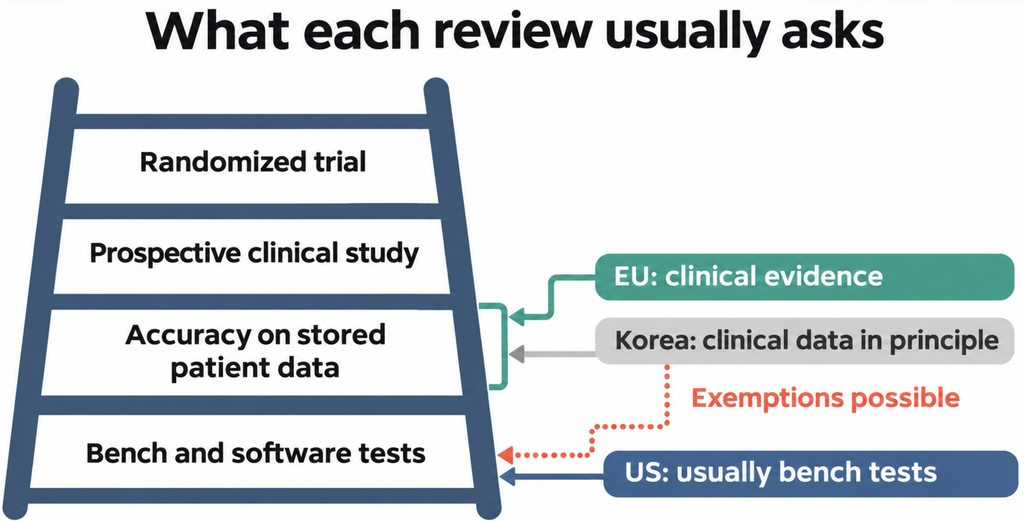
Approval in a region shows that a device passed the review its risk class requires there, but the label does not say what kind of evidence that review used. Bench and software tests that check the tool works as designed are often called performance testing. A study that measures the tool’s accuracy on patient data against a clear standard, using past records or new patients, is called clinical validation.
The US: compared with an older device
A 510(k) usually does not require clinical data. Bench tests and software checks can be enough to show that a new device is as safe and effective as the older device [FDA, Premarket Notification 510(k)] [CRS, FDA Regulation of Medical Devices, 2016]. Researchers reviewed the public summaries of 903 AI devices on FDA’s list as of August 31, 2024. Only about half (505 devices, 55.9%) described any clinical study, and 218 (24.1%) stated that none was done [Windecker, Generalizability of FDA-Approved AI-Enabled Medical Devices, 2025]. Among the studies described, about 8% were prospective and about 2% were randomized. Summaries can leave out studies that were done, so the real share may be higher.
The EU: clinical evidence now, AI rules from 2028
EU device rules ask makers of medical software to show clinical evidence for the benefit they claim [DQS, Medical Device Software MDR Guide, 2026]. The AI Act adds AI-specific duties: makers will have to manage AI risks, check training data for quality and bias, and design the tool so people can oversee it [CDT Europe, Open Joint Letter on AI Medical Devices, 2026]. Under the current rules, set by a July 2026 amendment, these duties start for medical devices on August 2, 2028, one year later than first planned [Regulation (EU) 2026/1744, 2026] [Taylor Wessing, AI-Enabled Devices Confirmed as High-Risk, 2026].
Korea: clinical data in principle, with exemptions
Korea’s written rule is stricter: since the 2025 law, software devices must in principle submit clinical trial data. Exceptions exist, and in July 2026 MFDS set clearer rules for them [Medifonews, Digital Device Clinical Data Exemption Rules, 2026]. MFDS built these rules from about 1,000 past approvals, some of them based on performance testing alone, but it has not said how many. MFDS has also been carrying out review reforms it announced in May 2026 [Dailymedi, Medical Product Review Reform Plan, 2026]. In October 2026 it presented more detailed review procedures and 13 new or revised guidelines for digital devices, including AI products [MFDS, Digital Medical Device Review Briefing, 2026].
| US (FDA) | EU (CE mark and AI Act) | Korea (MFDS) | |
|---|---|---|---|
| Main question of the review | Is it as safe and effective as a similar device already sold? | Does clinical evidence support the claimed benefit? | Does clinical trial data support it, unless an exemption applies? |
| Clinical data | Usually not required | Clinical evidence required for the claimed benefit | Required in principle; exemption rules exist, scale not public |
| Who signs off | FDA | Notified body (Class IIa or higher) | MFDS for full approval (grades 3 and 4) |
| Rules for AI updates | Optional pre-approved update plan | Pre-planned changes allowed; big unplanned changes need a new review (from 2028) | Optional change-control plan (2026 guideline) |
What none of the three checks
AI tools can perform differently on data from a new hospital. A systematic review of 86 radiology deep learning algorithms in 83 studies found that 81% did somewhat worse on data from other hospitals [Yu, External Validation of Deep Learning Algorithms, 2022]. About a quarter (24%) dropped by 0.10 or more in AUC (area under the curve) or a similar measure. Another review found an average drop of 6% across 77 studies with outside testing, and some tools did as well or better [Kelly, RAISE, 2022].
Outside imaging, a widely used sepsis model built into an electronic health record reached an AUC of 0.63 at one academic hospital and missed 67% of patients with sepsis [Wong, External Validation of a Proprietary Sepsis Model, 2021]. The model was not an FDA-cleared device.
Among recalled devices in the 2025 study, those with no reported clinical validation averaged 3.4 recall events each, against 1.9 with retrospective and 2.0 with prospective validation [Lee, Early Recalls and Clinical Validation Gaps, 2025]. These are associations, and recalls overall were uncommon.
Approval confirms that the maker met that region’s evidence rules, which may not include a clinical study. It does not show whether the tool was tested on patients like those in a given hospital, or how it performed there.
Can the AI change after approval?
FDA’s final guidance lets a maker get an update plan, called a predetermined change control plan (PCCP), approved together with the device. Updates that stay inside that plan do not need a new FDA filing each time [FDA, PCCP Guidance for AI-Enabled Device Software Functions, 2025].
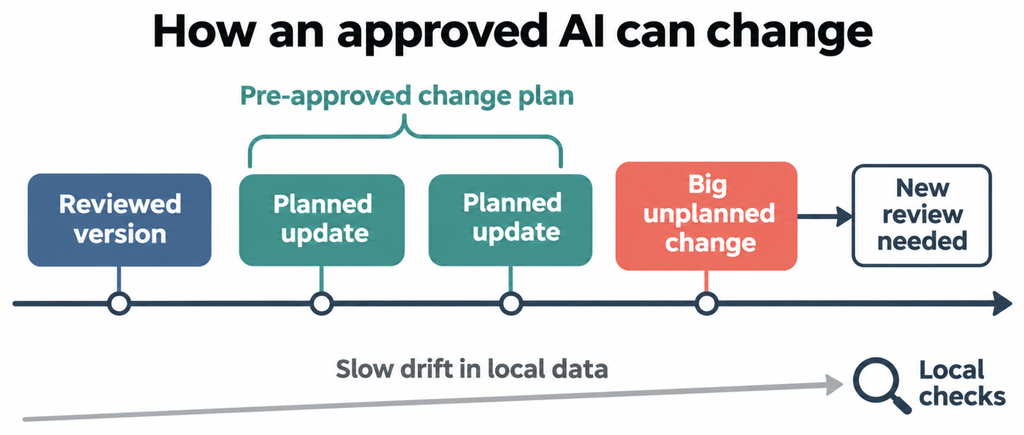
A PCCP has three parts: a list of the planned changes, the methods to build and test them, and an assessment of their impact. Korea’s MFDS issued a similar guideline for change-control plans on June 26, 2026 [MFDS, Change Control Plan Guideline for Digital Medical Devices, 2026]. The EU AI Act also requires a fresh review for a big change, unless the maker planned it in advance and it was checked at the original review [EU AI Act, Recital 128, 2024]. Under the current rules, it applies from August 2, 2028, like the other AI Act duties for devices. An approval shows whether the maker has an approved update plan, if the review included one. In all three regions, though, the version a hospital runs today may differ from the version first reviewed.
Change can also happen without any update, because a tool’s accuracy can drift as patients and care practices shift. In one nine-year study of hospital risk models for acute kidney injury, the models kept their ability to rank patients by risk. They increasingly overestimated risk, however, as the rate of the condition changed [Davis, Calibration Drift in Models for Acute Kidney Injury, 2017]. An update plan covers only changes the maker makes, so slow drift of this kind since approval can go unnoticed unless someone checks the tool’s results at the site.
Who watches the AI once a hospital uses it?
The EU has set out in law who must check that an AI tool still works once a hospital uses it. These duties do not apply yet: under the current rules, they start on August 2, 2028. A hospital using high-risk AI must then follow the maker’s instructions and name trained staff with the authority to oversee it [EU AI Act, Article 26, 2024]. It must also watch how the tool performs, keep its automatic records for at least six months, and report serious incidents. If it suspects a risk, it must stop using the tool and tell the maker and the authorities.

This duty to keep trained people in charge of the tool is called human oversight. In a hospital, these duties fall on the institution, not on each doctor. In a small practice, the two can be the same [Hogan Lovells, EU AI Act and MDR Regulate AI-Enabled Devices, 2026].
These duties could still change: a separate proposal to revise the EU device rules, published in December 2025, would remove most AI Act duties from medical devices [Gleiss Lutz, MDR/IVDR Simplification and the AI Act, 2026]. In May 2026, EU lawmakers agreed to amend the AI Act without such an exemption. As of November 2026, the device-rule proposal was still at the committee stage in the European Parliament, with no final agreement [European Parliament, Legislative Observatory, 2026]. Groups representing doctors and hospitals have publicly opposed it [CDT Europe, Open Joint Letter on AI Medical Devices, 2026].
In the US, FDA rules are written mainly for makers, although hospitals must report device-linked deaths and serious injuries [21 CFR Part 803, Medical Device Reporting]. Advice to test an AI tool locally before use comes from voluntary guidance. The Joint Commission and the Coalition for Health AI (CHAI) issued such guidance on September 17, 2025, covering local validation and monitoring [Joint Commission and CHAI, Responsible Use of AI in Healthcare, 2025]. Five radiology societies gave similar advice in a 2024 joint statement [Brady, Multi-Society Statement on AI Tools in Radiology, 2024].
Korea’s Medical Devices Act also places duties on hospital operators: they must report known or suspected device-related deaths or serious adverse effects to MFDS and keep records. They must also tell affected patients when MFDS notifies them of a device’s side effects and recall plan [Medical Devices Act (Korea), Article 31, 2025]. However, standalone AI software that runs on an ordinary computer is generally exempt from these provisions unless serious harm to public health is a concern [Digital Medical Products Act (Korea), Article 28, 2024]. Whether a given chest X-ray AI counts as standalone software depends on the product. The laws reviewed here set no general duty to test AI tools locally or to monitor drift.
Human oversight has limits, because people tend to favor a machine’s suggestion even when it is wrong, a pattern called automation bias. In one reading experiment, 27 radiologists read 40 test mammograms with help from a supposed AI, which was set to suggest the wrong category on 12 of them [Dratsch, Automation Bias in Mammography, 2023]. The most experienced group was correct on about 82% of mammograms when the AI was right, but on about 46% when it was wrong. For the least experienced readers, the figures were 79.7% and 19.8%.
The AI was not real and its errors were set on purpose. Even so, the result suggests that having a person check the AI does not by itself prevent errors when the AI is wrong.
Under the current EU rules, approval will show from August 2028 that the maker designed the tool so people can oversee it. Whether the hospital has trained staff, monitoring, and a clear way to stop the tool is a separate question that approval does not answer.
Approval is not payment, and not proof of benefit
Approval means a tool may be legally sold and used for its stated purpose. It does not settle whether insurance will pay for it or whether it improves patient outcomes.
In Korea, approval is only the first step. A new test or treatment usually then needs a check on whether the technology is new, a review of its clinical value, and a coverage decision [Shin & Kim, Immediate Market Entry Pathway for Medical Technologies, 2026]. The clinical-value review is called the new health technology assessment. The whole path could take up to 490 days, with that review alone taking up to 250 days.
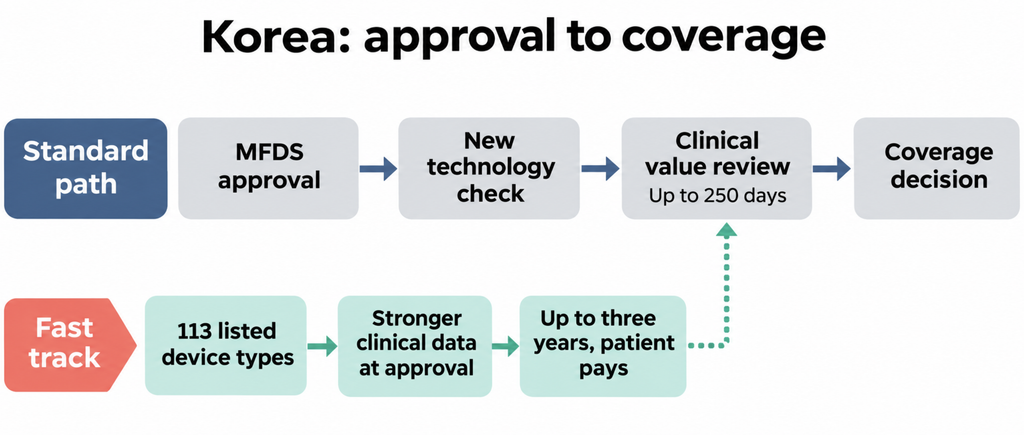
Since January 26, 2026, a fast track lets 113 listed types of digital and AI devices skip that review at first. In exchange, the maker must submit stronger clinical evaluation data at approval. The tool can then be used for up to three years, paid for by patients, while the review and coverage decision continue. The fastest path is about 80 days [Shin & Kim, Immediate Market Entry Pathway for Medical Technologies, 2026]. A later review can still end the tool’s use.
In the US, approval does not mean a tool is widely used or billed. In national data covering 11 billion claims from 2018 to mid-2023, only two AI uses, for coronary artery disease and for diabetic eye disease, had more than 10,000 claims [Wu, Clinical Adoption of Medical AI Devices through U.S. Insurance Claims, 2023].
Evidence of patient benefit is more limited: a 2024 review found 86 randomized trials of AI in clinical practice worldwide [Han, Randomised Controlled Trials Evaluating AI in Clinical Practice, 2024]. Of these, 70 (81%) reported a positive main result, but most of those results were about detection rates or test performance rather than patient outcomes. Most trials were also run at a single center.
Questions to ask a vendor before signing
The table turns the open questions from each section into questions a hospital can ask vendors before it buys an approved AI tool. A strong answer comes with documents or data.
| Question | Why it matters | A strong answer includes |
|---|---|---|
| Which route did each approval use? | Approval means different reviews in each region | The 510(k) summary, EU class, MFDS grade, and studies |
| Was the tool tested at hospitals that did not help build it? | In published radiology studies, most tools did somewhat worse on outside data | Results from several outside sites |
| Was there a prospective or randomized study? | Few FDA device summaries describe one | A published study with patient outcomes |
| Is there a pre-approved update plan? | The running version can differ from the reviewed one | The plan and a version history |
| What monitoring and records come with it? | Accuracy can drift with no update | Built-in logs and help with local checks |
| Has the tool had recalls? | Recalls are uncommon, but in one study 43.4% of recall events came within a year | A full list with causes and fixes |
| Is it covered or billable? | Approval does not decide payment | Current coverage status |
Each mark checks something different, and none of them shows how the tool performs on a particular hospital’s patients. That check is left to the hospital, under different rules in each region. In the US, local testing rests on voluntary guidance. Under the current EU rules, hospitals will have to oversee high-risk AI tools and keep their records from August 2, 2028. In Korea, the laws reviewed here set no general duty to test AI tools locally.
Key Takeaways
- FDA clearance, a CE mark, and MFDS approval each answer a different question.
- Nearly all AI devices on FDA’s list came through the 510(k) route, which usually does not require clinical data.
- Korea requires clinical trial data for software devices in principle, but exemption rules exist and their scale is not public.
- The EU alone plans broad oversight duties for hospitals using high-risk AI, from August 2, 2028 under current rules, and a pending proposal could narrow them.
- In published studies, radiology AI tools often did somewhat worse at other hospitals, and none of the three approval systems tests local performance.
- Approval does not decide payment or prove patient benefit, and most randomized AI trials have reported detection or test performance rather than patient outcomes.
FAQ
Does FDA clearance mean an AI tool was tested on patients?
Not necessarily. Most AI devices are cleared through the 510(k) route, which usually does not require clinical data. In FDA’s public summaries, only about half of AI devices described any clinical study, and about 2% of the described studies were randomized [Windecker, Generalizability of FDA-Approved AI-Enabled Medical Devices, 2025].
Is FDA “cleared” the same as FDA “approved”?
No. Clearance is the result of the 510(k) route, which compares a device with one already on the market. Approval is the term for the stricter premarket approval route for high-risk devices, which generally needs clinical data [CRS, FDA Regulation of Medical Devices, 2016].
Does a CE mark mean an AI tool will work in any European hospital?
No. For most diagnostic AI software, a CE mark means a notified body reviewed the maker’s evidence, including clinical evidence for the claimed benefit [DQS, Medical Device Software MDR Guide, 2026]. The review does not test the tool on each hospital’s patients.
Does MFDS approval mean Korean health insurance will cover the tool?
No. In Korea, approval is usually followed by separate steps: a check on whether the technology is new, a review of its clinical value, and a coverage decision. Under a 2026 fast track, makers of 113 listed types of digital and AI devices can submit stronger clinical data at approval. The device can then be used for up to three years at the patient’s expense before that review ends [Shin & Kim, Immediate Market Entry Pathway for Medical Technologies, 2026].
References
- U.S. Food and Drug Administration (FDA). Artificial Intelligence-Enabled Medical Devices [Internet]. Silver Spring (MD): FDA; 2026 [cited 2026 Nov 16]. Available from: https://www.fda.gov/medical-devices/digital-health-center-excellence/artificial-intelligence-enabled-medical-devices
- U.S. Food and Drug Administration (FDA). Premarket Notification 510(k) [Internet]. Silver Spring (MD): FDA [cited 2026 Nov 16]. Available from: https://www.fda.gov/medical-devices/premarket-submissions/premarket-notification-510k
- U.S. Food and Drug Administration (FDA). Marketing Submission Recommendations for a Predetermined Change Control Plan for Artificial Intelligence-Enabled Device Software Functions: Guidance for Industry and Food and Drug Administration Staff. Silver Spring (MD): FDA; 2025 Aug. Available from: https://www.fda.gov/regulatory-information/search-fda-guidance-documents/marketing-submission-recommendations-predetermined-change-control-plan-artificial-intelligence
- CRS (Congressional Research Service). FDA Regulation of Medical Devices (R42130). Washington (DC): CRS; 2016 Sep 14. Available from: https://www.everycrsreport.com/reports/R42130.html
- Lee B, Kramer P, Sandri S, Chanda R, Favorito C, Nasef O, et al. Early Recalls and Clinical Validation Gaps in Artificial Intelligence-Enabled Medical Devices. JAMA Health Forum. 2025;6(8):e253172.
- Ren Y, Zheng Y, Windecker D, Fraser AG, Siontis GCM, Caiani EG. Clinical Evidence and FDA Recalls of Artificial Intelligence-Enabled Medical Devices. JAMA Netw Open. 2026;9(6):e2617920.
- Windecker D, Baj G, Shiri I, Kazaj PM, Kaesmacher J, Gräni C, et al. Generalizability of FDA-Approved AI-Enabled Medical Devices for Clinical Use. JAMA Netw Open. 2025;8(4):e258052.
- DQS Global. Medical device software under the MDR: certification guide [Internet]. 2026 Sep 18 [cited 2026 Nov 16]. Available from: https://www.dqsglobal.com/en/explore/dqs-knowledge-center/medical-device-software-mdr-certification-guide
- Taylor Wessing. Update: AI-enabled medical devices and IVDs confirmed as high-risk [Internet]. 2026 [cited 2026 Nov 16]. Available from: https://www.taylorwessing.com/en/international-life-sciences-newsletter/life-sciences-legal-lens-vol-2/update-ai-enabled-medical-devices-and-ivds-confirmed-as-high-risk
- Hogan Lovells. EU AI Act and MDR regulate AI-enabled devices. LSHC Horizons 2026 [Internet]. 2026 [cited 2026 Nov 16]. Available from: https://insights.hoganlovells.com/report/lshc-horizons-2026/eu-ai-act-and-mdr-regulate-ai-enabled-devices
- Regulation (EU) 2026/1744 of the European Parliament and of the Council of 8 July 2026 amending Regulations (EU) 2024/1689, (EU) 2018/1139 and (EU) 2023/1230 (Digital Omnibus on AI). Off J Eur Union. 2026 Jul 24;L 2026/1744. Available from: https://eur-lex.europa.eu/eli/reg/2026/1744/oj?locale=en
- European Commission AI Act Service Desk. Regulation (EU) 2024/1689 (Artificial Intelligence Act), Article 26: Obligations of deployers of high-risk AI systems [Internet]. 2024 [cited 2026 Nov 16]. Available from: https://ai-act-service-desk.ec.europa.eu/en/ai-act/article-26
- European Commission AI Act Service Desk. Regulation (EU) 2024/1689 (Artificial Intelligence Act), Recital 128 [Internet]. 2024 [cited 2026 Nov 16]. Available from: https://ai-act-service-desk.ec.europa.eu/en/ai-act/recital-128
- CDT Europe, ANEC, BEUC, CPME, EAHP, HOPE. Open Joint Letter: The AI Act must keep regulating AI-embedded medical devices [Internet]. 2026 Jul 15 [cited 2026 Nov 16]. Available from: https://cdt.org/wp-content/uploads/2026/07/Open-Joint-Letter-on-AI-medical-devices.pdf
- Gleiss Lutz. Radical simplification of the MDR and IVDR and broad inapplicability of the AI Act to medical devices and IVDs [Internet]. 2026 [cited 2026 Nov 16]. Available from: https://www.gleisslutz.com/en/know-how/radical-simplification-mdr-and-ivdr-and-broad-inapplicability-ai-act-medical-devices-and-ivds
- Enforcement Rule of the Digital Medical Products Act (Korea), Article 6. Prime Minister’s Decree; enacted 2025 Feb 28.
- Medifonews. MFDS clarifies clinical data submission and exemption rules for digital medical devices [Internet]. 2026 Jul 28 [cited 2026 Nov 16]. Korean. Available from: https://medifonews.com/news/article.html?no=215360
- Ministry of Food and Drug Safety (MFDS). Guideline on review of change control plans for digital medical devices [press release, via KDI Economic Information and Education Center]. 2026 Jun 26. Korean. Available from: https://eiec.kdi.re.kr/policy/materialView.do?num=283340
- Ministry of Food and Drug Safety (MFDS). Second briefing on approval and review of digital medical devices [press release, via KDI Economic Information and Education Center]. 2026 Oct 28. Korean. Available from: https://eiec.kdi.re.kr/policy/materialView.do?num=288609&topic=P
- Shin & Kim LLC. Immediate Market Entry Pathway for Medical Technologies (effective Jan 26, 2026) [newsletter]. 2026 Feb 11. Korean. Available from: https://shinkim.com/kor/media/newsletter/pdf/3115
- Yu AC, Mohajer B, Eng J. External Validation of Deep Learning Algorithms for Radiologic Diagnosis: A Systematic Review. Radiol Artif Intell. 2022;4(3):e210064.
- Kelly BS, Judge C, Bollard SM, Clifford SM, Healy GM, Aziz A, et al. Radiology artificial intelligence: a systematic review and evaluation of methods (RAISE). Eur Radiol. 2022;32(11):7998-8007.
- Wong A, Otles E, Donnelly JP, Krumm A, McCullough J, DeTroyer-Cooley O, et al. External Validation of a Widely Implemented Proprietary Sepsis Prediction Model in Hospitalized Patients. JAMA Intern Med. 2021;181(8):1065-1070.
- Davis SE, Lasko TA, Chen G, Siew ED, Matheny ME. Calibration drift in regression and machine learning models for acute kidney injury. J Am Med Inform Assoc. 2017;24(6):1052-1061.
- 21 CFR Part 803. Medical Device Reporting. US Code of Federal Regulations, Title 21, Chapter I, Subchapter H.
- Joint Commission; Coalition for Health AI (CHAI). Guidance on the Responsible Use of AI in Healthcare [Internet]. 2025 Sep 17 [cited 2026 Nov 16]. Available from: https://www.chai.org/news/joint-commission-and-coalition-for-health-ai-chai-release-initial-guidance
- Brady AP, Allen B, Chong J, Kotter E, Kottler N, Mongan J, et al. Developing, Purchasing, Implementing and Monitoring AI Tools in Radiology: Practical Considerations. A Multi-Society Statement From the ACR, CAR, ESR, RANZCR & RSNA. J Am Coll Radiol. 2024;21(8):1292-1310.
- Dratsch T, Chen X, Rezazade Mehrizi M, Kloeckner R, Mähringer-Kunz A, Püsken M, et al. Automation Bias in Mammography: The Impact of Artificial Intelligence BI-RADS Suggestions on Reader Performance. Radiology. 2023;307(4):e222176.
- Wu K, Wu E, Theodorou B, Liang W, Mack C, Glass L, et al. Characterizing the Clinical Adoption of Medical AI Devices through U.S. Insurance Claims. NEJM AI. 2023;1(1):AIoa2300030.
- Han R, Acosta JN, Shakeri Z, Ioannidis JPA, Topol EJ, Rajpurkar P. Randomised controlled trials evaluating artificial intelligence in clinical practice: a scoping review. Lancet Digit Health. 2024;6(5):e367-e373.
- Dailymedi. MFDS to shorten review of new drugs and new-technology devices to as little as 240 days [Internet]. 2026 May 26 [cited 2026 Nov 16]. Korean. Available from: https://dailymedi.com/news/news_view.php?wr_id=936785
- European Parliament. Legislative Observatory: procedure 2025/0404(COD), simplifying the rules on medical devices and in vitro diagnostic medical devices [Internet]. 2026 [cited 2026 Nov 16]. Available from: https://oeil.europarl.europa.eu/oeil/en/procedure-file?reference=2025/0404(COD)
- Medical Devices Act (Korea), Articles 2 and 31. Act No. 20888; 2025 Apr 1.
- Digital Medical Products Act (Korea), Article 28. Act No. 20139; 2024 Jan 23 (in force 2025 Jan 24).
Joonpyo Hong, MD is a board-certified otolaryngologist practicing in Korea. This article reflects his clinical interpretation of published research and does not constitute individual medical advice. This article is not intended to advertise or promote any specific company or product.
For more articles:
https://curiousmd.com/google-health-ai-evidence-gap/
https://curiousmd.com/healthcare-ai-optum-notes-claims/
Link out to:
U.S. FDA: Artificial Intelligence-Enabled Medical Devices: FDA’s hub page and public list of authorized AI-enabled medical devices.
U.S. FDA: Final guidance on predetermined change control plans for AI device software: How FDA reviews pre-approved update plans for AI tools.
European Commission AI Act Service Desk: Article 26: Official text and summary of what EU hospitals using high-risk AI must do.
Joint Commission and CHAI: Guidance on the Responsible Use of AI in Healthcare: Guidance for hospitals on local validation and monitoring of AI tools.
Open Joint Letter on AI-embedded medical devices: Letter from groups representing doctors, hospitals, and consumers on keeping AI devices under the EU AI Act.