
A previously healthy 29-year-old man who used e-cigarettes daily walked into a Vancouver emergency department with severe sore throat, dysphagia, hoarseness, and shortness of breath. Direct laryngoscopy revealed acute epiglottitis — without any bacterial or viral infection on workup. The diagnosis was vaping-induced epiglottitis, the second adult case reported in the English literature [Khorrami, Vaping-induced acute epiglottitis: a case report, 2023].
That is a single case, not an epidemic. But it captures the awkward position the literature on the long-term effects of vaping is in right now. E-cigarettes have been on the market for about fifteen years — long enough to see early upper-airway signals, far too short for cancer latency to play out. Most public discussion collapses into “vaping is safer” or “vaping is dangerous.” The actual data does neither.
This article stratifies the current evidence into three tiers: what is confirmed, what is an emerging signal, and what remains genuinely unknown — with a focus on the throat, mouth, and head and neck, where ENT specialists see the first changes.
The Big Picture in 2025
A 2025 systematic review and meta-analysis pooled 119 studies on respiratory outcomes [Kundu, Evidence update on the respiratory health effects of vaping e-cigarettes: A systematic review and meta-analysis, 2025]. The three numbers worth remembering:
- Non-smoker vapers vs non-users: 1.90x higher risk of respiratory symptoms (95% CI 1.28–2.83)
- Non-smoker vapers vs current smokers: 0.75x — vapers had fewer symptoms than smokers
- Dual users (smoking + vaping) vs never users: 2.53x respiratory symptoms, 3.86x COPD prevalence — statistically similar to smokers alone
A separate 2025 scoping review in American Journal of Physiology – Heart and Circulatory Physiology reached a parallel conclusion: e-cigarettes show reduced toxicity compared with combustible tobacco and produce significant biological alterations driven by the propylene glycol and vegetable glycerin (PG/VG) base, with documented inflammatory, oxidative, and endothelial effects [Sgai, The impact of e-cigarettes versus traditional cigarettes on long-term cardiopulmonary outcomes, 2025].
What this means clinically is straightforward. For a smoker who switches completely, the harm-reduction case is real. For someone who keeps smoking and vapes, the data shows a smoker’s risk profile, not a vaper’s. For a never-smoker who starts vaping, risk has been added where there was none.
Throat, Larynx, Voice — Where the ENT Signal Is Strongest

The upper airway is the first and highest-concentration contact point for vape aerosol. Vapors aerosolize, pass through the oropharynx, deposit on the laryngeal mucosa, and then travel to the lungs. That sequence matters: the throat and larynx see the heaviest local exposure.
The most cited synthesis is a scoping review of 32 otolaryngology-relevant studies. Seventeen reported cough, sore throat, dry mouth, and mucosal irritation. Most resolved within several months. One study, however, documented symptoms persisting at 24 months [Amanian, Unintended Side Effects of Electronic Cigarettes in Otolaryngology: A Scoping Review, 2023].
A 2024 case report in Journal of Voice described vaping-related vocal fold injury with histologically confirmed mucosal burn — direct evidence that vape aerosol can produce thermal and chemical damage to the vocal cords [Lechien, E-Cigarette Vaping-Related Vocal Fold Injury: A Case Report, 2024]. Building on isolated case evidence, a 2025 multimodality study in The Laryngoscope compared 26 daily e-cigarette users with 39 non-users on vocal mechanism measures and found significantly greater self-reported voice and cough symptoms in users, along with measurable changes in vocal fold adductory velocity and amplitude quotient variability on high-speed videoendoscopy. Longer duration of use correlated with greater symptom burden [McKenna, Effects of Daily Electronic Cigarette Use on the Vocal Mechanism: A Multimodality Study, 2025].
The 2023 Vancouver epiglottitis case cited at the opening adds a third clinical phenotype — acute upper airway obstruction without infection. The patient’s symptoms resolved only after vaping cessation and corticosteroid treatment [Khorrami, Vaping-induced acute epiglottitis: a case report, 2023].
Clinical Perspective
Persistent hoarseness lasting more than three weeks in a young vaper warrants laryngoscopy, not reassurance. Vaping-related laryngeal injury is being reported in patients who would otherwise be considered low-risk for laryngeal disease, and the documented spectrum now includes mucosal burns, acute epiglottitis, and measurable changes in vocal fold kinematics.
What is still genuinely unknown: whether subclinical mucosal changes progress toward malignancy over decades, and what the dose-duration threshold is for irreversible injury. The signal exists. The denominator does not.
Long-Term Effects of Vaping in Oral Cavity — Microbiome Confirmed, Clinical Picture Filling In

The mouth is the second exposure site, and oral data has matured faster than data from any other ENT region.
A 2025 umbrella review synthesized ten systematic reviews on e-cigarette effects on the oral microbiome. The conclusion was direct: e-cigarette use contributes to oral dysbiosis and biofilm accumulation, with increased risk of periodontitis, peri-implantitis, oral candidiasis, and caries [Panariello, An Umbrella Review of E-Cigarettes’ Impact on Oral Microbiota and Biofilm Buildup, 2025].
The microbiome shift in vapers is not simply a milder version of smokers’ dysbiosis. A 6-month longitudinal study of 84 subjects in mBio showed vapers develop a unique subgingival microbial community — distinct from both non-smokers and smokers, with enrichment of Fusobacterium and Bacteroidales. The community remained stable as its own ecological state rather than transitioning toward the smoker pattern [Thomas, Electronic Cigarette Use Promotes a Unique Periodontal Microbiome, 2022].
Documented oral mucosal lesions in vapers include hyperplastic candidiasis, hairy tongue (lingua villosa nigra), and nicotine stomatitis [Cichońska, The Impact of E-Cigarettes on Oral Health — A Narrative Review, 2024].
What remains unknown: whether oral dysbiosis is fully reversible after cessation, how much flavoring chemicals contribute (and they vary enormously between products), and what the long-term caries incidence rate looks like in a vaping-only population.
Head and Neck Cancer — The Critical Unknown
This is the section where evidence stratification matters most, and where the most confident claims in either direction are the least defensible.
What is confirmed: cigarette smoking causes head and neck squamous cell carcinoma. That has been established for decades. E-cigarette aerosols generate reactive oxygen species, DNA-binding reactive intermediates, formaldehyde, and acrolein — all biologically capable of carcinogenesis. The 2025 systematic review on cancer risk noted consistent biomarker evidence of oxidative stress, cellular apoptosis, DNA damage, and genotoxicity in vapers, though it did not find a significant cancer incidence signal in never-smoker current vapers [Kundu, Evidence update on the cancer risk of vaping e-cigarettes: A systematic review, 2025].
What is a concerning laboratory signal: in head and neck squamous cell carcinoma cell lines, e-cigarette aerosol exposure increased cisplatin resistance through altered drug-transporter expression. The effect was nicotine-independent and occurred at exposure levels relevant to human use [Manyanga, Electronic cigarette aerosols alter the expression of cisplatin transporters and increase drug resistance in oral cancer cells, 2021].
What is genuinely unknown — and this is the honest answer: there is no direct human epidemiologic evidence that vaping causes head and neck cancer. That is not reassurance. Head and neck squamous cell carcinoma typically develops twenty to forty years after carcinogen exposure begins. Mass-market vaping is roughly fifteen years old. The cohort needed to answer the question has not yet aged into the answer.
Clinical Perspective
For head and neck cancer patients considering switching from smoking to vaping as a “safer” alternative, current laboratory evidence raises concern about compromised cisplatin chemotherapy efficacy. Full nicotine cessation remains the recommendation supported by outcome evidence. “No evidence of harm” is not the same as “evidence of no harm.”
EVALI — When Acute Becomes Chronic
E-cigarette and vaping product use-associated lung injury was first identified in 2019. By the time the outbreak peaked, the CDC had reported 2,807 hospitalizations and 68 deaths in the United States. What happened to the survivors at one year is now data, not speculation.
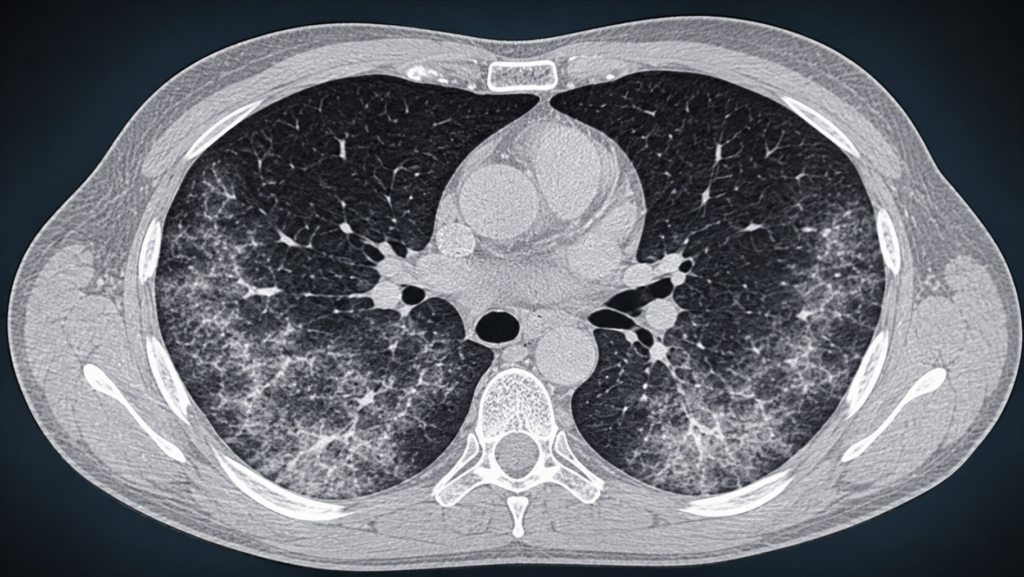
The largest prospective cohort followed 73 EVALI patients to 12 months [Blagev, Prospectively Assessed Long-Term Outcomes of Patients with E-Cigarette- or Vaping-associated Lung Injury, 2022]:
- 39% had cognitive impairment
- 48% had ongoing respiratory limitations
- 59% reported anxiety and/or depression
- 62% met criteria for post-traumatic stress related to the EVALI episode
- Only 38% had quit all vaping and smoking
A separate retrospective cohort of 41 patients admitted to the University of Pittsburgh Medical Center reported 24% one-year hospital readmission, with respiratory diagnoses accounting for the majority. Of the 18 patients with follow-up imaging, 67% had complete radiographic resolution, 22% showed improvement, and 11% had persistent or progressive findings — recovery is the norm but not universal [Triantafyllou, Long-term outcomes of EVALI: a 1-year retrospective study, 2021].
The clinical lesson is uncomfortable: EVALI is not a 2019 event that ended. A meaningful fraction of survivors carry respiratory, cognitive, and psychiatric burden a year later, and most continue to vape despite having survived a near-fatal episode. New EVALI cases continue to be reported, including in nicotine-free vapers [Al Alhadi, Severe Vaping Product Use-Associated Lung Injury in a Healthy Young Adult: A Case Report, 2025].
Putting It Together
The most defensible summary of where vaping research stands in 2025: vaping is less harmful than smoking, but it is not harmless, and the timescale needed to assess its worst potential effects has not yet elapsed. The strongest signals are where exposure is highest and most direct — throat, larynx, and oral mucosa. The biggest unknown is cancer, because the latency clock has not finished running.
For ENT practice, the practical implications are concrete. Hoarseness, oral mucosal lesions, and chronic throat symptoms in young vapers deserve laryngoscopy and oral examination, not reassurance. Patients who vape and smoke should be told that their risk profile matches a smoker’s, not a vaper’s. And patients facing head and neck cancer treatment should not switch to vaping as a “safer” alternative when the laboratory evidence raises questions about chemotherapy efficacy.
Key Takeaways
- A 2025 meta-analysis of 119 studies found non-smoker vapers had 1.90x higher respiratory symptom risk than non-users, but 0.75x lower risk than current smokers.
- Dual users (smoking and vaping) carry a smoker’s risk profile, not a harm-reduction profile — 3.86x COPD prevalence vs never users.
- PubMed-indexed case reports document vape-related upper airway injury including acute epiglottitis, vocal fold mucosal burns, and measurable changes in vocal fold kinematics in daily users.
- A 2025 umbrella review confirms e-cigarette use causes oral microbiome dysbiosis and increases periodontitis, peri-implantitis, candidiasis, and caries risk.
- Head and neck cancer risk from vaping is currently classified as unknown, not safe — the carcinogenic mechanisms are established, but cancer latency exceeds vaping’s market history.
- EVALI survivors at 12 months show 39% cognitive impairment, 48% respiratory limitation, and 62% post-traumatic stress.
FAQ
Is vaping safer than smoking long-term? For complete switchers, the current evidence supports lower (but not zero) risk compared with continued smoking. For dual users and for never-smokers who start vaping, risk is added rather than reduced. Long-term cancer outcomes data does not yet exist, because mass-market vaping is only fifteen years old.
What does vaping do to your throat over years? Confirmed effects include chronic irritation, dry throat, mucosal changes, and measurable vocal fold dysfunction in daily users. Case reports also document acute epiglottitis and vocal fold mucosal burns from vaping. Most symptoms improve with cessation, but the spectrum of documented injury continues to expand.
Can vaping cause oral cancer? No direct human evidence confirms this, but the carcinogenic mechanisms — DNA-damaging aldehydes, reactive oxygen species, and formaldehyde-induced DNA damage — are well established. The fifteen-year market history is shorter than typical oral cancer latency, so the answer is “unknown” rather than “no.”
What are the long-term effects of EVALI? One-year follow-up data shows persistent respiratory limitations in approximately 48% of survivors, cognitive impairment in 39%, anxiety or depression in 59%, and post-traumatic stress in 62%. Only about 38% quit all vaping and smoking after their episode.
Does vaping cause periodontal disease? A 2025 umbrella review confirms vapers develop a unique dysbiotic oral microbiome that increases periodontitis and peri-implantitis risk. The microbial pattern is distinct from — not just a milder version of — smokers’ oral dysbiosis.
References
- Al Alhadi NA, Alamer AK, Albalawi RH, Ahmed AE. Severe Vaping Product Use-Associated Lung Injury in a Healthy Young Adult: A Case Report. Cureus. 2025;17(8):e89495.
- Amanian A, Phulka J, Hu AC. Unintended Side Effects of Electronic Cigarettes in Otolaryngology: A Scoping Review. Otolaryngol Head Neck Surg. 2023;168(1):7-13.
- Blagev DP, Callahan SJ, Harris D, et al. Prospectively Assessed Long-Term Outcomes of Patients with E-Cigarette- or Vaping-associated Lung Injury. Ann Am Thorac Soc. 2022;19(11):1892-1899.
- Cichońska D, Kusiak A, Goniewicz ML. The Impact of E-Cigarettes on Oral Health — A Narrative Review. Dent J (Basel). 2024;12(12):404.
- Khorrami A, Khorrami MA, Gheriani H. Vaping-induced acute epiglottitis: a case report. Int J Emerg Med. 2023;16(1):56.
- Kundu A, Feore A, Abu-Zarour N, et al. Evidence update on the respiratory health effects of vaping e-cigarettes: A systematic review and meta-analysis. Tob Induc Dis. 2025;23:177.
- Kundu A, Sachdeva K, Feore A, et al. Evidence update on the cancer risk of vaping e-cigarettes: A systematic review. Tob Induc Dis. 2025;23:6.
- Lechien JR, Papon JF, Pouliquen C, Hans S. E-Cigarette Vaping-Related Vocal Fold Injury: A Case Report. J Voice. 2024;38(1):195-196.
- Manyanga J, Ganapathy V, Bouharati C, et al. Electronic cigarette aerosols alter the expression of cisplatin transporters and increase drug resistance in oral cancer cells. Sci Rep. 2021;11(1):1821.
- McKenna VS, Ling C, Llico AF, Patel R. Effects of Daily Electronic Cigarette Use on the Vocal Mechanism: A Multimodality Study. Laryngoscope. 2025. Online ahead of print.
- Panariello B, Panariello FD, Misir A, Barboza EP. An Umbrella Review of E-Cigarettes’ Impact on Oral Microbiota and Biofilm Buildup. Pathogens. 2025;14(6):578.
- Sgai MG, Robleto E, Shafazand S, Jackson RM, Shehadeh LA. The impact of e-cigarettes versus traditional cigarettes on long-term cardiopulmonary outcomes. Am J Physiol Heart Circ Physiol. 2025;329(2):H554-H571.
- Thomas SC, Xu F, Pushalkar S, et al. Electronic Cigarette Use Promotes a Unique Periodontal Microbiome. mBio. 2022;13(1):e00075-22.
- Triantafyllou GA, Tiberio PJ, Zou RH, et al. Long-term outcomes of EVALI: a 1-year retrospective study. Lancet Respir Med. 2021;9(12):e112-e113.
Joonpyo Hong, MD is a board-certified otolaryngologist practicing in Korea. This article reflects his clinical interpretation of published research and does not constitute individual medical advice.
For more interesting contents:
https://curiousmd.com/ai-de-escalation-in-hpv-throat-cancer/
https://curiousmd.com/hpv-vocal-cord-cancer-young-non-smokers/
https://curiousmd.com/silent-reflux-laryngopharngeal-disease/
Link out to:
https://www.headandneck.org/risk-factors/
https://www.fda.gov/news-events/public-health-focus/lung-injuries-associated-use-vaping-products
https://www.who.int/publications/m/item/technical-note-on-call-to-action-on-electronic-cigarettes