
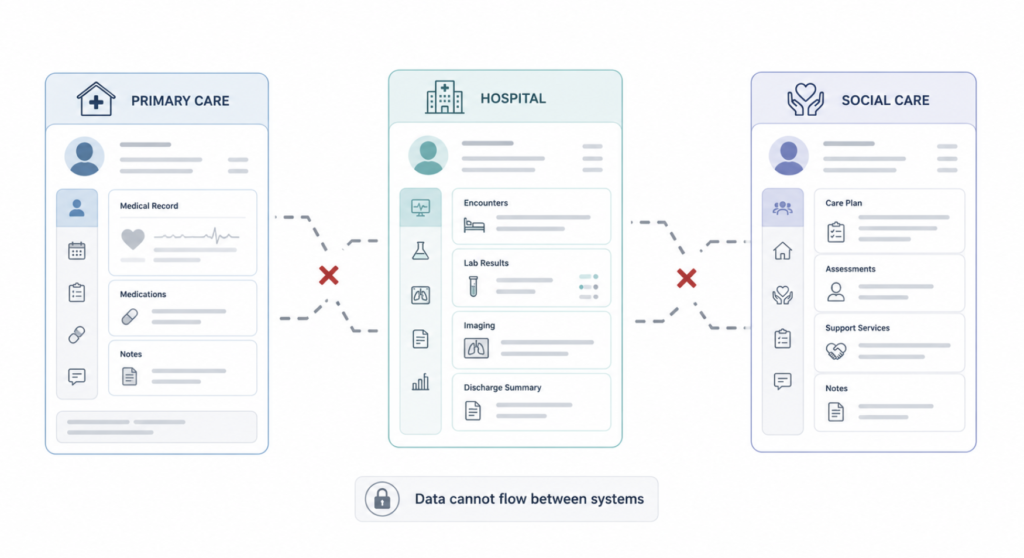
Patient information is often distributed across multiple, disconnected healthcare systems. Primary care records, outpatient notes, imaging results, and medication histories may each be stored in separate platforms with limited interoperability. As a result, clinicians may be unable to locate previous test results, leading to unnecessary repeat investigations, while medication lists and other key information must be reconciled manually. The underlying problem is not a shortage of clinical data, but the fragmentation of that data across systems.
The scale of that scattering is measurable. In NHS England’s 2024 Electronic Patient Record Usability Survey, the largest study of its kind with 23,662 responses, roughly 48% of clinicians reported spending three or more hours each week on record work described as duplicative or adding no value, and only 34% said their electronic record made them more efficient. This is the terrain Palantir Technologies entered — first for a pound, then for hundreds of millions.
What follows is not a story about a piece of software. It is a story about who a health system can trust, with what, and on what terms.
The Scattered Body: The Problem the NHS Already Had
The NHS did not develop a data problem because of any single vendor. It inherited one. Decades of incremental system adoption, often decided trust by trust or department by department, produced an arrangement in which critical records sit in silos. Patient information is split across primary, secondary, and social care, and the systems holding it were frequently built on proprietary technology never designed to interconnect.
The consequences are clinical, not merely administrative. A fragmented view of a patient’s journey invites duplicated tests, reconciliation errors, and gaps in care coordination. The National Data Guardian and multiple NHS reviews have described this fragmentation as a safety issue in its own right, not a back-office inconvenience.
Earlier attempts to solve it are a caution rather than a template. The National Programme for IT, an earlier centralised effort, is widely studied as one of the most expensive failures in public-sector computing. That history matters, because it explains both the appetite for a new integrating layer and the wariness about who builds it.
A large volume of data is not the same as usable data.
Clinical Perspective. The value of joined-up records is easy to underestimate from outside the ward. When a clinician cannot see a prior result, the safe default is often to repeat the test — which costs time, money, and occasionally the patient’s confidence. Any tool that reliably closes that gap addresses a real harm, which is precisely why the stakes around getting it right are high.
The One-Pound Door: How Palantir Entered
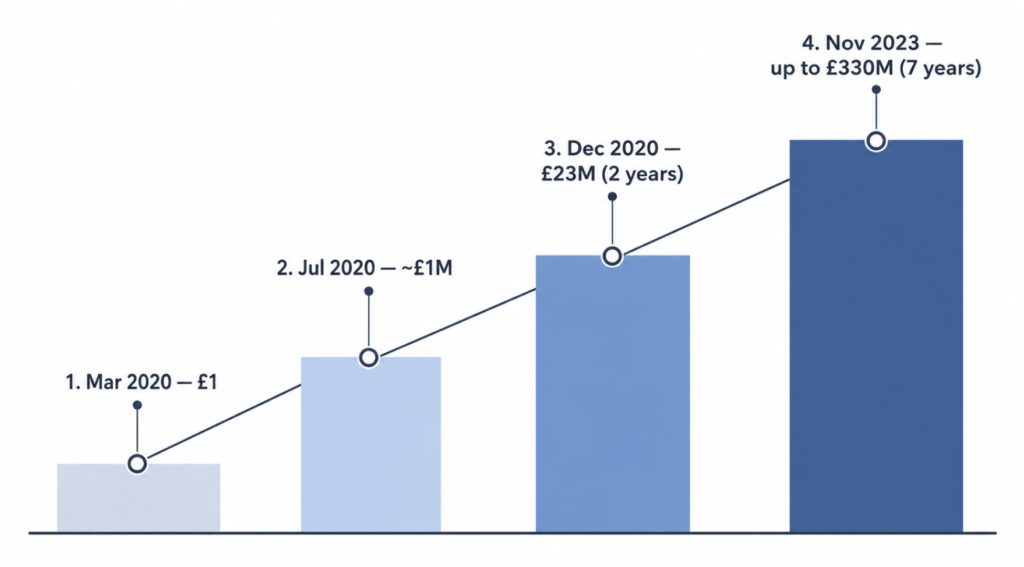
Palantir’s formal relationship with the NHS began in March 2020, when it built the NHS COVID-19 Data Store using its Foundry platform for a nominal fee of £1. The work was procured under emergency pandemic rules, without open competition, and was presented at the time as a short-term effort to model how the virus was spreading and where resources should go.
The entry point predates the pandemic. According to reporting by The Bureau of Investigative Journalism and openDemocracy, discussions between Palantir and NHS figures about working with patient data were underway during 2019, and by early 2020 a London team was building a product focused on the UK healthcare market. These accounts describe sustained commercial engagement before any emergency contract existed; they are journalistic findings rather than official disclosures, and are best read as such.
From that £1 start, the contracts grew. A roughly £1 million deal in July 2020 was extended to a two-year, £23 million arrangement that December. Then, in November 2023, a consortium led by Palantir Technologies UK — with Accenture, PwC, NECS, and Carnall Farrar — won the NHS Federated Data Platform (FDP) contract, worth up to £330 million over seven years. NHS England has maintained that the procurement was open and fair.
When the FDP contract was published in late December 2023, after pressure from campaigners, it arrived heavily redacted, with around 200 pages blacked out, including sections on personal data protection. The redactions themselves became part of the controversy.
An emergency measure had become permanent infrastructure.
Clinical Perspective. Emergency procurement exists for good reason: in a crisis, speed can save lives. The difficulty is that a contract awarded under emergency conditions carries none of the competitive scrutiny of a normal one, yet can quietly harden into a long-term dependency. The pandemic answered an urgent question. It did not answer the durable one of who should hold this role for a decade.
The Integrating Machine: What the FDP Actually Does
The Federated Data Platform is best understood as connective tissue rather than a new record system. Its stated purpose is to let separate NHS data sources be linked and analysed together, so that operational tasks can be coordinated across the fragments described earlier. In practice, this means software aimed at managing elective waiting lists, coordinating operating-theatre scheduling, supporting discharge planning, and similar workflows.
The word “federated” carries weight. The design is meant to leave data where it lives — within trusts — while providing a layer that can query and combine it. A related component, the National Data Integration Tenant (NDIT), is described by NHS England as a controlled environment where data can be brought together before being pseudonymised and shared onward with other systems. The distinction between identifiable data inside that environment and pseudonymised data leaving it becomes central to the later dispute.
It is a smarter front door, not a new house. The FDP does not replace the underlying hospital systems; it sits above them and attempts to make them legible to one another.
Whether that overlay earns its cost is a separate question from whether the engineering is sound — and it is the question that has proven hardest to answer cleanly.
Do the Numbers Speak? The Contested Record
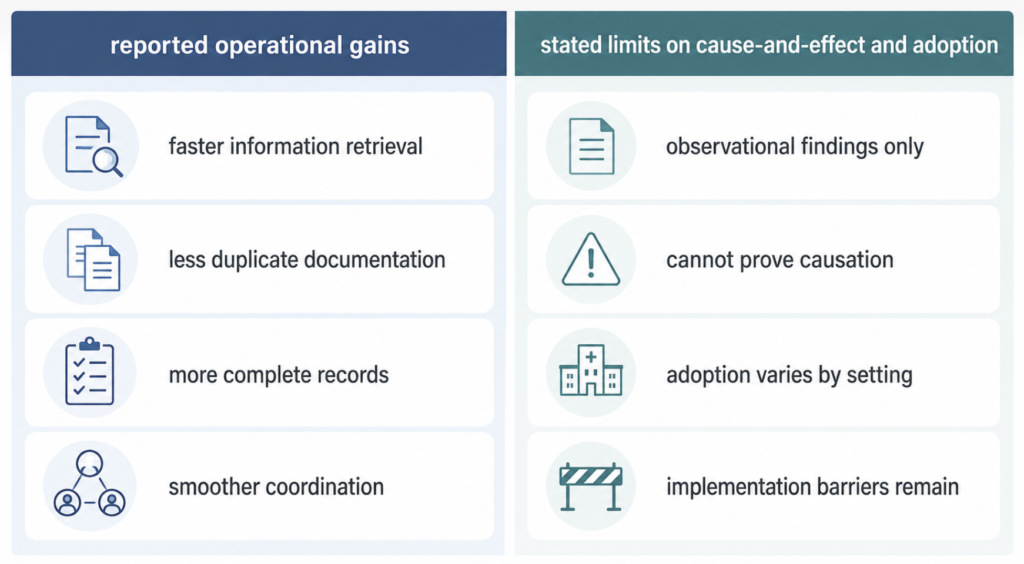
Palantir and NHS England have pointed to concrete figures. In their published accounts, FDP tools have been associated with around 797,728 patients removed from waiting lists after review, roughly 110,078 additional procedures carried out in hospital theatres, and a 6.8 percentage-point improvement in suspected-cancer referrals answered within 28 days compared with the prior year. Individual trusts have reported local gains; University Hospitals Sussex cited saving about 90 staff hours a week through improved waiting-list management. In October 2025, NHS estimates suggested the platform could return several times its cost.
These figures deserve to be read with the caveat NHS England itself attached. In its own documentation, NHS England stated that it was inappropriate to draw conclusions about cause and effect from the published FDP data, because other variables had not been controlled for. In plain terms: the numbers describe what happened alongside the tool, not what the tool alone caused.
Two further findings complicate the picture. Reporting has noted that a single trust, Chelsea and Westminster, accounted for around 84% of the reported fall in outpatient waiting lists, which makes a national success story rest heavily on one site. And adoption has been limited: Palantir reported about 72 trusts using the platform as of May 2025, still under a third of the total, with some trusts declining it. Leeds, responding to a freedom-of-information request, stated its view that adopting the products would mean losing functionality rather than gaining it.
| Claim | What supporters cite | What the record qualifies |
|---|---|---|
| Waiting lists | ~797,728 patients removed after review | NHS England: no cause-and-effect conclusion; ~84% of outpatient fall from one trust |
| Procedures | ~110,078 additional theatre procedures | Association, not attribution; variables uncontrolled |
| Cancer pathway | +6.8 points seen within 28 days | Improvement measured against prior year, not against a control |
| Value | Estimated multiple-times return (2025) | Audit bodies have asked NHS to show its working |
| Reach | ~72 trusts using it (May 2025) | Under one-third of trusts; some declined adoption |
The honest position is narrow: there are real operational improvements reported at some sites, and there is not, on the published evidence, a demonstrated causal case that the platform produced them across the system.
Clinical Perspective. Clinicians are trained to separate correlation from causation, and the same discipline applies here. An improvement recorded alongside a new tool is a hypothesis, not a verdict. That does not make the gains fictional; it means the burden of showing attribution has not yet been met, and saying so is a matter of accuracy rather than skepticism.
The Word “Unlimited”: Where Trust Fractured
The relationship shifted from contested to openly disputed in 2026. In May, the Financial Times reported, citing an internal briefing note, that NHS England had agreed to create an administrative role granting some non-NHS staff — including staff from Palantir — “unlimited access” to identifiable patient data within the NDIT while working on the platform. Officials confirmed to the FT that the recommendation had been accepted, while stating that it would apply to only a small number of non-NHS staff, and the note itself recommended capping such access, making it time-limited, and subjecting it to regular review.
The contract prohibits Palantir from exploiting patient data for its own purposes. The difficulty raised by critics is one of verification rather than of a proven breach. As one cybersecurity academic put it to reporters, it would be hard to know from the outside whether the rules were being followed. Critics, including campaigners at openDemocracy, have argued that highly interoperable systems could in principle enable data-driven abuses of state power; supporters counter that access controls, pseudonymisation, and contractual limits are designed precisely to prevent that. Those are competing claims about risk, and the article presents them as such rather than adjudicating between them.
The institutional response has been substantial. In February 2026, the British Medical Association said it would advise doctors to limit their engagement with the FDP over its links to Palantir. In June 2026, the House of Commons Science, Innovation and Technology Committee urged the government to use a February 2027 break clause in the contract and to develop an in-house replacement or seek a UK-based alternative, arguing that no single company should hold so central a role across health and defence. Separately, in May 2026, the Mayor of London blocked a proposed £50 million Metropolitan Police contract with Palantir, citing concerns about how the procurement had been arranged.
Interoperability is a feature and a risk carried by the same design.
Clinical Perspective. Trust in a health system is not a soft concern; it is operational. Patients disclose sensitive information on the understanding that it will be handled narrowly, and clinicians rely on that willingness. When a professional body advises its members to limit engagement with a data platform, that is a signal about confidence, and confidence, once lost, is expensive to rebuild — a cost that sits outside any efficiency calculation.
The Mirror of Other Countries, and What to Take From It
The NHS is not an isolated case. In the United States, Palantir’s healthcare footprint is larger: the company reports its hospital tools supporting workflows across a meaningful share of the US system, and in October 2025 it secured a US Department of Veterans Affairs contract worth about $385.4 million, described as its largest single health deal. The Department of Health and Human Services has held a blanket purchasing arrangement enabling agencies to buy its software, and the Centers for Medicare and Medicaid Services has explored using it for a national provider directory. In Germany, activity is earlier-stage: the company supported federal health authorities during the pandemic and has reportedly discussed introducing its Foundry platform with individual hospitals and research institutions.
Read against the British dispute, a few disciplined lessons emerge for any country weighing a national health-data platform. None depends on a verdict about Palantir specifically.
First, emergency procurement needs an expiry date. A £1 crisis contract that hardens into permanent infrastructure without open competition inherits none of the scrutiny such a role warrants. Crisis contracts should carry explicit sunset and re-competition clauses from the outset.
Second, avoid lock-in by design. When one vendor controls the integrating middleware, the cost and political difficulty of switching grow over time. Interoperability standards, data portability, and a costed exit plan belong in the contract at signing, not in a later dispute.
Third, transparency and verifiability are not optional. A contract published with 200 redacted pages, and access permissions that observers cannot audit, corrode trust regardless of intent. Time-limited access, audit logs, and independent oversight are the mechanisms that make assurances credible.
Fourth, measure effect honestly. Uncontrolled operational figures invite backlash when presented as proof. An evaluation designed to support causal claims protects both the public and the programme.
Done carefully, an integrating layer can make a fragmented health system safer and more efficient. Done carelessly, it becomes the most expensive dependency a health system can acquire, and the hardest to leave.
Clinical Perspective. The recurring lesson across these cases is that the technical question and the governance question are separate, and the second is usually decisive. Whether the software works is answerable with evaluation. Whether a public health system should hand a central, hard-to-reverse role to a single external provider is a question of governance, accountability, and trust — and it is that question, not the code, on which the NHS story now turns.
Key Takeaways
- The NHS entered this story with a genuine, safety-relevant problem: patient data fragmented across systems that do not communicate.
- Palantir’s role grew from a £1 emergency COVID contract in 2020 to a £330 million, seven-year Federated Data Platform contract in 2023.
- The FDP is an integrating layer over existing systems, aimed at operational workflows like waiting lists and theatre scheduling, not a replacement record.
- Reported gains are real at some sites but not causally established system-wide — NHS England itself cautioned against cause-and-effect conclusions, and adoption remains under a third of trusts.
- The 2026 dispute centres on verification and governance: reported “unlimited” access to identifiable data, redacted contracts, and calls from the BMA and a parliamentary committee to reconsider the deal.
- For any country, the transferable lessons are sunset clauses, anti-lock-in design, auditable transparency, and honest measurement of effect.
FAQ
Does the Federated Data Platform work? It depends on what “work” means. Some trusts report concrete operational improvements, such as staff hours saved in waiting-list management. But NHS England has stated that its published FDP data does not support cause-and-effect conclusions, and much of the headline waiting-list improvement traced to a single trust [The Register, NHS Told to Show Its Working, 2026].
Can patients opt out of having their data used in the FDP? Not individually in a simple way. Decisions about adopting FDP products have largely sat at the trust level rather than with individual patients, which is part of why critics have focused on institutional governance [Democracy for Sale, Palantir’s NHS Data Platform Rejected, 2025].
What is the “unlimited access” controversy about? It refers to a 2026 Financial Times report that NHS England agreed to grant some non-NHS staff, including Palantir staff, broad administrative access to identifiable patient data within a controlled environment. NHS officials said this would apply to a small number of people and be subject to limits and review [Financial Times via Digital Health, 2026].
Is Palantir only involved with the UK’s NHS? No. Its healthcare presence is larger in the United States, including a 2025 Veterans Affairs contract worth about $385 million, with earlier-stage activity in countries such as Germany [GovConWire, Palantir Secures VA Contract, 2025].
References
- NHS England. 2024 Electronic Patient Record (EPR) Usability Survey for secondary care — key findings. NHS England; 2024.
- Health Foundation. Electronic patient record systems in England: what do NHS staff think? Health Foundation; 2024.
- Digital Health. Palantir’s road to the Federated Data Platform contract: a timeline. Digital Health; 2023.
- CNBC. Britain gave Palantir access to sensitive medical records of Covid-19 patients in £1 deal. CNBC; 2020.
- The Bureau of Investigative Journalism. Data giant given ’emergency’ Covid contract had been wooing NHS for months. TBIJ; 2021.
- NHS England. NHS Federated Data Platform — contract explainer and FAQs. NHS England; 2023–2024.
- Palantir. Ready, Set, Build with the NHS Federated Data Platform. Palantir Blog; 2024.
- PublicTechnology. NHS estimates Palantir data platform will deliver returns of five times its costs. PublicTechnology; 2025.
- The Register. NHS told to show its working on Palantir platform benefits. The Register; 2026.
- Democracy for Sale. Palantir’s NHS data platform rejected by most hospitals. 2025.
- Financial Times (via Digital Health). Palantir to be granted ‘unlimited access’ to NHS patient data. 2026.
- Al Jazeera. ‘Potential security risk’: Unpacking the UK’s trust issues with Palantir. 2026.
- The Register. UK lawmakers call on government to ditch Palantir NHS contract. 2026.
- Computing. Sadiq Khan blocks Met’s £50m AI deal with Palantir. 2026.
- GovConWire. Palantir Secures $385M VA Contract for National Center for Veterans Data Platform. 2025.
- LabNews. Palantir and the healthcare industry in Germany. 2025.
Joonpyo Hong, MD is a board-certified otolaryngologist practicing in Korea. This article reflects his clinical interpretation of published research and does not constitute individual medical advice.
This article is not intended to advertise or promote any specific company or product.
For more interesting content:
https://curiousmd.com/polypharmacy-in-older-adults/
https://curiousmd.com/neuralink-voice-speech-first/
https://curiousmd.com/global-aging-and-ai-medicine/
Link out to:
https://www.england.nhs.uk/digitaltechnology/nhs-federated-data-platform/
https://www.england.nhs.uk/digitaltechnology/digitising-the-frontline/2024-electronic-patient-record-epr-usability-survey-for-secondary-care-key-findings/
https://hansard.parliament.uk/commons/2026-04-16/debates/2FDCA71C-D0C1-4738-BEE8-A4BDA311DB99/NHSFederatedDataPlatform
https://www.health.org.uk/reports-and-analysis/analysis/electronic-patient-record-systems-in-england-what-do-nhs-staff-think
https://www.digitalhealth.net/2023/11/palantirs-road-to-the-federated-data-platform-contract-a-timeline/