
Hearing loss is one of the most common chronic conditions and one of the most quietly neglected. Global estimates place more than 1.5 billion people on the spectrum of hearing loss, and in the United States it reaches close to a quarter of adults (WHO, World Report on Hearing, 2021; Haile, Hearing Loss Prevalence, 2024). The condition tends to arrive slowly, gets blamed on mumbling speakers and noisy rooms, and often goes years without assessment (Lin, Age-Related Hearing Loss, 2024). Against that backdrop, the AirPods hearing test — a five-minute assessment taken at home with earbuds most people already own — is a meaningful proposition.
In September 2024, the U.S. Food and Drug Administration authorized the first over-the-counter hearing-aid software, built around Apple’s AirPods Pro, and with it a self-administered Hearing Test Feature (FDA, OTC Hearing Aid Software Authorization, 2024). Apple describes the output as a “scientifically validated audiogram” comparable to clinic-based audiometry (Apple, Hearing Health Features, 2024). The phrase that travels furthest is clinical-grade.
That phrase is where the useful skepticism begins. A test can be accurate and still be narrow. The AirPods hearing test measures one thing — air-conduction thresholds — and reports an average that flatters the per-frequency detail beneath it. Read carefully, the evidence supports a specific and limited verdict: this is a trustworthy screening and self-monitoring tool, not a substitute for a diagnostic evaluation. It is a smarter front door, not a new house.
What the test actually is, and how it works
The Apple Hearing Test Feature is an over-the-counter, air-conduction hearing assessment that runs on AirPods Pro 2 and Pro 3 paired with a recent iPhone or iPad, for adults 18 and older (Apple, Take a Hearing Test, support). It plays pulsed pure tones across frequencies from 250 to 8000 Hz and records the softest tone the listener can detect — the same logic as the pure-tone audiometry performed in clinics, adapted for a living room.
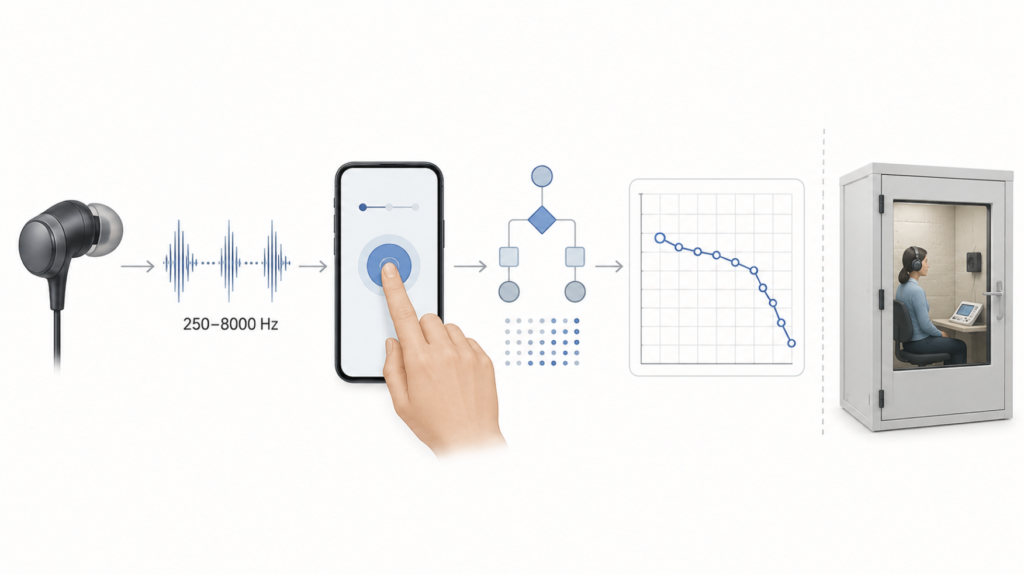
The adaptation is the interesting part. Booth audiometry steps through fixed frequencies at fixed loudness increments. Apple’s test instead uses a probabilistic model: it estimates the entire audiogram curve with a method called Gaussian process classification and chooses each next tone with Bayesian active learning, sampling wherever uncertainty is highest rather than marching through a grid (Apple, Hearing Health Features, 2024). This is not a proprietary black box invented for marketing. The underlying approach — machine-learning audiometry — was developed and tested in peer-reviewed work by Dennis Barbour’s group at Washington University, where automated machine-learning audiograms matched conventional thresholds to within roughly three to five decibels and ran faster than manual testing (Heisey, Dynamically Masked Audiograms, 2020; Barbour, Conjoint Estimation for Bilateral Audiometry, 2019). Apple productized a real scientific method.
To move a booth test into an uncontrolled room, the software adds guardrails: it checks that background noise is low enough, verifies that the AirPods form an acoustic seal, calibrates the microphones and speakers, and pauses automatically if the room becomes loud (Apple, Hearing Health Features, 2024).
Why this matters is access. The dominant model of hearing care is clinic-based, time-intensive, and limited by the finite supply of professionals (WHO, World Report on Hearing, 2021). A free, repeatable test inside an app that tens of millions of people already carry lowers the threshold to ever being checked at all.
But adaptation carries a cost that the rest of this piece returns to: every guardrail is an admission that a home is not a booth, and a test built to estimate an average is not the same as a test built to find a diagnosis.
Clinical Perspective. The method here deserves credit rather than reflexive suspicion — probabilistic audiometry is sound science with an independent track record. The open question is never whether the algorithm is clever, but whether a clever algorithm delivered through earbuds, in a kitchen, by an untrained user, holds up at the level of the individual threshold.
How accurate is it, read against the evidence
Two bodies of evidence exist, and they are easy to conflate. One is Apple’s own; the other is independent.
What Apple’s own validation did, and did not, test
Apple’s evidence lives in a company white paper and the regulatory submission behind the FDA authorization (Apple, Hearing Health Features, 2024). The validation study was more rigorous than skeptics often assume: 202 adults spanning no, mild, moderate, and severe hearing loss; randomized test order to control for practice effects; institutional-review-board oversight. Its headline numbers are strong. The median absolute difference between the app and audiologist-administered audiometry was 1.81 decibels on the four-frequency average and 1.75 decibels on the eight-frequency average, with correlation near 0.97; classification of hearing-loss severity matched the audiologist 86.4 percent of the time and fell within one category every single time. In plain terms, on the averaged score the app and the clinician rarely disagreed by a hair’s breadth.
Two features of that study temper the headline. First, the impressive figure is an average of averages. The 1.81-decibel number is the deviation of the four-frequency mean; averaging across frequencies cancels the noise present at any single pitch. Second, and more consequential, the validation population was pre-screened by professionals. Before testing, an audiologist performed otoscopy, tympanometry, and bone-conduction testing specifically to confirm the absence of conductive hearing loss (Apple, Hearing Health Features, 2024). The test was validated, in other words, on ears in which the very pathologies it cannot detect had already been ruled out. That is sound study design. It is also a gap between the laboratory and the kitchen, where no one rules anything out first. The cohort also contained no profound-loss participants and one erratic responder that Apple disclosed and kept in the analysis — a point in favor of its transparency.
What independent testing found
The first independent evaluation, published in 2026, tested the feature against booth audiometry in 25 adults and reported the granular picture Apple’s averages smooth over (Kruger, AirPods Pro 2 Hearing Test Accuracy, 2026). Looking frequency by frequency rather than at the average, 86.5 percent of the app’s thresholds fell within 10 decibels of the reference, and the per-frequency spread reached roughly 9.7 decibels in one ear — wider than the sub-two-decibel headline implies, though still inside the band audiologists treat as minimally acceptable. The test was also reliable on repeat, with about 97 percent of repeat thresholds within 10 decibels, and roughly twice as fast as manual audiometry. The evidence consistently points in a favorable direction, though it comes from one small single-center study and is not yet settled.
Both readings are true at once. Apple’s averaged metric is excellent; the independent per-frequency view is good but looser. A large agreement on the average is not the same as precision at every pitch.
| Apple’s own validation | First independent validation | |
|---|---|---|
| Source | Company white paper / FDA submission (Apple, 2024) | Peer-reviewed (Kruger et al., 2026) |
| Participants | 201 completed; full loss spectrum; conductive loss pre-excluded | 25 adults; self-reported mild–moderate loss |
| What was compared | Averaged thresholds (4- and 8-frequency means) | Per-frequency thresholds |
| Headline agreement | Median absolute difference ~1.8 dB; severity class matched 86.4% | 86.5% of thresholds within 10 dB; spread up to ~9.7 dB |
| Test–retest | Not the focus | ~97% of repeats within 10 dB |
| Speed | Not reported | ~5.5 min vs ~10 min for manual |
| Independence | Manufacturer-sponsored | Independent |
Clinical Perspective. The honest way to hold this is to trust the direction and respect the spread. For deciding whether a person probably has hearing loss and roughly how much, the agreement is more than adequate. For reading a single high-frequency threshold to the decibel — the kind of detail that separates one diagnosis from another — the averaged headline is the wrong number to lean on.
What the test cannot see
Accuracy answers how well the test measures what it measures. The harder question is what it measures at all.
The AirPods test is air-conduction only. It sends sound down the ear canal and records the softest tone heard. A clinical evaluation adds what earbuds cannot: bone-conduction testing that bypasses the outer and middle ear, tympanometry that gauges eardrum and middle-ear function, otoscopy that looks for wax or structural problems, and a clinical history (Apple, Hearing Health Features, 2024; Krishnan, New Hearing Technologies, 2024). The difference is not cosmetic. Air conduction alone cannot separate conductive hearing loss — a mechanical problem such as wax, fluid, or a middle-ear issue, often treatable — from sensorineural loss of the inner ear or nerve, usually permanent. The screen reveals whether hearing is reduced; it cannot reveal why. The irony noted earlier is exact: bone conduction is precisely the test Apple used to clean its validation sample, and precisely the test the product omits.
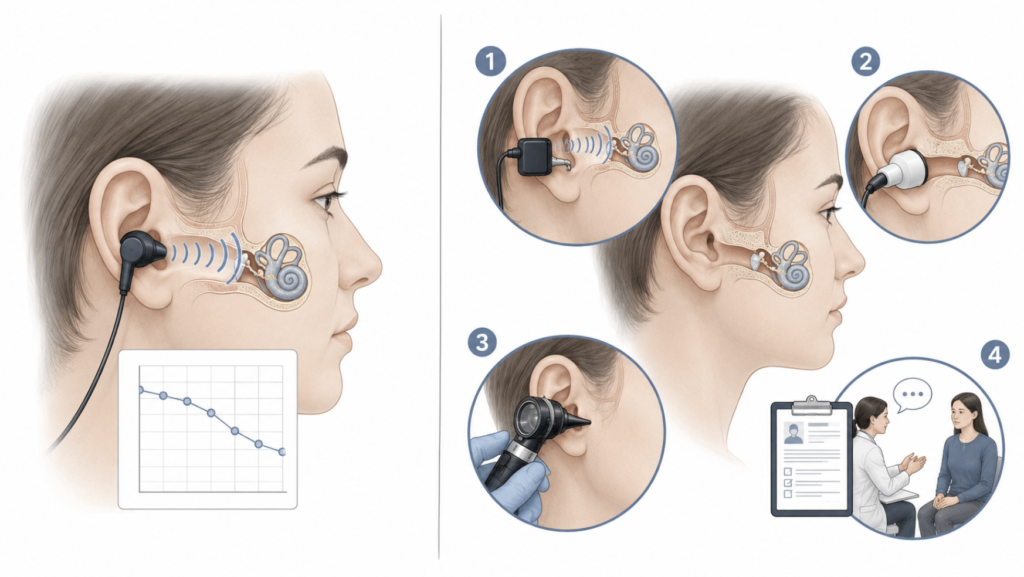
The feature’s own design draws further boundaries. Its measurement ceiling is 85 decibels of hearing level; beyond that, Apple itself directs users to a professional (Apple, Take a Hearing Test, support). Asymmetry between ears, sudden changes, or warning signs that point to underlying disease sit outside what a self-administered screen is built to catch. Apple’s framing is, to its credit, consistent with this: the company positions the test as augmenting professional care and generating a PDF to bring to a clinician, not replacing the visit (Apple, Hearing Health Features, 2024).
Fit, seal, and why the earbud type is not a free choice
One error source sits between the user and the result: the fit of the earbud. The test is calibrated for a sealed in-ear coupling, and it runs only on AirPods Pro 2 and Pro 3 — the sealed, silicone-tipped models. Open-fit earbuds such as the standard AirPods are not supported, because the calibration assumes the seal; arbitrary earbuds will not do (Apple, Feature Availability; Apple, Take a Hearing Test, support). The exclusion is less a limitation than a control: the test is restricted to hardware whose acoustic behavior the manufacturer has characterized.
Within that hardware, fit still matters. The calibration assumes a standard seal and a standard amount of passive attenuation; if the actual seal differs, the sound level reaching the eardrum differs from what the device intends, and thresholds drift (Apple, Hearing Health Features, 2024). Apple’s own guidance for the related hearing-protection feature states the principle plainly: the actual attenuation depends on how well the AirPods fit (Apple, Take a Hearing Test, support). The software counters this with an automatic fit check, an ear-tip fit (or acoustic seal) test that flags a poor seal, multiple ear-tip sizes including different sizes for each ear, cleaning guidance, and automatic pausing if the AirPods shift. Depth of insertion matters less than a complete seal with the right tip; tighter is not automatically better.
What these safeguards cannot erase is individual anatomy. A “good seal” confirms that a seal exists, not that the coupling matches the model’s assumption; ear canals vary, and so does the real-ear-to-coupler difference. Independent electroacoustic work documents this directly — measured in-ear output diverged from bench predictions, and the Pro 3 showed reduced acoustic coupling relative to the Pro 2 despite comparable bench output (Kim, Electroacoustic Comparison, 2026); a separate study found an in-ear deviation above 10 decibels at 6000 Hz in one ear (Kim, AirPods as Hearing Assistive Device, 2024). This residual variation is a plausible contributor to the per-frequency spread the independent accuracy study observed, though no study has isolated fit as the cause.
Clinical Perspective. A screening test that cannot distinguish a treatable middle-ear problem from permanent nerve loss is doing real work and leaving real work undone. The correct response to a result is not relief or alarm but a question — and for anything asymmetric, sudden, or beyond the test’s ceiling, that question belongs to a clinician, not an app.
From test to hearing aid, the next step’s reality
For most users the test is a doorway to the Hearing Aid Feature, which uses the audiogram to amplify the frequencies a person struggles with (Apple, Hearing Health Features, 2024). Here Apple’s evidence and the independent evidence diverge more sharply, and the reason is the choice of yardstick.
Apple’s hearing-aid validation was a separate 118-person study comparing self-fitting against professional fitting to the NAL-NL2 prescription standard (Apple, Hearing Health Features, 2024). Its primary endpoint was subjective: a validated questionnaire of perceived benefit. On that measure, self-fitting was statistically noninferior to professional fitting, and the company reported real-ear amplification within about two decibels of the prescription target. By the measure of how users feel about the result, the do-it-yourself path held its own.
Independent work, measuring objective outputs, is more equivocal. The first independent evaluation found that importing the test’s audiogram into the hearing-aid feature was itself less accurate — about 71 to 73 percent of thresholds within five decibels, with some thresholds dropped entirely — that the resulting speech-in-noise benefit was not statistically significant, and that amplification generally fell below NAL-NL2 targets (Kruger, Apple OTC Hearing Aid Usability, 2026). Electroacoustic measurements point the same way: AirPods produced less in-ear output than prescriptively fitted hearing aids, with the largest shortfalls for moderate loss and high frequencies (Kim, Electroacoustic Comparison, 2026). Across several independent studies the consistent pattern is that AirPods perform comparably to validated amplifiers in quiet but fall behind in noise (Kim, AirPods as Hearing Assistive Device, 2024; Lin, Earphones as PSAPs, 2022).
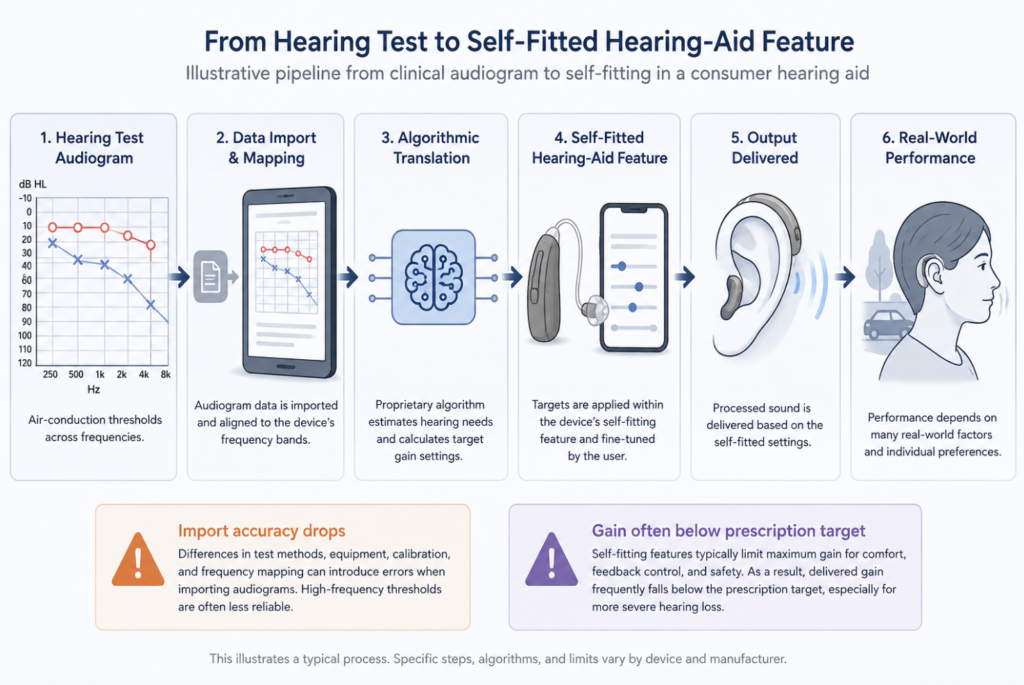
The two pictures are not contradictory; they answer different questions. Self-reported satisfaction can be high while objective gain sits below prescription and measurable speech-in-noise benefit is small. Which matters more depends on the user and the setting — a point of genuine, unresolved tension rather than a flaw to be explained away.
Clinical Perspective. For mild loss in quiet rooms, an accessible amplifier that people actually like and will wear has value that a perfectly fitted device left in a drawer does not. For meaningful loss or demanding, noisy environments, the objective shortfall against prescription targets is the more honest signal, and a professionally fitted aid remains the stronger tool.
So how far can it be trusted
The data support a verdict that is neither dismissive nor promotional.
What can be trusted now: as a screening and self-monitoring instrument, the test performs well. It agrees closely with clinical audiometry on whether hearing loss is present and roughly how severe, it is repeatable, it is fast, and it rests on a method with an independent scientific pedigree (Kruger, AirPods Pro 2 Hearing Test Accuracy, 2026; Heisey, Dynamically Masked Audiograms, 2020). For a person wondering whether to take their hearing seriously, it is a reasonable, low-cost first step, and the exportable audiogram makes the next conversation with a clinician more productive.
What still needs improvement: the independent evidence base is thin — small samples, single centers, and to date largely one research group (Kruger, AirPods Pro 2 Hearing Test Accuracy, 2026; Kruger, Apple OTC Hearing Aid Usability, 2026). Reliability across different AirPods units is not yet established, nor is performance in noisier real-world settings or across languages and populations beyond those studied. On the hearing-aid side, the gap between subjective noninferiority and objective under-amplification deserves direct, independent resolution.
What is reasonably promising: the largest contribution may sit upstream of accuracy. A credible, stigma-light, widely owned tool can pull people toward earlier detection of a condition they otherwise ignore for years (Lin, Age-Related Hearing Loss, 2024; Haile, Hearing Loss Prevalence, 2024). If even a fraction of users move from “I’ll get to it” to a measured result and a clinic visit, the public-health value is real regardless of any single decibel.
The boundary is the whole point. Done right, the AirPods hearing test sends more people through the front door of hearing care sooner. Done wrong — mistaken for a diagnosis — it lets a treatable or serious problem masquerade as a number on a phone.
Clinical Perspective. The verdict that fits the evidence is narrow on purpose: a good screen, an imperfect hearing aid, and not a diagnosis. Used as a prompt to seek care, it is one of the better things to happen to hearing health in years. Used as a substitute for the exam room, it quietly removes the one step — finding out why — that a screen was never built to provide.
Key Takeaways
- The AirPods hearing test is a validated air-conduction screening tool, not a diagnostic evaluation. It can show whether hearing is reduced, not why.
- Apple’s own headline accuracy of roughly two decibels reflects averaged scores; independent testing shows looser per-frequency spread of up to about ten decibels — good rather than flawless.
- Apple’s validation pre-excluded conductive hearing loss using the bone-conduction testing the product itself omits — strong study design, but a gap from real-world self-use.
- The test runs only on sealed AirPods Pro 2 and Pro 3; open-fit earbuds are unsupported because the calibration depends on the ear seal, and fit remains a residual error source despite built-in fit checks.
- As a hearing aid, self-fitting matched professional fitting on user-reported satisfaction, but independent objective measures show gain below prescription targets and limited speech-in-noise benefit.
- Its clearest value is access: prompting earlier detection and a more useful clinic visit for a condition people typically neglect for years.
Frequently Asked Questions
Can the AirPods hearing test replace a visit to an audiologist? No. It is a screening test that measures air-conduction thresholds only. It cannot perform bone conduction, tympanometry, or an ear examination, so it cannot determine the cause of hearing loss or catch problems that need medical attention. Apple itself positions it as a complement to professional care, with an exportable audiogram to share with a clinician (Apple, Hearing Health Features, 2024).
How accurate is the AirPods hearing test really? It depends on what is measured. On averaged hearing scores it agrees with clinical audiometry to within about two decibels in Apple’s own study; independent testing found roughly 86 percent of individual-frequency thresholds within ten decibels, with wider spread at single pitches (Kruger, AirPods Pro 2 Hearing Test Accuracy, 2026). Good enough to screen, not precise enough to substitute for diagnosis.
Does earbud fit or model affect the result? Yes. The test works only on sealed AirPods Pro 2 or Pro 3, not open-fit models, because its calibration assumes an in-ear seal. A poor seal shifts the measured thresholds, which is why the software runs an automatic fit check and offers multiple ear-tip sizes. Individual ear-canal differences still introduce some residual variation (Kim, Electroacoustic Comparison, 2026).
Does a “normal” result rule out a hearing problem? Not necessarily. The test has an upper measurement limit and cannot detect every condition, and a normal screen does not exclude problems that require examination. Sudden changes, asymmetry between ears, ringing, or hearing difficulty despite a normal result warrant a professional evaluation (Apple, Hearing Health Features, 2024).
References
- US Food and Drug Administration. FDA Authorizes First Over-the-Counter Hearing Aid Software. 2024. https://www.fda.gov/news-events/press-announcements/fda-authorizes-first-over-counter-hearing-aid-software
- Apple Inc. Using AirPods Pro 2 with iPhone and iPad to Help Protect, Assess, and Assist Hearing. October 2024. https://www.apple.com/health/pdf/Hearing_Health_Features_on_AirPods_Pro_2_October_2024.pdf
- Apple Inc. Take a Hearing Test with AirPods Pro 2 or AirPods Pro 3. Apple Support. https://support.apple.com/en-us/120991
- Apple Inc. AirPods Pro — Hearing Health Feature Availability. https://www.apple.com/airpods-pro/feature-availability/
- Kruger M, Manchaiah V, Swanepoel W. Apple Hearing Test Feature for the AirPods Pro 2: Accuracy, Reliability, and Time-Efficiency. Otolaryngol Head Neck Surg. 2026;174(6):1484-1493. https://doi.org/10.1002/ohn.70194
- Kruger M, Manchaiah V, Swanepoel W. Usability and Performance of the Apple Over-the-Counter Hearing Aid Feature. Am J Audiol. 2026;35(2):472-486. https://doi.org/10.1044/2025_AJA-25-00192
- Kim S, Thibodeau L. Electroacoustic Verification Comparison of AirPods Pro 2nd and 3rd Generations and Traditional Hearing Aids. Audiol Res. 2026;16(2). https://doi.org/10.3390/audiolres16020055
- Kim GY, Yun HJ, Jo M, et al. Apple AirPods Pro as a Hearing Assistive Device in Patients with Mild to Moderate Hearing Loss. Yonsei Med J. 2024;65(10):596-601. https://doi.org/10.3349/ymj.2023.0375
- Lin HH, Lai HS, Huang CY, et al. Smartphone-bundled earphones as personal sound amplification products in adults with sensorineural hearing loss. iScience. 2022;25(12):105436. https://doi.org/10.1016/j.isci.2022.105436
- Krishnan PS, Kamrava B, Snapp HA, Telischi FF. The iHearingAids? New Technologies in the Hearing World. Otolaryngol Head Neck Surg. 2024;172(3):1088-1091. https://doi.org/10.1002/ohn.1121
- Heisey KL, Walker AM, Xie K, Abrams JM, Barbour DL. Dynamically Masked Audiograms With Machine Learning Audiometry. Ear Hear. 2020;41(6):1692-1702. https://doi.org/10.1097/AUD.0000000000000891
- Barbour DL, DiLorenzo JC, Sukesan KA, et al. Conjoint psychometric field estimation for bilateral audiometry. Behav Res Methods. 2019;51(3):1271-1285. https://doi.org/10.3758/s13428-018-1062-3
- Haile LM, Orji AU, Reavis KM, et al. Hearing Loss Prevalence, Years Lived With Disability, and Hearing Aid Use in the United States: Findings From the Global Burden of Disease Study. Ear Hear. 2024;45(1):257-267. https://pubmed.ncbi.nlm.nih.gov/37712826/
- World Health Organization. World Report on Hearing. 2021. https://www.who.int/publications/i/item/9789240020481
- Lin FR. Age-Related Hearing Loss. N Engl J Med. 2024;390(16):1505-1512. https://pubmed.ncbi.nlm.nih.gov/38657246/
Joonpyo Hong, MD is a board-certified otolaryngologist practicing in Korea. This article reflects his clinical interpretation of published research and does not constitute individual medical advice.
This article is not intended to advertise or promote any specific company or product.
For more interesting contents:
https://curiousmd.com/airpods-hearing-test-ent-perspective/
https://curiousmd.com/apple-watch-sleep-apnea-accuracy/
https://curiousmd.com/apple-watch-sleep-apnea-accuracy/