
The relationship between music genre and hearing loss often comes down to one variable most listeners ignore. Two people listen to music at the same volume for the same length of time. One develops ringing in the ears that night; the other goes to sleep fine. The difference isn’t volume or duration — it’s what genre was playing.
The WHO estimates that 1.1 billion young people worldwide face hearing loss from recreational sound exposure, but the risk isn’t distributed evenly across genres. The acoustic structure of the music itself — particularly its dynamic range — shapes how much energy your inner ear absorbs. Here is what the data show, and what clinicians watch for.
What “Acoustic Difference” Actually Means
Three variables explain why one genre feels “louder” than another at the same volume setting.
Dynamic range is the gap between the quietest and loudest moments in a track, measured in decibels. A study published in Trends in Hearing analyzed 100 recorded samples across 10 music genres and found that classical genres — chamber, choir, opera, orchestra, piano — preserve dynamic ranges of roughly 20 to 32 dB, while jazz sits between 13 and 23 dB. Modern popular genres including pop, rock, and rap cluster tightly together at far smaller ranges, often around 10 dB or less [Kirchberger, Dynamic Range Across Music Genres and the Perception of Dynamic Compression in Hearing-Impaired Listeners, 2016]. Electronic dance music was not included in that academic dataset, but commercial mastering practice routinely compresses EDM further still, often to roughly 6 dB. This leaves the cochlea no rest moments between peaks.
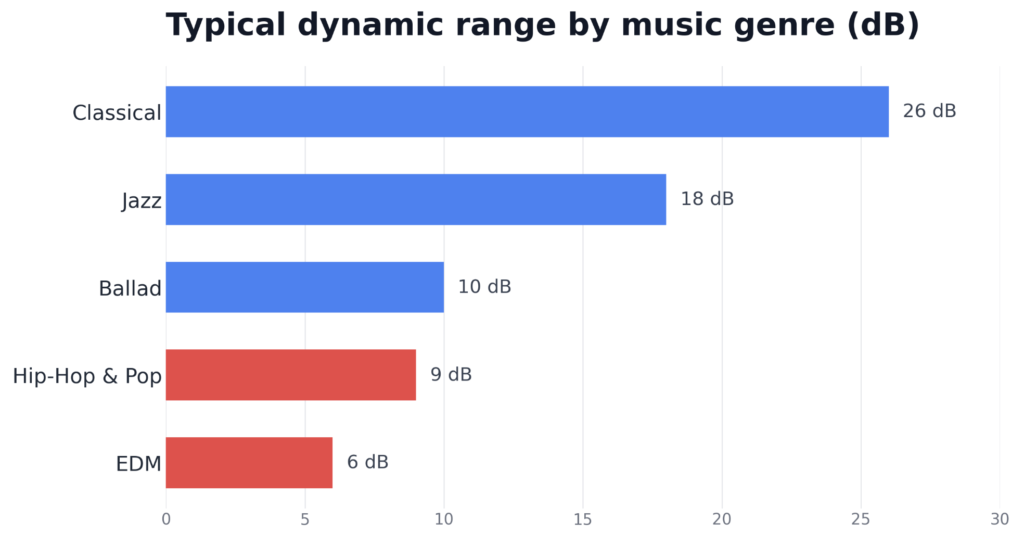
Spectral content is how energy distributes across frequencies. Classical recordings show pronounced high-frequency roll-off and pockets of silence. Hip-hop’s spectrum is more uniform, closer to pink noise, with bass-heavy low-end dominance. Ballads concentrate energy in the vocal midrange.
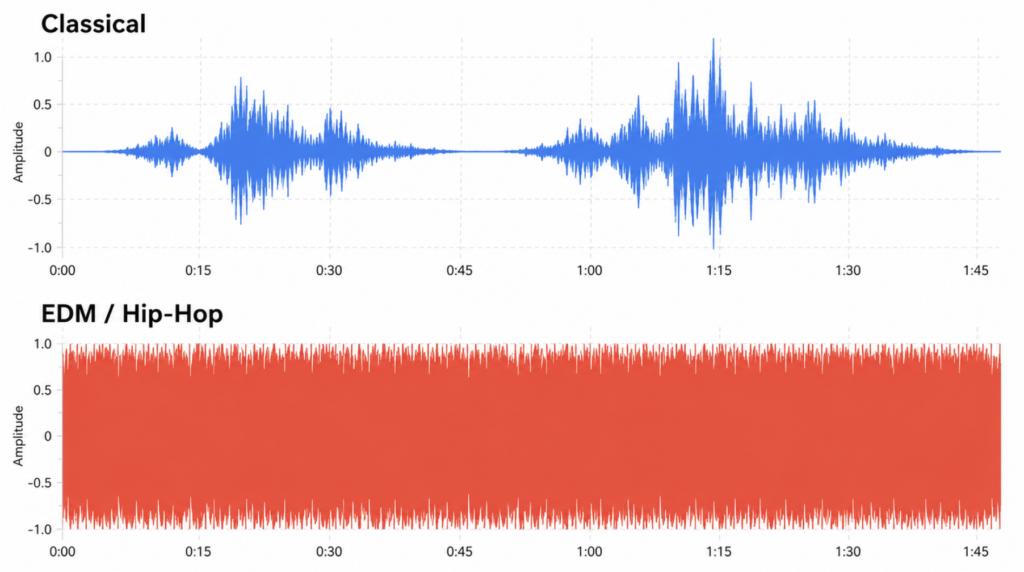
Sustained loudness — the average level your ear integrates over minutes — often matters more than peak amplitude. A heavily compressed track keeps the average loudness pinned close to the peak. A classical recording, by contrast, spends much of its time well below its loudest passages.
Why Compressed Music Hurts More
The cochlea is not a peak detector. The hair cells that translate sound into nerve signals fatigue based on total energy delivered over time, not the highest momentary spike. This is why noise-induced hearing loss follows a dose-response curve.
A classical recording at moderate volume delivers bursts of high-energy sound separated by passages of relative quiet. Those quiet moments are not just artistic — they allow brief physiological recovery. A heavily compressed hip-hop or EDM track at the same peak volume offers no rest moments. The average sound pressure level stays close to the peak for the entire song.
A controlled experiment at Ghent University exposed 21 young adults to one hour of pop-rock music through an MP3 player. At full gain, stock earbuds delivered 102.56 dBA. After exposure, the researchers measured significant changes in hearing thresholds and transient-evoked otoacoustic emissions — objective evidence of temporary inner-ear dysfunction [Keppler, Short-term auditory effects of listening to an MP3 player, 2010]. Pop-rock was chosen specifically because its compressed dynamic profile delivers a more uniform acoustic dose.
Music Genre and Hearing Loss: Genre-by-Genre Hearing Risk Profile
The values below combine published acoustic measurements with epidemiological data on listening behaviors.
| Genre | Typical dynamic range | Typical listening setting | Relative NIHL risk |
|---|---|---|---|
| Classical / opera | 20–32 dB | Concert hall, home | Low |
| Jazz | 13–23 dB | Live venue, home | Low–moderate |
| Ballad / K-pop ballad | ~10 dB | Earbuds, daily | Moderate |
| Pop, hip-hop, rock | ~10 dB or less | Earbuds, parties | High |
| EDM | ~6 dB (industry mastering) | Clubs, festivals, earbuds | Highest |
A Korean study tested four music categories — K-pop dance-pop, K-pop hip-hop, K-pop pop-ballad, and an assorted Billboard chart — through six different smartphones at the volume step where each device triggers its own hearing-risk warning. Dance-pop produced the highest output level across all six smartphones at 91.1 dBA, exceeding the NIOSH-recommended exposure limit of 85 dBA over 8 hours and the OSHA action level for hearing conservation programs [Kim, Sound pressure levels generated at risk volume steps of portable listening devices, 2018]. The same study found that at maximum volume, an iPhone 6 delivered 113.1 dBA — a level for which NIOSH guidance permits less than one minute of cumulative exposure.
The Paradox: EDM Fans Protect Their Ears the Best
Here is a counterintuitive finding from recent literature. A 2025 study in The Laryngoscope surveyed 2,352 music event attendees recruited from online communities and compared EDM attendees with attendees of rock, hip-hop, and country events. EDM attendees were significantly more likely to use hearing protection, with 64.52% preferring high-fidelity earplugs versus 31.45% of non-EDM attendees. They also reported greater concern about noise-induced hearing loss and were more receptive to harm-reduction messaging from their music community [Ayo-Ajibola, Safe Sound: Highlighting Electronic Dance Music Attendees’ Unique Hearing Protection Practices, 2025].
The clinical implication is uncomfortable: the population listening to the most acoustically damaging genre is the one taking protection most seriously. Classical concertgoers and hip-hop listeners — who face real but underestimated risk — are far less likely to wear earplugs because the setting does not feel “loud.”
Clinical Perspective
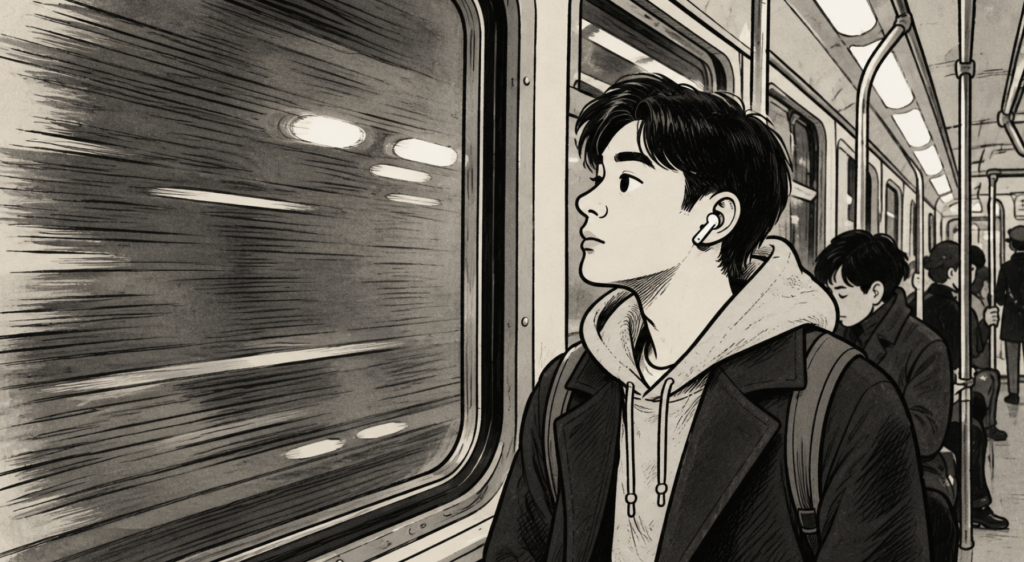
A predictable pattern emerges in otolaryngology clinics: young adults presenting with tinnitus or asymmetric high-frequency hearing loss frequently report daily earbud use during commuting. A Korean study measuring interior noise across nine Seoul subway lines reported time-weighted average levels of 73.45 dB, with peak instantaneous values averaging around 88 dB across lines and reaching 91.94 dB on the loudest line. The authors concluded that subway noise alone is not sufficient to cause noise-induced hearing loss [Lee, Analysis of Subway Interior Noise at Peak Commuter Time, 2017]. The clinical risk emerges in combination: commuters typically raise device volume to overcome this background, which pushes earbud output into the 91+ dBA range documented in the Kim & Han 2018 measurements, and compressed genres deliver sustained acoustic input through the entire commute.
The most widely cited clinical guideline for personal listening is the 60/60 rule — device volume no higher than 60% and listening sessions no longer than 60 minutes per day. This recommendation is endorsed by audiologists and aligns with the WHO Make Listening Safe campaign. For genres with very narrow dynamic ranges, the average level sits much closer to the peak, which compresses the safe exposure envelope further than the rule assumes.
Key Takeaways
- Dynamic range, not just peak volume, predicts inner-ear damage from music
- Classical and jazz preserve 13–32 dB of dynamic range; modern compressed genres deliver 6–10 dB
- Sustained loudness from compressed music gives the cochlea no recovery time between peaks
- EDM attendees use hearing protection more than fans of any other genre, despite higher exposure
- Smartphone maximum volumes can exceed 110 dBA, well above safe daily exposure thresholds
- The 60/60 rule (60% volume, 60 minutes) aligns with WHO safe-listening guidance
FAQ
Which music genre is most dangerous for hearing?
EDM carries the highest acoustic risk because its dynamic range is the most compressed of any major genre and it is typically consumed at high sustained volume in club settings. Hip-hop and pop follow closely when listened to through earbuds at daily commute volumes.
Is classical music safe to listen to at high volume?
Classical music carries lower risk per minute than compressed genres at equivalent peak volume because its quiet passages let the inner ear recover. Live orchestral and operatic performances can still exceed 95 dB at the loudest passages, so prolonged exposure remains a concern for musicians and front-row attendees.
Does bass-heavy music cause more damage?
Bass itself is not the primary culprit. The aggressive compression and limiting used in mastering bass-heavy genres — to maximize perceived loudness — is what raises risk. Low frequencies are also better tolerated by the cochlea than the mid-to-high frequencies typical of noise-induced hearing loss damage zones.
How do I know if my hearing is being damaged?
Ringing in the ears (tinnitus) lasting more than a few minutes after listening, a sensation of muffled hearing, or difficulty understanding speech in noise the next day are early warning signs. These symptoms reflect temporary threshold shifts that can become permanent with repeated exposure.
References
Ayo-Ajibola O, Jung T, Lin ME, Long R, Parsons J, Choi JS, Doherty J. Safe Sound: Highlighting Electronic Dance Music Attendees’ Unique Hearing Protection Practices. Laryngoscope. 2025 Dec;135(12):4858-4871.
Keppler H, Dhooge I, Maes L, D’haenens W, Bockstael A, Philips B, Swinnen F, Vinck B. Short-term auditory effects of listening to an MP3 player. Arch Otolaryngol Head Neck Surg. 2010 Jun;136(6):538-548.
Kim G, Han W. Sound pressure levels generated at risk volume steps of portable listening devices: types of smartphone and genres of music. BMC Public Health. 2018 May 1;18(1):481.
Kirchberger M, Russo FA. Dynamic Range Across Music Genres and the Perception of Dynamic Compression in Hearing-Impaired Listeners. Trends Hear. 2016 Feb 10;20:2331216516630549.
Lee D, Kim G, Han W. Analysis of Subway Interior Noise at Peak Commuter Time. J Audiol Otol. 2017 Jul;21(2):61-65.
Joonpyo Hong, MD is a board-certified otolaryngologist practicing in Korea. This article reflects his clinical interpretation of published research and does not constitute individual medical advice.
For more interesting contents:
https://curiousmd.com/active-noise-cancellation-principle-applications/
https://curiousmd.com/objective-hearing-tests-abr-assr-oae/
https://curiousmd.com/ai-hearing-aids-2026-ent-review/
Link out to:
https://www.who.int/activities/making-listening-safe
https://www.nidcd.nih.gov/health/noise-induced-hearing-loss
https://www.cdc.gov/niosh/noise/about/noise.html