
Picture a hypothetical scene. It is the middle of the night in an emergency department, and a patient on an unfamiliar anticoagulant has come in with a head injury. The attending physician has a few minutes before the next decision. Ten years ago, that physician would have gone on memory, asked a colleague, or run a slow search. Today there is a good chance the question goes into OpenEvidence, an AI system that answers clinical questions with citations from medical journals and guidelines.
The scene is made up, but the numbers behind it are not. According to The New York Times, as reported by Becker’s Hospital Review, OpenEvidence handled 30 million questions in May 2026 alone, and more than half of US physicians now use it regularly [Bruce, OpenEvidence: 6 Things to Know, 2026]. The software was not publicly available before 2023. Medicine is slow to take up new tools, which makes that pace of adoption even more unusual.
OpenEvidence promises individual doctors what evidence-based medicine once promised the whole profession: decisions based on the best available research rather than habit and hierarchy. The catch is that automation copies flaws as faithfully as strengths. A tool built on the published literature inherits that literature’s gaps and lag, along with the commercial pressures behind much of it. OpenEvidence adds a pressure of its own, because pharmaceutical advertising pays for it.
So OpenEvidence has clearly made evidence-based medicine faster. Whether it has made it better is still unproven.
Why OpenEvidence exists: medicine outgrew the human reader
The problem OpenEvidence goes after predates AI: medical knowledge grows faster than any clinician can read. The medical educator Peter Densen estimated that the doubling time of medical knowledge was about 50 years in 1950 and about 3.5 years in 2010, and projected that it would fall to roughly 73 days by 2020 [Densen, Challenges and Opportunities Facing Medical Education, 2011]. That last figure is an extrapolation rather than a measurement, so it is better read as a direction than a fact. The direction itself holds up well. By 2010, roughly 75 clinical trials and 11 systematic reviews were being published every day [Bastian, Seventy-Five Trials and Eleven Systematic Reviews a Day, 2010]. Nobody reads that fast.
You can see the consequence in ordinary clinics. In a classic observational study, 103 family doctors raised 1,101 questions about patient care. They never pursued 64% of them, and when they did look for an answer, they usually gave it less than two minutes [Ely, Analysis of Questions Asked by Family Doctors, 1999]. A later systematic review pooled studies from many settings and found that clinicians raise about one question for every two patients they see, pursue about half, and find answers to roughly three in four of the ones they chase [Del Fiol, Clinical Questions Raised at the Point of Care, 2014]. Questions come up constantly. What runs short is time.
This is the gap OpenEvidence was built for. Its founder, Daniel Nadler, had earlier built Kensho, a financial AI company that S&P Global acquired in 2018 (CNBC, 2026). He teamed up with Zachary Ziegler, then a machine-learning doctoral student at Harvard. Accounts of the founding year differ: the two started working together in 2021, but most coverage dates the company to 2022 (Forbes, 2025; CNBC, 2026). The platform launched publicly in 2023 in collaboration with the Mayo Clinic Platform [Philip, OpenEvidence, 2026]. Both founders point to personal reasons. Nadler’s grandfather died after a medical error, and Ziegler watched his young brother-in-law go through leukemia treatment (Forbes, 2025).
A real problem and a sincere motive are the beginning of a product, not evidence that it works.
The numbers behind the OpenEvidence phenomenon
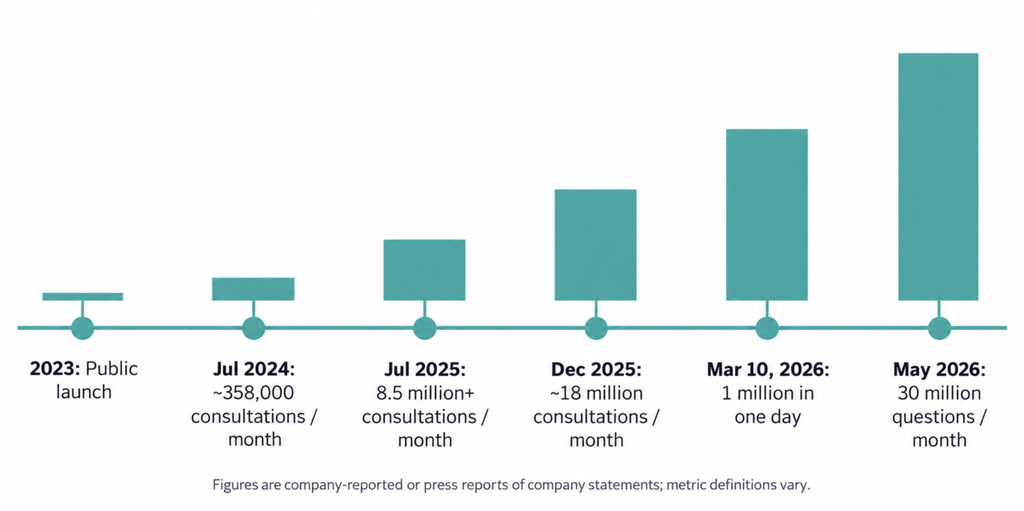
A caution before the figures: nearly every usage number below comes from the company itself or from press coverage of what the company said. The metric also keeps changing, from “consultations” to “questions” to “daily users,” so the figures don’t form one continuous series.
| Date | Milestone | Source type |
|---|---|---|
| 2021 to 2022 | Company formed; no public usage data | Press reports |
| 2023 | Public launch with Mayo Clinic Platform | Journal review |
| July 2024 | About 358,000 physician consultations per month | Company announcement |
| July 2025 | More than 8.5 million consultations per month; more than 40% of US physicians using it daily; about 65,000 new verified clinicians per month | Company announcement |
| December 2025 | About 18 million consultations in the month | Company announcement |
| March 10, 2026 | 1 million consultations in a single day | Company announcement |
| May 2026 | 30 million questions in the month; more than half of US physicians are regular users | The New York Times, via Becker’s |
By the company’s count, monthly consultations grew more than twentyfold in the year to July 2025 (OpenEvidence, 2025). At the end of 2025 it reported about 18 million consultations a month, up from about 3 million a year earlier, with more than 40% of US physicians using the platform daily across more than 10,000 hospitals and medical centers (OpenEvidence, 2026). Press coverage in early 2026 put the number of regular clinician users above 757,000 [Adams, OpenEvidence’s $12B Valuation, 2026].
Investors followed the doctors. The company was valued at about $1 billion in early 2025 (HLTH, 2026). A $210 million round in July 2025 put it at $3.5 billion (OpenEvidence, 2025), a $200 million round in October 2025 at $6 billion (TechCrunch, 2025), and a $250 million round in January 2026 at $12 billion. That comes to roughly $700 million raised over twelve months (CNBC, 2026) and a twelvefold rise in valuation in about a year.
The company says it has passed $100 million in annualized revenue (CNBC, 2026), most of it from pharmaceutical advertising shown to physicians, while the app stays free for verified US clinicians [Adams, OpenEvidence’s $12B Valuation, 2026]. Its chief executive has said that 95% of new users hear about it from another physician (CNBC, 2026).
Hospitals are now making official what their doctors were already doing. Earlier in 2026, Sutter Health began building OpenEvidence into its Epic electronic health record (Healthcare IT News, 2026). In March 2026, Mount Sinai Health System rolled it out across its seven hospitals and opened access to nurses and pharmacists (Mount Sinai, 2026). Press coverage reported that about a third of Mount Sinai’s roughly 9,000 physicians were already regular users before leadership formally approached the company [Bruce, OpenEvidence: 6 Things to Know, 2026]. Memorial Sloan Kettering announced its own integration in September 2026 (OpenEvidence, 2026).
Adoption measures trust, convenience, and marketing, not accuracy or patient benefit. Popularity is a signal, not a verdict.
Clinical Perspective. Most clinical software enters medicine through institutional purchasing, so adoption driven by individual physicians is unusual. It suggests OpenEvidence solves a problem people actually feel at the bedside. It doesn’t tell us whether the problem is being solved correctly.
OpenEvidence vs ChatGPT, Claude, Gemini and Perplexity: what is actually different
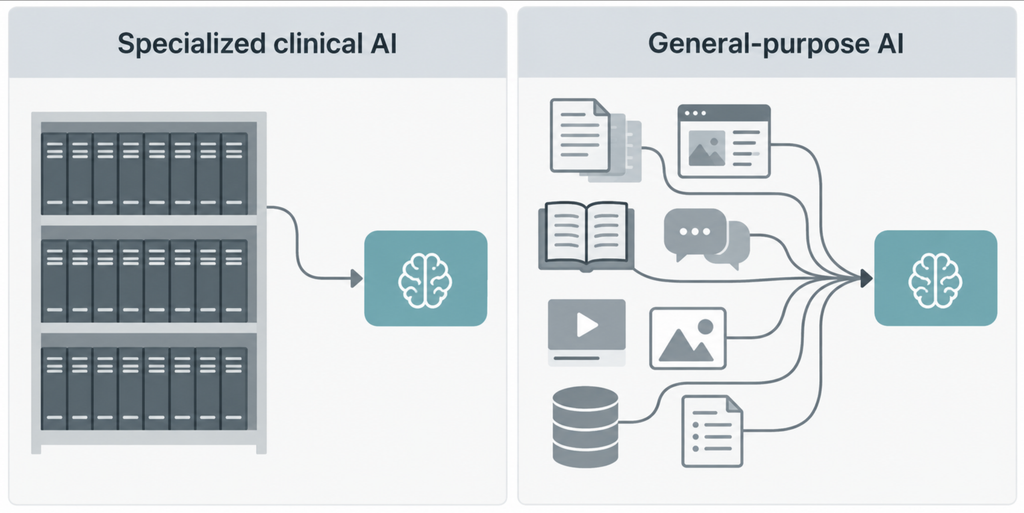
People often call OpenEvidence “ChatGPT for doctors.” That gets the interface right and the design wrong. The differences are real. Whether they produce better answers is another question, and the evidence on that is mixed.
| Dimension | OpenEvidence | General-purpose assistants (ChatGPT, Claude, Gemini) | Perplexity |
|---|---|---|---|
| Intended user | Verified healthcare professionals | General public | General public |
| Access | Free with professional verification (US NPI) | Free and paid tiers | Free and paid tiers |
| Primary sources | Licensed content from NEJM, JAMA, NCCN, Cochrane, Nature and others, per the company | Broad training data; web search in some modes | Real-time web retrieval |
| Business model | Pharmaceutical advertising; enterprise contracts | Subscriptions and enterprise contracts | Subscriptions and enterprise contracts |
| Independent accuracy evidence | Mixed; the most recent large comparison favored general models | Mixed across studies | Improves when restricted to professional sources |
The clearest difference is where the answers come from. OpenEvidence says it has content agreements with the New England Journal of Medicine, the JAMA Network, the National Comprehensive Cancer Network, Cochrane, and the Nature Portfolio, among others (OpenEvidence, 2025). In principle, a curated library makes it less likely that a blog post gets cited as if it were a trial.
The comparative studies only partly support that. In one evaluation, nine physicians reviewed answers to 50 real-world clinical questions. OpenEvidence gave relevant, evidence-based answers to about one question in four, while general-purpose models managed 2% to 10%. Most of that study’s authors, however, worked for a company whose own competing product was also in the test [Low, Answering Real-World Clinical Questions, 2025].
In neurology, OpenEvidence answered about four in five guideline questions correctly, about the same as a general search assistant once that assistant was limited to professional neurology sources [Masanneck, Web Retrieval-Assisted LLMs for Evidence-Based Neurology, 2025].
In orthopedics, OpenEvidence matched all nine guideline recommendations, ChatGPT matched eight, and Gemini and Claude matched seven each, a gap too small to be statistically meaningful [Hsu, Concordance With AAOS Meniscal Guidelines, 2026]. In structural heart disease, ChatGPT-4o did better [Hajj, ChatGPT-4o and OpenEvidence for Structural Heart Disease, 2025].
A large independent comparison published in 2026 points the other way. The study, in Nature Medicine, tested OpenEvidence and UpToDate Expert AI against three frontier general models on 500 exam-style questions, 500 clinician-alignment items, and 100 real queries that physicians had sent to an AI system. Twelve clinicians produced 1,800 blinded ratings. The general models beat both clinical tools in all three evaluations, and on the real clinical queries the specialized tools did about as well as Google’s automatic AI search summaries [Vishwanath, General-Purpose LLMs Outperform Specialized Clinical AI Tools, 2026].
Evidence of real clinical impact is thinner still. In a small Mayo Clinic study of five primary care cases, physicians rated OpenEvidence’s answers as clear and relevant. Its effect on their decisions, though, averaged under 2 on a 0-to-4 scale, mostly because it confirmed plans they had already made [Hurt, OpenEvidence to Augment Primary Care Decision-Making, 2025]. Mayo Clinic is also an investor in the company (HLTH, 2026). Pharmacists have published case examples of wrong medication answers and summarization errors [Bergsbaken, Prescribing Caution, 2026], and an early editorial raised concerns about how opaque the curation process is [Patel, OpenEvidence in Clinical Rotations, 2025]. As of September 2026, no published prospective study has shown that OpenEvidence improves patient outcomes.
A curated source list is a design choice. It is not a guarantee of a better answer.
Clinical Perspective. A benchmark win doesn’t carry straight over to the bedside, in either direction. Real use depends on things benchmarks miss: how well a physician knows the tool, how precisely a question gets typed under time pressure, and how fast a cited source can be checked between patients. A tool that scores a little lower on a test set may still be the one a busy clinician uses well. The reverse can happen too.
Why evidence-based medicine had to happen
Before judging a tool that automates evidence-based medicine, it helps to remember why the movement started. A group of clinical epidemiologists coined the term in 1992, proposing that medicine be taught around critical appraisal of research instead of deference to authority [Evidence-Based Medicine Working Group, A New Approach to Teaching Medicine, 1992]. Four years later, David Sackett and colleagues gave the definition still quoted today: the integration of the best research evidence with clinical expertise and the patient’s own values [Sackett, Evidence Based Medicine: What It Is and What It Isn’t, 1996]. Of those three parts, a search engine can supply only one.
The case for the movement rests on a hard lesson: treatments that make biological sense can kill. In the Cardiac Arrhythmia Suppression Trial, heart attack survivors with irregular heartbeats were given drugs that did suppress those rhythms. Among 1,498 randomized patients, 43 of those taking encainide or flecainide died of arrhythmia, against 16 on placebo, nearly three times as many [Echt, Mortality in Patients Receiving Encainide, Flecainide, or Placebo, 1991]. The drugs fixed the number on the monitor and made the outcome that mattered worse.
Hormone therapy taught a similar lesson. After decades of observational data, the balance of risks and benefits of combined estrogen and progestin was still uncertain, and heart disease prevention was the main question the trial set out to answer. The Women’s Health Initiative randomized 16,608 healthy postmenopausal women and was stopped after an average of 5.2 years, because in that population the regimen’s overall risks, including breast cancer, stroke, and blood clots, outweighed its benefits [Rossouw, Risks and Benefits of Estrogen Plus Progestin, 2002].
Both trials make the core argument for evidence-based medicine. Plausibility is not proof, and only a fair test separates the two.
Proof is also slow to reach practice. People often quote a lag of 17 years, but the review that examined that figure found that studies measured the lag so differently that no single number holds up [Morris, The Answer Is 17 Years, 2011]. The delay is long; nobody knows exactly how long.
Clinical Perspective. Evidence-based medicine often gets described as rule-following, but it began as the opposite: a demand that clinicians question their own certainty. A tool that gives confident, well-cited answers in seconds can support that. It can also quietly swap the questioning for a new kind of deference.
The shadow side of evidence-based medicine, and what AI amplifies
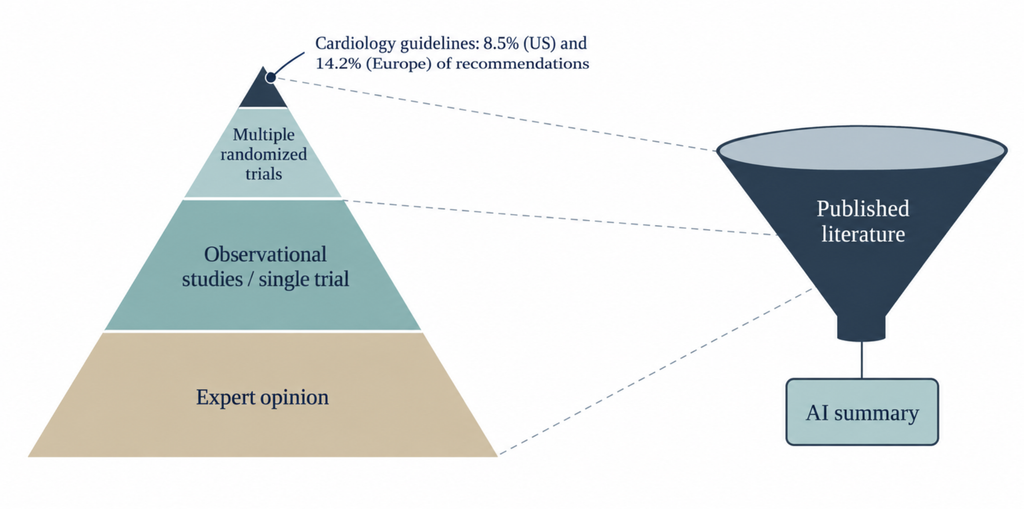
Evidence-based medicine can only be as strong as the evidence behind it, and in many areas that evidence is thin. In American cardiology practice guidelines current in 2008, the median share of recommendations backed by the highest level of evidence (multiple randomized trials) was 11%, while 48% rested mainly on expert opinion [Tricoci, Scientific Evidence Underlying ACC/AHA Guidelines, 2009]. Ten years later it hadn’t improved: only 8.5% of American and 14.2% of European cardiology recommendations had top-level support [Fanaroff, Levels of Evidence Supporting ACC/AHA and ESC Guidelines, 2019]. So even in one of medicine’s most heavily studied fields, fewer than one recommendation in seven rests on the strongest kind of proof.
Some critics inside the movement have gone further. In 2014, Trisha Greenhalgh and colleagues asked whether evidence-based medicine had become “a movement in crisis.” They argued that its benefits had come with unintended harms and called for evidence that can be combined with clinical context to serve individual patients [Greenhalgh, Evidence Based Medicine: A Movement in Crisis?, 2014]. John Ioannidis argued that the movement had been hijacked, with influential trials, meta-analyses, and guidelines increasingly serving commercial interests [Ioannidis, Evidence-Based Medicine Has Been Hijacked, 2016]. There is data behind that worry. A 2003 systematic review found that drug-company-sponsored studies had about four times the odds of reaching conclusions favorable to the sponsor [Lexchin, Pharmaceutical Industry Sponsorship and Research Outcome, 2003].
Averages are a second limit. A trial’s average effect can hide large benefits for some patients, little for many, and harm for a few [Kravitz, The Trouble With Averages, 2004]. The patient in the exam room is never the average.
Timing is a third. Wherever proof hasn’t built up yet, as with new technologies, rare diseases, and unusual patients, evidence-based medicine is slow by design. That isn’t the same as blocking progress; it works more like a speed limit. The best-known critique of this was a joke. In 2003 the BMJ published a “systematic review” that found no randomized trials of parachutes and suggested that the most radical advocates of evidence-based medicine volunteer for one [Smith, Parachute Use to Prevent Death, 2003]. The satire works because the point is real: absence of trial evidence is not evidence of absence.
This is where the problem with OpenEvidence gets sharper. A system that retrieves and summarizes the published literature can be no more current, complete, or independent than that literature. In the comparative study cited earlier, OpenEvidence gave actionable answers to about half of the questions where published evidence already existed, but could do little where it didn’t [Low, Answering Real-World Clinical Questions, 2025].
That is the design doing what it was meant to do, and it is also the speed limit rebuilt in software. Unless the reader checks who paid for a cited trial, an industry-sponsored study and an independent one can look the same in a summarized answer. Then there is the business model. Most of the company’s revenue comes from pharmaceutical advertising shown to the same physicians who use the tool to choose treatments [Adams, OpenEvidence’s $12B Valuation, 2026]. No published study has shown that advertising affects OpenEvidence’s answers, and nobody should assume it does. But the incentive is there, and it deserves independent scrutiny.
Automation does not correct the weaknesses of evidence-based medicine. It scales them.
Clinical Perspective. At the bedside, “What does the evidence say?” is a less useful question than “How much evidence is there, and who produced it?” A tool that answers the first question quickly can make it easier to skip the second.
What the OpenEvidence story means beyond the United States
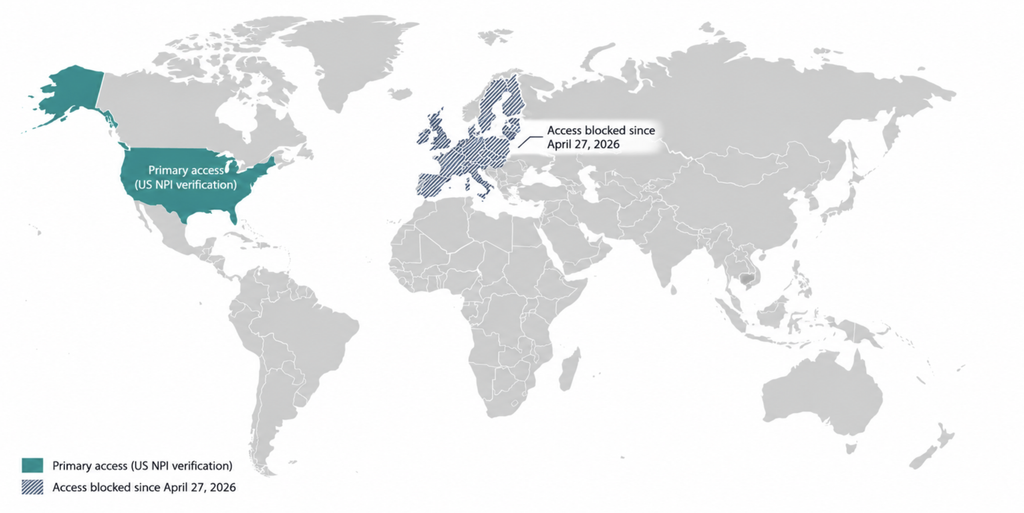
For now, OpenEvidence is mostly an American product. Free full access requires verification through the US National Provider Identifier (NPI), a credential issued only to US healthcare providers, and access for clinicians elsewhere is more limited and has changed over time. On April 27, 2026, the company blocked access across the European Union and the United Kingdom, citing regulatory uncertainty around the EU Artificial Intelligence Act [De Angelis, The Need for Regulatory Certainty on Medical AI, 2026]. The episode showed how quickly a tool clinicians rely on can vanish for regulatory reasons.
Any health system adopting an AI evidence tool has to ask whose literature it is built on, whose guidelines it follows, and who pays for it. An engine tuned to American guidelines and drug approvals won’t always fit practice elsewhere, even when its answers are technically correct.
A fair assessment has to hold two things at once. OpenEvidence is a real advance in getting evidence to the bedside, and physicians adopted it because it solves a problem they feel every shift. It is also an unproven intervention, validated mostly by popularity, with mixed independent evaluations and a funding model that needs scrutiny.
Clinical Perspective. OpenEvidence works best as a very fast reference librarian, not a consultant. Its value depends on a physician who reads the citations, weighs how strong the underlying studies are, and remembers that the patient in front of them may not look like the trial population. Used that way, it shortens the path to evidence. Used as an oracle, it shortens the path to error. The tool made evidence-based medicine faster; making it better remains the clinician’s job.
Key Takeaways
- OpenEvidence is an AI system that answers clinical questions from licensed medical journals and guidelines. Press reports say more than half of US physicians use it.
- Nearly all of its growth figures come from the company, and adoption reflects convenience and trust rather than accuracy.
- Independent studies comparing it with general AI assistants are mixed, and a large 2026 comparison found that general models did better on benchmarks.
- No published prospective study has yet shown that using OpenEvidence improves patient outcomes.
- Evidence-based medicine protects patients from treatments that sound right but cause harm. Much of medicine still rests on limited evidence, though, and AI retrieval carries those gaps forward.
- Its free, advertising-funded model raises a conflict-of-interest question that no one has studied independently.
FAQ
Is OpenEvidence more accurate than ChatGPT? Not consistently. Some small studies favored OpenEvidence, others found no meaningful difference, and one found ChatGPT-4o more accurate in structural heart disease. A large independent comparison published in Nature Medicine in 2026 found that frontier general models outperformed OpenEvidence in all three of its evaluations [Vishwanath, General-Purpose LLMs Outperform Specialized Clinical AI Tools, 2026]. Benchmark results also don’t automatically predict how a tool performs in real clinical use.
Can patients use OpenEvidence? Not in its full form. The platform is built for verified healthcare professionals, and free full access depends on a US National Provider Identifier. Patients who want to understand a treatment are better off going over the cited evidence with their own physician [Philip, OpenEvidence, 2026].
Who founded OpenEvidence and why? Daniel Nadler and Zachary Ziegler. Nadler previously built Kensho, a financial AI company sold to S&P Global. Both founders cite personal experiences with medical care, and the product is aimed at a literature that grows faster than anyone can read (Forbes, 2025).
Does evidence-based medicine slow down medical progress? It depends on what counts as progress. Evidence-based medicine moves slowly where trials don’t exist yet, such as new technologies or rare diseases. It has also stopped harmful treatments that seemed logical, including heart rhythm drugs that nearly tripled deaths from arrhythmia in a landmark trial [Echt, Mortality in Patients Receiving Encainide, Flecainide, or Placebo, 1991].
References
- Bruce G. OpenEvidence: 6 things to know about the AI tool. Becker’s Hospital Review. June 8, 2026. https://www.beckershospitalreview.com/healthcare-information-technology/ai/openevidence-6-things-to-know-about-the-ai-tool-used-by-half-of-physicians/
- Densen P. Challenges and opportunities facing medical education. Trans Am Clin Climatol Assoc. 2011;122:48-58.
- Bastian H, Glasziou P, Chalmers I. Seventy-five trials and eleven systematic reviews a day: how will we ever keep up? PLoS Med. 2010;7(9):e1000326.
- Ely JW, Osheroff JA, Ebell MH, et al. Analysis of questions asked by family doctors regarding patient care. BMJ. 1999;319(7206):358-361.
- Del Fiol G, Workman TE, Gorman PN. Clinical questions raised by clinicians at the point of care: a systematic review. JAMA Intern Med. 2014;174(5):710-718.
- Philip S, Kurian R. OpenEvidence. J Med Libr Assoc. 2026;114(1):86-87.
- Adams K. Thunderstruck by OpenEvidence’s $12B valuation? Don’t be. MedCity News. February 8, 2026. https://medcitynews.com/2026/02/openevidence-healthcare-valuation/
- Low YS, Jackson ML, Hyde RJ, et al. Answering real-world clinical questions using large language model, retrieval-augmented generation, and agentic systems. Digit Health. 2025;11:20552076251348850.
- Masanneck L, Epping PZ, Meuth SG, Pawlitzki M. Evaluating web retrieval-assisted large language models with and without whitelisting for evidence-based neurology: comparative study. J Med Internet Res. 2025;27:e79379.
- Hsu WK, Chuang HC, Wang YY, et al. Concordance of ChatGPT, Gemini, Claude, and OpenEvidence with the 2024 AAOS guidelines on acute isolated meniscal pathology. Knee. 2026;61:104427.
- Hajj J, Mdaihly M, Kassab J, Miyasaka R, Harb SC. Evaluating ChatGPT-4o and OpenEvidence for structural heart disease support: insights from tricuspid valve therapies. Struct Heart. 2025;9(9):100696.
- Vishwanath K, Alyakin A, Ghosh M, et al. General-purpose large language models outperform specialized clinical AI tools on medical benchmarks. Nat Med. 2026;32(7):2405-2409.
- Hurt RT, Stephenson CR, Gilman EA, et al. The use of an artificial intelligence platform OpenEvidence to augment clinical decision-making for primary care physicians. J Prim Care Community Health. 2025;16:21501319251332215.
- Bergsbaken JM, Wilson P, Vandagriff S, Christensen L, Vellardita L. Prescribing caution: a critique of OpenEvidence to answer medication-related questions. J Am Coll Clin Pharm. 2026;9(7):e70237.
- Patel N, Grewal H, Buddhavarapu V, Dhillon G. OpenEvidence: enhancing medical student clinical rotations with AI but with limitations. Cureus. 2025;17(1):e76867.
- Evidence-Based Medicine Working Group. Evidence-based medicine: a new approach to teaching the practice of medicine. JAMA. 1992;268(17):2420-2425.
- Sackett DL, Rosenberg WM, Gray JA, Haynes RB, Richardson WS. Evidence based medicine: what it is and what it isn’t. BMJ. 1996;312(7023):71-72.
- Echt DS, Liebson PR, Mitchell LB, et al. Mortality and morbidity in patients receiving encainide, flecainide, or placebo: the Cardiac Arrhythmia Suppression Trial. N Engl J Med. 1991;324(12):781-788.
- Rossouw JE, Anderson GL, Prentice RL, et al. Risks and benefits of estrogen plus progestin in healthy postmenopausal women: principal results from the Women’s Health Initiative randomized controlled trial. JAMA. 2002;288(3):321-333.
- Morris ZS, Wooding S, Grant J. The answer is 17 years, what is the question: understanding time lags in translational research. J R Soc Med. 2011;104(12):510-520.
- Tricoci P, Allen JM, Kramer JM, Califf RM, Smith SC Jr. Scientific evidence underlying the ACC/AHA clinical practice guidelines. JAMA. 2009;301(8):831-841.
- Fanaroff AC, Califf RM, Windecker S, Smith SC Jr, Lopes RD. Levels of evidence supporting American College of Cardiology/American Heart Association and European Society of Cardiology guidelines, 2008-2018. JAMA. 2019;321(11):1069-1080.
- Greenhalgh T, Howick J, Maskrey N; Evidence Based Medicine Renaissance Group. Evidence based medicine: a movement in crisis? BMJ. 2014;348:g3725.
- Ioannidis JPA. Evidence-based medicine has been hijacked: a report to David Sackett. J Clin Epidemiol. 2016;73:82-86.
- Lexchin J, Bero LA, Djulbegovic B, Clark O. Pharmaceutical industry sponsorship and research outcome and quality: systematic review. BMJ. 2003;326(7400):1167-1170.
- Kravitz RL, Duan N, Braslow J. Evidence-based medicine, heterogeneity of treatment effects, and the trouble with averages. Milbank Q. 2004;82(4):661-687.
- Smith GCS, Pell JP. Parachute use to prevent death and major trauma related to gravitational challenge: systematic review of randomised controlled trials. BMJ. 2003;327(7429):1459-1461.
- De Angelis L, Sacchi FA, Pappalardo C, et al. The need for regulatory certainty on medical AI: lessons from the OpenEvidence geoblocking in the EU and UK over the EU AI Act. Lancet Reg Health Eur. 2026;65:101718.
Company and press sources
- OpenEvidence. OpenEvidence, the fastest-growing application for physicians in history, announces $210 million round at $3.5 billion valuation. July 15, 2025. https://www.openevidence.com/announcements/openevidence-the-fastest-growing-application-for-physicians-in-history-announces-dollar210-million-round-at-dollar35-billion-valuation
- OpenEvidence. OpenEvidence raises $250 million to build medical superintelligence for doctors. Business Wire. January 21, 2026. https://www.businesswire.com/news/home/20260121029132/en/OpenEvidence-Raises-$250-Million-to-Build-Medical-Superintelligence-for-Doctors
- OpenEvidence. OpenEvidence achieves historic milestone: 1 million clinical consultations in a single day. PR Newswire. March 12, 2026. https://www.prnewswire.com/news-releases/openevidence-achieves-historic-milestone-1-million-clinical-consultations-between-verified-doctors-and-an-artificial-intelligence-system-in-a-single-day-302712459.html
- OpenEvidence. Announcements (Memorial Sloan Kettering partnership, September 16, 2026). https://www.openevidence.com/announcements
- CNBC. OpenEvidence, the “ChatGPT for doctors,” doubles valuation to $12 billion. January 21, 2026. https://www.cnbc.com/2026/01/21/openevidence-chatgpt-for-doctors-doubles-valuation-to-12-billion.html
- Forbes. This AI founder became a billionaire by building ChatGPT for doctors. July 15, 2025. https://www.forbes.com/sites/amyfeldman/2025/07/15/this-ai-founder-became-a-billionaire-by-building-chatgpt-for-doctors/
- HLTH. OpenEvidence doubles valuation to $12bn as physician adoption accelerates. January 22, 2026. https://hlth.com/insights/news/openevidence-doubles-valuation-to-12bn-as-physician-adoption-accelerates-2026-01-22
- Healthcare IT News. Mount Sinai to integrate OpenEvidence AI enterprise-wide. 2026. https://www.healthcareitnews.com/news/mount-sinai-integrate-openevidence-ai-enterprise-wide
- Mount Sinai Health System. Mount Sinai Health System collaborates with OpenEvidence to provide evidence-based knowledge within electronic medical record. March 31, 2026. https://www.mountsinai.org/about/newsroom/2026/mount-sinai-health-system-collaborates-with-openevidence-to-provide-evidence-based-knowledge-within-electronic-medical-record
- TechCrunch. OpenEvidence, the ChatGPT for doctors, raises $200M at $6B valuation. October 20, 2025. https://techcrunch.com/2025/10/20/openevidence-the-chatgpt-for-doctors-raises-200m-at-6b-valuation/
Joonpyo Hong, MD is a board-certified otolaryngologist practicing in Korea. This article reflects his clinical interpretation of published research and does not constitute individual medical advice. This article is not intended to advertise or promote any specific company or product.
For more articles:
https://curiousmd.com/palantir-nhs-federated-data-platform/
https://curiousmd.com/future-of-clinical-decision-support/
https://curiousmd.com/palantir-nhs-federated-data-platform/
Link out to:
OpenEvidence: About and content partnerships
CNBC: OpenEvidence doubles valuation to $12 billion
Mount Sinai Newsroom: Enterprise deployment of OpenEvidence in Epic
The Lancet Regional Health – Europe: Lessons from the OpenEvidence geoblocking