
Deciding when to test for flu or COVID looks simple: swab and find out. Consider a composite case drawn from everyday clinic visits. An office worker in her thirties wakes on a Tuesday with a scratchy throat and a low fever, runs a combination home test for both viruses, sees a single line, and goes to work. On Thursday the same kit turns positive for COVID-19. The first test worked; she had taken it too early.
This happens often. In a study of mostly vaccinated or previously infected adults, viral levels were used to estimate that an antigen test taken on the first day of symptoms might catch somewhere between a third and three-fifths of COVID-19 infections, rising to roughly four in five or more by day four. These figures are model estimates rather than head-to-head test results, but measured studies point the same way [Frediani, Delayed Peak SARS-CoV-2 Viral Loads, 2024] [Chu, Home Antigen Testing vs RT-PCR and Culture, 2022].
According to figures released by the Korea Disease Control and Prevention Agency, Korea declared this season’s influenza advisory on September 11, 2026, with 25.3 influenza-like illnesses per 1,000 outpatient visits, roughly double the epidemic threshold of 12.9 and about 3.8 times last year’s level at the same point [SBS Biz, Early Influenza Advisory, 2026].
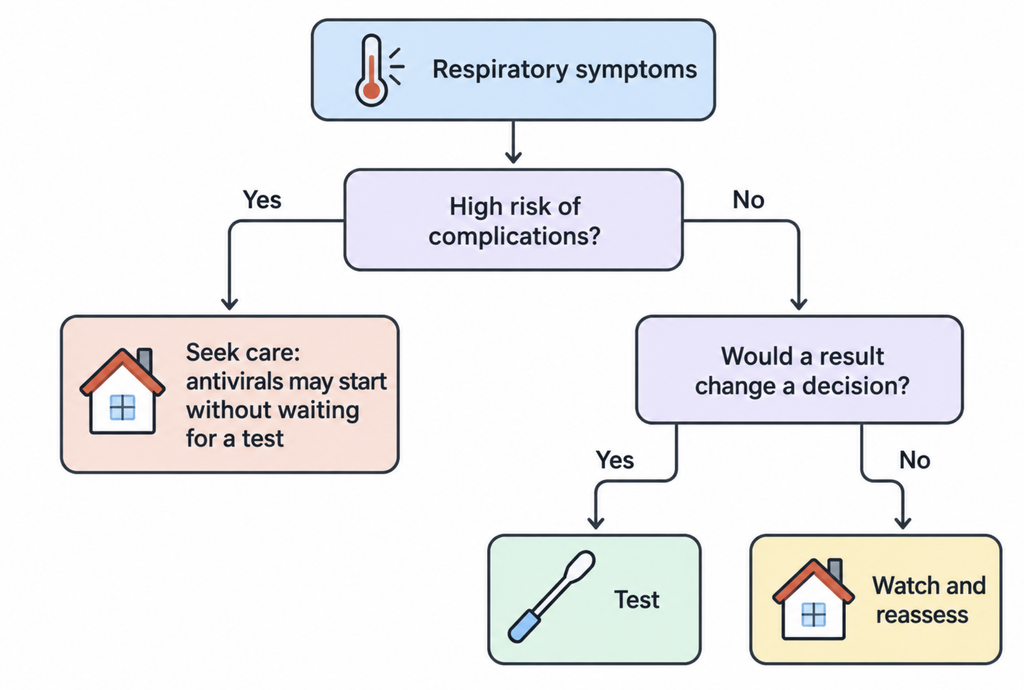
A swab feels objective. In practice, what a test can tell you depends less on the virus than on who is asking, what the result would change, and which day of illness it is. So “Is it the flu?” is the wrong first question. Ask whether knowing would change anything, and whether today is a day a swab can answer.
Why Symptoms Can’t Sort It Out, and Why That Doesn’t Mean Testing Everyone
No single symptom reliably separates influenza, COVID-19, and a common cold. A classic review of bedside findings found that no symptom more than doubled the odds of influenza; the absence of fever, cough, or nasal congestion lowered the odds, with likelihood ratios of 0.40, 0.42, and 0.49, each roughly halving them, but did not rule it out [Call, Does This Patient Have Influenza?, 2005].
Scoring rules do little better: a review of 14 prediction rules from 10 studies found an area under the curve of 0.7–0.8, meaning moderate discrimination, and only 1 rule had been tested outside the setting that created it [Ebell, Clinical Prediction Rules for Influenza, 2021]. For COVID-19, the Infectious Diseases Society of America (IDSA) states that clinical assessment alone cannot reliably identify the infection [Hayden, IDSA COVID-19 Molecular Testing Guideline, 2024].
Symptoms still shift probability. During flu season, a sudden fever with cough is the most telling combination, with a sensitivity above 70%, meaning it catches most, but not all, flu cases [Uyeki, IDSA Seasonal Influenza Guideline, 2019]. In adults 60 and older, fever, cough, and acute onset together carried a likelihood ratio of 5.4, about five times the odds [Call, Does This Patient Have Influenza?, 2005].
It is tempting to conclude that everyone with a sniffle should be swabbed. That skips a step. Symptoms set the starting odds; they don’t tell you whether the answer is worth having. The reason to test is a decision that depends on the result, and uncertainty by itself isn’t one.
The Decision a Test Is Supposed to Change
Major influenza guidelines frame testing around one question: will the result change what happens next, whether that is treatment, further tests, antibiotics, isolation, or protection of vulnerable contacts? [Uyeki, IDSA Seasonal Influenza Guideline, 2019]. COVID-19 guidance for people without symptoms uses the same logic, suggesting testing when results will affect isolation or protective-equipment decisions [Hayden, IDSA COVID-19 Molecular Testing Guideline, 2024].
| Who | What guidelines say | What a result can change |
|---|---|---|
| High risk of complications: adults 65 and older, young children, pregnancy and up to 2 weeks after, BMI of 40 or higher, chronic disease, weakened immunity | Test for influenza when the result will change care; strongly recommended, though for outpatients largely on expert consensus | Antivirals, antibiotics, admission |
| Hospital admission, worsening chronic disease, or pneumonia | Test | Treatment, infection control |
| People with suspected COVID-19 symptoms | A molecular (PCR-type) test is recommended once testing is chosen | Treatment eligibility, isolation |
| Healthy adults with typical flu symptoms | Testing “can be considered” if a result would change a decision (weak, opinion-based) | Antibiotic avoidance, high-risk household members |
The table draws on the IDSA guidelines and the Centers for Disease Control and Prevention (CDC) risk list, which define young children as younger than 2 (CDC) / younger than 5, especially under 2 (IDSA) [Uyeki, IDSA Seasonal Influenza Guideline, 2019] [Hayden, IDSA COVID-19 Molecular Testing Guideline, 2024] [CDC, Higher Risk of Flu Complications, 2024].
The people who most need a diagnosis can often be treated without waiting for one. Once flu is known to be circulating, the CDC says a clinical diagnosis is acceptable for outpatients with typical symptoms, and not everyone needs a test to start treatment [CDC, Rapid Influenza Diagnostic Tests, 2026]. For hospitalized, severely ill, or high-risk patients, antivirals should begin as soon as possible, ideally within 48 hours of symptom onset, without waiting for laboratory confirmation [CDC, Influenza Antiviral Summary for Clinicians, 2026].
Korea builds this into insurance: during an influenza advisory, national coverage pays for antivirals prescribed on clinical judgement, without a confirmatory test, to high-risk patients: children aged 9 or younger, pregnant women or those within 2 weeks of delivery, adults 65 and older, people with weakened immunity, and people with chronic conditions [KHA, Influenza Advisory Notice, 2026].
Testing pays off when a result can stop unnecessary care. Some studies, mainly in children and emergency departments, found that a confirmed flu result led to fewer antibiotics and extra tests, but a trial in hospitalised adults did not [Uyeki, IDSA Seasonal Influenza Guideline, 2019]. A swab is most worth taking when its result can stop the wrong treatment; confirming the right one adds less.
Clinical Perspective. The most useful test is often for the patient who is not high risk but lives with someone who is. The result changes little for the person swabbed and a great deal for the grandparent, newborn, or chemotherapy patient at home.
The Gray Zone: Healthy Adults With Mild Symptoms
No guideline located for this article tells an otherwise healthy adult with mild cold symptoms whether testing is required. U.S. influenza guidance offers only a weak, opinion-based “consider”; COVID-19 guidance focuses on which test to use once testing is chosen; and no Korean guideline reviewed addresses the question directly. There is also no official retesting rule for home flu tests [Uyeki, IDSA Seasonal Influenza Guideline, 2019] [Hayden, IDSA COVID-19 Molecular Testing Guideline, 2024]. Whether the COVID-19 advice was meant to cover every mild cold is open to interpretation.
Research narrows the gap. For influenza, trials show oseltamivir shortens symptoms by roughly a day in otherwise healthy adults: 16.8 hours, less than a day, in one review of regulatory trial reports [Jefferson, Oseltamivir Clinical Study Reports, 2014], and 25.2 hours, about a day, in a pooled analysis of manufacturer-sponsored trials [Dobson, Oseltamivir Meta-analysis of RCTs, 2015]. Whether it also prevents complications is still argued over. The second analysis found hospital admission of 0.6% vs 1.7%, about 1 fewer admission per 100 treated, while the first found no clear difference. Both agree it adds nausea and vomiting (8.0% vs 3.3% for vomiting in the pooled analysis, roughly 1 extra person vomiting for every 20 treated).
For COVID-19, a trial of 1,288 participants who were either at standard risk or vaccinated with risk factors found nirmatrelvir did not meaningfully shorten symptoms, at 12 vs 13 days to symptom relief [Hammond, Nirmatrelvir for Vaccinated or Unvaccinated Outpatients, 2024]. An earlier trial in unvaccinated high-risk patients had shown an 89% lower risk of hospitalization or death (0.77% vs 7.01%), about 6 fewer serious outcomes per 100 treated [Hammond, Oral Nirmatrelvir for High-Risk Adults, 2022]. Both trials were manufacturer-funded, and the benefit depends heavily on who is treated.
Self-testing is far more efficient when symptoms are present: pooled data from 61 studies suggest 75 tests per case found (symptomatic) vs 1,002 (asymptomatic), about 13 times more efficient with symptoms, though the studies vary widely [Brümmer, Self-Testing Outcomes, 2026].
Taken together, the evidence supports a clinical opinion rather than a rule. For a healthy adult, testing appears most justified when one of these applies:
- A household member or care recipient is at high risk of complications.
- It is flu season, and fever and cough began suddenly within the last 48 hours.
- Symptoms are worsening, or recovery is stalling.
- A result would change attendance at work, school, or a care facility.
Otherwise, careful observation is reasonable. The list is a clinical synthesis, not an official standard. In the gray zone, test when you can name the decision the result will settle.
When to Test for Flu or COVID: Two Viruses, Two Clocks
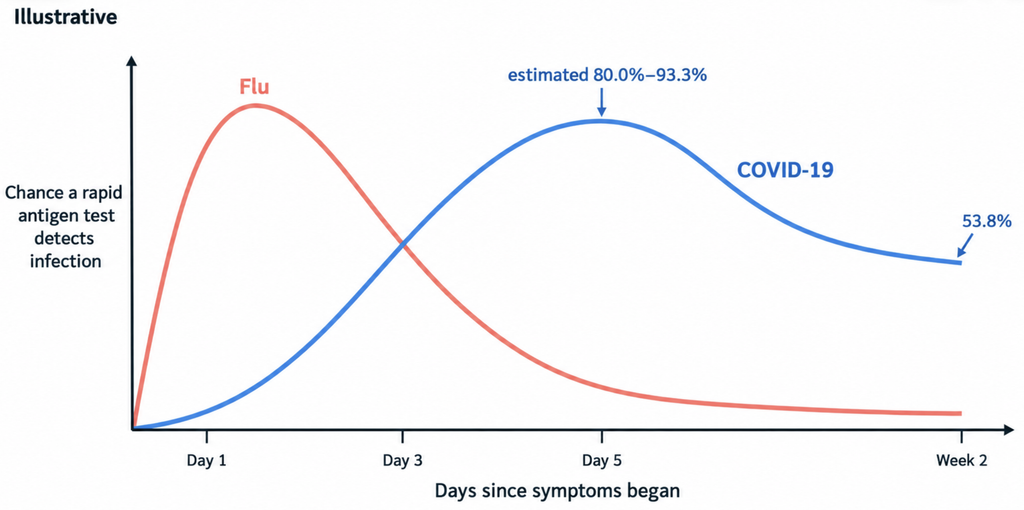
The two viruses keep different schedules. In healthy people, influenza shedding peaks in the first 1–2 days of symptoms and fades within about a week [Uyeki, IDSA Seasonal Influenza Guideline, 2019]. In the study of 348 adults, 91.1% of whom (about nine in ten) were vaccinated or previously infected, COVID-19 viral levels in the nose kept rising after symptoms began and peaked around day 4–5, whereas influenza A peaked around day 2 [Frediani, Delayed Peak SARS-CoV-2 Viral Loads, 2024].
One proposed explanation is that a primed immune system produces symptoms earlier, before the virus has built up [Frediani, Delayed Peak SARS-CoV-2 Viral Loads, 2024]. The timing matters because of how the tests work. Antigen tests need a certain amount of viral protein to show a line; molecular tests copy genetic material over and over, so they can detect far smaller amounts [Dinnes, Rapid Antigen Tests for SARS-CoV-2, 2022].
The modelled antigen sensitivity was an estimated 30.0%–60.0% on day 1, an estimated 59.2%–74.8% on day 3, roughly three in five to three in four, and an estimated 80.0%–93.3% on day 4 [Frediani, Delayed Peak SARS-CoV-2 Viral Loads, 2024]. Even before Omicron, a CDC-led study of 225 participants enrolled January–May 2021 found home antigen tests peaked at 77% on day 4, about three in four, and a second test a day or two later helped [Chu, Home Antigen Testing vs RT-PCR and Culture, 2022].
| Day of symptoms | Influenza antigen test | COVID-19 antigen test | PCR (either virus) |
|---|---|---|---|
| Day 1 | Good window: shedding near peak | Often too early; a negative means little | Most sensitive option |
| Day 3 | Still reasonable | Improving | Most sensitive option |
| Day 4–5 | Declining in adults after 3–4 days | Near peak | Most sensitive option |
| Week 2 | A negative is weak evidence | About half detected | May stay positive up to 90 days for COVID-19 |
Too early
A negative COVID-19 antigen test on the first day of symptoms carries the least information, which is why the FDA advises repeating it 48 hours later, for at least 2 tests in total [FDA, At-Home COVID-19 Antigen Tests Safety Communication, 2022].
Too late
For influenza, guidelines advise sampling as early as possible, ideally within 4 days of symptom onset. After that, a negative result in an adult means less, while young children and people with weakened immunity can shed for longer [Uyeki, IDSA Seasonal Influenza Guideline, 2019] [CDC, Rapid Influenza Diagnostic Tests, 2026]. For COVID-19, antigen tests found 80.9% in week 1 vs 53.8% in week 2, about four in five versus about half [Dinnes, Rapid Antigen Tests for SARS-CoV-2, 2022]. Testing late also muddies positives. Some COVID-19 tests can stay positive for up to 90 days, about three months, after an infection, so a late positive may reflect a past infection [CDC, COVID-19 Testing, 2025].
The combination-test trap
A combination home test reads both viruses from one swab, but they do not peak on the same day. A negative on day 1 says something about influenza and little about COVID-19; a first test on day 4 or day 5 says the reverse. This reading combines the timing data above, and no guideline addresses it directly. No single test day falls at the peak of both viruses.
Reading a Home Nasal Swab: Positives, Negatives, and the 48-Hour Rule
A positive home antigen test during flu or COVID-19 season is usually right; a single negative is not enough to rule either out.
Positives: usually trustworthy, with two exceptions
COVID-19 antigen tests showed specificity 99.1% (symptomatic), about 1 false positive per 100 uninfected people tested [Dinnes, Rapid Antigen Tests for SARS-CoV-2, 2022]. A separate meta-analysis found point-of-care antigen specificity of 98.9%; molecular point-of-care tests were more sensitive, at 92.8% versus 70.6% for antigen tests [Fragkou, Point-of-Care Tests for SARS-CoV-2, 2023]. Guidelines say most positive antigen results can be acted on without a confirmatory test [Hayden, IDSA COVID-19 Antigen Testing Guideline, 2024].
The first exception is a quiet season, when a larger share of positives are false. In modelling, a positive predictive value of 89% at 5% prevalence meant 1 in 10 positives would be false, while at 0.5% prevalence in people without symptoms the value fell to 38%–52%, about half or more of positives false [Dinnes, Rapid Antigen Tests for SARS-CoV-2, 2022]. The second exception applies only where nasal-spray flu vaccine is used: it can cause a positive influenza test for up to 7 days after vaccination [CDC, Rapid Influenza Diagnostic Tests, 2026].
Negatives: the 48-hour rule, and why flu negatives deserve extra doubt
For COVID-19, the FDA recommends repeat testing 48 hours apart: at least 2 tests with symptoms, and at least 3 tests without symptoms after an exposure [FDA, At-Home COVID-19 Antigen Tests Safety Communication, 2022]. Measured data back the rule. In a prospective study of 154 infections, two home tests 48 hours apart caught 93.4% of symptomatic infections, about 93 in 100, while people without symptoms needed a third test, rising from 62.7% to 79.0% [Soni, Rapid Antigen Test Performance, 2023]. Intervals shorter than 48 hours were not studied.
Influenza is the weaker side of the strip. Rapid flu antigen tests typically detect 50%–70% of infections, missing roughly a third to half, rising to 76%–80% with a reader device vs 53%–54% without [CDC, Rapid Influenza Diagnostic Tests, 2026]. A meta-analysis found 54.4% (influenza A) and 53.2% (influenza B) for traditional rapid tests, and 91.6% and 95.4% for rapid molecular tests, with sensitivity 12.1–31.8 percentage points higher in children than adults [Merckx, Rapid Influenza Tests vs RT-PCR, 2017].
Combination kits show the gap. In one UK primary-care study of 481 patients in 17 practices, a single combination test on clinician-collected nose-and-throat swabs detected 29.1% of influenza A infections (16 of 55) versus 70.4% of COVID-19 infections: fewer than one in three flu cases against about seven in ten COVID-19 cases [Fanshawe, RAPTOR-C19 Antigen Test Accuracy, 2025]. A Dutch study of 1,740 emergency patients found 52.7% (influenza) vs 67.7% (COVID-19), missing nearly half of flu cases [Van der Moeren, Combined Rapid Antigen Test Isolation Policy, 2023]. Both evaluated specific professional-use products rather than home use, and brands vary: COVID-19 antigen sensitivity alone ranged 34.3%–91.3% by brand [Dinnes, Rapid Antigen Tests for SARS-CoV-2, 2022].
In June 2026, Korea’s drug regulator created a legal category for influenza self-test kits, to be labelled as supplementary rather than confirmatory tests [Medifo News, MFDS Expands Self-Test Categories, 2026]. That label matches the evidence. For high-risk people with typical flu symptoms, the CDC advises against withholding antivirals on the basis of a negative rapid result [CDC, Rapid Influenza Diagnostic Tests, 2026].
| Result | When taken | Reasonable next step |
|---|---|---|
| Positive, flu or COVID-19 season | Any day | Act on it; contact a clinician if high risk |
| Negative for COVID-19 | Day 1–3 | Retest in 48 hours (FDA rule) |
| Negative for influenza, high risk or worsening | Any day | See a clinician; do not rely on the home result (clinician advice) |
Technique counts
For antigen tests, limited data show no clear loss of accuracy from a front-of-the-nose swab compared with a deep nasopharyngeal one, although for PCR the nasal sample ran 12 percentage points lower [Davenport, Sample Site and SARS-CoV-2 Detection, 2024].

Clinical Perspective. From the otolaryngology side, many poor home samples come down to technique: a swab dipped in fresh mucus, one nostril instead of two, or a tip that never touches the nasal lining. Gently clearing the nose and sampling both sides exactly as the kit directs gives the test its fairest chance.
When the Test Stops Being the Point
Some symptoms make the swab irrelevant. CDC emergency warning signs in adults include difficulty breathing, persistent chest or abdominal pain or pressure, persistent dizziness or confusion, seizures, not urinating, severe weakness, worsening chronic illness, and fever or cough that improve and then return or worsen [CDC, Flu Signs and Symptoms, 2024]. In children the list adds fast breathing, bluish lips, dehydration, a 104°F (40°C) fever not controlled by medicine, and any fever under 12 weeks of age. Getting worse after improving is a specific warning: guidelines advise evaluating and treating for a secondary bacterial infection when a patient deteriorates after initial improvement [Uyeki, IDSA Seasonal Influenza Guideline, 2019].
Key Takeaways
- No symptom reliably distinguishes flu, COVID-19, and a cold, but that uncertainty alone does not justify testing everyone.
- Influenza guidelines tie testing to whether a result will change treatment, antibiotics, isolation, or protection of high-risk contacts.
- For healthy adults with mild symptoms, no guideline requires testing; the case for it rests on household risk, timing, and real decisions.
- Influenza is easiest to catch in the first days of symptoms, while COVID-19 antigen tests in immune populations improve over several days.
- A positive home test in season is usually correct; a single negative is not, which is why a repeat COVID-19 test after 48 hours matters.
- The influenza side of combination home tests misses many infections, so a negative flu result should never delay care for a high-risk person.
FAQ
Should mild cold symptoms be tested for flu or COVID?
Guidelines do not require testing for otherwise healthy adults with mild symptoms; U.S. influenza guidance only says testing “can be considered” when a result would change a decision. Testing makes more sense with a high-risk household member, sudden fever and cough in flu season, or worsening illness [Uyeki, IDSA Seasonal Influenza Guideline, 2019].
How many days after symptoms start is a COVID home test most accurate?
Usually day 3 to day 5. In largely immune adults, COVID-19 viral levels peaked around day 4–5, and estimated antigen sensitivity rose from low on day 1 to roughly four in five or more by day 4 [Frediani, Delayed Peak SARS-CoV-2 Viral Loads, 2024]. Testing early is still useful if a negative result is repeated 48 hours later.
Can a flu test be done too late?
Yes. Influenza shedding peaks in the first 1–2 days and declines after 3–4 days in most adults, so guidelines advise sampling within 4 days of symptom onset. A negative rapid test after that point is weak evidence against influenza [Uyeki, IDSA Seasonal Influenza Guideline, 2019].
Is a positive home test reliable?
Usually, yes. COVID-19 antigen tests showed specificity 99.1% (symptomatic), so false positives are uncommon during an active season [Dinnes, Rapid Antigen Tests for SARS-CoV-2, 2022]. A positive in a quiet season with no known exposure deserves confirmation.
References
- Uyeki TM, Bernstein HH, Bradley JS, et al. Clinical practice guidelines by the Infectious Diseases Society of America: 2018 update on diagnosis, treatment, chemoprophylaxis, and institutional outbreak management of seasonal influenza. Clin Infect Dis. 2019;68(6):e1-e47.
- Hayden MK, Hanson KE, Englund JA, et al. The Infectious Diseases Society of America guidelines on the diagnosis of COVID-19: molecular diagnostic testing (December 2023). Clin Infect Dis. 2024;78(7):e385-e415.
- Hayden MK, Hanson KE, Englund JA, et al. The Infectious Diseases Society of America guidelines on the diagnosis of COVID-19: antigen testing (January 2023). Clin Infect Dis. 2024;78(7):e350-e384.
- Centers for Disease Control and Prevention (CDC). Rapid influenza diagnostic tests. Updated June 22, 2026. https://www.cdc.gov/flu/hcp/testing-methods/clinician_guidance_ridt.html
- Centers for Disease Control and Prevention (CDC). Influenza antiviral medications: summary for clinicians. Updated March 10, 2026. https://www.cdc.gov/flu/hcp/antivirals/summary-clinicians.html
- Centers for Disease Control and Prevention (CDC). People at higher risk of flu complications. Updated September 11, 2024. https://www.cdc.gov/flu/highrisk/index.htm
- Centers for Disease Control and Prevention (CDC). Signs and symptoms of flu. 2024. https://www.cdc.gov/flu/signs-symptoms/index.html
- Centers for Disease Control and Prevention (CDC). COVID-19 testing. 2025. https://www.cdc.gov/covid/testing/index.html
- US Food and Drug Administration (FDA). At-home COVID-19 antigen tests—take steps to reduce your risk of false negative results: FDA safety communication. August 11, 2022; updated November 17, 2022. https://www.fda.gov/medical-devices/safety-communications/home-covid-19-antigen-tests-take-steps-reduce-your-risk-false-negative-results-fda-safety
- Call SA, Vollenweider MA, Hornung CA, Simel DL, McKinney WP. Does this patient have influenza? JAMA. 2005;293(8):987-997.
- Ebell MH, Rahmatullah I, Cai X, et al. A systematic review of clinical prediction rules for the diagnosis of influenza. J Am Board Fam Med. 2021;34(6):1123-1140.
- Jefferson T, Jones M, Doshi P, Spencer EA, Onakpoya I, Heneghan CJ. Oseltamivir for influenza in adults and children: systematic review of clinical study reports and summary of regulatory comments. BMJ. 2014;348:g2545.
- Dobson J, Whitley RJ, Pocock S, Monto AS. Oseltamivir treatment for influenza in adults: a meta-analysis of randomised controlled trials. Lancet. 2015;385(9979):1729-1737.
- Hammond J, Fountaine RJ, Yunis C, et al. Nirmatrelvir for vaccinated or unvaccinated adult outpatients with Covid-19. N Engl J Med. 2024;390(13):1186-1195.
- Hammond J, Leister-Tebbe H, Gardner A, et al. Oral nirmatrelvir for high-risk, nonhospitalized adults with Covid-19. N Engl J Med. 2022;386(15):1397-1408.
- Brümmer LE, Faehling V, McGrath S, et al. Population health and implementation outcomes of self-testing for SARS-CoV-2 using antigen detecting diagnostics: a systematic review and meta-analysis. EClinicalMedicine. 2026;94:103838.
- Frediani JK, Parsons R, McLendon KB, et al. The new normal: delayed peak SARS-CoV-2 viral loads relative to symptom onset and implications for COVID-19 testing programs. Clin Infect Dis. 2024;78(2):301-307.
- Chu VT, Schwartz NG, Donnelly MAP, et al. Comparison of home antigen testing with RT-PCR and viral culture during the course of SARS-CoV-2 infection. JAMA Intern Med. 2022;182(7):701-709.
- Dinnes J, Sharma P, Berhane S, et al. Rapid, point-of-care antigen tests for diagnosis of SARS-CoV-2 infection. Cochrane Database Syst Rev. 2022;7(7):CD013705.
- Soni A, Herbert C, Lin H, et al. Performance of rapid antigen tests to detect symptomatic and asymptomatic SARS-CoV-2 infection: a prospective cohort study. Ann Intern Med. 2023;176(7):975-982.
- Fragkou PC, Moschopoulos CD, Dimopoulou D, et al. Performance of point-of care molecular and antigen-based tests for SARS-CoV-2: a living systematic review and meta-analysis. Clin Microbiol Infect. 2023;29(3):291-301.
- Merckx J, Wali R, Schiller I, et al. Diagnostic accuracy of novel and traditional rapid tests for influenza infection compared with reverse transcriptase polymerase chain reaction: a systematic review and meta-analysis. Ann Intern Med. 2017;167(6):394-409.
- Fanshawe TR, Tonner S, Turner PJ, et al. Diagnostic accuracy evaluation of a point-of-care antigen test for SARS-CoV-2 and influenza in UK primary care (RAPTOR-C19). PLoS One. 2025;20(8):e0329611.
- Van der Moeren N, Zwart VF, Louise van Leest M, et al. A SARS-CoV-2 and influenza rapid antigen test-based hospital isolation policy awaiting RT-PCR, a prospective observational study. Clin Microbiol Infect. 2023;29(12):1595-1599.
- Davenport C, Arevalo-Rodriguez I, Mateos-Haro M, et al. The effect of sample site and collection procedure on identification of SARS-CoV-2 infection. Cochrane Database Syst Rev. 2024;12(12):CD014780.
- SBS Biz. Flu patients 3.8 times last year; KDCA to begin influenza vaccination on the 21st [in Korean]. September 11, 2026. https://biz.sbs.co.kr/amp/article/20000334201
- Medifo News. MFDS expands self-test in vitro diagnostic categories to influenza and narcotics [in Korean]. June 30, 2026.
- Korean Hospital Association (KHA). Notice on the 2026–2027 influenza advisory and antiviral coverage [in Korean]. September 14, 2026.
Joonpyo Hong, MD is a board-certified otolaryngologist practicing in Korea. This article reflects his clinical interpretation of published research and does not constitute individual medical advice. This article is not intended to advertise or promote any specific company or product.
For more articles:
https://curiousmd.com/flu-vaccine-mismatch/
https://curiousmd.com/is-covid-over-2026/
https://curiousmd.com/when-to-test-for-flu-and-covid/
Link out to:
- CDC: Rapid Influenza Diagnostic Tests — how rapid flu antigen tests perform and when a negative result should not be trusted.
- CDC: COVID-19 Testing — when to use PCR or antigen tests for COVID-19 and how to read results.
- FDA: At-Home COVID-19 Antigen Tests Safety Communication — why home antigen tests should be repeated after a negative result.
- CDC: Influenza Antiviral Medications, Summary for Clinicians — who should receive flu antivirals and why treatment should not wait for test results.
- CDC: People at Higher Risk of Flu Complications — groups at higher risk of serious flu complications.
- IDSA Seasonal Influenza Guideline (Clinical Infectious Diseases) — the guideline on who should be tested for influenza and how.