
There is no monthly injection for hot flashes. In August 2026 one got closer. In a mid-stage trial, women who received a single subcutaneous dose went from about ten moderate-to-severe hot flashes a day to fewer than two, and the effect lasted four weeks. The drug is ABCL635, and the number in the press release was an 83% reduction against 33% on placebo.
That is a striking result. It is also four weeks of data in 92 women, from a company that has never brought its own drug to market. So it is worth going through what the trial actually measured, why two drugs already approved for the same condition have sold poorly, and what still sits between a positive Phase 2 and a prescription pad.
The company that found a COVID antibody in three days
AbCellera, based in Vancouver, was spun out of the University of British Columbia in 2012. What it sells is a way of searching for antibodies rather than any particular antibody.
Conventional discovery screens candidates in bulk, and slowly. AbCellera runs single B cells through microfluidic chips holding tens of thousands of separate chambers, then applies machine learning to the resulting sequence and binding data to rank which of millions of natural antibodies are worth pursuing. Instead of testing a handful of candidates carefully, the system tests an enormous number quickly and lets computation do the sorting.
The most public demonstration came in 2020. AbCellera received a blood sample from a recovered COVID-19 patient in late February, isolated hundreds of antibody candidates within three days, narrowed them to 24 within three weeks, and, with Eli Lilly, had bamlanivimab in human trials roughly 90 days later. The peer-reviewed account of that discovery describes high-throughput microfluidic screening of antigen-specific B cells as the step that surfaced the molecule [Jones, The neutralizing antibody LY-CoV555 protects against SARS-CoV-2 infection in nonhuman primates, 2021].
It is worth remembering how that story ended. Bamlanivimab received emergency authorization, generated substantial revenue in 2020, and was then sidelined as SARS-CoV-2 variants escaped it. Finding a molecule fast did not keep it useful.
ABCL635 matters to AbCellera for a different reason. It is the first program from the company’s G protein-coupled receptor and ion channel platform to reach the clinic, and the first real test of whether the company can turn a discovery engine into a drug of its own.
Why hot flashes are a bigger problem than they sound
Vasomotor symptoms, meaning hot flashes and night sweats, affect up to 80% of women through the menopausal transition. The part clinicians underestimate is duration. In the SWAN cohort, women with frequent vasomotor symptoms had a median total duration of 7.4 years, persisting a median of 4.5 years past the final menstrual period [Avis, Duration of menopausal vasomotor symptoms over the menopause transition, 2015]. For Black women in that cohort the median was 10.1 years.
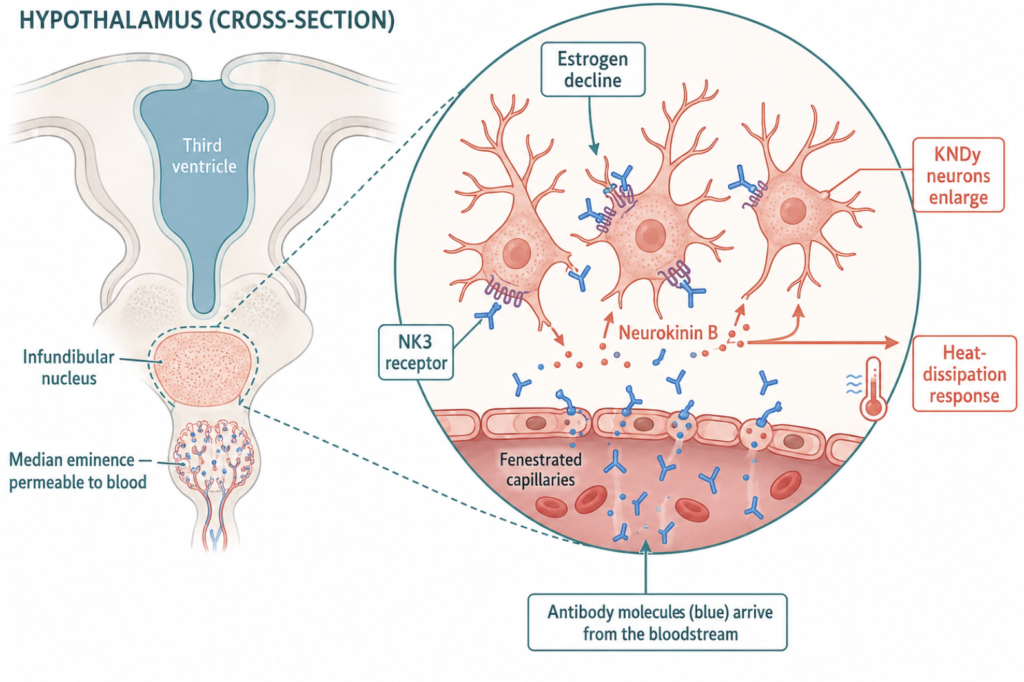
The mechanism explains why hormones are not the only lever. As estrogen falls, KNDy neurons in the hypothalamus hypertrophy and increase neurokinin B signaling onto thermoregulatory pathways, which is thought to trigger the heat-dissipation response experienced as a flash [Rance, Modulation of body temperature and LH secretion by hypothalamic KNDy neurons, 2013]. Blocking the neurokinin 3 receptor interrupts that signal without touching estrogen.
Why a monthly injection for hot flashes could matter
Coverage of this area often implies that hot flashes have no drug. They do, and the situation is more interesting than an empty category.
Two non-hormonal agents are already approved. Fezolinetant, an NK3 receptor antagonist, was FDA-approved in 2023 on the strength of the SKYLIGHT program, which showed significant reductions in vasomotor symptom frequency and severity at weeks 4 and 12 [Lederman, Fezolinetant for treatment of moderate-to-severe vasomotor symptoms associated with menopause (SKYLIGHT 1), 2023]. Its 52-week safety study established tolerability and endometrial safety [Neal-Perry, Safety of fezolinetant for vasomotor symptoms associated with menopause, 2023]. The FDA later added a boxed warning for hepatotoxicity.
Elinzanetant, a dual NK1/NK3 antagonist, followed with FDA approval in October 2025, supported by the OASIS 1 and 2 trials [Pinkerton, Elinzanetant for the treatment of vasomotor symptoms associated with menopause: OASIS 1 and 2 randomized clinical trials, 2024] and a third pivotal trial published in 2025 [Panay, Elinzanetant for the treatment of vasomotor symptoms associated with menopause: a phase 3 randomized clinical trial, 2025].
Both are once-daily oral pills, and neither has sold the way its developer projected. Astellas reported fezolinetant revenue of ¥33.8 billion (roughly USD 220 million) for fiscal 2024, below internal expectations.
So the opportunity here is a category where effective drugs already exist and uptake has lagged the projections made for them. AbCellera estimates that roughly 12 million US women have moderate-to-severe vasomotor symptoms and that fewer than half seek treatment at all. That is a company figure and worth treating as such, though it is consistent with the commercial record. Daily dosing, prior authorization friction, cost, and hepatic monitoring are the usual explanations. ABCL635 is pitched at that gap, with a new format rather than a new mechanism.
| Fezolinetant | Elinzanetant | ABCL635 | |
|---|---|---|---|
| Status | FDA approved 2023 | FDA approved 2025 | Phase 2 |
| Mechanism | NK3R antagonist | NK1/NK3R antagonist | NK3R antagonist |
| Molecule type | Small molecule | Small molecule | Antibody |
| Dosing | Once daily oral | Once daily oral | Single subcutaneous dose (monthly intended) |
| Notable label issue | Boxed hepatotoxicity warning | None | Not yet applicable |
What the Phase 2 data actually showed
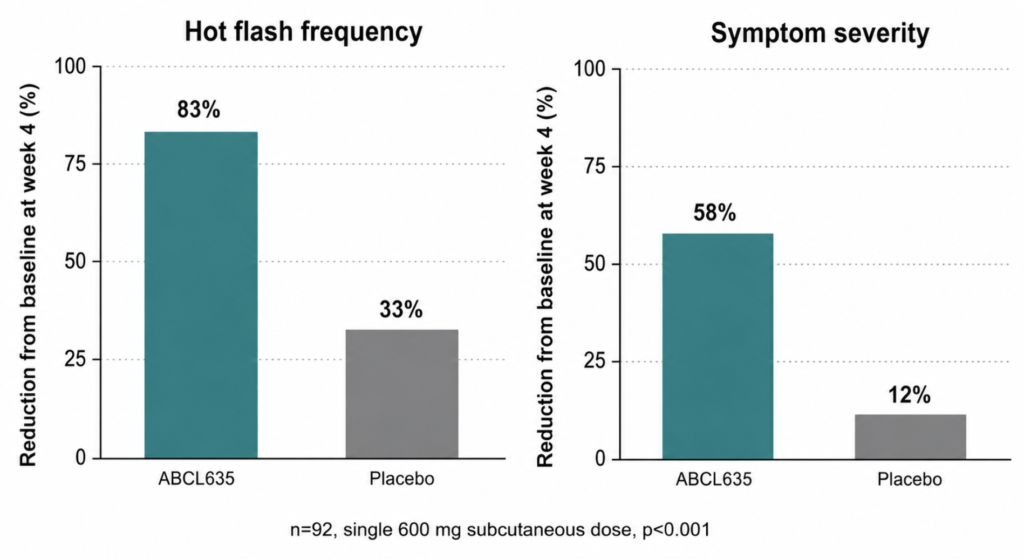
The trial (NCT07118891) was multicenter, randomized, double-blind, and placebo-controlled. It enrolled 92 postmenopausal women averaging roughly ten moderate or severe hot flashes daily, randomized 1:1 to a single 600 mg subcutaneous dose of ABCL635 or placebo.
At week 4, the ABCL635 group averaged 8.8 fewer moderate-to-severe events per day from baseline, versus 3.5 on placebo, a placebo-adjusted difference of 5.3 events (p<0.001), or 83% versus 33% in percentage terms. Severity fell 1.4 points versus 0.3 (placebo-adjusted 1.1, p<0.001). Significance held from week 1 through week 4, and sleep scores and patient global impression of change also improved.
Tolerability was clean over the four weeks. All 92 participants completed the study, with no serious or severe adverse events and no discontinuations. Headache, fatigue, and injection site reactions occurred more often than on placebo.
Several caveats belong next to those numbers.
The data is top line, from a small and short study: 92 women, four weeks, a single dose, and no peer review yet. The Phase 3 programs for the approved comparators enrolled thousands and followed patients for 12 to 52 weeks.
Cross-trial comparison is also not evidence. AbCellera noted that placebo-adjusted reductions in the fezolinetant and elinzanetant registrational studies ran 2.1 to 3.3 events per day, against its own 5.3. The company acknowledged the limits of comparing across trials, and that acknowledgment should be taken seriously, since different populations, baselines, and eras produce different placebo responses. The 33% placebo reduction here is itself a reminder of how large placebo effects are in this condition.
The 12-week data is the real test. The company expects it later in 2026, and it determines whether monthly dosing is feasible. A Phase 1 half-life of 24 days supports the idea, but if the effect wanes at week 8 or 10, the central differentiator weakens.
Mechanistic questions also remain open, and they follow from anatomy. Antibodies do not cross an intact blood-brain barrier in meaningful quantities. The infundibular nucleus, where the KNDy neurons sit, is an exception: it lies adjacent to the median eminence, a circumventricular organ whose fenestrated portal capillaries leave that region accessible to the peripheral circulation in a way most of the brain is not [Prevot, Tanycytes in the infundibular nucleus and median eminence and their role in the blood-brain barrier, 2021]. That anatomy is plausibly what makes a peripherally injected antibody workable here at all. It also frames the open question AbCellera’s leadership has flagged, which is whether NK3 receptors in the preoptic region, sitting behind an intact barrier, need to be engaged as well. Twelve-week data will not settle that. It is a question for larger and longer studies.
The hepatic safety argument for an antibody rests on a separate mechanism. Antibodies are catabolized to amino acids rather than processed through hepatic cytochrome enzymes, which is why they are not generally associated with the drug-induced liver injury signal that produced fezolinetant’s boxed warning. Phase 1 reportedly showed no perceptible liver enzyme elevation. That is a reasonable expectation rather than a demonstrated finding at this stage, and confirming it requires long-term data.
The odds, and what “success” still leaves undone
Positive Phase 2 results invite a mental leap to approval. The base rates argue against making it.
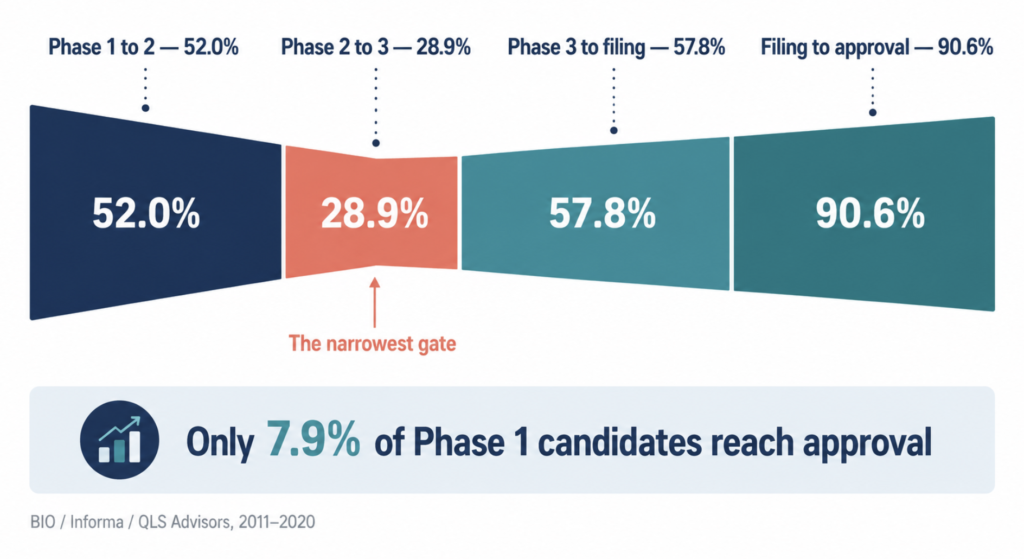
The most cited dataset here is the BIO / Informa Pharma Intelligence / QLS Advisors analysis of 12,728 phase transitions across 9,704 development programs from 2011 to 2020:
| Transition | All modalities | Monoclonal antibodies |
|---|---|---|
| Phase 1 to 2 | 52.0% | 54.7% |
| Phase 2 to 3 | 28.9% | 34.1% |
| Phase 3 to filing | 57.8% | 68.1% |
| Filing to approval | 90.6% | 95.4% |
| Phase 1 to approval | 7.9% | 12.1% |
Phase 2 is the narrowest gate in drug development, and ABCL635 has cleared it. But Phase 3 success still sits near 58% across all modalities and 68% for antibodies. Chronic, high-prevalence conditions, which vasomotor symptoms are, carry lower overall approval likelihood than rare diseases.
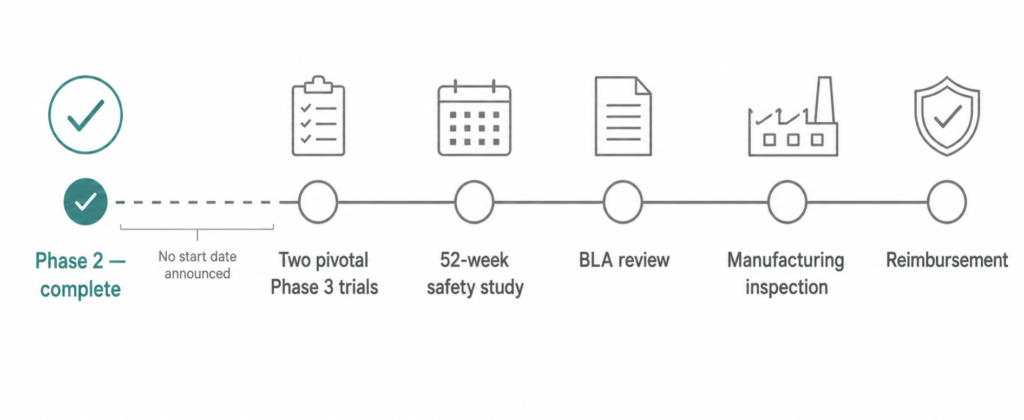
Phase 3 is not the last gate either. Chronic, non-life-threatening indications typically require two pivotal studies rather than one. Both approved comparators ran 52-week safety programs, and four-week data does not substitute for that. The biologics license application and its review is historically the highest-yield step, but it still consumes about a year. Antibodies are harder to produce at commercial scale than pills, so manufacturing and facility inspection is a hurdle of its own. Then there is reimbursement, which is where the approved drugs already stumbled. A monthly injectable biologic will not price below a daily generic hormone regimen, and payer friction shapes uptake more than efficacy data does.
No Phase 3 start date has been announced. The company has said it will complete 12-week follow-up, discuss late-stage design with clinical advisors and regulators, and is weighing options including a head-to-head study.
The shape of drug development risk
Drug development releases information in lumps, and that distorts how these stories get read. A program can run for years generating nothing public, and then a single press release resolves a question that had been open the entire time. Years of work surface in one morning, and the assessment of the whole program changes with it.
The consequences are clinical as well as commercial. How much coverage a drug receives tracks the timing of its readouts rather than how close it is to patients. Excellent four-week Phase 2 data generates more headlines than a second pivotal trial finishing quietly, even though the second drug is far closer to being prescribable. Patients, and the clinicians answering their questions, end up calibrating on news cycles instead of development stage.
A positive Phase 2 means a question worth continuing to ask has been answered favorably once, in a small group, over a short period. It is not the same as a treatment on the way.
Key Takeaways
- ABCL635 reduced moderate-to-severe hot flash frequency by 83% at four weeks versus 33% for placebo, a placebo-adjusted difference of 5.3 events per day (p<0.001), in 92 women given a single dose.
- Two non-hormonal drugs for menopausal vasomotor symptoms are already FDA approved, fezolinetant in 2023 and elinzanetant in 2025, and both are once-daily oral pills.
- ABCL635’s proposed differentiation is format rather than mechanism: an antibody given as a monthly subcutaneous injection instead of a daily tablet.
- Across 2011 to 2020 industry data, about 57.8% of drugs entering Phase 3 reach regulatory filing; for monoclonal antibodies the figure is 68.1%.
- A successful Phase 3 still leaves long-term safety requirements, license review, manufacturing inspection, and reimbursement ahead, and no Phase 3 start date for ABCL635 has been announced.
FAQ
What is ABCL635? It is an investigational antibody that blocks the neurokinin 3 receptor, developed as a non-hormonal treatment for moderate-to-severe menopausal hot flashes. The two approved drugs in this class are daily oral small molecules, while ABCL635 is given by subcutaneous injection and is intended for monthly dosing. It completed the Phase 2 portion of a Phase 1/2 trial in August 2026 and is not approved anywhere.
What percentage of drugs that pass Phase 2 succeed in Phase 3? Roughly 58% of programs entering Phase 3 reach regulatory filing, based on BIO/Informa/QLS analysis of data from 2011 to 2020, and monoclonal antibodies do somewhat better at 68%. Phase 2 is the harder gate, with only 28.9% of Phase 2 programs advancing. These are industry averages across all indications rather than predictions for any specific drug.
Is there already a non-hormonal treatment for hot flashes? Yes. Fezolinetant was FDA approved in 2023 and elinzanetant in 2025, both as once-daily oral non-hormonal options. Older off-label approaches include certain SSRIs and SNRIs. Anyone currently experiencing bothersome symptoms has options available now and should discuss them with their own clinician rather than waiting on an investigational agent.
When could ABCL635 become available? There is no answer to this yet. Phase 3 has not started and no timeline has been announced. Even under favorable conditions, pivotal trials plus a required long-term safety program plus regulatory review typically span several years.
Why does a company’s platform matter if the drug is what counts? Because a discovery platform determines how many shots on goal a company gets. AbCellera’s microfluidic and computational approach produced a clinical antibody in 90 days during the pandemic. Whether that speed advantage in discovery translates into advantages in the slower, more failure-prone phases of clinical development is what ABCL635 is now testing.
References
- Avis NE, Crawford SL, Greendale G, et al. Duration of menopausal vasomotor symptoms over the menopause transition. JAMA Intern Med. 2015;175(4):531-539.
- Rance NE, Dacks PA, Mittelman-Smith MA, Romanovsky AA, Krajewski-Hall SJ. Modulation of body temperature and LH secretion by hypothalamic KNDy (kisspeptin, neurokinin B and dynorphin) neurons: a novel hypothesis on the mechanism of hot flushes. Front Neuroendocrinol. 2013;34(3):211-227.
- Lederman S, Ottery FD, Cano A, et al. Fezolinetant for treatment of moderate-to-severe vasomotor symptoms associated with menopause (SKYLIGHT 1): a phase 3 randomised controlled study. Lancet. 2023;401(10382):1091-1102.
- Neal-Perry G, Cano A, Lederman S, et al. Safety of fezolinetant for vasomotor symptoms associated with menopause: a randomized controlled trial. Obstet Gynecol. 2023;141(4):737-747.
- Pinkerton JV, Simon JA, Joffe H, et al. Elinzanetant for the treatment of vasomotor symptoms associated with menopause: OASIS 1 and 2 randomized clinical trials. JAMA. 2024;332(16):1343-1354.
- Panay N, Joffe H, Maki PM, et al. Elinzanetant for the treatment of vasomotor symptoms associated with menopause: a phase 3 randomized clinical trial. JAMA Intern Med. 2025;185(11):1319-1327.
- Prevot V, Nogueiras R, Schwaninger M. Tanycytes in the infundibular nucleus and median eminence and their role in the blood-brain barrier. Handb Clin Neurol. 2021;180:253-273.
- Jones BE, Brown-Augsburger PL, Corbett KS, et al. The neutralizing antibody, LY-CoV555, protects against SARS-CoV-2 infection in nonhuman primates. Sci Transl Med. 2021;13(593).
Additional sources
The following are not peer-reviewed publications and are cited as industry documents:
- AbCellera Biologics. Positive top-line Phase 2 clinical trial results for ABCL635. Press release, August 10, 2026.
- AbCellera Biologics. Second quarter 2026 business results. Press release, August 5, 2026.
- Biotechnology Innovation Organization, Informa Pharma Intelligence, QLS Advisors. Clinical development success rates and contributing factors 2011–2020. February 2021.
- ClinicalTrials.gov. Study evaluating ABCL635 for vasomotor symptoms of menopause. NCT07118891.
- Astellas Pharma. Fiscal year 2024 financial results.
Joonpyo Hong, MD is a board-certified otolaryngologist practicing in Korea. This article reflects his clinical interpretation of published research and does not constitute individual medical advice.
For more articles:
https://curiousmd.com/why-small-cap-biotech-investing-is-hard/
https://curiousmd.com/depression-nasal-spray-esketamine/
Link out to:
ClinicalTrials.gov — Study Evaluating ABCL635 for Vasomotor Symptoms of Menopause (NCT07118891) — the primary trial registry record
BIO / Informa / QLS Advisors — Clinical Development Success Rates 2011–2020 (PDF) — the source of phase transition figure quoted above.
AbCellera — Top-Line Phase 2 Results for ABCL635 (press release) — the company’s own account of the data
SKYLIGHT 1: Fezolinetant Phase 3 trial, The Lancet (PubMed) — the registrational evidence behind the first approved non-hormonal option.
OASIS 1 and 2: Elinzanetant Phase 3 trials, JAMA (PubMed) — the registrational evidence behind the second.