
A presentation that recurs constantly in ENT practice: episodic vertigo, a normal audiogram, a normal MRI, a normal physical exam between attacks, and episodes severe enough that the person has stopped driving.
The diagnosis that fits this pattern best is vestibular migraine, and the question that follows immediately is vestibular migraine vs Meniere’s disease. The two conditions overlap enough that telling them apart is the central clinical task, and neither has a confirmatory test. Vestibular migraine is thought to be one of the most common cause of spontaneous, non-positional episodic vertigo, affecting roughly 1% of the population [Smyth, Vestibular migraine treatment: a comprehensive practical review, 2022]. A survey-based analysis of US adults put the figure higher, at 2.7%, though that estimate applied a case definition retrospectively to questionnaire data rather than to clinically diagnosed patients [Formeister, The Epidemiology of Vestibular Migraine: A Population-based Survey Study, 2018]. Either way, it is common, and frequently missed.
What the attacks feel like
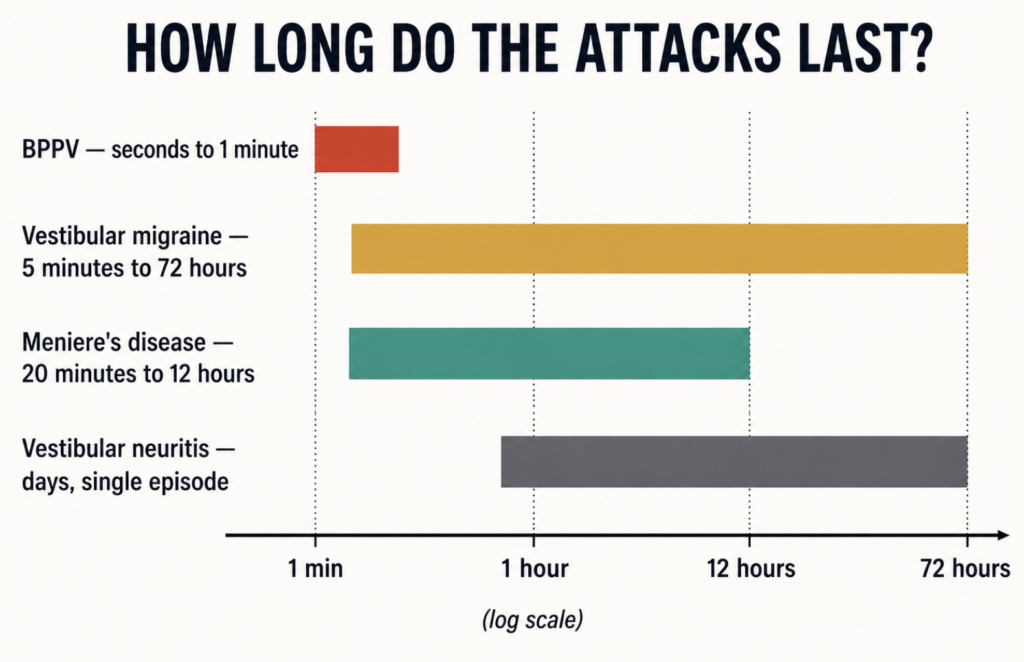
The core feature is episodic vestibular symptoms: spinning vertigo, a sense of internal motion, unsteadiness triggered by head movement, or vertigo provoked by visual scenes like scrolling text or a busy supermarket aisle. Episodes last anywhere from five minutes to 72 hours [Lempert, Vestibular migraine: Diagnostic criteria (Update), 2022]. That range is enormous, and it is part of why the condition is so hard to pin down.
Most of the diagnostic delay comes down to a single detail: many attacks have no headache at all. The vertigo and the headache can occur together, in sequence, or entirely independently across a patient’s lifetime. Someone who had migraines in their twenties and stopped having them in their forties can begin having vestibular attacks in their fifties, and will not connect the two, because as far as they are concerned the migraines are over.
Nausea, sensitivity to light and sound, and visual aura commonly accompany the episodes. A history of motion sickness dating back to childhood is common enough that it is worth asking about directly.
Why it happens, and whether it runs in families
The mechanism is unsettled. The leading proposal is that migraine and the vestibular system share overlapping central pathways: the trigeminal system that generates migraine pain and the brainstem nuclei that process balance signals sit close together and influence one another. That is a hypothesis with supporting anatomy, not a proven chain of causation.
Vestibular migraine clearly clusters in families, but it is not a single-gene disease. A systematic review of the genetics found consistent familial aggregation and a female predominance, and concluded that the evidence base is not yet strong enough to estimate heritability, because the field lacks the twin and adoption studies that would separate genetic effects from shared household environment [Paz-Tamayo, Systematic Review of Prevalence Studies and Familial Aggregation in Vestibular Migraine, 2020].
A family history raises suspicion. It confirms nothing, and there is no genetic test to order.
How this differs from an ordinary migraine
Vestibular migraine is not a different disease. It is migraine in which the vestibular system, rather than the pain system, produces the dominant symptom.
Three practical differences follow. The presenting complaint is dizziness, so patients arrive at an ENT or a general clinic rather than a headache clinic. The attack duration is defined by the vertigo, not the headache, and the two do not have to align. And the one that matters most for diagnosis: the absence of a headache during an episode does not rule migraine out.
The Bárány Society diagnostic criteria
These criteria were developed jointly by the Bárány Society and the International Headache Society. The 2022 publication left the original 2012 criteria unchanged and updated the supporting literature [Lempert, Vestibular migraine: Diagnostic criteria (Update), 2022].
Definite vestibular migraine requires all four:
A. At least five episodes of vestibular symptoms of moderate or severe intensity, each lasting between 5 minutes and 72 hours.
B. A current or past history of migraine with or without aura, meeting the criteria of the International Classification of Headache Disorders.
C. At least one migraine feature during at least 50% of the vestibular episodes:
- Headache with at least two of these four characteristics: one-sided, pulsating, moderate or severe intensity, worsened by routine physical activity
- Photophobia and phonophobia together
- Visual aura
D. Not better accounted for by another vestibular or headache diagnosis.
Probable vestibular migraine applies when the episodes qualify under A, but only one of criteria B or C is met. A patient with typical vertigo episodes accompanied by photophobia and phonophobia, but no personal history of migraine headache, falls here.
One point tends to get lost in summaries. Vestibular migraine sits in the appendix of the ICHD-3, not the main body. The appendix is where the classification places entities considered real but still accumulating evidence. It is a formal diagnosis with formal criteria, and also an acknowledgment that the definition may still change.
What else it could be
Criterion D is doing a lot of work, and it is where the clinical thinking happens.
| Condition | Attack duration | Hearing symptoms | Key distinguishing feature |
|---|---|---|---|
| BPPV | Seconds to a minute | No | Triggered by specific head positions; positional testing reproduces it |
| Meniere’s disease | 20 minutes to 12 hours | Yes: fluctuating loss, tinnitus, fullness | Documented low-frequency hearing loss on audiogram |
| Vestibular neuritis | Days, single episode | No | One prolonged attack, not recurrent |
| PPPD | Continuous, not episodic | No | Persistent unsteadiness worsened by upright posture and visual motion |
| Posterior circulation TIA/stroke | Minutes to permanent | Sometimes | Focal neurological signs; sudden onset in a vascular risk profile |
| Episodic ataxia type 2 | Hours | No | Ataxia and interictal nystagmus; often early onset and familial |
| Superior canal dehiscence | Seconds | Autophony, hyperacusis | Sound- or pressure-induced vertigo; CT confirms |
Red flags. Sudden vertigo accompanied by weakness, numbness, difficulty speaking, double vision, or severe unsteadiness that prevents standing is a neurological emergency until proven otherwise. New-onset vertigo in an older patient with vascular risk factors deserves the same urgency. Neither belongs in a discussion of migraine management.
Treatment: what the evidence supports
For acute attacks, the practical approach is symptom control: antiemetics, antihistamines, occasionally a short-acting vestibular suppressant. Triptans, borrowed from headache migraine, have shown less benefit for vertigo than for headache [Smyth, Vestibular migraine treatment: a comprehensive practical review, 2022]. Vestibular suppressants such as meclizine deserve a specific warning. Used regularly rather than occasionally, they interfere with the brain’s own compensation process and can prolong symptoms.
For prevention, the drugs used are the ones used for headache migraine: beta-blockers (propranolol, metoprolol), calcium channel blockers (flunarizine, cinnarizine), antiepileptics (topiramate, valproate), and tricyclics (amitriptyline). Lifestyle measures are first-line and cost nothing, including regular sleep, avoiding meal skipping and dehydration, and identifying personal triggers.
Flunarizine deserves a note of its own, because it is widely prescribed in Korea and barely available in the United States, which skews how English-language reviews treat it. It is contraindicated in people with a history of depression or Parkinson’s disease, and its use is restricted or withdrawn in several countries over long-term risks including depression and parkinsonism. The reassuring safety numbers in trials reflect short treatment durations, not long-term use [Vasireddy, Comparative effectiveness and safety of preventive treatments for vestibular migraine, 2025]. Long-term monitoring for parkinsonism is recommended, with caution and lower starting doses in older patients [Smyth, Vestibular migraine treatment: a comprehensive practical review, 2022]. Weight gain and somnolence are the side effects patients most often report.
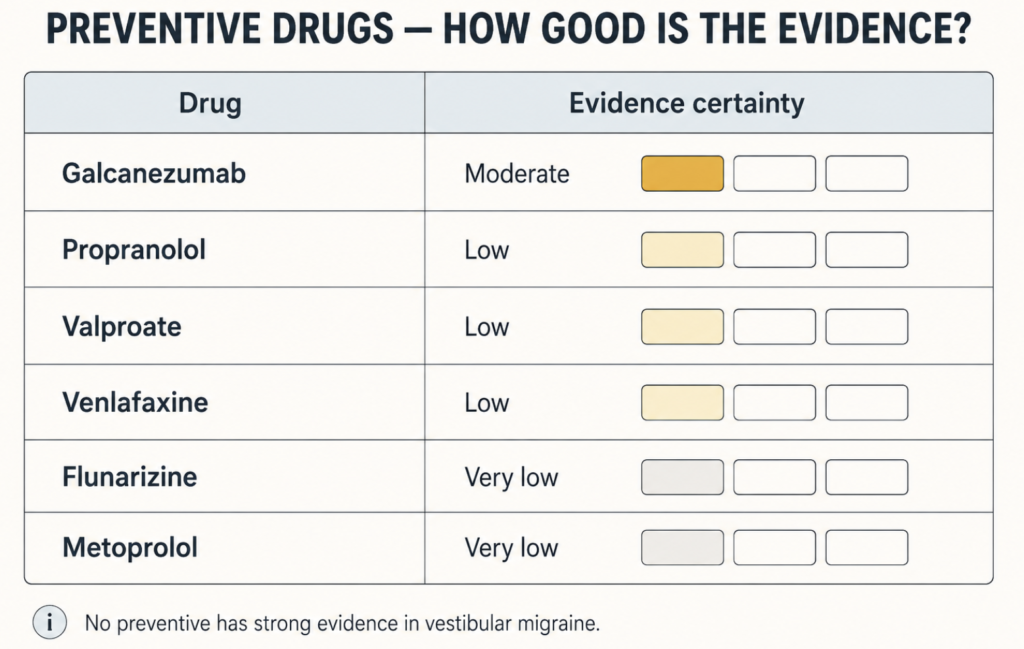
Then there is the trial evidence, which is thinner than the prescribing patterns suggest. A Cochrane review searching for controlled trials of preventive drugs in vestibular migraine found evidence for only two drugs. One trial of 130 participants compared metoprolol against placebo; two smaller trials, 79 participants combined, compared flunarizine against no treatment at all. Every outcome was rated low or very low certainty, and the reviewers concluded that the benefits and harms of these treatments cannot be established from what currently exists [Webster, Pharmacological interventions for prophylaxis of vestibular migraine, 2023]. The metoprolol trial did not show superiority over placebo [Smyth, Vestibular migraine treatment: a comprehensive practical review, 2022].
That is a statement about the evidence, not about the drugs. “Not established” is not the same as “does not work.” These drugs have solid evidence in headache migraine prevention, and their use in vestibular migraine is an extrapolation that has not yet been properly tested rather than one that has been tested and failed. The trials that exist are small and short, three to six months, and the field has not even agreed on how much reduction in attack frequency counts as clinically meaningful, a gap the Cochrane authors flag themselves. None of this is a reason to stop a preventive medication that is working.
Network meta-analyses have since ranked propranolol at the top for reducing monthly attacks. That ranking deserves an asterisk. In the most recent analysis, propranolol’s estimate came entirely from indirect comparison rather than from any trial that tested it against placebo, and the authors describe the result as an efficacy-evidence paradox: the highest-ranked drug had among the weakest evidence [Vasireddy, Comparative effectiveness and safety of preventive treatments for vestibular migraine, 2025].
Where CGRP fits
Anti-CGRP monoclonal antibodies are the one genuinely new element here, and the evidence has moved recently enough that older summaries understate it. A 2024 pooled review found only four studies totaling 99 patients, cohort studies plus a case report [Frosolini, Monoclonal Antibodies Targeting CGRP to Treat Vestibular Migraine, 2024]. A placebo-controlled randomized trial of galcanezumab has since been published, and when the 2025 network meta-analysis assessed all available preventive treatments, that trial was the only one rated at low risk of bias across every domain, and galcanezumab the only treatment to reach moderate certainty on GRADE. Every other option, including propranolol, valproate, venlafaxine, and flunarizine, came in at low or very low [Vasireddy, Comparative effectiveness and safety of preventive treatments for vestibular migraine, 2025].
The Cochrane review predates that trial, which is why the two conclusions sit differently rather than contradicting each other.
So galcanezumab currently has the best-quality evidence of any preventive for vestibular migraine, and that evidence is a single pilot trial. Both halves of that sentence have to be read together. It also says something uncomfortable about the rest of the field that one small pilot study is the strongest thing in it.
Does treatment work?
A retrospective study of patients treated with preventive medication reported that 80.9% improved, with amitriptyline, flunarizine, propranolol, and topiramate all associated with reduced vestibular symptoms [Salmito, Prophylactic treatment of vestibular migraine, 2017]. That number is encouraging and uninterpretable on its own, because there was no placebo group. Vestibular migraine fluctuates naturally, patients seek treatment when symptoms peak, and regression toward the mean alone would produce substantial apparent improvement. Placebo response in migraine trials is consistently large.
So uncontrolled studies show most patients getting better, and controlled trials cannot confirm that the drugs are responsible. Both statements are true, and holding them together is the correct position rather than a contradiction to be resolved.
Vestibular migraine vs Meniere’s: what the evidence shows
The evidence linking the two comes in layers of very different strength.
The symptoms overlap, and the overlap is documented. A prospective multicenter study of 268 patients (119 with Meniere’s disease, 84 with vestibular migraine, 65 with probable vestibular migraine) found that Meniere’s patients predominantly reported auditory symptoms while vestibular migraine patients predominantly reported migraine features. But a subset of Meniere’s patients had migraine-type headache during attacks, and some vestibular migraine patients reported tinnitus and hearing loss. The authors concluded that no symptom was highly specific to any single entity, and that only the combination discriminates [Lopez-Escamez, Accompanying Symptoms Overlap during Attacks in Menière’s Disease and Vestibular Migraine, 2014].
Migraine is also more common in Meniere’s patients than in controls. In a controlled study of 78 patients with Meniere’s disease, the lifetime prevalence of migraine was 56%, against 25% in age- and sex-matched controls. Forty-five percent of the Meniere’s patients experienced at least one migrainous symptom (headache, photophobia, or aura) during their Meniere’s attacks [Radtke, Migraine and Ménière’s disease: is there a link?, 2002].
Some patients meet both sets of criteria simultaneously. A review of ten such patients, each showing features of both diseases during every vertigo attack, led to the proposal of a VM/MD overlapping syndrome, framing the dual presentation as a recognizable entity rather than a diagnostic error [Murofushi, Simultaneous Presentation of Definite Vestibular Migraine and Definite Ménière’s Disease, 2018].
Biological markers to separate them remain research-stage. Cytokine and chemokine profiling has shown differences between the two patient groups, but in a single case-control study without external validation [Flook, Differential Proinflammatory Signature in Vestibular Migraine and Meniere Disease, 2019]. Nothing from this line of work has entered clinical practice.
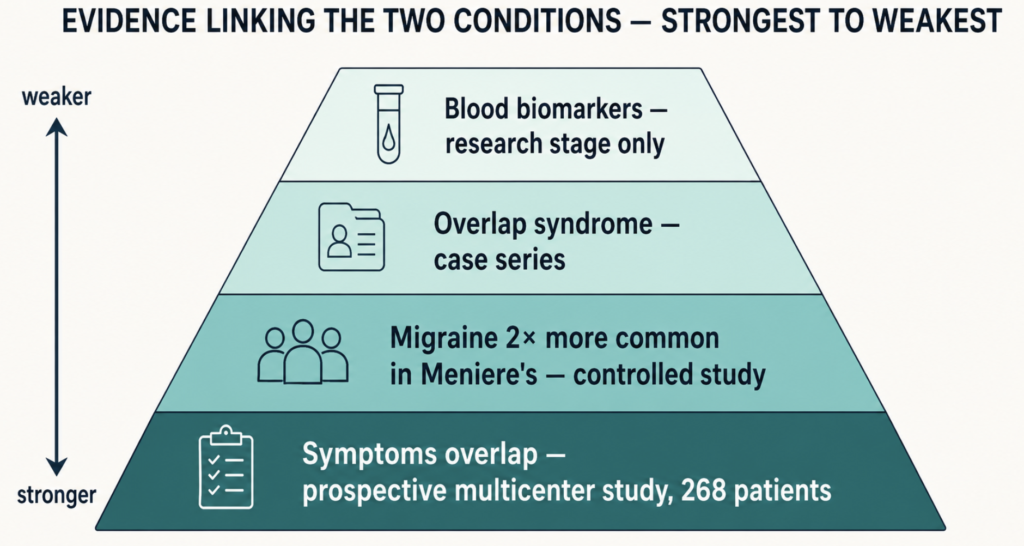
All of this supports an association. None of it establishes a shared cause. The observation that the two conditions co-occur more than chance is solid; the explanation for why is not.
The practical consequence is structural. The diagnostic criteria for Meniere’s disease require audiometrically documented low- to mid-frequency sensorineural hearing loss in the affected ear, and the criteria for vestibular migraine contain no hearing requirement at all [Lopez-Escamez, Diagnostic criteria for Menière’s disease, 2015]. That asymmetry is why the audiogram is the single most useful discriminator available: it is the one test that one diagnosis demands and the other does not.
Two limits on that. Early Meniere’s disease can show normal hearing between attacks, so a single normal audiogram settles less than a series of them does. And the discriminating power belongs to the audiogram specifically, not to vestibular testing. Roughly 10 to 20% of vestibular migraine patients show abnormal vestibular function tests between attacks [Smyth, Vestibular migraine treatment: a comprehensive practical review, 2022]. Normal vestibular function is not required for the diagnosis, and abnormal vestibular function does not overturn it.
Clinical perspective
In an ENT clinic, the patients who reach this diagnosis are often the ones who have already been through a full workup that found nothing. The instinct after a normal audiogram and a normal MRI is to reassure and discharge, and that is where the diagnosis gets missed.
A clean scan does not tick criterion D. Criterion D is a clinical judgment: normal results remove specific competitors like Meniere’s disease and vestibular schwannoma, while BPPV, canal dehiscence, and vascular causes still have to be excluded on history and examination. What the normal workup does is clear the way to trust the history, which is the actual positive finding: recurrent, stereotyped episodes lasting five minutes to three days, in someone with migraine somewhere in their life.
That last part is the question most often left unasked. Has this person ever had migraines, at any point? Someone whose headaches stopped twenty years ago will not volunteer it.
The other thing worth saying out loud to patients is that the treatment is a trial rather than a prescription based on proof. Framing it that way at the start makes it much easier to switch agents at eight weeks without the patient feeling that something has gone wrong.
Key takeaways
- Vestibular migraine is diagnosed entirely from history. No blood test, imaging finding, or vestibular test confirms it.
- Attacks last from 5 minutes to 72 hours, and many of them involve no headache at all.
- The Bárány Society criteria require at least five episodes, a current or past history of migraine, and migraine features during at least half of the vestibular episodes.
- Controlled trial evidence for preventive medication covers only two older drugs and is rated low or very low certainty, even though most patients in uncontrolled studies improve.
- Galcanezumab, a CGRP antibody, currently has the highest-quality evidence of any preventive for vestibular migraine, and that evidence comes from a single pilot randomized trial.
- Migraine is roughly twice as common in Meniere’s disease patients as in matched controls, and the two conditions can occur in the same patient, but a shared cause has not been established.
- A documented fluctuating low-frequency hearing loss is the most practical feature separating Meniere’s disease from vestibular migraine.
FAQ
Can you have vestibular migraine without a headache? Yes, and this is one of the most common reasons the diagnosis is delayed. The criteria require a current or past history of migraine, and migraine features during at least half of the vertigo episodes. Photophobia with phonophobia, or visual aura, satisfies that requirement without any headache. A patient whose migraines stopped decades ago can still develop vestibular migraine.
How long does a vestibular migraine attack last? Between 5 minutes and 72 hours, per the diagnostic criteria. Episodes shorter than a minute suggest BPPV; a single episode lasting several days without recurrence suggests vestibular neuritis; continuous daily dizziness without discrete attacks suggests PPPD.
Is vestibular migraine hereditary? It clusters in families and affects women more often than men, but it is not a single-gene condition and no genetic test exists. A systematic review found consistent familial aggregation while concluding that heritability cannot yet be estimated, because studies capable of separating genes from shared environment have not been done.
Can vestibular migraine turn into Meniere’s disease? There is no evidence that one converts into the other. What does happen is that some patients meet the criteria for both conditions at the same time, and that early-stage Meniere’s disease can be difficult to distinguish from vestibular migraine before a hearing loss pattern becomes documentable. Repeat audiograms over time, rather than a single test, are what resolve this.
Should I see an ENT or a neurologist? Either can make the diagnosis, and the choice often depends on which symptom dominates. An ENT evaluation is particularly useful when hearing symptoms are present, because ruling Meniere’s disease in or out requires audiometry. Neurology referral is appropriate when headache is the dominant burden or when preventive treatment has failed.
References
- Lempert T, Olesen J, Furman J, Waterston J, Seemungal B, Carey J, et al. Vestibular migraine: Diagnostic criteria (Update). J Vestib Res. 2022;32(1):1-6.
- Smyth D, Britton Z, Murdin L, Arshad Q, Kaski D. Vestibular migraine treatment: a comprehensive practical review. Brain. 2022;145(11):3741-3754.
- Formeister EJ, Rizk HG, Kohn MA, Sharon JD. The Epidemiology of Vestibular Migraine: A Population-based Survey Study. Otol Neurotol. 2018;39(8):1037-1044.
- Webster KE, Dor A, Galbraith K, Haj Kassem L, Harrington-Benton NA, Judd O, et al. Pharmacological interventions for prophylaxis of vestibular migraine. Cochrane Database Syst Rev. 2023;4:CD015187.
- Paz-Tamayo A, Perez-Carpena P, Lopez-Escamez JA. Systematic Review of Prevalence Studies and Familial Aggregation in Vestibular Migraine. Front Genet. 2020;11:954.
- Radtke A, Lempert T, Gresty MA, Brookes GB, Bronstein AM, Neuhauser H. Migraine and Ménière’s disease: is there a link? Neurology. 2002;59(11):1700-1704.
- Lopez-Escamez JA, Dlugaiczyk J, Jacobs J, Lempert T, Teggi R, von Brevern M, et al. Accompanying Symptoms Overlap during Attacks in Menière’s Disease and Vestibular Migraine. Front Neurol. 2014;5:265.
- Flook M, Frejo L, Gallego-Martinez A, Martin-Sanz E, Rossi-Izquierdo M, Amor-Dorado JC, et al. Differential Proinflammatory Signature in Vestibular Migraine and Meniere Disease. Front Immunol. 2019;10:1229.
- Salmito MC, Duarte JA, Morganti LOG, Brandão PVC, Nakao BH, Villa TR, et al. Prophylactic treatment of vestibular migraine. Braz J Otorhinolaryngol. 2017;83(4):404-410.
- Frosolini A, Lovato A. Monoclonal Antibodies Targeting CGRP to Treat Vestibular Migraine: A Rapid Systematic Review and Meta-Analysis. Indian J Otolaryngol Head Neck Surg. 2024;76(4):3737-3744.
- Murofushi T, Tsubota M, Kitao K, Yoshimura E. Simultaneous Presentation of Definite Vestibular Migraine and Definite Ménière’s Disease: Overlapping Syndrome of Two Diseases. Front Neurol. 2018;9:749.
- Lopez-Escamez JA, Carey J, Chung WH, Goebel JA, Magnusson M, Mandalà M, et al. Diagnostic criteria for Menière’s disease. J Vestib Res. 2015;25(1):1-7.
- Vasireddy S, Biswas S, Kollu R, Krishnan E, Khan MS, Fasil C, et al. Comparative effectiveness and safety of preventive treatments for vestibular migraine: a systematic review and network meta-analysis. BMC Neurol. 2025;25(1):513.
- Sharon JD, Krauter R, Chae R, Gardi A, Hum M, Allen I, et al. Galcanezumab for the prevention of vestibular migraine: a pilot randomized clinical trial. Headache. 2024;64(10):1264-1272.
Joonpyo Hong, MD is a board-certified otolaryngologist practicing in Korea. This article reflects his clinical interpretation of published research and does not constitute individual medical advice.
For more articles:
https://curiousmd.com/menieres-disease-vs-syndrome/
https://curiousmd.com/menieres-disease-low-sodium-diet/
Link out to:
- Cochrane: How effective are medicines used to prevent attacks of vestibular migraine — the plain-language summary of the review discussed above.
- Brain: Vestibular migraine treatment — a comprehensive practical review — open-access, with drug-by-drug dosing and monitoring guidance.
- BMC Neurology: Comparative effectiveness and safety of preventive treatments for vestibular migraine — the 2025 network meta-analysis, including the galcanezumab data.
- Johns Hopkins Medicine: Vestibular Migraine — a patient-facing overview.