
The depression nasal spray known as esketamine has changed what rapid relief can look like in psychiatry. About one in three people with major depressive disorder never reach remission, even after trying two or more antidepressants at adequate doses [Popova, Efficacy and Safety of Flexibly Dosed Esketamine Nasal Spray, 2019]. For those patients, a medicine that starts working in hours rather than weeks — sprayed into the nose in a clinic chair — sounded like science fiction a decade ago. It is now an FDA-approved reality. This article explains what the depression nasal spray actually is, how it works, who it helps, what the trials show, and where the market stands.
What Is a Depression Nasal Spray? (Esketamine)
The depression nasal spray is esketamine, marketed as Spravato. Esketamine is the S-enantiomer of ketamine, the anesthetic that clinicians noticed could lift depressive symptoms at low doses. In early in vitro binding studies, this S-form proved at least four times as potent as its mirror-image counterpart, (R)-ketamine, at displacing a ligand from the receptor’s binding site — a basic-pharmacology finding that helps explain why the S-enantiomer was later developed as a stand-alone medicine [Öye, Effects of Ketamine on Sensory Perception: Evidence for a Role of NMDA Receptors, 1992].
What sets it apart from familiar antidepressants is both the target and the timing. SSRIs and SNRIs act on serotonin and norepinephrine and typically need four to six weeks to show full benefit. Esketamine works through the brain’s glutamate system and can reduce symptoms within a day — a difference that matters enormously for someone in acute distress.
How Esketamine Works (Mechanism of Action)
Depression is increasingly understood as a disorder of disrupted connectivity, with deficits in both glutamate (the brain’s main excitatory signal) and GABA (its main inhibitory signal) in mood-regulating circuits [Duman, Altered Connectivity in Depression, 2019]. Conventional antidepressants don’t address this directly.
Esketamine does something more mechanism-based. The prevailing theory is that it preferentially blocks NMDA receptors on inhibitory GABAergic interneurons. Silencing those “brakes” produces a brief surge of glutamate, which activates AMPA receptors and triggers downstream signaling thought to restore synaptic connections. A useful analogy: rather than slowly turning up a dimmer switch, esketamine briefly releases a jammed circuit, letting the network re-establish healthier signaling.
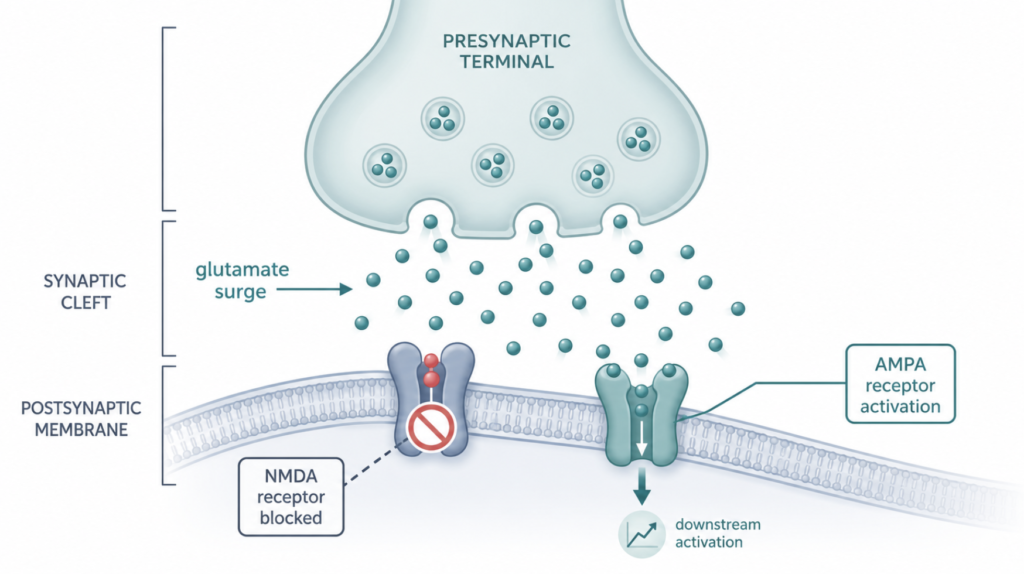
One honest caveat belongs here. The precise mechanism behind esketamine’s antidepressant effect is still unknown, and researchers continue to debate how much of the benefit truly depends on NMDA blockade versus other targets [Bhavya, A New Era for Esketamine in Managing Treatment-Resistant Depression, 2025]. The clinical effect is well documented; the full biology is not yet settled.
Indications: Who It’s For
Esketamine nasal spray is approved by the FDA for two specific groups of adults. The first is treatment-resistant depression (TRD) — major depressive disorder that hasn’t responded to at least two oral antidepressants — where it can be used alone or alongside an oral antidepressant. The second is major depressive disorder with acute suicidal ideation or behavior, used together with an oral antidepressant.
It is not a first-line treatment for ordinary depression, and it is not approved as an anesthetic in this setting. The indications are deliberately narrow because the drug carries meaningful risks and requires supervised administration.
Developer and FDA Approval Timeline
Esketamine was developed by Johnson & Johnson through its Janssen pharmaceutical division. Its regulatory path unfolded in three steps. The FDA first approved it in 2019 for treatment-resistant depression as an add-on to an oral antidepressant. In 2020, approval expanded to MDD with acute suicidal ideation or behavior. Then, in January 2025, the FDA cleared esketamine as the first and only monotherapy for treatment-resistant depression, meaning it can now be prescribed without a companion oral antidepressant (FDA; Johnson & Johnson).
How Effective Is It? (Reported Efficacy)
The evidence has matured alongside the approvals. In the pivotal TRANSFORM-2 trial, patients who switched to esketamine plus a newly started oral antidepressant improved significantly more on the Montgomery-Åsberg Depression Rating Scale (MADRS) at day 28 than those given a new oral antidepressant plus placebo spray, with meaningful separation appearing at earlier time points too [Popova, Efficacy and Safety of Flexibly Dosed Esketamine Nasal Spray, 2019].
For the sickest patients, speed is the point. In the ASPIRE I study of people hospitalized with active suicidal ideation with intent, esketamine added to standard care produced greater improvement in depressive symptoms at 24 hours than placebo added to standard care [Fu, Esketamine Nasal Spray for Rapid Reduction of MDD Symptoms in Patients With Active Suicidal Ideation (ASPIRE I), 2020]. Notably, that same trial did not show a statistically significant advantage on its measure of suicidality severity — a reminder that “rapid symptom relief” and “reduced suicide risk” are not the same claim.
The 2025 monotherapy approval rested on a phase 4 randomized trial of 378 adults. At day 28, esketamine beat placebo on MADRS by a least-squares mean difference of about 5 points at the 56 mg dose and about 7 points at 84 mg, with observed effect sizes of 0.48 and 0.63 respectively, and significant separation from placebo by roughly 24 hours after the first dose [Janik, Esketamine Monotherapy in Adults With Treatment-Resistant Depression, 2025]. These are moderate effects in a population that had already failed multiple treatments — clinically worthwhile, not miraculous.
How Treatment Works (Dosing and Administration)
Each Spravato device delivers 28 mg of esketamine, with treatment sessions dosed at 56 mg or 84 mg. Dosing is front-loaded during an induction phase and then tapered to a maintenance schedule based on response. Patients self-administer the spray, but only in a certified healthcare setting and only under direct supervision.

That supervision isn’t a formality. Because of the risk of sedation and dissociation, patients are monitored by a healthcare provider for at least two hours after each dose before being cleared to leave (FDA prescribing information). In practice, the drug is rapid-acting but not convenient — it reorganizes a patient’s day around clinic visits.
Safety and Side Effects
Esketamine carries an FDA boxed warning covering sedation, dissociation, respiratory depression, and the potential for abuse and misuse (FDA prescribing information). In the monotherapy trial, the most common adverse events were nausea, dissociation, dizziness, and headache, each affecting roughly one in five to one in four treated patients [Janik, Esketamine Monotherapy in Adults With Treatment-Resistant Depression, 2025]. Across earlier trials, side effects such as dissociation and dizziness generally appeared soon after dosing and faded within about 90 minutes [Popova, Efficacy and Safety of Flexibly Dosed Esketamine Nasal Spray, 2019].
Because it is a Schedule III controlled substance, esketamine is dispensed only through a restricted Risk Evaluation and Mitigation Strategy (REMS) program. Patients with certain cardiovascular or aneurysmal conditions, or a history of psychosis, require careful assessment before it is considered (FDA prescribing information).
Clinical Perspective The nasal route is easy to underestimate. It makes a rapid-acting glutamatergic drug deliverable in an outpatient chair without an IV line — a genuine access advantage over intravenous ketamine. But the two-hour monitoring window, the REMS logistics, and the moderate effect sizes mean this is a targeted tool for patients who have run out of easier options, not a replacement for first-line care. The right framing is “another door opening for treatment-resistant patients,” not “a better antidepressant for everyone.”
Market Size and Commercial Picture
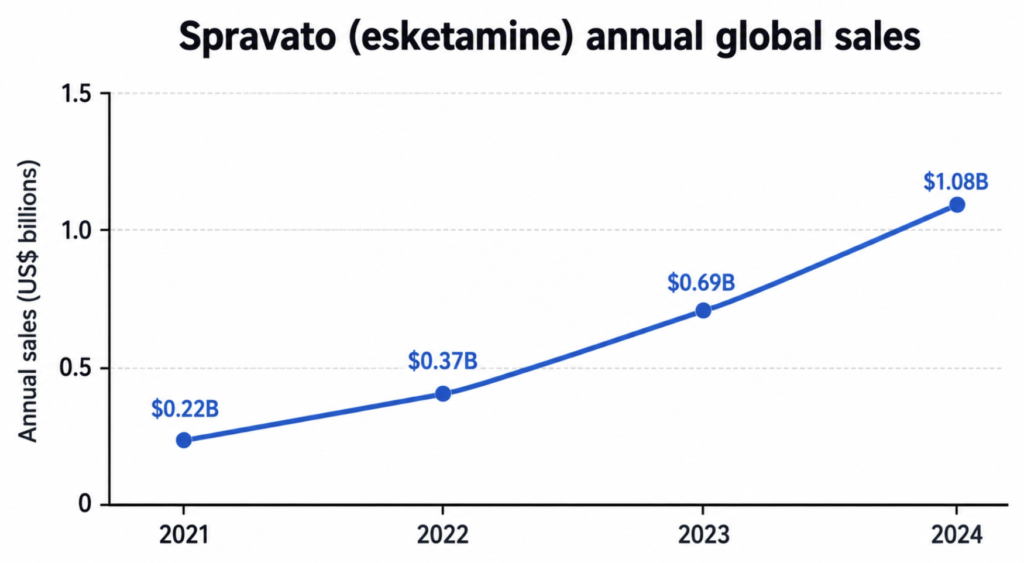
Esketamine has quietly become a commercial success. Spravato’s reported global sales rose from about $224 million in full-year 2021 to roughly $1.08 billion in full-year 2024, crossing into blockbuster territory. By the fourth quarter of 2025, quarterly sales of about $503 million implied an annualized run rate above $2 billion (Johnson & Johnson quarterly and full-year financial disclosures). Because reported sales can swing by hundreds of millions of dollars from one quarter to the next, these figures are best read against their specific reporting period rather than treated as a fixed number. Separately, one market analysis valued the broader esketamine market at around $1.05 billion in 2025, with a forecast near $2.15 billion by 2034 (market research estimate).
Access has scaled with demand. More than 5,000 certified clinics now offer the treatment, though cost remains a barrier: list prices run in the range of roughly $590 to $895 per treatment visit before insurance, not counting the clinic and monitoring time (published cost analyses).
How It Compares to Other New Antidepressants
Esketamine is no longer alone in the rapid-acting category. Zuranolone (Zurzuvae), an oral drug that modulates GABA-A receptors, can improve symptoms within about three days and is given as a short two-week course. Auvelity, an oral combination that includes an NMDA-active component, offers another fast-onset option, and psilocybin remains in late-stage development for treatment-resistant depression.
The shared thread is onset speed — the main commercial and clinical argument for these newer agents over inexpensive generic SSRIs. What still distinguishes esketamine is the depth of its trial program and its specific foothold in the most severe, treatment-resistant cases.
Key Takeaways
- The depression nasal spray is esketamine (brand name Spravato), developed by Johnson & Johnson, and works on the brain’s glutamate system rather than serotonin.
- The FDA approved it for treatment-resistant depression in 2019, for MDD with acute suicidal ideation in 2020, and as a stand-alone monotherapy in January 2025.
- In trials it can reduce depressive symptoms within about 24 hours, with moderate effect sizes in patients who had already failed multiple antidepressants.
- Because of sedation, dissociation, respiratory depression, and abuse risk, it carries a boxed warning and is given only in certified clinics with at least two hours of monitoring.
- Spravato surpassed $1 billion in annual sales in 2024 and reached a $2 billion-plus run rate by late 2025, making it one of psychiatry’s notable commercial successes.
FAQ
What is a depression nasal spray? It is esketamine (Spravato), a ketamine-derived antidepressant given as a nasal spray. It targets NMDA/glutamate signaling in the brain, which allows it to ease depressive symptoms far faster than oral antidepressants that work on serotonin.
Who can receive it? It is approved for adults with treatment-resistant depression, or for major depressive disorder with acute suicidal ideation or behavior. It is not a first-line option and is reserved for patients who have not responded to at least two oral antidepressants.
How fast does it work? Some patients improve within about 24 hours of the first dose. That speed is the central reason it is used in severe cases, compared with the four to six weeks typical of SSRIs.
Is it safe to use at home? No. It must be self-administered in a certified clinic under supervision, with at least two hours of monitoring afterward, because of risks including sedation and dissociation.
Is esketamine the same as recreational ketamine? No. It is a purified enantiomer of ketamine, delivered at controlled doses in a medical setting, and it remains a Schedule III controlled substance dispensed only through a restricted safety program.
References
Bhavya, Shetty S, Sadasivam B. A New Era for Esketamine in Managing Treatment-Resistant Depression: A Systematic Review of Its Use From Adjunct to First-Line Therapy. Cureus. 2025;17(9):e91829.
Duman RS, Sanacora G, Krystal JH. Altered Connectivity in Depression: GABA and Glutamate Neurotransmitter Deficits and Reversal by Novel Treatments. Neuron. 2019;102(1):75-90.
Fu DJ, Ionescu DF, Li X, et al. Esketamine Nasal Spray for Rapid Reduction of Major Depressive Disorder Symptoms in Patients Who Have Active Suicidal Ideation With Intent: Double-Blind, Randomized Study (ASPIRE I). J Clin Psychiatry. 2020;81(3):19m13191.
Janik A, Qiu X, Lane R, et al. Esketamine Monotherapy in Adults With Treatment-Resistant Depression: A Randomized Clinical Trial. JAMA Psychiatry. 2025;82(9):877-887.
Öye I, Paulsen O, Maurset A. Effects of Ketamine on Sensory Perception: Evidence for a Role of N-Methyl-D-Aspartate Receptors. J Pharmacol Exp Ther. 1992;260(3):1209-1213.
Popova V, Daly EJ, Trivedi M, et al. Efficacy and Safety of Flexibly Dosed Esketamine Nasal Spray Combined With a Newly Initiated Oral Antidepressant in Treatment-Resistant Depression: A Randomized Double-Blind Active-Controlled Study. Am J Psychiatry. 2019;176(6):428-438.
Joonpyo Hong, MD is a board-certified otolaryngologist practicing in Korea. This article reflects his clinical interpretation of published research and does not constitute individual medical advice.
For more interesting content:
https://curiousmd.com/ai-ent-referral/
https://curiousmd.com/summer-allergic-rhinitis/
https://curiousmd.com/allergic-vs-nonallergic-rhinitis/
Link out to:
https://www.jnj.com/media-center/press-releases/spravato-esketamine-approved-in-the-u-s-as-the-first-and-only-monotherapy-for-adults-with-treatment-resistant-depression
https://www.janssenlabels.com/package-insert/product-monograph/prescribing-information/SPRAVATO-pi.pdf
JAMA Psychiatry: Esketamine Monotherapy in Adults With Treatment-Resistant Depression (Janik et al., 2025)
National Institute of Mental Health: Depression overview