
In 1963, a paper reported that N-acetylcysteine reduced the viscosity of mucoprotein solutions in vitro. Its title called the compound a new mucolytic agent [Sheffner, The Reduction In Vitro in Viscosity of Mucoprotein Solutions by a New Mucolytic Agent, N-Acetyl-L-Cysteine, 1963]. Six decades later that name is still carrying most of the argument in clinics around the world, and in some settings it may be carrying more than the drugs are. So do mucolytics work? It depends on which drug, which patient, and which of the four claims packed into that one word you happen to be testing.
The word does a lot of work
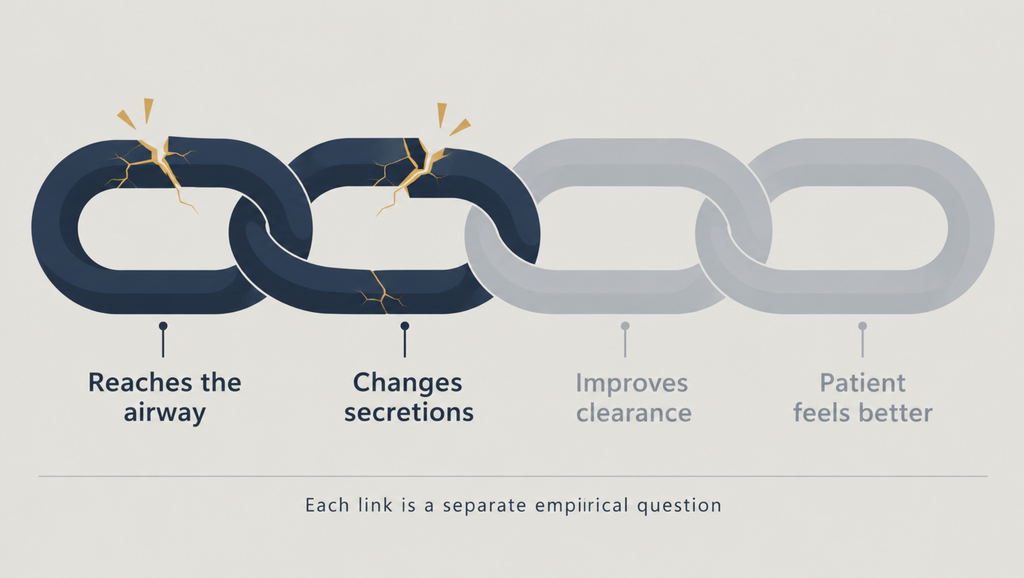
Read the name and the argument seems finished before it starts. Muco- is mucus. -lytic means it breaks things apart. So the drug breaks apart mucus, which thins it, which makes it easier to cough up, which helps the patient. That is four separate steps, and the name supplies all of them at once.
The name only ever described the first one, and it described it in glassware. Everything after that is an inference. When a drug class is named after its proposed mechanism rather than its demonstrated effect, the mechanism borrows credibility from an outcome nobody has shown it produces.
The classification is messier than the label suggests. Drugs that act on airway secretions are usually grouped into four categories, expectorants, mucolytics, mucoregulators and mucokinetics, according to how they are thought to work [Balsamo, Mucoactive Drugs, 2010]. In that scheme carbocisteine sits with the mucoregulators rather than with true mucolytics like N-acetylcysteine, because it isn’t thought to act directly on mucus structure. These boundaries aren’t settled and different reviews draw them differently. That is rather the point. In practice all of them collapse into one word, and the word is mucolytic.
What would have to be true
For an oral mucolytic to help a patient, four things have to hold. The drug has to reach the airway in meaningful concentration. It has to change the physical properties of secretions there. That change has to improve clearance. And better clearance has to produce something the patient actually notices. Each of those is a separate empirical question, and the name asserts all four at once.
Where the chain breaks
The first link is the one least often examined.
Oral N-acetylcysteine has poor bioavailability. In healthy volunteers given the drug intravenously and orally in a crossover design, oral bioavailability was 4.0% for reduced NAC and 9.1% based on total NAC [Olsson, Pharmacokinetics and Bioavailability of Reduced and Oxidized N-Acetylcysteine, 1988]. Six subjects in 1988 is thin and dated enough to dismiss, except that the finding was reproduced thirty-three years later in a completely different population. Among 54 critically ill patients, enteral bioavailability was estimated at 11.6% (95% CI 6.3–16.9%), which the authors noted was similar to figures in healthy volunteers and in patients with chronic lung disease [Teder, The Pharmacokinetic Profile and Bioavailability of Enteral N-Acetylcysteine in Intensive Care Unit, 2021].
The second link has been tested once, memorably. In 1985 a small crossover study measured the exact property Sheffner had measured, but in living people. Nine patients with chronic bronchitis took oral NAC 200 mg three times daily for four weeks. Lung function didn’t change, mucociliary clearance didn’t change, and sputum viscosity, the original observation that the whole name is built on, didn’t change either [Millar, Effect of Oral N-Acetylcysteine on Mucus Clearance, 1985].
Nine patients cannot prove a negative, and a study that small can easily miss a real effect. What’s striking is how rarely anyone has repeated it, given that it aims straight at the assumption everything else rests on.
Guaifenesin, sold over the counter, fares no better. A widely cited review concluded there is no evidence it is effective for any form of lung disease, and that mucolytics which depolymerize mucin have no proven benefit [Rubin, Mucolytics, Expectorants, and Mucokinetic Medications, 2007]. That is one author’s synthesis rather than a systematic review, and it is nearly two decades old, so read it as an expert reading of the field rather than a settled verdict.
So where do mucolytics actually work?
That leaves the last two links, whether clearance improves and whether patients end up better off. Anyone who wants to call these drugs simply useless has to deal with the Cochrane data first.
A review pooling 28 studies and 6,723 participants found that people taking mucolytics were more likely to remain exacerbation-free than those on placebo (Peto OR 1.73, 95% CI 1.56–1.91). Over an average of nine months, the number needed to treat to keep one additional person free of exacerbations was eight (95% CI 7–10) [Poole, Mucolytic Agents versus Placebo for Chronic Bronchitis or Chronic Obstructive Pulmonary Disease, 2019].
That is a real signal, and the review authors qualified it heavily. Heterogeneity was high (I² = 62%). More recent studies showed less benefit than older ones and longer studies showed smaller effects than shorter ones, a pattern the authors suggested may reflect selection or publication bias in the earlier trials. Quality of life improved by a mean difference of −1.37 (95% CI −2.85 to 0.11) across seven studies and 2,721 participants, which neither reached the minimal clinically important difference of −4 units nor excluded no difference at all.
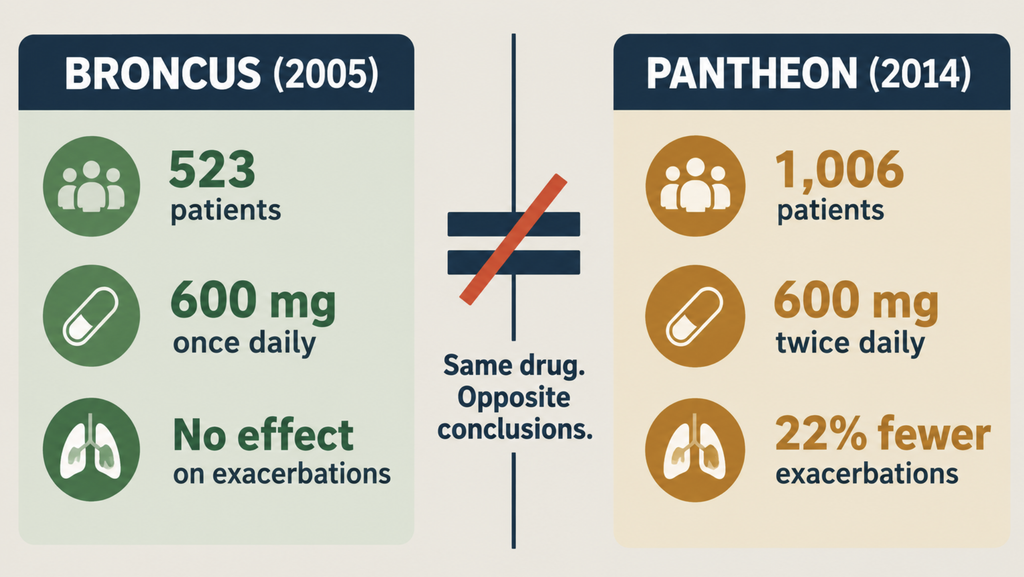
Two large trials disagree outright. BRONCUS randomized 523 patients to NAC 600 mg daily for three years and found no effect on exacerbation rate (HR 0.99, 95% CI 0.89–1.10, p=0.85) [Decramer, Effects of N-Acetylcysteine on Outcomes in Chronic Obstructive Pulmonary Disease (BRONCUS), 2005]. PANTHEON randomized 1,006 patients across 34 Chinese hospitals to 600 mg twice daily for one year and found exacerbation rates of 1.16 versus 1.49 per patient-year (RR 0.78, 95% CI 0.67–0.90, p=0.0011) [Zheng, Twice Daily N-Acetylcysteine 600 mg for Exacerbations of Chronic Obstructive Pulmonary Disease (PANTHEON), 2014]. PANTHEON was funded by a pharmaceutical manufacturer, with company-affiliated authors. Differences in dose and population are the usual explanation for the discrepancy, though that explanation was assembled after the fact.
The European Respiratory Society and American Thoracic Society do recommend mucolytic therapy for preventing COPD exacerbations. Their recommendation is explicitly conditional, as were all but one recommendation in that guideline [Wedzicha, Prevention of COPD Exacerbations: A European Respiratory Society/American Thoracic Society Guideline, 2017]. Conditional is not a formality. It means the balance of benefit and burden is uncertain enough that well-informed patients could reasonably choose differently.
The reasoning behind the trials is worth noticing too. Both BRONCUS and PANTHEON were designed around oxidative stress and inflammation in COPD, and tested N-acetylcysteine for its antioxidant and anti-inflammatory properties, not for its effect on mucus [Decramer, Effects of N-Acetylcysteine on Outcomes in Chronic Obstructive Pulmonary Disease (BRONCUS), 2005; Zheng, Twice Daily N-Acetylcysteine 600 mg for Exacerbations of Chronic Obstructive Pulmonary Disease (PANTHEON), 2014]. The drug may work and the name may still be wrong.
The drug that earns its name
Cystic fibrosis offers the cleanest counterexample, and it cuts against the label rather than for it.
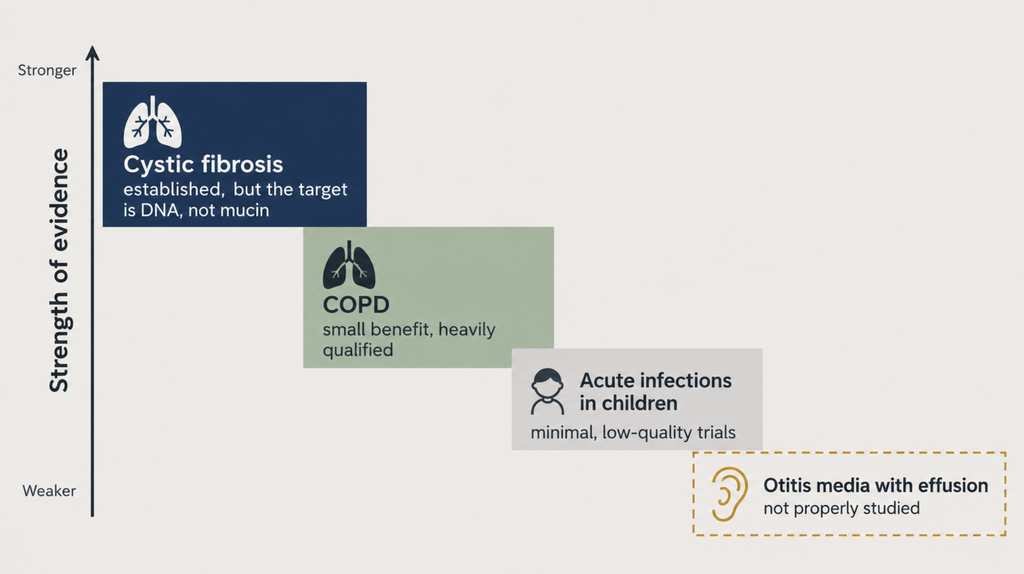
Airway secretions in cystic fibrosis contain almost no mucin. What accumulates is closer to pus: DNA and filamentous actin released by inflammatory cells [Rubin, Mucolytics, Expectorants, and Mucokinetic Medications, 2007]. Knowing that, the therapeutic target was set on DNA rather than mucus. In 968 patients treated for 24 weeks, aerosolized recombinant human DNase reduced the age-adjusted risk of respiratory exacerbations by 28% with once-daily dosing and 37% with twice-daily dosing, with modest improvements in FEV1 of 5.8% and 5.6% [Fuchs, Effect of Aerosolized Recombinant Human DNase on Exacerbations of Respiratory Symptoms and on Pulmonary Function in Patients with Cystic Fibrosis, 1994].
DNase works because someone established what was actually in the airway and aimed a drug at it. Membership in a category called mucolytics had nothing to do with it.
The ENT problem
These drugs are prescribed most reflexively in the settings where they have been studied least.
For otitis media with effusion, the UK’s national guideline is unambiguous: do not offer mucolytics for OME or OME-related hearing loss [National Institute for Health and Care Excellence, Otitis Media with Effusion in Under 12s, 2023]. The wording is firm, but the basis for it is not what most readers would assume. The committee did not conduct a new evidence review for these interventions. The recommendation was carried forward from the 2008 guideline, where the review had found no evidence of effectiveness and nothing new had emerged since. In the same document, the committee listed the effect of mucolytics on hearing in children with OME as a question requiring future research.
That deserves care in both directions. It does not mean mucolytics have been shown not to work, because nobody has properly asked. It also does not mean prescribing them anyway is fine. A drug that has been given for decades without anyone establishing whether it helps is not sitting in a neutral position.
The American guideline is quieter still. Its update on OME issues strong recommendations against intranasal and systemic steroids, systemic antibiotics, and antihistamines or decongestants [Rosenfeld, Clinical Practice Guideline: Otitis Media with Effusion (Update), 2016]. Mucolytics do not appear among the treatments addressed at all, neither endorsed nor rejected.
Children, and where caution stops being theoretical
For acute respiratory infections in children without chronic lung disease, a Cochrane review of six trials and 497 participants found some benefit from acetylcysteine and carbocysteine, such as reduced cough at day seven, but the differences were of little clinical relevance and the quality of the included studies was questionable. The reviewers also noted that these drugs are prescribed for conditions that resolve on their own. Across 34 studies and 2,064 children, safety appeared good, with very little data in infants under two. In that age group, 59 cases of paradoxically increased bronchorrhoea had been reported to the French pharmacovigilance system [Chalumeau, Acetylcysteine and Carbocysteine for Acute Upper and Lower Respiratory Tract Infections in Paediatric Patients without Chronic Broncho-Pulmonary Disease, 2013].
Spontaneous reports don’t establish causation and carry no denominator, so 59 reports tells you nothing about how often this happens. Regulators judged it enough to act anyway. As of 29 April 2010, France contraindicated oral mucolytics in infants under two because of the risk of increased bronchial congestion, and three products marketed specifically for infants were withdrawn [Agence française de sécurité sanitaire des produits de santé, Contre-indication chez le nourrisson, 2010].
For an illness that resolves on its own, the bar for adding a drug is low. There is still a bar, and increased bronchial secretions in an infant is the sort of thing that fails it.
Clinical Perspective
The habit worth examining is adding a mucolytic to something else.
A drug treated as an optional extra, sitting alongside the treatment actually doing the work, never has to justify itself. Nobody asks what it’s for, because nothing depends on it. A prescription that has to earn its place gets scrutinized in a way that one merely occupying space does not.
It’s also worth remembering what a cough is. In a productive cough, clearing secretions is the body doing its job. Wanting to make that smoother assumes it’s going badly, which in most self-limiting infections it isn’t.
None of this means these drugs should never be used. It means the reason for using one should be something other than the fact that its name sounds like an explanation.
Key Takeaways
“Mucolytic” is a mechanism label from a 1963 test-tube experiment, not a claim about patient outcomes.
Oral N-acetylcysteine has low bioavailability, 4.0% to 9.1% in healthy volunteers and 11.6% in critically ill patients, and the one small study that measured sputum viscosity in patients rather than glassware found no change.
In COPD, mucolytics produce a small reduction in exacerbations, but the effect shrinks in more recent and longer trials, and quality-of-life gains fall below the clinically meaningful threshold.
Dornase alfa works in cystic fibrosis because it targets DNA rather than mucin. Precision about the target, not membership in a drug class, is what produced the benefit.
The UK guideline advises against mucolytics for otitis media with effusion, but on the basis of absent evidence rather than demonstrated failure. The US guideline does not address them at all.
FAQ
Do mucolytics help with a common cold? There is no good evidence that they do. Trials in children with acute respiratory infections found differences too small to matter clinically, in studies of questionable quality [Chalumeau, Acetylcysteine and Carbocysteine for Acute Upper and Lower Respiratory Tract Infections in Paediatric Patients without Chronic Broncho-Pulmonary Disease, 2013]. Colds resolve on their own, which sets a high bar for adding anything.
Is oral N-acetylcysteine useful for thinning mucus? Very little of an oral dose reaches the circulation intact, 4.0% to 9.1% in healthy volunteers and 11.6% in critically ill patients [Olsson, Pharmacokinetics and Bioavailability of Reduced and Oxidized N-Acetylcysteine, 1988; Teder, The Pharmacokinetic Profile and Bioavailability of Enteral N-Acetylcysteine in Intensive Care Unit, 2021]. Where oral NAC does appear to help, in COPD, the benefit is generally attributed to antioxidant and anti-inflammatory activity rather than to thinning mucus.
Are mucolytics safe for young children? In France they are contraindicated in infants under two, following reports of paradoxically increased bronchial secretions [Agence française de sécurité sanitaire des produits de santé, Contre-indication chez le nourrisson, 2010]. In children older than two the available data suggest they are generally well tolerated, though the evidence base is thin [Chalumeau, Acetylcysteine and Carbocysteine for Acute Upper and Lower Respiratory Tract Infections in Paediatric Patients without Chronic Broncho-Pulmonary Disease, 2013]. Age restrictions differ between countries, so decisions about a specific child belong with the clinician treating that child.
What’s the difference between a mucolytic and an expectorant? A mucolytic is meant to break down the structure of mucus. An expectorant is meant to increase airway water or secretion volume so that coughing clears it more effectively [Balsamo, Mucoactive Drugs, 2010]. In practice the distinction collapses, since everyone calls all of them mucus medicine, which is part of how the category came to be judged by its name rather than its results.
References
- Sheffner AL. The reduction in vitro in viscosity of mucoprotein solutions by a new mucolytic agent, N-acetyl-L-cysteine. Ann N Y Acad Sci. 1963;106:298–310.
- Olsson B, Johansson M, Gabrielsson J, Bolme P. Pharmacokinetics and bioavailability of reduced and oxidized N-acetylcysteine. Eur J Clin Pharmacol. 1988;34(1):77–82.
- Teder K, Maddison L, Soeorg H, Meos A, Karjagin J. The pharmacokinetic profile and bioavailability of enteral N-acetylcysteine in intensive care unit. Medicina (Kaunas). 2021;57(11):1218.
- Millar AB, Pavia D, Agnew JE, Lopez-Vidriero MT, Lauque D, Clarke SW. Effect of oral N-acetylcysteine on mucus clearance. Br J Dis Chest. 1985;79(3):262–6.
- Rubin BK. Mucolytics, expectorants, and mucokinetic medications. Respir Care. 2007;52(7):859–65.
- Balsamo R, Lanata L, Egan CG. Mucoactive drugs. Eur Respir Rev. 2010;19(116):127–33.
- Poole P, Sathananthan K, Fortescue R. Mucolytic agents versus placebo for chronic bronchitis or chronic obstructive pulmonary disease. Cochrane Database Syst Rev. 2019;5(5):CD001287.
- Wedzicha JA, Calverley PMA, Albert RK, et al. Prevention of COPD exacerbations: a European Respiratory Society/American Thoracic Society guideline. Eur Respir J. 2017;50(3):1602265.
- Decramer M, Rutten-van Mölken M, Dekhuijzen PNR, et al. Effects of N-acetylcysteine on outcomes in chronic obstructive pulmonary disease (Bronchitis Randomized on NAC Cost-Utility Study, BRONCUS): a randomised placebo-controlled trial. Lancet. 2005;365(9470):1552–60.
- Zheng JP, Wen FQ, Bai CX, et al. Twice daily N-acetylcysteine 600 mg for exacerbations of chronic obstructive pulmonary disease (PANTHEON): a randomised, double-blind placebo-controlled trial. Lancet Respir Med. 2014;2(3):187–94.
- Fuchs HJ, Borowitz DS, Christiansen DH, et al. Effect of aerosolized recombinant human DNase on exacerbations of respiratory symptoms and on pulmonary function in patients with cystic fibrosis. N Engl J Med. 1994;331(10):637–42.
- Chalumeau M, Duijvestijn YCM. Acetylcysteine and carbocysteine for acute upper and lower respiratory tract infections in paediatric patients without chronic broncho-pulmonary disease. Cochrane Database Syst Rev. 2013;2013(5):CD003124.
- Rosenfeld RM, Shin JJ, Schwartz SR, et al. Clinical practice guideline: otitis media with effusion (update). Otolaryngol Head Neck Surg. 2016;154(1 Suppl):S1–S41.
- National Institute for Health and Care Excellence. Otitis media with effusion in under 12s. NICE guideline NG233. London: NICE; 2023.
- Agence française de sécurité sanitaire des produits de santé. Spécialités mucolytiques, mucofluidifiantes administrées par voie orale et hélicidine: contre-indication chez le nourrisson. Saint-Denis: Afssaps; 2010.
Joonpyo Hong, MD is a board-certified otolaryngologist practicing in Korea. This article reflects his clinical interpretation of published research and does not constitute individual medical advice.
For more articles:
https://curiousmd.com/cough-that-wont-go-away-after-a-cold/
https://curiousmd.com/do-antihistamines-help-a-cold/
https://curiousmd.com/summer-allergic-rhinitis/
Link out to:
https://www.nhs.uk/medicines/carbocisteine/about-carbocisteine/ — The NHS medicines page for carbocisteine. Worth reading as an artefact of the belief this article examines: it states plainly that the drug works by making phlegm less thick and sticky.
https://www.cochrane.org/evidence/CD001287_mucolytic-agents-chronic-bronchitis-or-chronic-obstructive-pulmonary-disease — Cochrane’s plain-language summary of the 38-trial review of oral mucolytics in COPD and chronic bronchitis. The clearest single source on both the benefit and its limits.
https://www.cff.org/managing-cf/mucus-thinners — The Cystic Fibrosis Foundation’s guide to mucus thinners, which describes dornase alfa as acting like scissors on DNA strands rather than on mucus itself.
https://www.nice.org.uk/guidance/ng233/chapter/Recommendations — The full NICE recommendations for otitis media with effusion in under 12s. Recommendation 1.5.4 is the one that names mucolytics directly.
https://www.enthealth.org/be_ent_smart/treating-and-managing-ear-fluid/ — The American Academy of Otolaryngology’s patient guide to ear fluid. Note which medications it names as ineffective, and which it leaves out.