
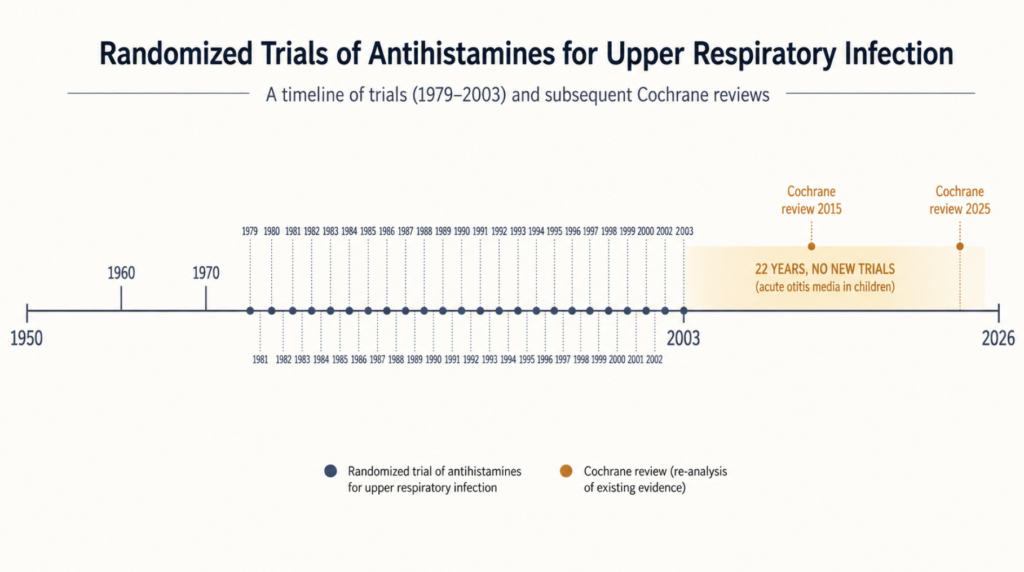
Do antihistamines help a cold? The most recent evidence on that question is a gap rather than a finding. In November 2025, a Cochrane team published an updated review of decongestants and antihistamines for acute otitis media in children. Their search turned up no relevant randomized trial published on that question since 2003, and none ongoing [Darlison, Decongestants and antihistamines for acute otitis media in children, 2025]. That is twenty-two years without a new trial, while the drugs stayed on pharmacy shelves and in prescription pads worldwide.
Whether antihistamines help an upper respiratory infection (URI) has three defensible answers, and each rests on a different slice of evidence: that they help, that they don’t, and that they cause harm. Each one runs out of data somewhere, and where it runs out is worth stating as plainly as the findings themselves.
Do antihistamines help a cold? Start with what causes one
Antihistamines got into cold medicine by analogy. Allergic rhinitis and viral rhinitis look nearly identical from the outside: sneezing, clear rhinorrhea, watery eyes, congestion. Histamine drives the first one, so the reasoning went that blocking histamine should help the second.
That analogy was tested directly, and it failed. When volunteers were inoculated with rhinovirus and their nasal lavage fluid was sampled every four hours for five days, kinin levels rose in those who became infected and symptomatic, along with albumin and neutrophils. Histamine levels did not change at all [Naclerio, Kinins are generated during experimental rhinovirus colds, 1988]. The same pattern held in naturally acquired colds: kinins up, histamine flat, suggesting that mast cells and basophils simply are not participating [Proud, Kinins are generated in nasal secretions during natural rhinovirus colds, 1990].
The reverse experiment closed the loop. Spraying bradykinin into healthy noses produced dose-dependent rhinitis symptoms and a sore throat, with measurable unilateral obstruction, and no rise in histamine [Proud, Nasal provocation with bradykinin induces symptoms of rhinitis and a sore throat, 1988].
A cold, then, runs on kinins and cytokines rather than on histamine. Whatever benefit an antihistamine produces in a URI has to come from something other than H1 blockade.
The case for benefit
The strongest evidence for benefit comes from a trial that counted sneezes and weighed the tissues, not from symptom diaries.
In a double-blind rhinovirus challenge study, 150 infected, evaluable volunteers received clemastine fumarate or placebo (75 per group). Sneeze counts dropped on illness days 2, 3, and 5 (day 3: 1.7 versus 5.6 sneezes, P = .0001). Rhinorrhea scores fell on days 2 and 3. Nasal secretion weight on day 3 was 3.6 g versus 6.3 g. Averaged over four days of treatment, sneeze counts fell 57%, rhinorrhea scores 27%, and secretion weight 35% [Gwaltney, Randomized controlled trial of clemastine fumarate for treatment of experimental rhinovirus colds, 1996]. Those reductions were objective and placebo controlled. First-generation antihistamines do something measurable to a viral nose.
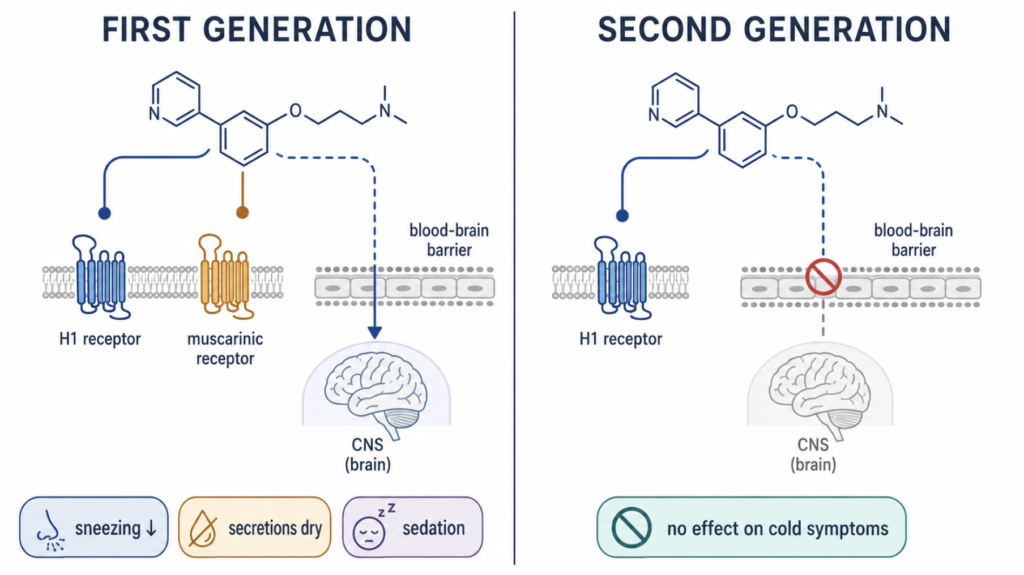
The mechanism is the interesting part. Sedating antihistamines block muscarinic receptors and cross the blood-brain barrier; non-sedating ones mostly do neither. When loratadine was tested in the same rhinovirus challenge model, it failed, confirming earlier negative studies of second-generation agents in natural colds. The authors’ reading was that first-generation efficacy against sneezing comes primarily from neuropharmacologic effects rather than antihistaminic ones [Muether, Variant effect of first- and second-generation antihistamines as clues to their mechanism of action on the sneeze reflex in the common cold, 2001]. What helps a runny nose, in other words, is the anticholinergic drying and the central sedation, not the receptor the drug class is named after.
There is also a combination-product argument, which is separate. A Cochrane review of 27 trials found that antihistamine-decongestant-analgesic combinations have some general benefit in adults and older children, with no evidence of effectiveness in young children, and with benefits that must be weighed against adverse effects [De Sutter, Oral antihistamine-decongestant-analgesic combinations for the common cold, 2022]. It does not attribute that benefit to the antihistamine component. A product containing a decongestant and an analgesic has two ingredients with plausible independent effects on congestion and sore throat.
Then there is the practical argument. A patient who sneezes through the night and cannot sleep is not asking for disease modification. In that setting the sedation is the point rather than a side effect, and it deserves to be named as a real reason people reach for these drugs.
The case against
The clemastine trial contains one more result that rarely gets quoted. When Cochrane reviewers went back through the same study, they noted that participants rating their overall illness on a five-point scale showed no significant difference between clemastine and placebo [De Sutter, Antihistamines for the common cold, 2015]. Fewer sneezes and less measured mucus, in patients who did not feel meaningfully better.
That dissociation repeats at the level of the systematic review.
The 2015 Cochrane review identified 18 randomized trials of antihistamine monotherapy versus placebo in 4,342 participants, excluding anyone with an allergic component, though heterogeneity was severe enough that only five could be entered into meta-analysis. Its findings were narrow and specific. In adults, on day one or two of treatment, 45% reported a beneficial effect versus 38% on placebo, and that difference vanished by days three to four. On individual symptoms, sedating antihistamines produced measurable but clinically non-significant differences: rhinorrhea on day three improved by 0.23 points on a four-to-five-point severity scale, sneezing by 0.35 points. No conclusion was possible for children. The authors’ bottom line was that the evidence does not support prescribing or purchasing antihistamines for the common cold [De Sutter, Antihistamines for the common cold, 2015].
A seven-percentage-point difference on a global “do you feel better” question, confined to the first two days, is the entire positive finding. The individual-symptom numbers are worth sitting with too: a third of a point on a five-point scale is the difference between “moderate” and “moderate.”
One feature of this evidence base cuts in an unexpected direction. Every one of the 18 trials disclosed financial support from a pharmaceutical company, whether grants, supply of the study drug, or an author employed by the manufacturer. Industry sponsorship is generally associated with results that favor the sponsor’s product, which is why disclosure matters. Here the tilt should have produced an optimistic literature. Instead the pooled result was a two-day, seven-point blip and nothing on individual symptoms. When trials designed and funded by people with an interest in a positive answer cannot find much of one, the negative conclusion becomes harder to dismiss rather than easier. It also means the shortage of independent replication matters less than it first appears, since an independent trial would be more likely to shrink this effect than to enlarge it.
A one-to-two-day effect on a global severity score, in an illness that resolves on its own in seven to ten days, is also difficult to separate from regression to the mean. Patients start medication when they feel worst, then feel better with or without it. The individual-symptom analyses, the outcomes that should have been most sensitive if the drug worked on rhinorrhea, are exactly where the effect disappears.
The natural-cold replication of the clemastine work makes the same point differently. In 403 people with colds of less than 24 hours’ duration, the differences that emerged were small and appeared only on selected days [Turner, Effectiveness of clemastine fumarate for treatment of rhinorrhea and sneezing associated with the common cold, 1997]. A drug that requires a large trial to detect a modest, intermittent signal is not producing the experience patients are paying for.
The pediatric picture is not negative so much as empty. Cochrane could draw no conclusion at all about children, and the acute otitis media review that opened this article found the evidence very uncertain, with no relevant trial since 2003 [Darlison, Decongestants and antihistamines for acute otitis media in children, 2025]. Neither of those is the same as “shown not to work.” They mean the question was asked, answered inconclusively, and then abandoned.
The case for harm, in three parts
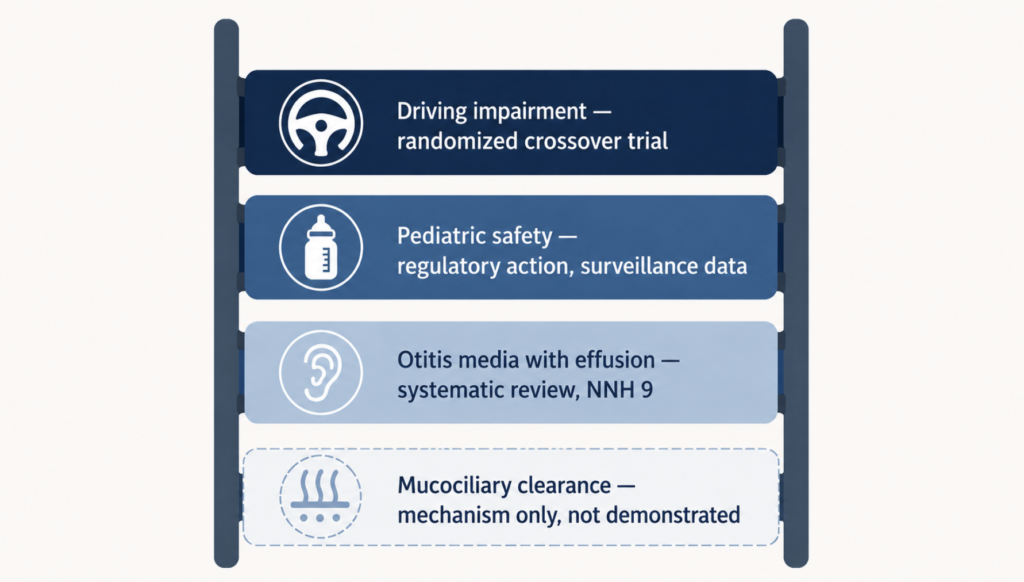
The harm case is not one argument. It is at least three, and they carry very different evidentiary weight. Keeping them separate matters, because the strongest ones get diluted when they are lumped in with the weakest.
One caveat belongs at the front. In the 2015 Cochrane monotherapy review, adverse events including sedation were reported more often with sedating antihistamines than with placebo, 9% versus 5.2%, but the difference did not reach statistical significance [De Sutter, Antihistamines for the common cold, 2015]. That is not the same as “no risk,” and it is not proven risk either. Anyone building a harm case has to account for it. The explanation is largely about what those trials measured and in whom: short courses in adults, modest samples, and outcomes that do not capture next-morning driving, cumulative exposure over decades, or a bottle sitting in a house with a toddler. The harms below come from study designs built to detect exactly those things.
Harm that is well documented: impairment
Forty licensed drivers aged 25 to 44 took a single dose of diphenhydramine 50 mg, fexofenadine 60 mg, alcohol to roughly 0.1% blood concentration, or placebo at weekly intervals, then drove for an hour in the Iowa Driving Simulator. Driving performance was poorest after diphenhydramine, worse than after alcohol. Fexofenadine performed like placebo. Self-reported drowsiness did not predict impairment, so drivers could not use how sleepy they felt to judge whether they should drive [Weiler, Effects of fexofenadine, diphenhydramine, and alcohol on driving performance, 2000].
This is the cleanest harm finding in the field: randomized, crossover, objectively measured. Two limits are worth naming, in that participants had seasonal allergic rhinitis rather than colds, and each drug was given as a single dose. Neither changes the core result, which is that a common sedating antihistamine degraded driving more than a blood alcohol concentration above the legal limit in most countries, and did so without the subjective warning signal that alcohol provides.
Harm that is well documented: the pediatric safety record
Regulators have moved on this. Australia’s Therapeutic Goods Administration stated in 2022 that first-generation sedating antihistamines should not be used for cough, cold, and flu symptoms in children under six, and should not be given to children under two for any indication, citing potential for serious harm and minimal evidence of efficacy; mandatory product warnings to that effect took effect in 2020. In the United States, following 2008 FDA and American Academy of Pediatrics advice, manufacturers voluntarily relabelled these products against use in children under four, with caution advised between four and six.
The fatality data require careful reading. A surveillance panel reviewed 180 pediatric deaths involving cough and cold ingredients and judged 40 related or potentially related. Diphenhydramine was the most frequent ingredient (70%), 60% of cases were in children under two, and the majority involved non-therapeutic intent, including seven deaths after deliberate sedation of a child and six that were homicides. No fatality was associated with a known therapeutic dose [Halmo, Pediatric fatalities associated with over-the-counter cough and cold medications, 2021].
That last point often disappears when these numbers get quoted. The deaths are not evidence that label-dose antihistamines kill children. They are evidence of a sedating drug, freely available, sitting in households with small children and being used to make a child sleep. The harm pathway runs through misuse, and it is the drug’s availability and sedating profile that hold that pathway open.
Harm in specific ENT conditions: no benefit, real side effects
For otitis media with effusion, a Cochrane review of 16 trials in 1,880 children found no statistical or clinical benefit for any intervention or outcome studied: not effusion resolution, not hearing, not need for referral. Treated children experienced 11% more side effects than untreated children, including gastrointestinal upset, irritability, drowsiness, and dizziness, giving a number needed to harm of 9 [Griffin, Antihistamines and/or decongestants for otitis media with effusion (OME) in children, 2022].
An intervention with zero measured benefit and one additional harm for every nine children treated has a negative expected value. The review authors recommend against its use, and this is the one clinical setting where “should not be used” follows from the data without further argument.
Harm that is mechanistic, not demonstrated: mucociliary clearance
This is where clinical reasoning most often outruns the evidence, so the label matters.
The nose clears pathogens by moving a mucus blanket backward on a carpet of beating cilia, and that system depends on adequate airway surface liquid and appropriate mucus viscosity. Anticholinergic drugs reduce glandular secretion, which is precisely the mechanism by which first-generation antihistamines dry rhinorrhea. The same clemastine trial that showed reduced secretion weight also recorded excess dry nose in 19% of treated subjects, dry throat in 17%, and dry mouth in 6% [Gwaltney, Randomized controlled trial of clemastine fumarate for treatment of experimental rhinovirus colds, 1996].
The concern that follows is that thicker mucus and a drier mucosa slow clearance, prolonging contact between pathogens and epithelium and impairing sinus and eustachian tube drainage. It is physiologically coherent. But no randomized trial has shown that antihistamine use during a URI increases rates of sinusitis, otitis media, or prolonged illness. The mechanism is real. The clinical consequence has not been demonstrated, and it belongs here as a reason for caution rather than as an established harm.
Clinical perspective
What keeps this prescription alive is not the evidence. It is that the drug produces a sensation of working.
Sneezing drops, nasal drip slows, and the patient falls asleep. All three are perceptible within hours, and all three are what the anticholinergic and sedative properties predict. Meanwhile the illness runs its ordinary course and resolves in about a week, and the drug collects the credit.
Otolaryngology sees the failures rather than the successes, and they follow recognizable patterns: middle ear effusion that persisted through weeks of cold medicine, crusted nasal mucosa alongside a rhinorrhea that never actually stopped, cognitive fogginess in an older patient whose medication list carries several anticholinergic drugs at once. That last pattern has cohort data behind it. A prospective study found a dose-response relationship between cumulative use of strong anticholinergics and incident dementia, and first-generation antihistamines are among the drug classes counted in that exposure [Gray, Cumulative use of strong anticholinergics and incident dementia, 2015]. The design is observational and open to confounding by indication, so it is a signal rather than a verdict. But it is a signal attached to a drug that a healthy adult might reasonably choose to skip for a self-limiting seven-day illness.
The summary is narrow. In an adult with a cold, a sedating antihistamine will probably reduce sneezing and mucus volume for a night or two, will probably not change how sick they feel or how long it lasts, and carries a well-documented impairment cost the next morning. It should not be used in young children, or in otitis media with effusion.
One more group sits outside this debate entirely, and identifying them is a matter of clinical judgment rather than published data. A substantial share of habitual cold-medicine users carry a self-assigned diagnosis of allergic rhinitis, asserted rather than confirmed, often never tested. Some of them do have it, in which case the drug is properly indicated and none of the argument above applies to them. Others have a non-allergic rhinitis, or a chronically dry and irritated mucosa, and are treating a label instead of a mechanism. Sorting the two apart changes the answer more than any evidence discussed here.
The larger issue is the one the 2025 review exposed. For acute otitis media in children, this is a question that stopped being investigated rather than one that got answered. Twenty-two years without a trial, and none registered, is not scientific consensus. Across the wider URI literature the pattern is milder but similar: most of the monotherapy trials Cochrane could find are decades old, every one of them carried industry support, and the newer reviews are re-analyses of the same aging dataset rather than fresh evidence.
That combination is worth stating plainly. The people who funded the research had reason to want a positive answer and did not get one. The people who might have funded a neutral replication had no product to sell and did not bother. So millions of people go on using a drug whose evidence base stopped growing decades ago.
Key takeaways
Histamine levels do not rise during rhinovirus colds; kinins do, which means an antihistamine’s benefit in a URI cannot come from H1 blockade.
First-generation antihistamines measurably reduce sneeze counts and nasal secretion weight, but the same trials show no improvement in how sick patients feel overall.
In adults, 45% reported feeling better on antihistamines during the first two days of a cold versus 38% on placebo, and the difference disappeared by day three.
Diphenhydramine impaired driving performance more than alcohol at 0.1% blood concentration, and self-reported drowsiness failed to predict that impairment.
In otitis media with effusion, antihistamines showed no benefit on any outcome while producing 11% more side effects than no treatment, a number needed to harm of 9.
All 18 trials in the Cochrane monotherapy review disclosed pharmaceutical industry support, yet still failed to show a clinically meaningful benefit.
No randomized trial of decongestants or antihistamines for acute otitis media in children has been published since 2003.
FAQ
Do antihistamines stop a runny nose from a cold? Partially, and briefly. Sedating antihistamines reduced measured nasal secretion weight by about 35% over four days of treatment in a rhinovirus challenge trial, and cut sneeze counts by more than half. But systematic review data show no clinically significant improvement in rhinorrhea as patients experience it, and no change in how long the cold lasts. The drying comes from anticholinergic activity, which is also what produces dry nose, throat, and mouth.
Why do cold medicines still contain antihistamines if the evidence is this weak? Combination products containing an antihistamine, a decongestant, and an analgesic do show some general benefit in adults and older children, but the benefit cannot be attributed to the antihistamine specifically, since the other two ingredients have plausible independent effects. Formulations also predate modern efficacy standards, and the perceptible drying and sedation give users a strong impression that the product is working. The trials that failed to show meaningful benefit were themselves industry-supported, so the weak result is unlikely to reflect a lack of commercial effort.
Is Benadryl good for a cold? Diphenhydramine is the ingredient most frequently identified in pediatric cough-and-cold fatalities, and it impaired simulated driving more than alcohol did in a randomized crossover trial. For a self-limiting illness with modest expected symptom benefit, that trade-off is difficult to justify in anyone who drives, works, or supervises children, and it should not be used in young children at all.
Can antihistamines make a sinus infection worse? There is a coherent mechanism but no proof. Anticholinergic drying increases mucus viscosity and reduces airway surface liquid, both of which slow mucociliary clearance in principle. No randomized trial has demonstrated that antihistamine use during a URI increases sinusitis rates. Treat it as a reason for caution, not as an established harm.
Are antihistamines safe for children with a cold? Regulators say no for young children. Australian authorities advise against first-generation sedating antihistamines for cough, cold, and flu symptoms under age six and against any use under age two; US manufacturers withdrew these products for children under four. Cochrane could reach no conclusion about efficacy in children at all, which leaves a known risk profile paired with unknown benefit.
References
De Sutter AIM, Saraswat A, van Driel ML. Antihistamines for the common cold. Cochrane Database Syst Rev. 2015;(11):CD009345.
De Sutter AIM, Eriksson L, van Driel ML. Oral antihistamine-decongestant-analgesic combinations for the common cold. Cochrane Database Syst Rev. 2022;1(1):CD004976.
Darlison P, Moresco L, Nussbaumer-Streit B, Bruschettini M, Gisselsson-Solen M. Decongestants and antihistamines for acute otitis media in children. Cochrane Database Syst Rev. 2025;11(11):CD015839.
Griffin G, Flynn CA. Antihistamines and/or decongestants for otitis media with effusion (OME) in children. Cochrane Database Syst Rev. 2022;(3):CD003423.
Naclerio RM, Proud D, Lichtenstein LM, Kagey-Sobotka A, Hendley JO, Sorrentino J, Gwaltney JM. Kinins are generated during experimental rhinovirus colds. J Infect Dis. 1988;157(1):133-42.
Proud D, Naclerio RM, Gwaltney JM, Hendley JO. Kinins are generated in nasal secretions during natural rhinovirus colds. J Infect Dis. 1990;161(1):120-3.
Proud D, Reynolds CJ, Lacapra S, Kagey-Sobotka A, Lichtenstein LM, Naclerio RM. Nasal provocation with bradykinin induces symptoms of rhinitis and a sore throat. Am Rev Respir Dis. 1988;137(3):613-6.
Gwaltney JM Jr, Park J, Paul RA, Edelman DA, O’Connor RR, Turner RB. Randomized controlled trial of clemastine fumarate for treatment of experimental rhinovirus colds. Clin Infect Dis. 1996;22(4):656-62.
Turner RB, Sperber SJ, Sorrentino JV, O’Connor RR, Rogers J, Batouli AR, Gwaltney JM Jr. Effectiveness of clemastine fumarate for treatment of rhinorrhea and sneezing associated with the common cold. Clin Infect Dis. 1997;25(4):824-30.
Muether PS, Gwaltney JM Jr. Variant effect of first- and second-generation antihistamines as clues to their mechanism of action on the sneeze reflex in the common cold. Clin Infect Dis. 2001;33(9):1483-8.
Weiler JM, Bloomfield JR, Woodworth GG, Grant AR, Layton TA, Brown TL, McKenzie DR, Baker TW, Watson GS. Effects of fexofenadine, diphenhydramine, and alcohol on driving performance. A randomized, placebo-controlled trial in the Iowa driving simulator. Ann Intern Med. 2000;132(5):354-63.
Gray SL, Anderson ML, Dublin S, Hanlon JT, Hubbard R, Walker R, Yu O, Crane PK, Larson EB. Cumulative use of strong anticholinergics and incident dementia: a prospective cohort study. JAMA Intern Med. 2015;175(3):401-7.
Halmo LS, Wang GS, Reynolds KM, Delva-Clark H, Rapp-Olsson M, Banner W, Bond GR, Kauffman RE, Palmer RB, Paul IM, Green JL, Dart RC. Pediatric fatalities associated with over-the-counter cough and cold medications. Pediatrics. 2021;148(5):e2020049536.
Luks D, Anderson MR. Antihistamines and the common cold. A review and critique of the literature. J Gen Intern Med. 1996;11(4):240-4.
For more articles:
https://curiousmd.com/cough-that-wont-go-away-after-a-cold/
https://curiousmd.com/summer-allergic-rhinitis/
https://curiousmd.com/hand-foot-and-mouth-disease-in-adults/
Link out to:
- Cochrane: Antihistamines for the common cold (CD009345) — the 2015 monotherapy review, including the 45% versus 38% figure and the adverse-event data.
- Cochrane: Antihistamines and/or decongestants for otitis media with effusion (CD003423) — the OME review reporting no benefit and a number needed to harm of 9.
- TGA: First-generation oral sedating antihistamines — do not use in children — Australia’s regulatory position and its underlying adverse-event reports.
- Cochrane: Oral antihistamine-decongestant-analgesic combinations for the common cold (CD004976) — the combination-product review referenced above.