
A traumatic eardrum perforation takes a second: a slap across the ear, a cotton swab pushed too far, a sharp pop on a dive. Most of these holes close by themselves. In a German series of 272 patients managed by watchful waiting, 95% of those who came back for follow-up healed completely [Heitmann, Spontaneous course of traumatic tympanic membrane perforations, 2021]. Now and then, though, the injury reaches the inner ear, and that is a different problem with a more urgent timeline.
What Causes a Traumatic Eardrum Perforation?
The eardrum is a thin membrane stretched under tension, much like the skin of a drum, and it tears in one of two ways. Either a surge of air hits it hard enough to split it (an open-hand slap, a blast, a pressure change while diving), or something solid goes straight through, usually a cotton swab or an ear pick. Which of the two dominates varies from study to study.
| Cause | How it injures | What studies report |
|---|---|---|
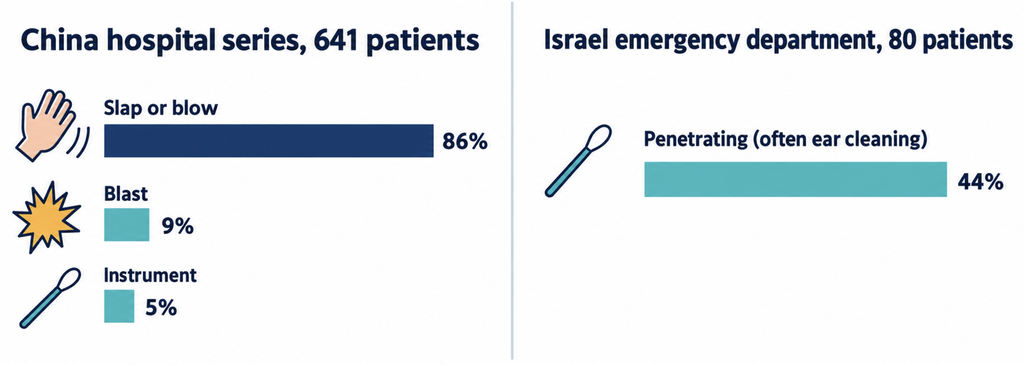
| Slap, punch, or blow to the ear | Sudden air compression | 86% of 641 patients in a Chinese hospital series, mostly assaults [Lou, Traumatic tympanic membrane perforations: a study of etiology and factors affecting outcome, 2012] |
| Swab, pick, or other object | Direct puncture | 44% of 80 emergency patients in Israel, often from ear cleaning [Sagiv, Traumatic perforation of the tympanic membrane: a review of 80 cases, 2018], but 5% in the Chinese series |
| Diving or flying (barotrauma) | Pressure difference across the drum | Second most common cause in the German series |
| Explosion or blast | High-energy pressure wave | 9% in the Chinese series, with extra long-term risks |
The Chinese and Israeli figures show how much the country and clinical setting change the picture.
Eardrum Hole vs. Inner Ear Injury: Why Dizziness Changes Everything
A simple hole is a sound-delivery problem
The eardrum and three tiny bones behind it, the ossicles, carry sound inward. The fluid-filled inner ear then turns that sound into nerve signals. A hole in the drum weakens the first step, which is called conductive hearing loss, and bigger holes cause more of it. In a Nigerian cohort of people struck on the ear, 39% had purely conductive loss, and it largely recovered once the drum healed [Orji, Patterns of hearing loss in tympanic membrane perforation resulting from physical blow to the ear, 2009].
When the injury goes deeper
Another 28% in the same cohort had mixed hearing loss, meaning the inner ear was hurt as well, and that part recovered less completely. A swab or pick pushed deep enough can also knock the ossicles out of place or break the stapes, which sits in a small window opening into the inner ear. If that window tears, inner ear fluid leaks out. This is called a perilymph fistula. One way to picture it: the inner ear is a sealed water tank behind a front door. A hole in the door is a nuisance, but a crack in the tank puts what’s inside at risk.
If nerve-type hearing loss or vertigo lasts more than a few hours after the injury, that points to inner ear damage [Jan, Eardrum Perforation, 2026]. Watch for these signs that the injury went past the eardrum:
- Spinning vertigo, nausea, or vomiting
- Hearing that seems nearly gone rather than muffled
- Weakness on one side of the face
- An object that went deep into the ear canal
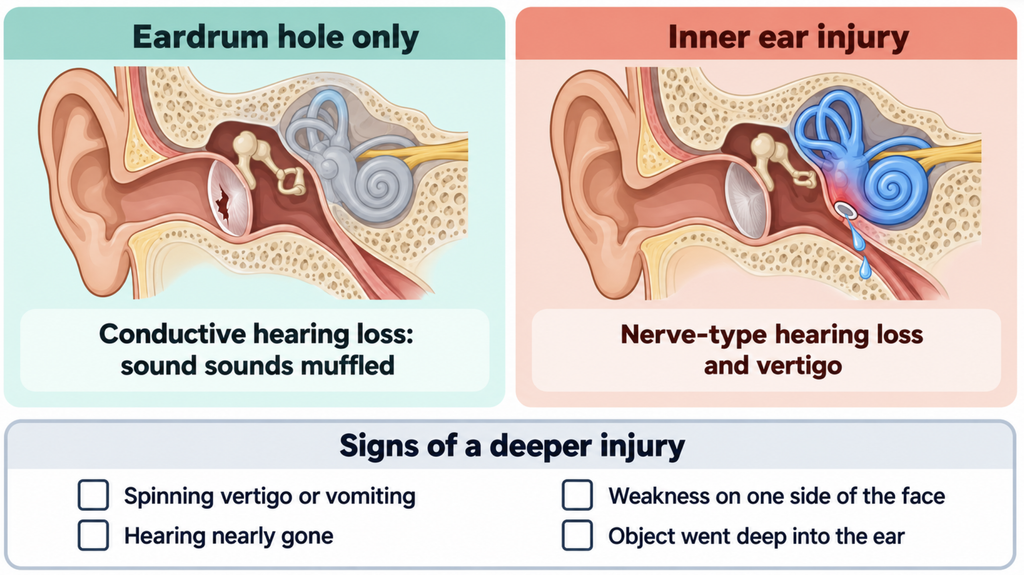
Clinical Perspective. A hearing test is how the two are told apart. Comparing hearing through air with hearing through bone shows whether the problem lies in sound delivery or in the inner ear, and that answer decides whether waiting is safe. An ear that sounds muffled but stable can usually be watched. Spinning vertigo with a drop in bone-conducted hearing needs urgent assessment.
Will a Ruptured Eardrum Heal on Its Own?
Most do. A Danish series of 133 patients reported closure in 97%, with a median healing time of 3 to 4 weeks [Jellinge, Spontaneous closure of traumatic tympanic membrane perforations: observational study, 2015]. In the Chinese series, 89% closed at a mean of 27.4 days, but size made a big difference: 92% of small holes closed, compared with only 54% of larger ones.
A hole that hasn’t closed yet may simply be slow. In a Japanese study of 40 patients, a few perforations closed only after 6 months, and holes touching the malleus (the bone attached to the drum) closed less often [Tachibana, Spontaneous closure of traumatic tympanic membrane perforation following long-term observation, 2019]. Blast injuries are the one case where relaxed waiting doesn’t fit. Skin cells driven into the middle ear can later grow into a cholesteatoma, even behind a drum that looks healed [Ungar, Blast-Induced Cholesteatomas After Spontaneous Tympanic Membrane Healing, 2019].
While you wait, keep water out and leave the ear alone. That means no swabs, no swimming, and covering the ear in the shower, because water reaching the middle ear can cause infection [Jan, Eardrum Perforation, 2026].
There is also an in-office option: an ENT doctor can place a thin patch over the hole. In a randomized trial of perforations covering more than half of the eardrum, healing took an average of 26 days with observation alone, 14 days with a gelatin sponge patch, and 11 days with daily applications of epidermal growth factor (EGF). Final closure rates, however, were not significantly different between the groups [Lou, Efficacy of EGF and Gelatin Sponge for Traumatic Tympanic Membrane Perforations: A Randomized Controlled Study, 2018].
Surgery Now or Weeks Later? How the Timing Is Decided
The answer depends on which part of the ear was damaged.
| Situation | Typical timing | Why |
|---|---|---|
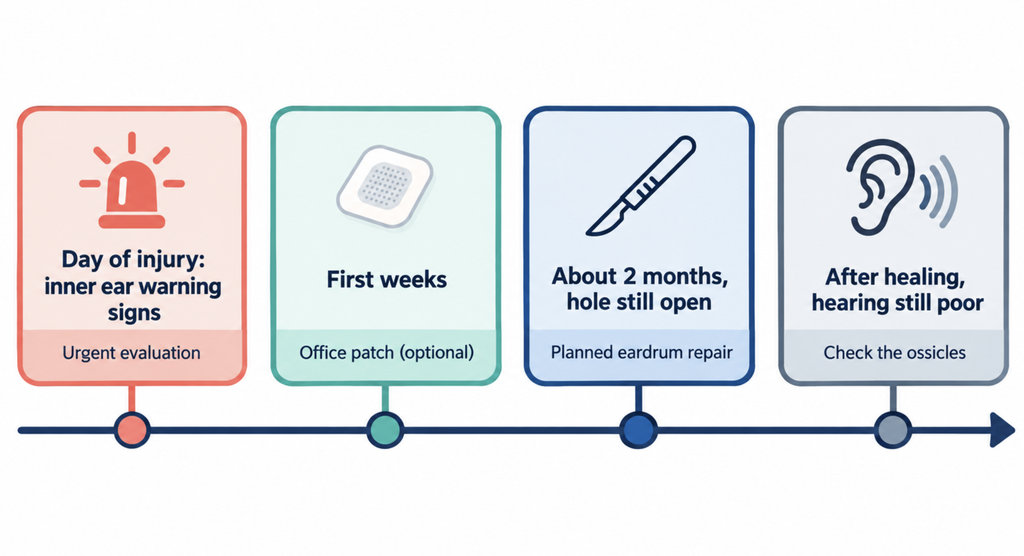
| Vertigo, nerve-type hearing loss, or deep penetrating injury | Urgent evaluation; surgery within days if severe or worsening | Find and seal a possible perilymph fistula |
| Large or slow-closing hole, no inner ear signs | Office patching in the first weeks | Shortens healing time |
| Hole still open after about 2 months | Planned repair (myringoplasty or tympanoplasty) | Spontaneous closure becomes less likely |
| Drum healed, conductive loss persists | Planned middle ear exploration | Suggests disrupted ossicles |
Inner ear injuries like these are rare, so most of the evidence comes from case reports. In one report of three children with traumatic fistulas, repair stopped the vertigo in all three, but two were left with nerve-type hearing loss [Kim, Traumatic perilymphatic fistulas in children: etiology, diagnosis and management, 2001]. Results like that are part of why surgeons tend to operate quickly while staying careful about what they predict for hearing.
A simple hole is a different situation. Most close on their own, so waiting is reasonable. Clinical references suggest considering repair if the drum hasn’t healed within about 2 months [Jan, Eardrum Perforation, 2026], although the Japanese data suggest a hole that is still getting smaller at 6 months can be given more time. Surgeons don’t all draw the line in the same place.
Hearing After Eardrum Repair Surgery: What the Studies Show
Most surgical data come from chronic perforations caused by infection, so the numbers below are only a rough guide for traumatic ones. A meta-analysis of 214 studies and 26,097 patients put the closure rate after type I tympanoplasty at 86.6% [Tan, Type I Tympanoplasty Meta-Analysis: A Single Variable Analysis, 2016].
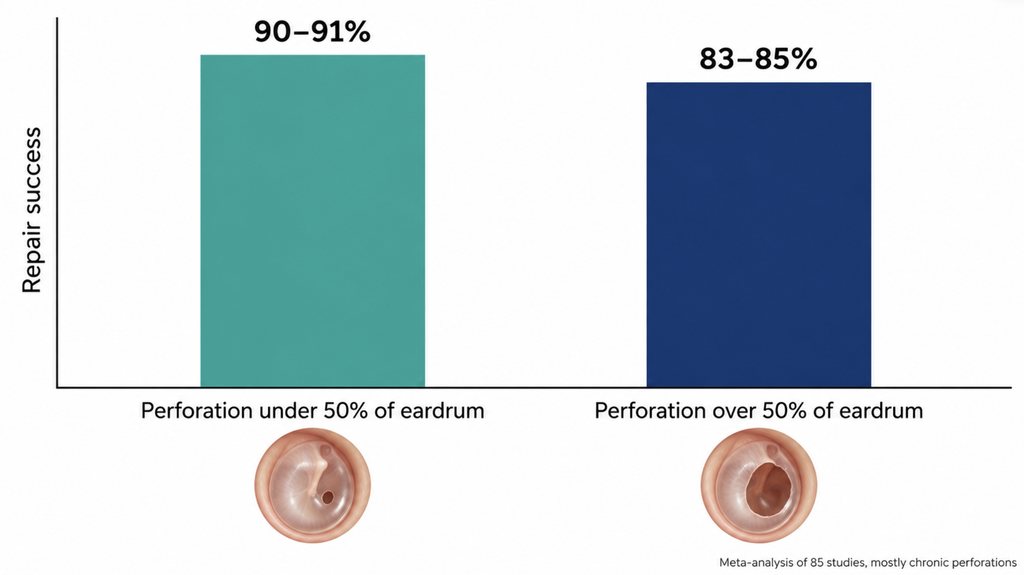
The size of the hole before surgery makes a difference. A meta-analysis of 85 studies found success rates of about 90-91% for perforations under 50% of the eardrum, compared with about 83-85% for larger ones. Both of the main techniques significantly narrowed the air-bone gap, the measure of how much sound delivery has been lost [Nicholas Jungbauer, Comparing Myringoplasty to Type I Tympanoplasty in Tympanic Membrane Repair, 2023].
Traumatic perforations may do better than infected ones. In one pediatric series, traumatic perforations reopened less often after repair than those caused by chronic otitis media [Cunha-Cabral, Predictors of anatomical and functional success in pediatric type I tympanoplasty, 2026].
There is little data on how satisfied patients are with the result. One Italian series reported closure in 90.1% of patients and a hearing outcome the authors judged satisfying in 71.5% [Pontillo, Prognostic factors in myringoplasty: a single institution retrospective chart review, 2026].
Key Takeaways
- Most traumatic eardrum perforations close on their own, in roughly 89-97% of patients across observational series.
- Blows to the ear and ear cleaning with swabs or picks are the leading causes, though the ranking varies by setting.
- Vertigo, vomiting, or near-total hearing loss after an ear injury suggests inner ear damage and needs prompt specialist assessment.
- Planned repair of a simple hole is usually considered only after about 2 months without healing.
- Repair surgery closes the hole in most patients, and smaller perforations do better.
FAQ
Will a ruptured eardrum heal on its own?
In most cases, yes. Most traumatic perforations close within weeks with simple observation [Heitmann, Spontaneous course of traumatic tympanic membrane perforations, 2021]. Large holes, holes touching the malleus, and blast injuries need closer follow-up.
Is dizziness after an eardrum injury an emergency?
It can be. Vertigo or hearing loss that lasts more than a few hours suggests inner ear damage [Jan, Eardrum Perforation, 2026], and an ENT specialist should see you as soon as possible.
Does hearing come back after eardrum repair surgery?
Usually, at least in part. Repair reliably narrows the air-bone gap [Nicholas Jungbauer, Comparing Myringoplasty to Type I Tympanoplasty in Tympanic Membrane Repair, 2023]. Nerve-type loss from an inner ear injury is a separate problem, though, and closing the eardrum won’t fix it.
References
- Heitmann D, Scheffler B, Abrams J, Gerstner AOH. Spontaneous course of traumatic tympanic membrane perforations. HNO. 2021;69(3):192-197.
- Lou ZC, Lou ZH, Zhang QP. Traumatic tympanic membrane perforations: a study of etiology and factors affecting outcome. Am J Otolaryngol. 2012;33(5):549-55.
- Sagiv D, Migirov L, Glikson E, Mansour J, Yousovich R, Wolf M, et al. Traumatic perforation of the tympanic membrane: a review of 80 cases. J Emerg Med. 2018;54(2):186-190.
- Orji FT, Agu CC. Patterns of hearing loss in tympanic membrane perforation resulting from physical blow to the ear: a prospective controlled cohort study. Clin Otolaryngol. 2009;34(6):526-32.
- Jan TA. Eardrum perforation. Merck Manual Consumer Version. Rahway (NJ): Merck & Co.; 2026 [cited 2026 Oct 4]. Available from: https://www.merckmanuals.com/home/ear-nose-and-throat-disorders/middle-ear-disorders/eardrum-perforation
- Jellinge ME, Kristensen S, Larsen K. Spontaneous closure of traumatic tympanic membrane perforations: observational study. J Laryngol Otol. 2015;129(10):950-4.
- Tachibana T, Kariya S, Orita Y, Makino T, Haruna T, Matsuyama Y, et al. Spontaneous closure of traumatic tympanic membrane perforation following long-term observation. Acta Otolaryngol. 2019;139(6):487-491.
- Ungar OJ, Shilo S, Anat W, Cavel O, Handzel O, Oron Y. Blast-induced cholesteatomas after spontaneous tympanic membrane healing. Ann Otol Rhinol Laryngol. 2019;128(12):1147-1151.
- Lou ZC, Lou Z. Efficacy of EGF and gelatin sponge for traumatic tympanic membrane perforations: a randomized controlled study. Otolaryngol Head Neck Surg. 2018;159(6):1028-1036.
- Kim SH, Kazahaya K, Handler SD. Traumatic perilymphatic fistulas in children: etiology, diagnosis and management. Int J Pediatr Otorhinolaryngol. 2001;60(2):147-53.
- Tan HE, Santa Maria PL, Eikelboom RH, Anandacoomaraswamy KS, Atlas MD. Type I tympanoplasty meta-analysis: a single variable analysis. Otol Neurotol. 2016;37(7):838-46.
- Nicholas Jungbauer W Jr, Jeong S, Nguyen SA, Lambert PR. Comparing myringoplasty to type I tympanoplasty in tympanic membrane repair: a systematic review and meta-analysis. Otolaryngol Head Neck Surg. 2023;168(5):922-934.
- Cunha-Cabral D, Gomes PM, Gonçalves AI, Carção AA, Penêda JF, Lopes G. Predictors of anatomical and functional success in pediatric type I tympanoplasty. Eur Ann Otorhinolaryngol Head Neck Dis. 2026;143(4):274-280.
- Pontillo V, Mastrodonato M, Foscolo V, Pantaleo A, Barbara F, Quaranta N. Prognostic factors in myringoplasty: a single institution retrospective chart review. Acta Otolaryngol. 2026;146(2):199-205.
Joonpyo Hong, MD is a board-certified otolaryngologist practicing in Korea. This article reflects his clinical interpretation of published research and does not constitute individual medical advice.
For more articles:
https://curiousmd.com/preauricular-sinus-infection/
https://curiousmd.com/itchy-ear-canal-no-infection-otitis-externa/
https://curiousmd.com/otomycosis/
Link out to:
https://www.merckmanuals.com/home/ear-nose-and-throat-disorders/middle-ear-disorders/eardrum-perforation — Merck Manual’s expert-reviewed overview of eardrum perforation, including when an inner ear injury should be suspected.
https://www.pennmedicine.org/conditions/ruptured-eardrum — Penn Medicine’s patient guide to ruptured eardrum care, warning signs, and repair options.
https://med.stanford.edu/ohns/OHNS-healthcare/earinstitute/conditions-we-treat/tympanic-membrane-perforation.html — Stanford Ear Institute’s explanation of eardrum perforation, with before-and-after repair images.
https://www.nidirect.gov.uk/conditions/perforated-eardrum — A UK government health page on keeping a perforated eardrum dry while it heals.