
Headlines about AI clinical trials tend to promise that algorithms will soon replace the slow, expensive work of testing drugs in people. What is actually happening is narrower, and in some ways more interesting. AI already shapes how candidate drugs are found, how some animal studies are run, and how certain trials are analyzed. Under current rules, though, it cannot show that a medicine works in human beings, and so far it hasn’t.
The excitement makes sense once you look at the odds. Drug development is a funnel with a narrow neck. Industry tallies covering 2011 to 2020, which count programs dropped for business reasons alongside scientific failures, put the chance that a drug entering its first human trial eventually wins U.S. approval at 7.9%, roughly one in thirteen [Thomas, Clinical Development Success Rates 2011–2020, 2021]. A technology that widened that neck would matter a great deal, so it is worth being precise about which part of the funnel AI actually touches.
Aviation offers a useful comparison. Engineers model new aircraft exhaustively on computers, and pilots spend long hours in flight simulators, but a new airliner still earns its certification in the air. For now, AI in drug development is the simulator. It keeps getting more powerful and is trusted for a growing list of specific jobs. It can help decide which designs deserve a test flight and make the instruments more precise, but it cannot fly the test.
The ladder every drug must climb
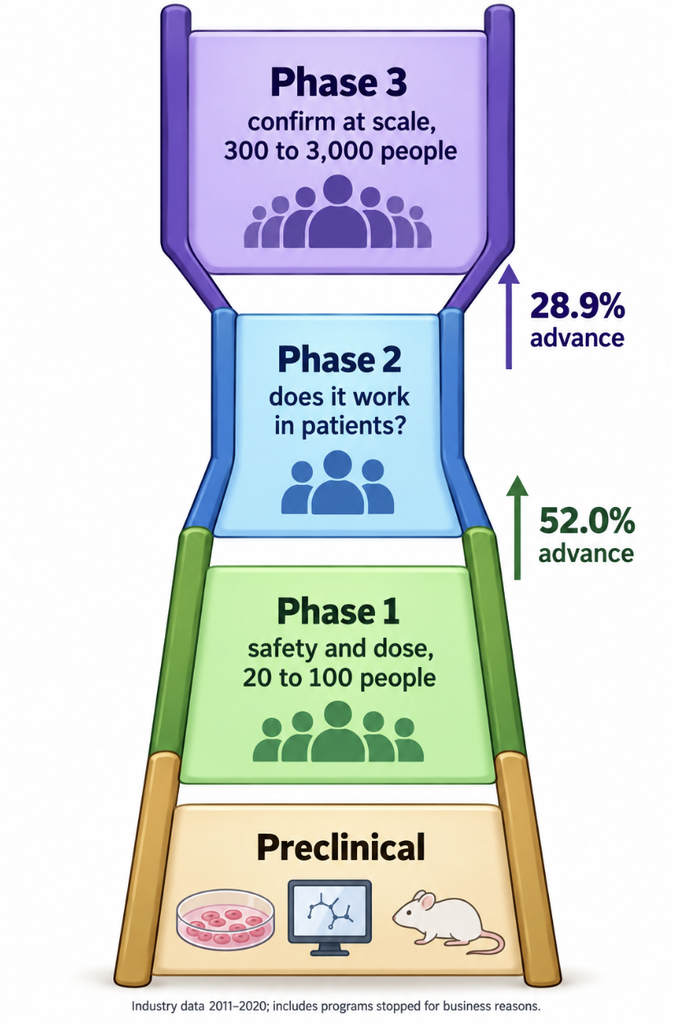
Before anyone receives a candidate drug, it goes through preclinical work: cell experiments, computer models, and animal studies of toxicity. Phase 1 then asks whether the drug is safe in people and at what dose, usually in 20 to 100 participants who are often healthy volunteers. Phase 2 asks whether it shows signs of working in patients with the target disease, typically in up to several hundred people. Phase 3 checks whether the benefit holds at scale, in 300 to 3,000 participants, against placebo or an existing treatment [FDA, Step 3: Clinical Research, 2018]. Each rung answers a different question about the human body.
The ladder exists for a reason, and it is written into federal regulation. 21 CFR 314.126 states that adequate and well-controlled studies are the primary basis for judging whether a new drug works, and that uncontrolled studies cannot serve as the sole basis for approval [FDA, 21 CFR 314.126, 2026]. FDA’s own plain-language definition says clinical research means studies done in people [FDA, Step 3: Clinical Research, 2018]. The current rules have no provision for a model’s prediction to stand in for that evidence.
Most drugs fail somewhere on this ladder. In an industry analysis of 9,704 development programs, about half of drugs cleared phase 1 (52.0%). By the same measure, fewer than one in three cleared phase 2 (28.9%), the first stage designed to test whether a drug actually helps [Thomas, Clinical Development Success Rates 2011–2020, 2021]. The average trip from phase 1 to approval took 10.5 years, about a decade. Phase 2 is where biology stops being a forecast and becomes a measurement.
“AI” is not one thing
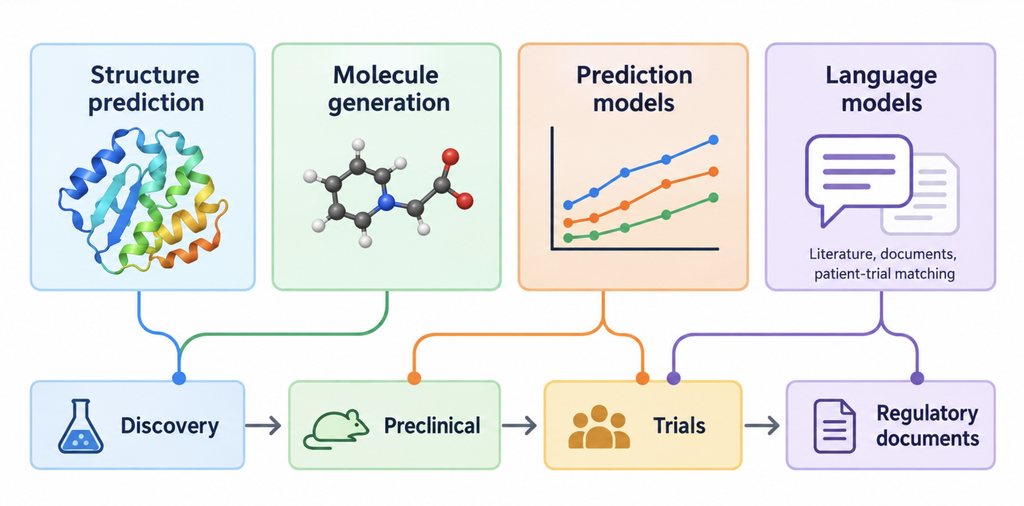
Part of the confusion comes from the word itself. The AI most people know, such as ChatGPT, Claude, or Gemini, consists of large language models: systems trained on text to predict and generate language. In drug development, most of the heavy lifting is done by other tools. Structure predictors infer a protein’s three-dimensional shape, generative models propose new molecules, and prediction models are trained on laboratory or patient data. Calling all of them “AI” is like calling an MRI scanner and a dictation app “hospital software.”
The best-known example is AlphaFold. Before it, experiments had solved the structures of about 100,000 unique proteins, a sliver of the billions of known protein sequences. The 2021 AlphaFold paper reported predictions competitive with experimental structures in a majority of test cases [Jumper, AlphaFold Structure Prediction, 2021], and the work shared the 2024 Nobel Prize in Chemistry [Lindau Nobel Laureate Meetings, Nobel Prize in Chemistry 2024, 2024]. Chatbots and some protein tools are actually related. Protein language models use the same family of architecture, applied to amino-acid sequences instead of words. One such model, scaled to 15 billion parameters, learned enough about protein shape to predict structures for more than 617 million sequences [Lin, Evolutionary-Scale Protein Structure Prediction, 2023].
General chatbots are useful too, mostly for work that runs on language: reviewing literature, drafting documents, and matching patients to trials. In one study, a language-model system judged trial eligibility criteria correctly 87.3% of the time, nearly nine in ten, and in a small user study it cut screening time by 42.6%, roughly two-fifths [Jin, Matching Patients to Clinical Trials with LLMs, 2024]. The evidence is early, since it comes from 183 synthetic patients rather than real enrollment. More to the point, none of these tools measures what a drug does to a person. Knowing a protein’s shape tells you nothing yet about whether a drug aimed at it will help anyone.
What AbCellera actually does
AbCellera is often called an “AI drug company,” which is a loose description. Its engine combines microfluidic hardware, genetic sequencing, and machine learning, all pointed at one job: finding the right antibody among millions of immune cells. The COVID-19 antibody bamlanivimab, developed with Eli Lilly, shows how this works. Researchers screened 5.8 million blood cells from a recovered patient in microfluidic chips with vast numbers of tiny chambers. Machine-vision and machine-learning pipelines flagged more than 4,500 hits, sequencing yielded 440 unique antibodies, 175 were cloned, 24 formed a lead panel, and 1 was selected [Jones, LY-CoV555 Neutralizing Antibody, 2021]. That is a single antibody out of 5.8 million cells.
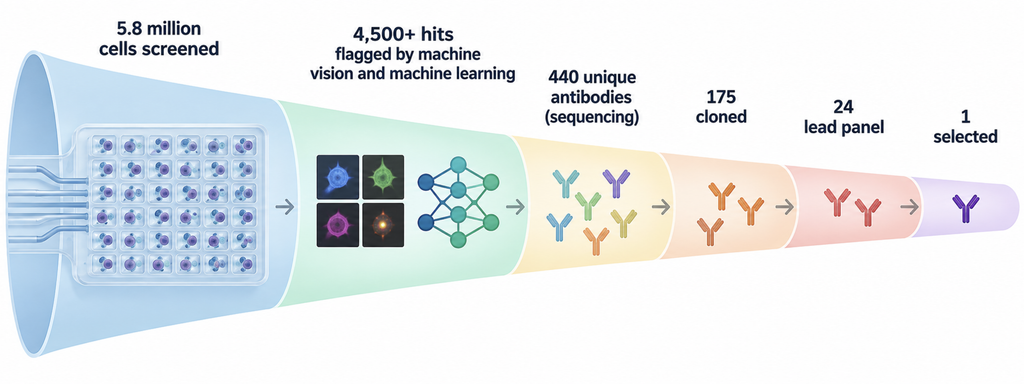
What the platform bought was speed in discovery. The antibody reached its first human recipients 90 days after screening began, about three months [Jones, LY-CoV555 Neutralizing Antibody, 2021], and received emergency use authorization in November 2020 [FDA, Bamlanivimab EUA Revocation, 2021]. The testing steps were all still there. The antibody was tested for drug levels and protection in monkeys, and then in human trials. The time saved came from finding the candidate faster.
Then the virus changed. Between January and March 2021, resistant variants rose from about 5% to about 20% of viruses sequenced in the U.S., from one in twenty to one in five, and FDA revoked the single-antibody authorization in April 2021 [FDA, Bamlanivimab EUA Revocation, 2021]. A fast discovery platform had no way to account for mutations that had not happened yet.
AbCellera’s in-house drugs follow the same path. ABCL635, an antibody for menopausal hot flashes that came from the company’s platform for hard-to-target receptors, entered the clinic in July 2025 through a conventional randomized, placebo-controlled phase 1 trial in healthy volunteers [AbCellera, Q1 2026 Results and Interim Phase 1 Data, 2026].
Its phase 2 enrolled 92 women given a single 600 mg dose or placebo. In company-reported, four-week topline results announced in August 2026 and not yet peer reviewed, the frequency of moderate-to-severe hot flashes fell by 83% versus 33% on placebo, more than four-fifths versus about a third [AbCellera, ABCL635 Phase 2 Top-Line Results, 2026]. A drug found with a smarter net still has to swim in the same water.
The replacement is happening in animal studies
The most concrete “replacement” news concerns the preclinical rung. On April 10, 2025, FDA announced a plan to reduce, refine, or potentially replace animal testing for monoclonal antibodies and other drugs, using so-called new approach methodologies (NAMs). These include AI-based computational models of toxicity, human cell lines, and organoids, which are miniature organ tissues grown in the lab [FDA, Plan to Phase Out Animal Testing, 2025]. The stated goals were safer evaluation, faster development, and fewer animals.
There is precedent. A type 1 diabetes simulator built from 300 virtual patients based on real data was accepted by FDA as a substitute for animal trials in preclinical testing of insulin-dosing algorithms for the artificial pancreas [Kovatchev, In Silico Preclinical Trials, 2009]. Policy has moved since the 2025 announcement. The agency’s first-year report credited the program with dropping the requirement for six-month primate studies in monoclonal antibody development, and FDA issued draft guidance on using NAMs in March 2026 [Craven, FDA Animal Testing Plan at 1 Year, 2026].
Regulators have also started writing rules for AI itself. A January 2025 draft guidance ties the credibility a model must demonstrate to its specific context of use [FDA, AI Regulatory Decision-Making Draft Guidance, 2025], and in January 2026 FDA and the European Medicines Agency (EMA) published 10 shared principles for good AI practice [FDA, Guiding Principles of Good AI Practice, 2026].
The approach has limits. An animal-research industry group argued at the time that no full replacement for animal models yet exists [Reuters, FDA to Phase Out Animal Testing, 2025]. Even supportive experts, writing a year later, concede that validated alternatives are still scarce for reproductive toxicity and long-term cancer risk [Craven, FDA Animal Testing Plan at 1 Year, 2026]. For this debate, the bigger point is that the whole initiative concerns what happens before the first human dose. A better simulator can shorten ground school, but the pilot’s license is still earned in the air.
Inside AI clinical trials: digital twins shrink the control arm
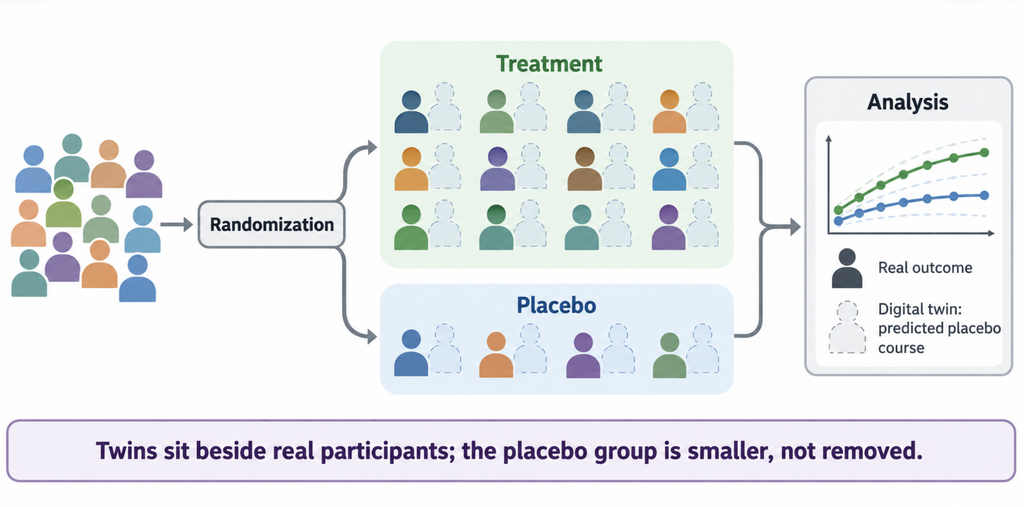
Within human trials, one AI idea has already passed formal regulatory review: the “digital twin.” A model trained on historical trial and observational data predicts how each enrolled participant’s disease would likely progress on placebo. That prediction then goes into the statistical analysis of an ordinary randomized trial as a single adjustment factor. EMA qualified this approach, known as PROCOVA, in September 2022 for phase 2 and 3 trials with continuous outcomes. It concluded that the method can raise statistical power or precision while keeping the risk of false-positive results controlled in sufficiently large trials [EMA, PROCOVA Qualification Opinion, 2022].
Think of a school evaluating a tutoring program. If past grades predict reasonably well how each student would score without tutoring, the school needs fewer untutored students to see what the program does. Independent academic work reaches a compatible conclusion: well-built progression models can reduce the number of controls needed while keeping the estimate statistically valid [Poulet, Prediction-Powered Inference for Clinical Trials, 2025]. The developer of PROCOVA reports cuts to the control group of up to about 33% to 35%, about a third. Those figures are company-reported [Unlearn, TwinRCT and PROCOVA Materials, 2022], and the gain in any given trial depends on how well the model predicts that particular disease [EMA, PROCOVA Qualification Opinion, 2022].
In practice, the twins are added to a trial of real patients. Randomization still happens and a real placebo group still exists. EMA also explicitly left the model-building step outside its endorsement, with warnings about overfitting and about historical data that may not match a future trial’s patients. Even the company’s own leadership, in a sponsored interview, describes a fully virtual control group as a long-term possibility rather than current practice [Fierce Biotech, Unlearn Scientific Intelligence Layer, 2026].
Fully external control groups, built from registries or old trials without randomization, face a higher bar, and FDA’s February 2023 draft guidance on such designs spends much of its length on the bias they can introduce [FDA, Externally Controlled Trials Draft Guidance, 2023]. The twin narrows the placebo arm; it does not abolish it.
| Stage | Question asked | What AI does today | Human data still required? |
|---|---|---|---|
| Discovery | Which target and which molecule? | Structure prediction, molecule generation, single-cell screening | Not efficacy data, though some platforms start from human samples such as patient blood cells |
| Preclinical | Safe enough to try in people? | Toxicity models alongside organoids; reduces some animal studies | Indirectly, through human cells and prior human data |
| Phase 1 | Safe, and at what dose? | Document drafting and other language tasks | Yes |
| Phase 2 | Does it work in patients? | Patient-to-trial matching; digital-twin analysis | Yes |
| Phase 3 | Does the benefit hold at scale? | Digital-twin analysis to trim control groups | Yes |
| Approval | Is the evidence substantial? | Regulators judge AI credibility by context of use (draft guidance) | Yes, from well-controlled human studies |
The scorecard: do AI-picked drugs succeed more often?
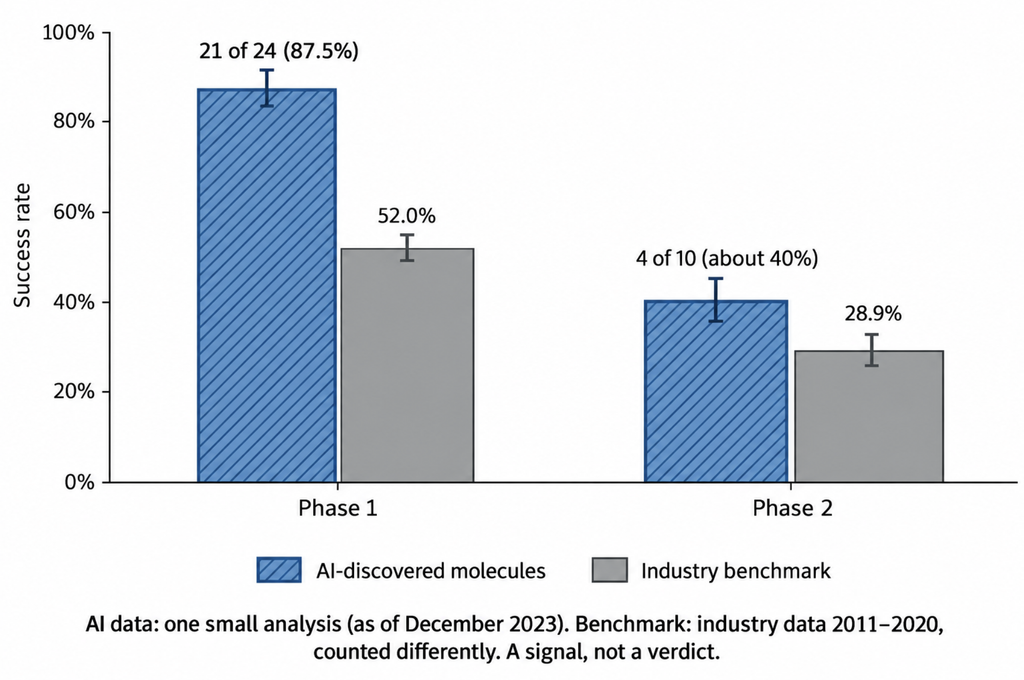
The track record is the best check on the hype. A first analysis by consultants at Boston Consulting Group followed molecules from AI-native biotech companies. As of December 2023, 21 of the 24 that had completed phase 1 were judged successful, roughly seven in eight, reported as 80% to 90%. In phase 2, 4 of 10 succeeded, about 40%, or four in ten, a rate the authors judged comparable to historical averages [Jayatunga, AI-Discovered Drugs in Clinical Trials, 2024].
Against industry benchmarks of about half passing phase 1 (52.0%) and fewer than one in three passing phase 2 (28.9%) [Thomas, Clinical Development Success Rates 2011–2020, 2021], the pattern is suggestive. The authors read it as a sign that AI is good at producing molecules that behave like drugs in the body. It is still far from conclusive. The AI samples are tiny: with only ten molecules, a single result moves the phase 2 rate by a full tenth.
The two sources also count “success” differently, since the benchmark includes programs abandoned for commercial reasons. And the two phases measure different things. Phase 1 mostly checks whether a molecule behaves like a drug, while phase 2 checks whether it treats a disease.
The most advanced test case is rentosertib, from Insilico Medicine. Its developers report that AI identified both the target, a protein called TNIK, and the molecule, going from target discovery to a preclinical candidate in about 18 months [Ren, TNIK Inhibitor Preclinical and Clinical Models, 2024].
After that the drug took the ordinary route: a phase 1 trial in 78 healthy volunteers, then a randomized phase 2a in 71 patients with idiopathic pulmonary fibrosis over 12 weeks. On a secondary measure, forced vital capacity at the highest dose rose by 98.4 mL versus a 20.3 mL decline on placebo, about a tenth of a liter of lung capacity gained versus a slight loss [Xu, Rentosertib Phase 2a Trial, 2025]. The trial’s primary aim was safety, and some patients stopped treatment because of liver toxicity or diarrhea.
That small, 12-week signal now has to hold up over a year: the first patient in a 52-week phase 3 was dosed in September 2026 [Insilico Medicine, GENESIS-IPF-3 First Patient Dosed, 2026]. The developer calls it the first drug with both an AI-found target and an AI-generated molecule to reach this stage. That claim exposes a definitional problem, because what counts as “AI-discovered” varies from company to company. Whether AI improves the odds at phase 2, where they are worst, is still unknown, and only trials in people can settle it.
Key Takeaways
- Every phase of clinical development is still required. AI is changing the work done before and around those phases.
- FDA’s 2025 “replacement” plan targets animal studies in preclinical safety testing, not trials in people.
- Most AI in drug discovery is specialized, such as structure predictors and molecule generators, rather than general-purpose chatbots.
- AbCellera’s platform took a COVID-19 antibody from the start of screening to first human dosing in about three months. The drug still went through animal and human testing, and viral variants later made it ineffective.
- Digital twins can trim placebo groups inside randomized trials. Real participants are still enrolled and randomized.
- Early, small-sample data suggest AI-found molecules clear phase 1 more often. There is no proof yet that they treat disease more often.
FAQ
Can AI replace phase 2 and phase 3 clinical trials?
No. U.S. rules make adequate and well-controlled studies in people the primary basis for showing that a new drug works, and uncontrolled evidence cannot serve as the sole basis [FDA, 21 CFR 314.126, 2026]. AI can help design and analyze those trials, for example by predicting placebo outcomes so that control groups can be smaller, but the comparison itself still needs human participants.
Did FDA approve using AI instead of animal testing?
Partly. In April 2025, FDA announced a plan to reduce, refine, or potentially replace animal testing for monoclonal antibodies and other drugs, using AI-based toxicity models alongside human cell and organoid tests [FDA, Plan to Phase Out Animal Testing, 2025]. The change is being phased in through pilots and guidance, and some safety questions still depend on animals.
Does ChatGPT discover new drugs?
Mostly no. The core discovery tools are specialized models such as AlphaFold, which predicts protein structures [Jumper, AlphaFold Structure Prediction, 2021]. General language models help with literature review, documents, and trial matching. In one study using synthetic patients, a system of this kind judged eligibility criteria correctly 87.3% of the time [Jin, Matching Patients to Clinical Trials with LLMs, 2024].
Is any AI-discovered drug approved yet?
Not clearly. The most advanced candidate that its developer describes as AI-discovered from target to molecule, rentosertib, only began phase 3 in September 2026 [Insilico Medicine, GENESIS-IPF-3 First Patient Dosed, 2026]. Definitions of “AI-discovered” vary, so claims about firsts should be read carefully.
References
- Thomas D, Chancellor D, Micklus A, LaFever S, Hay M, Chaudhuri S, Bowden R, Lo AW. Clinical Development Success Rates and Contributing Factors 2011–2020. Biotechnology Innovation Organization, Informa Pharma Intelligence, QLS Advisors; 2021. https://www.bio.org/clinical-development-success-rates-and-contributing-factors-2011-2020
- FDA. Step 3: Clinical Research. U.S. Food and Drug Administration. Updated 2018. https://www.fda.gov/patients/drug-development-process/step-3-clinical-research
- FDA. 21 CFR §314.126 Adequate and well-controlled studies. Code of Federal Regulations. Accessed October 2026.
- Jumper J, Evans R, Pritzel A, et al. Highly accurate protein structure prediction with AlphaFold. Nature. 2021;596(7873):583-589.
- Lindau Nobel Laureate Meetings. Nobel Prize in Chemistry 2024. Published October 9, 2024.
- Lin Z, Akin H, Rao R, et al. Evolutionary-scale prediction of atomic-level protein structure with a language model. Science. 2023;379(6637):1123-1130.
- Jin Q, Wang Z, Floudas CS, et al. Matching patients to clinical trials with large language models. Nat Commun. 2024;15(1):9074.
- Jones BE, Brown-Augsburger PL, Corbett KS, et al. The neutralizing antibody, LY-CoV555, protects against SARS-CoV-2 infection in nonhuman primates. Sci Transl Med. 2021;13(593):eabf1906.
- FDA. Coronavirus (COVID-19) Update: FDA Revokes Emergency Use Authorization for Monoclonal Antibody Bamlanivimab. April 16, 2021.
- AbCellera. AbCellera Reports Q1 2026 Business Results and Announces Positive Interim Phase 1 Clinical Data for ABCL635. May 11, 2026.
- AbCellera. AbCellera Announces Positive Top-Line Phase 2 Clinical Trial Results for ABCL635. August 10, 2026. https://www.sec.gov/Archives/edgar/data/1703057/000170305726000053/a2026-08x10abcl635phase2.htm
- FDA. FDA Announces Plan to Phase Out Animal Testing Requirement for Monoclonal Antibodies and Other Drugs. April 10, 2025. https://www.fda.gov/news-events/press-announcements/fda-announces-plan-phase-out-animal-testing-requirement-monoclonal-antibodies-and-other-drugs
- Kovatchev BP, Breton M, Dalla Man C, Cobelli C. In silico preclinical trials: a proof of concept in closed-loop control of type 1 diabetes. J Diabetes Sci Technol. 2009;3(1):44-55.
- Craven J. Experts say FDA’s plan to reduce animal testing is already seeing success at 1 year, but challenges remain. Regulatory Focus (RAPS). June 25, 2026. https://www.raps.org/resource/experts-say-fda-s-plan-to-reduce-animal-testing-is-already-seeing-success-at-1-year-but-challenges-remain.html
- FDA. Considerations for the Use of Artificial Intelligence To Support Regulatory Decision-Making for Drug and Biological Products. Draft guidance. January 2025.
- FDA, European Medicines Agency. Guiding Principles of Good AI Practice in Drug Development. January 2026.
- EMA, Committee for Medicinal Products for Human Use. Qualification opinion for Prognostic Covariate Adjustment (PROCOVA). September 20, 2022. https://www.ema.europa.eu/documents/regulatory-procedural-guideline/qualification-opinion-prognostic-covariate-adjustment-procovatm_en.pdf
- Poulet PE, Tran M, Tezenas du Montcel S, Dubois B, Durrleman S, Jedynak B. Prediction-powered inference for clinical trials: application to linear covariate adjustment. BMC Med Res Methodol. 2025;25(1):204.
- Unlearn. Company materials on TwinRCT and PROCOVA (Company, 2022).
- Fierce Biotech. How Unlearn is building a scientific intelligence layer for clinical development. Sponsored content. 2026.
- FDA. Considerations for the Design and Conduct of Externally Controlled Trials for Drug and Biological Products. Draft guidance. February 2023.
- Jayatunga MKP, Ayers M, Bruens L, Jayanth D, Meier C. How successful are AI-discovered drugs in clinical trials? A first analysis and emerging lessons. Drug Discov Today. 2024;29(6):104009.
- Ren F, Aliper A, Chen J, et al. A small-molecule TNIK inhibitor targets fibrosis in preclinical and clinical models. Nat Biotechnol. 2025;43(1):63-75. Published online March 8, 2024.
- Xu Z, Ren F, Wang P, et al. A generative AI-discovered TNIK inhibitor for idiopathic pulmonary fibrosis: a randomized phase 2a trial. Nat Med. 2025;31(8):2602-2610.
- Insilico Medicine. Insilico Medicine Doses First Patient in GENESIS-IPF-3, the World’s First Phase III Trial of a Generative AI-Driven Innovative Drug. September 10, 2026.
- Reuters. FDA to phase out animal testing in drug development. April 2025.
Joonpyo Hong, MD is a board-certified otolaryngologist practicing in Korea. This article reflects his clinical interpretation of published research and does not constitute individual medical advice. This article is not intended to advertise or promote any specific company or product.
For more articles:
https://curiousmd.com/ai-clinical-decision-support-global-health-gap/
https://curiousmd.com/biotech-rd-productivity/
https://curiousmd.com/monthly-injection-for-hot-flashes-abcl635/
Link out to:
U.S. FDA, plan to reduce animal testing with new approach methodologies: https://www.fda.gov/news-events/press-announcements/fda-announces-plan-phase-out-animal-testing-requirement-monoclonal-antibodies-and-other-drugs
U.S. FDA, plain-language guide to clinical trial phases: https://www.fda.gov/patients/drug-development-process/step-3-clinical-research
European Medicines Agency, qualification opinion on prognostic covariate adjustment: https://www.ema.europa.eu/documents/regulatory-procedural-guideline/qualification-opinion-prognostic-covariate-adjustment-procovatm_en.pdf
BIO, clinical development success rates 2011–2020: https://www.bio.org/clinical-development-success-rates-and-contributing-factors-2011-2020
RAPS Regulatory Focus, one-year assessment of the FDA animal-testing roadmap: https://www.raps.org/resource/experts-say-fda-s-plan-to-reduce-animal-testing-is-already-seeing-success-at-1-year-but-challenges-remain.html