
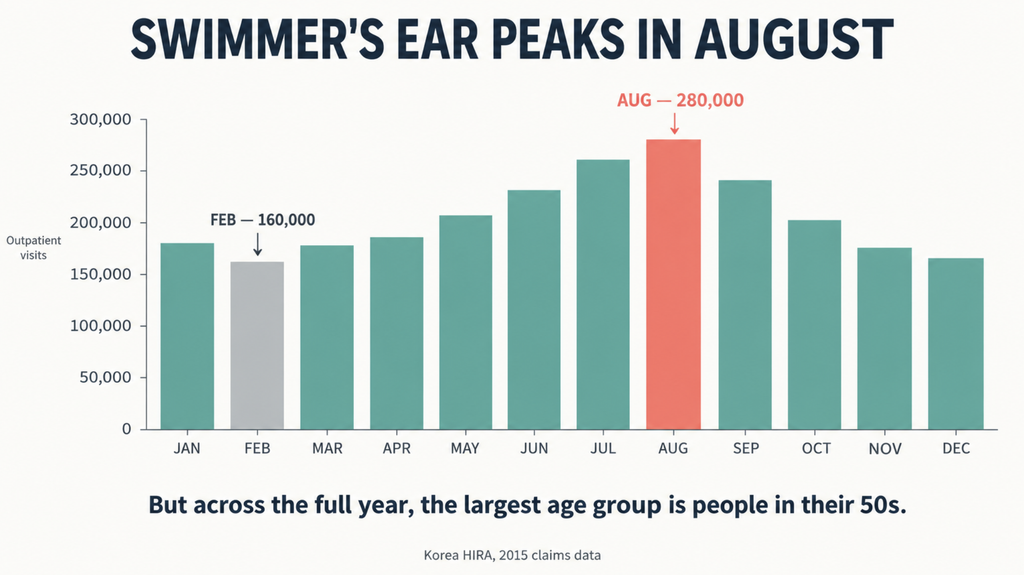
In Korea, roughly 1.58 million people a year are treated for otitis externa, the diagnosis that most often gets attached to a painful or itchy ear canal. The busiest month was August, with about 280,000 patients, 1.8 times the February low. That fits the disease’s nickname, swimmer’s ear.
The age breakdown fits it much less well. People in their fifties made up the largest share at 16.1%, and children under ten the smallest at 9.3% [Health Insurance Review and Assessment Service, Otitis Externa Treatment Statistics, 2016]. The gaps between age bands were small, which means the diagnosis was spread almost evenly across the population.
US data shows the same shape. Visit rates peak in children aged 5 to 14, but 53% of all outpatient visits for acute otitis externa occur in adults aged 20 and over [Centers for Disease Control and Prevention, Estimated Burden of Acute Otitis Externa, 2011].
Swimming does not explain a disease distributed that evenly, so something else is being counted under the same name. What follows covers how otitis externa is diagnosed, what causes it, and how it is treated, along with the case that fits none of it: an ear that itches while the canal looks fine.
How doctors actually diagnose otitis externa
Diagnosis rests on what a clinician sees in the canal, not on the symptoms a patient reports.
The clinical practice guideline from the American Academy of Otolaryngology-Head and Neck Surgery defines acute otitis externa as diffuse inflammation of the external ear canal, and it asks clinicians to distinguish it from other causes of ear pain, discharge, and canal inflammation before treating [Rosenfeld, Clinical Practice Guideline: Acute Otitis Externa, 2014]. Three elements have to line up: rapid onset, symptoms of canal inflammation, and visible signs of it. The third is the part that gets skipped.
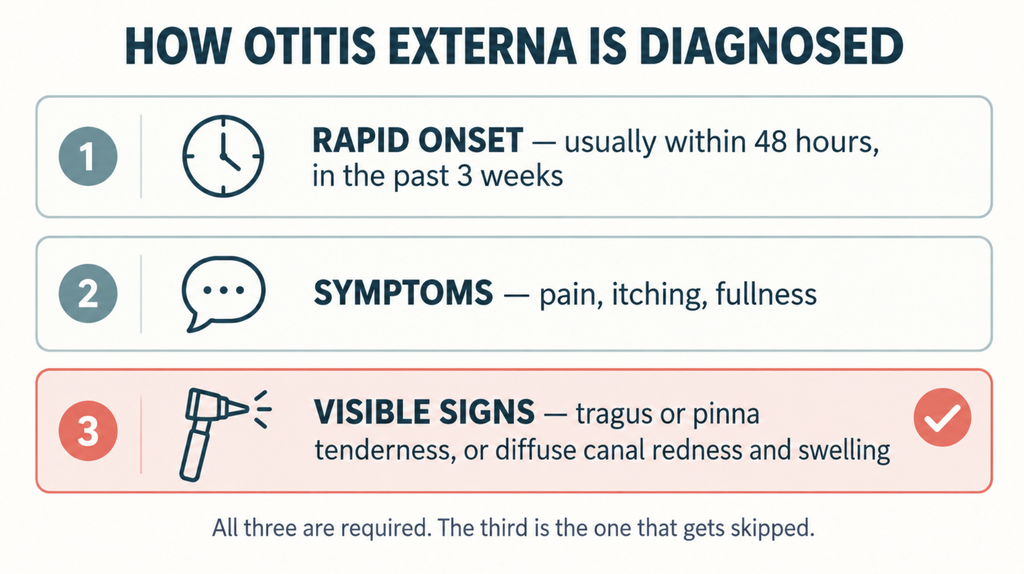
Through the otoscope or microscope, a clinician looks for redness and swelling of the canal skin, debris or discharge, and whether the eardrum is visible at all. One maneuver carries unusual weight: pressing the tragus or pulling the pinna, which hurts in diffuse otitis externa but usually not in a middle ear infection.
Swab cultures are not part of the guideline’s initial workup. They become useful when treatment fails, when episodes keep returning, or when the patient is immunocompromised. For a first, uncomplicated episode, the examination is all that is needed.
The guideline also asks clinicians to check for factors that change management, including a perforated eardrum, a tympanostomy tube, diabetes, immunocompromise, and prior radiotherapy. Anyone who has not responded within 48 to 72 hours should be reassessed, explicitly in order to confirm the diagnosis and exclude other causes [Rosenfeld, Clinical Practice Guideline: Acute Otitis Externa, 2014]. A guideline that builds in a formal diagnostic recheck suggests the first pass misses often enough to matter.
What it feels like, and why two patients describe it differently
| Symptom | How it typically presents | What it may point toward |
|---|---|---|
| Pain | Worse when chewing, or when the ear is touched or pulled | Acute bacterial inflammation |
| Itching | Persistent, often worse at night, little or no pain | Eczematous or dry-skin process |
| Fullness | Blocked or plugged sensation | Swelling, debris, or fungal growth |
| Discharge | Variable color and consistency | Active infection |
| Muffled hearing | Usually temporary | Canal obstruction |
The Korean health authority’s own description separates two patterns filed under one billing code: an inflammatory type that follows water entry or a scratch and brings pain, and an eczematous type that presents with itching and a sense of fullness [Health Insurance Review and Assessment Service, Otitis Externa Treatment Statistics, 2016]. Both are billed under the same diagnosis, but they are not the same condition.
Some findings need same-day attention rather than watchful waiting: severe pain in someone elderly or diabetic, redness and swelling spreading beyond the ear onto the face or neck, facial weakness, or fever.
What causes it
The organisms are broadly consistent across countries. In a UK rapid-access ear clinic, 315 organisms were isolated from 302 swabs: Pseudomonas aeruginosa was most common at 31.1%, followed by Candida species at 22.9% and Staphylococcus aureus at 11.7% [Heward, Microbiology and Antimicrobial Susceptibility of Otitis Externa, 2018]. In Queensland, Australia, P. aeruginosa accounted for 37.9%, but inland, away from the coast, S. aureus was the most prevalent organism [Wijesekera, Otitis Externa Microbiota in Queensland, 2024].
Two caveats. The UK figures come from a specialist referral setting rather than primary care, which may explain the high Candida share. And the Australian coastal versus inland split suggests that what grows in an ear canal depends partly on where that ear lives.
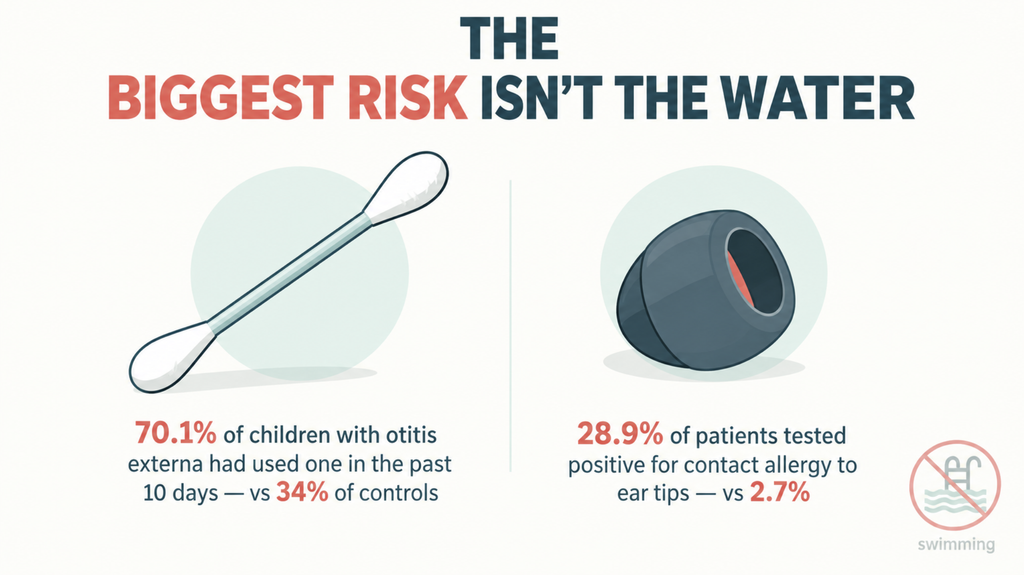
The risk factors are worth reordering, because the usual ranking puts water first. In a prospective case-control study of children, 70.1% of those diagnosed with otitis externa had cleaned their ears with a cotton-tip applicator in the preceding ten days, compared with 34% of age-matched controls (P<0.001) [Nussinovitch, Cotton-Tip Applicators as a Leading Cause of Otitis Externa, 2004]. Swimming in a pool was reported by 34% of the children with otitis externa, but the study reported no control comparison for swimming, so the cotton swab finding is the one carrying statistical weight, not a head-to-head ranking against water.
A case-control study of fungal ear infection points the same way. Among 160 patients with otomycosis and 320 controls, habitual ear picking was independently associated with disease (OR 2.75, 95% CI 1.67 to 4.53), as was a narrow ear canal (OR 3.74, 95% CI 2.38 to 5.86). Swimming, earphone use, and diabetes showed no significant association [Liu, Clinical Features and Risk Factors of Otomycosis, 2026]. This was a single-center study, so the exact odds ratios should not be read as precise. What carries across both studies is that cleaning or picking at the canal is associated with disease more consistently than water exposure is.
Earphones deserve a more precise accusation than the usual one, which is that they ferry bacteria into the canal. A case-control patch-test study points elsewhere: among 38 patients with otitis externa and 37 volunteers, contact allergy to earphone or earplug tips was found in 28.9% versus 2.7% (P=.002) [Jin, Otitis Externa Due to Allergic Contact Dermatitis to Earphones and Earplugs, 2025]. The sample was small and this was a research letter, so read it as suggestive. Even so, allergy and friction under an occlusive tip explain the finding better than contamination does.
Treatment: what you can do, and what a clinic adds
On your own
Keep the canal dry. Tilt your head after showering and let gravity work. Stop using cotton swabs, ear picks, and earphones until symptoms resolve. Don’t try to “disinfect” a sore or itchy canal with alcohol or hydrogen peroxide. Drying agents are often suggested for preventing swimmer’s ear on healthy skin, though trials supporting them are lacking. On skin that is already inflamed or dry, they strip the barrier further. Use an over-the-counter analgesic for pain. The guideline treats pain control as a strong recommendation in its own right, not an afterthought [Rosenfeld, Clinical Practice Guideline: Acute Otitis Externa, 2014]. Don’t reach for leftover drops from a previous episode, and don’t irrigate the ear yourself.
What a clinic adds
Aural toilet, meaning suctioning debris out under magnification so medication can reach the skin. The guideline ties treatment success directly to getting drops where they need to go. Topical drops as first-line therapy for uncomplicated cases. A wick, when the canal is too swollen for drops to enter. A non-ototoxic preparation if the eardrum is perforated or a tube is in place. A recheck at 48 to 72 hours if nothing has improved.
The systemic antibiotic numbers are the hardest part to square with that. Across 907,261 initial US outpatient visits for acute otitis externa, with complicating conditions already excluded, 32.1% of 2010 visits ended in a systemic antimicrobial prescription, down only modestly from 36.5% in 2004. Emergency departments prescribed them at 47.1% of visits, otolaryngologists at 25.9%, pediatricians at 20.4%.
The choice of drug matters more than the rate. Penicillins made up 42.3% of those systemic prescriptions [Collier, Antimicrobial and Analgesic Prescribing Patterns for Acute Otitis Externa, 2013], and penicillins do not reliably cover Pseudomonas.
That gap is better read as a system-level finding than as a verdict on individual clinicians. Prescribing happens under real constraints, including diagnostic uncertainty at first contact, a patient who may not come back, and a setting with no guaranteed follow-up, and the highest rates in the data appear exactly where those constraints press hardest. For a patient, the practical implication is narrow: an oral antibiotic is not the expected first treatment for uncomplicated otitis externa, and it is reasonable to ask what indication prompted one.
When the itchy ear canal looks normal
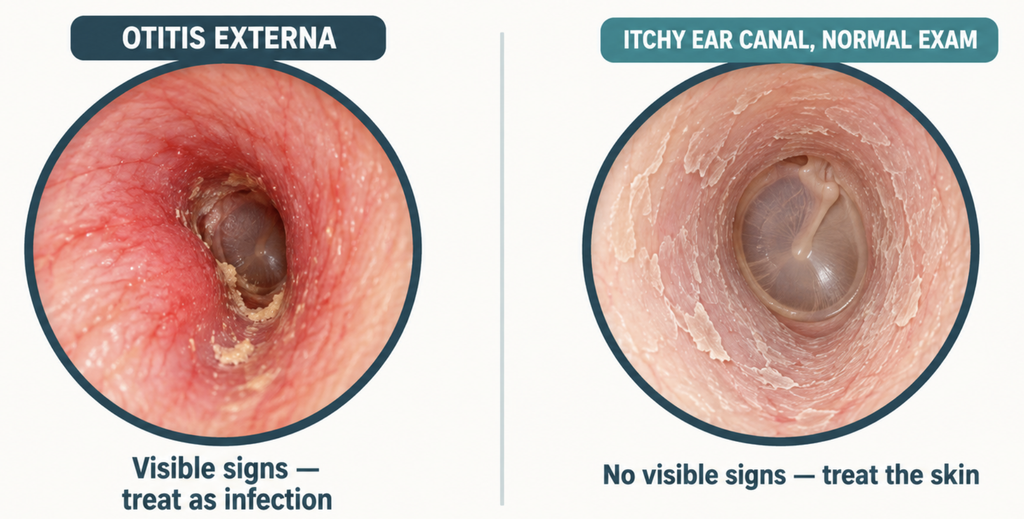
Consider a patient who describes weeks of itching, with an otoscope showing a canal that is pale, dry, perhaps faintly pink. There is no swelling, no discharge, and no tragal tenderness, so nothing meets the guideline definition.
This presentation has its own name. Pruritic external auditory canal, sometimes called itchy ear syndrome, describes isolated itching in the canal without underlying local or systemic disease. It is recognized as relatively common, clusters in older patients, and its mechanism remains unclear [Lee, Topical Calcineurin Inhibitor and Moisturizing Cream on Pruritic External Auditory Canal, 2021].
That name rarely reaches the chart; “otitis externa” usually goes in instead. The reasons are structural rather than sinister. A billable code has to be entered, visits are short, patients want a name and a prescription, and the topical steroid preparations commonly used for itchy ears tend to help either way [Lee, Topical Calcineurin Inhibitor and Moisturizing Cream on Pruritic External Auditory Canal, 2021], which makes the label look retrospectively correct.
The mislabel has a cost. A label that says infection invites treatment for infection, while the likelier driver, whether a dry skin barrier, contact dermatitis, or atopic skin, goes unaddressed and the itch returns.
One low-risk alternative is worth knowing about. In 39 patients with pruritic external auditory canal, a topical calcineurin inhibitor and a plain moisturizing cream were compared over two weeks. The calcineurin inhibitor worked faster (P=0.0021 at two weeks), but by two months the groups were indistinguishable on both reported itch and visible redness [Lee, Topical Calcineurin Inhibitor and Moisturizing Cream on Pruritic External Auditory Canal, 2021]. This was a small single-center study and it does not establish moisturizer as standard care. It does suggest that restoring the skin barrier deserves consideration before reaching for a drug.
None of this means acute otitis externa is imaginary. The August surge in Korean clinics is real, those patients are in genuine pain, and topical treatment works. The narrower claim is that two different conditions are recorded under one name, and only one of them answers to antibiotics.
Clinical Perspective
Given what AI now does with medical images, the obvious question is whether an algorithm could sort this out.
Deep learning models trained on otoscopic images perform well until they meet images from a hospital they were not trained on. Across 1,842 otoscopic images from three countries, algorithms distinguishing normal from abnormal ears reached a mean AUC of 0.95 internally but 0.76 on external images, a drop of 0.19 (P≤0.04) [Habib, Evaluating the Generalizability of Deep Learning Image Classification Algorithms, 2023]. That study treated middle ear disease as a binary task rather than classifying otitis externa, so it says nothing direct about ear canals.
The limitation that matters here is not resolution or training data. An image classifier can see redness but not itch. A patient whose canal looks unremarkable and feels unbearable produces a photograph that any model will correctly call normal. The problem with this diagnosis was never that no one looked carefully enough.
Key Takeaways
Acute otitis externa is defined by visible signs of canal inflammation plus tenderness on moving the tragus or pinna, not by symptoms alone.
In a case-control study of children, 70.1% of those with otitis externa had used a cotton swab in the previous ten days, versus 34% of controls.
Pseudomonas aeruginosa and Staphylococcus aureus are the dominant organisms, and their relative frequency shifts with geography and clinical setting.
In 2010, 32.1% of US outpatient visits for uncomplicated acute otitis externa resulted in a systemic antibiotic prescription, and penicillins, which do not reliably cover Pseudomonas, made up 42.3% of them.
Isolated itching in a normal-looking ear canal has its own name, pruritic external auditory canal, and it is not the same condition as acute otitis externa.
FAQ
Can you have otitis externa if your ear looks normal? Not by the standard definition. Acute otitis externa requires visible inflammation of the canal along with tenderness on moving the tragus or pinna. Itching in a normal-looking canal is a different entity, pruritic external auditory canal, which points toward dry skin, contact dermatitis, or eczema rather than bacterial infection.
How do doctors tell otitis externa from a middle ear infection? Mainly by where the inflammation sits and what hurts. Otitis externa inflames the canal skin and produces pain when the tragus is pressed or the pinna pulled. Middle ear infection sits behind an intact eardrum and usually doesn’t hurt on external manipulation. The guideline asks clinicians to distinguish the two before treating.
Do I need oral antibiotics for swimmer’s ear? Usually not. The guideline makes a strong recommendation against systemic antimicrobials as initial therapy for uncomplicated cases, reserving them for infection spreading beyond the canal or for specific host factors such as diabetes or immunocompromise. Topical treatment is first-line.
Why do my ears itch every night with no infection? Persistent itch without visible inflammation usually reflects a skin problem rather than an infection: a dry or damaged canal barrier, contact dermatitis from earphone tips, or underlying eczema. It is more common in older adults, and scratching with swabs or picks makes it worse by stripping the protective lipid layer.
Is it safe to use cotton swabs if I’m careful? The evidence argues against it regardless of technique. Cotton swab use in the preceding ten days was significantly more common in children with otitis externa than in controls, and habitual ear picking was independently associated with fungal ear infection. Cerumen migrates out on its own.
References
- Rosenfeld RM, Schwartz SR, Cannon CR, et al. Clinical practice guideline: acute otitis externa. Otolaryngol Head Neck Surg. 2014;150(1 Suppl):S1-S24.
- Centers for Disease Control and Prevention (CDC). Estimated burden of acute otitis externa — United States, 2003-2007. MMWR Morb Mortal Wkly Rep. 2011;60(19):605-609.
- Nussinovitch M, Rimon A, Volovitz B, Raveh E, Prais D, Amir J. Cotton-tip applicators as a leading cause of otitis externa. Int J Pediatr Otorhinolaryngol. 2004;68(4):433-435.
- Heward E, Cullen M, Hobson J. Microbiology and antimicrobial susceptibility of otitis externa: a changing pattern of antimicrobial resistance. J Laryngol Otol. 2018;132(4):314-317.
- Wijesekera A, Chiam Xu Wen A, Walker A, Anders C. Effects of seasonal, geographical and demographic factors on otitis externa microbiota in Queensland, Australia. Aust J Gen Pract. 2024;53(11 Suppl):S27-S32.
- Collier SA, Hlavsa MC, Piercefield EW, Beach MJ. Antimicrobial and analgesic prescribing patterns for acute otitis externa, 2004-2010. Otolaryngol Head Neck Surg. 2013;148(1):128-134.
- Liu P, Ye C, Zhuang L, Zou S. Clinical features and risk factors of otomycosis: a case-control study. Ear Nose Throat J. 2026 Jan 19. Epub ahead of print.
- Jin Y, Hua W, Liu Q, et al. Otitis externa due to allergic contact dermatitis to earphones and earplugs: a case control study. JAAD Int. 2025;23:1-3.
- Lee SY, Cho S, Kim M, Lee DH, Kim YH. Comparison of therapeutic effects of topical calcineurin inhibitor and moisturizing cream on pruritic external auditory canal. J Clin Med. 2021;10(19):4313.
- Habib AR, Xu Y, Bock K, et al. Evaluating the generalizability of deep learning image classification algorithms to detect middle ear disease using otoscopy. Sci Rep. 2023;13(1):5368.
- Health Insurance Review and Assessment Service. Press release: caution for otitis externa during the holiday season. Wonju, Korea: HIRA; July 8, 2016. Analysis of 2011-2015 national claims data.
Joonpyo Hong, MD is a board-certified otolaryngologist practicing in Korea. This article reflects his clinical interpretation of published research and does not constitute individual medical advice.
For more articles:
https://curiousmd.com/otomycosis/
https://curiousmd.com/wet-earwax-vs-dry-earwax-genetics/
https://curiousmd.com/cotton-swabs-in-your-ears/
https://curiousmd.com/random-stabbing-ear-pain-few-seconds/
Link out to:
AAO-HNS Clinical Practice Guideline: Acute Otitis Externa (Update) — The guideline hub itself, including a plain-language summary and patient instruction sheets you can print.
ENT Health: Swimmer’s Ear (Otitis Externa) — The AAO-HNS Foundation’s patient-facing explainer, with a useful list of questions to ask at a visit.
Acute Otitis Externa: Rapid Evidence Review (American Family Physician) — A 2023 primary-care summary with the full diagnostic criteria table and a differential diagnosis list worth scanning if your symptoms don’t fit.
HIRA: Otitis externa treatment statistics (Korean) — The Korean national claims analysis behind the figures in this article, including the monthly and age-band breakdowns.