
Hearing loss deserves treatment. Dementia prevention is the wrong reason to buy it, and the wrong way to judge it.
The connection between hearing aids and dementia has become one of the most repeated claims in consumer health. Slogans such as “healthy hearing, healthy brain” circulate widely, and headlines report a 33% or 61% lower dementia risk among hearing-aid users. Both numbers are real, and both come from respected journals. The fine print travels less well: how those numbers were produced, and what a randomized trial found.
By one widely cited estimate, hearing loss ranks among the largest modifiable risk factors for dementia, and the benefits of treating it for hearing itself are well supported. But calling something a “modifiable risk factor” does not mean a hearing aid can prevent the disease. The observational studies consistently point one way; the only large randomized trial found no slowing of decline across the group as a whole.
The claim travels from the source studies to the headlines and, now, to earbuds that double as hearing aids. There are good reasons to treat hearing loss. Preventing dementia may one day prove to be one of them. For now it is the weakest reason, and a purchase should not rest on it.
Hearing loss is worth treating on its own terms
A 2026 update of the Cochrane review on hearing aids for mild to moderate hearing loss pooled 16 randomized trials with 2,261 participants, average ages from 58 to 83, and follow-up from 4 weeks to 3 years [Ferguson, Hearing Aids for Mild to Moderate Hearing Loss, 2026]. Hearing aids likely produce a large improvement in hearing-specific quality of life, meaning how much hearing loss gets in the way of conversation, phone calls and social life. They likely improve listening ability by a similar margin. Gains in general quality of life were smaller and less certain.
The same review found the evidence on working memory very uncertain, and hearing aids may make little to no difference to loneliness. Hearing aids reliably treat the problem they were built for. Whether they help anything downstream is a separate question.
Even so, most people with hearing loss do not wear hearing aids. In US national data from 1999–2006, only 14.2% of adults aged 50+ with measurable hearing loss wore them, about one in seven, and fewer than 4% of those with mild loss did [Chien, Prevalence of Hearing Aid Use, 2012]. More recent estimates still put use under 20–30% in high-income countries, well under a third [Lin, ACHIEVE Randomised Controlled Trial, 2023].
On hearing alone, the case for treatment is already strong.
Where the dementia promise comes from
The association itself is consistent. In the Baltimore Longitudinal Study of Aging, 639 people without dementia were followed for a median of 11.9 years. Risk rose by 27% for every 10 dB of hearing loss, and people with moderate loss had about three times the risk of those with normal hearing [Lin, Hearing Loss and Incident Dementia, 2011]. Even mild loss was linked to nearly double the risk, though that estimate is imprecise. A 2018 meta-analysis of 36 studies and about 20,264 participants found the same direction in long-term cohorts, with about 28% higher odds of dementia [Loughrey, Age-Related Hearing Loss and Dementia, 2018]. These are associations, and an association does not establish cause.
On that basis, the 2024 report of the Lancet Commission on dementia listed 14 modifiable risk factors. It estimated that nearly half (an estimated 45%) of dementia could potentially be prevented or delayed if all of them were eliminated, and it attributed 7% to hearing loss, tied for largest with high LDL cholesterol [Livingston, Lancet Commission on Dementia, 2024]. The 7% is easy to misread. It comes from a population model that assumes the link is causal, and it describes societies, not any one person’s odds.
Researchers have proposed four ways hearing loss could affect the brain, and more than one may be at work [Griffiths, How Can Hearing Loss Cause Dementia, 2020].
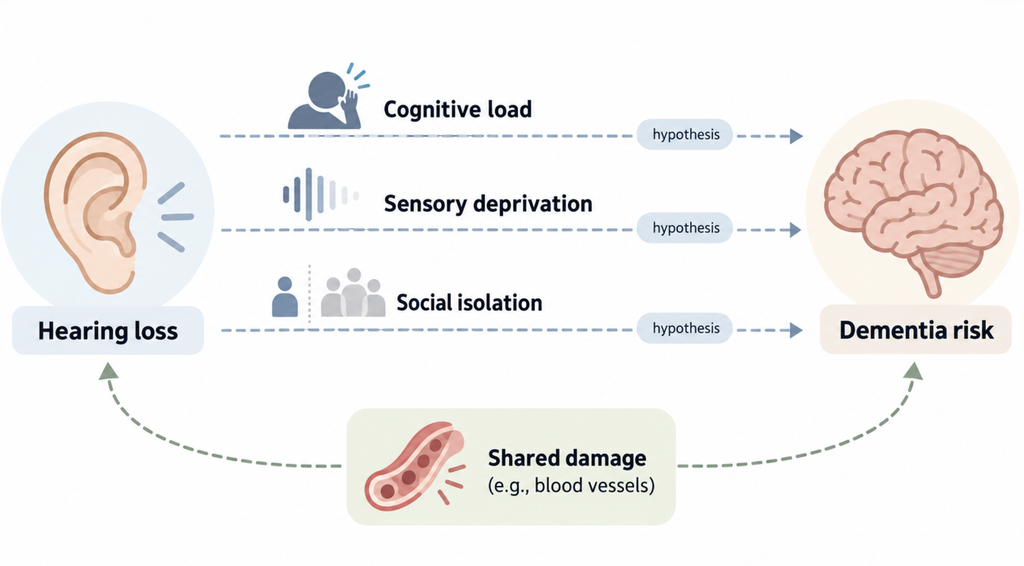
Cognitive load. Straining to hear takes mental effort; that part is well established [Pichora-Fuller, Framework for Understanding Effortful Listening, 2016]. The idea that years of strain wear down the brain’s reserves has been proposed but not proven.
Sensory deprivation. In one brain-imaging study of 126 participants followed for 6.4 years, people with hearing loss lost brain volume faster, especially in temporal regions that process sound [Lin, Hearing Impairment and Brain Volume Changes, 2014]. The finding fits the idea of an under-stimulated brain, but the study did not test whether hearing aids stop the change.
Social isolation. Hearing loss can shrink a social life, and isolation is thought to be bad for the brain. Yet in randomized trials, hearing aids made little to no difference to loneliness, though that evidence is limited [Ferguson, Hearing Aids for Mild to Moderate Hearing Loss, 2026].
A common cause. The same underlying damage, such as blood-vessel disease or a shared pathology along the auditory pathway and cortex, may quietly harm both ear and brain [Loughrey, Age-Related Hearing Loss and Dementia, 2018; Griffiths, How Can Hearing Loss Cause Dementia, 2020]. If this is the main story, a hearing aid would not touch dementia risk at all.
If the first three explanations hold, treatment could help. If the fourth dominates, it would not, and it is still unknown which one dominates. A risk factor tells researchers where to look. It does not tell them what happens when the factor is removed.
Hearing aids and dementia: what the headline studies found
The observational evidence points the same way. A 2023 meta-analysis pooled 8 long-term studies with 126,903 participants followed for 2 to 25 years and found that hearing-aid users had a 19% lower risk of cognitive decline, about one-fifth lower [Yeo, Hearing Aids, Cochlear Implants and Cognitive Decline, 2023]. Short-term studies showed a 3% improvement in test scores, a small bump. But every long-term study in that pool compared people who chose to wear hearing aids with people who did not.
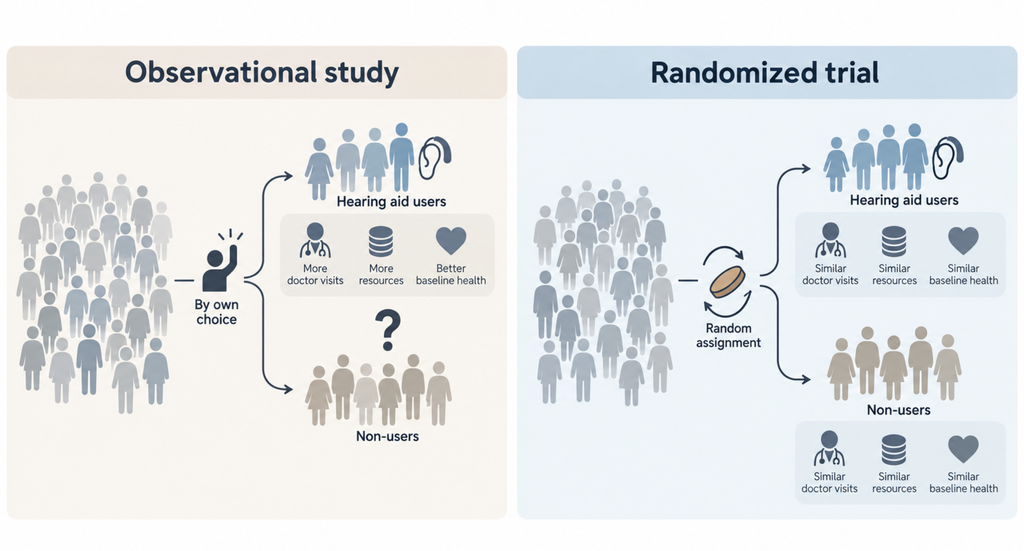
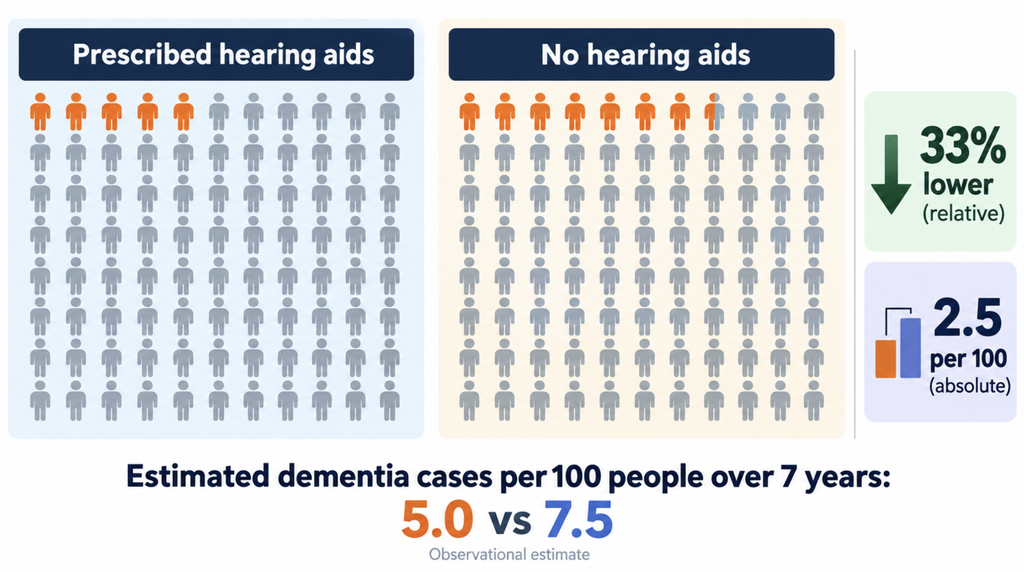
The Australian study behind January’s headlines is more careful than most. Using data from 2,777 adults with an average age of 75, researchers emulated a clinical trial, comparing 664 people who received a new hearing-aid prescription with similar people who did not, over 7 years [Cribb, Treating Hearing Loss With Hearing Aids, 2026]. The estimated dementia risk was 5.0% vs 7.5%, the reported 33% lower risk (risk ratio 0.67, 95% CI 0.37–0.97), a wide range. The risk of cognitive impairment was 36.1% vs 42.4%, a borderline difference whose range touches “no difference.” Those who wore their aids more often had lower risk. Yet overall memory and thinking scores differed by 0.03 standard deviations, essentially no difference, and the authors write that they cannot rule out residual confounding.
The Framingham analysis behind the “61% lower” figure followed 2,953 participants aged 60+ for up to about 20 years; 583 (20%) developed dementia, one in five [Francis, Self-Reported Hearing Aid Use and Dementia, 2025]. Among people whose hearing was tested before age 70, hearing-aid users had a reported 61% lower risk than those with untreated loss, with a hazard ratio of 0.39 (95% CI 0.17–0.89). That range is wide: the true figure could plausibly lie anywhere from about 11% to 83% lower. Among those tested at 70 or older, the researchers found no clear link. The age of 70 referred to the hearing test, not to when anyone started wearing hearing aids, and use was a single yes-or-no answer.
| Study | Design | Who was studied | Headline result | What it did not show |
|---|---|---|---|---|
| Yeo meta-analysis | Pooled observational studies | 126,903 people in 8 long-term studies | 19% lower risk of cognitive decline | A test of cause and effect |
| Australian (ASPREE) analysis | Observational, emulating a trial | 2,777 adults, average age 75 | Dementia risk 5.0% vs 7.5% over 7 years | Better memory or thinking scores |
| Framingham analysis | Observational, self-reported use | 2,953 adults aged 60+ | 61% lower risk if tested before 70 | Any link at 70 or older |
| ACHIEVE trial | Randomized trial | 977 adults aged 70–84 | No overall slowing of decline over 3 years | A benefit in the full group |
The caution comes from who wears hearing aids. People who obtain and keep wearing them tend to differ from those who do not: more contact with doctors, more resources, often better health at the start. A UK Biobank analysis showed how much this matters. Before accounting for how often people used health care, hearing-aid users appeared to have a higher dementia risk (risk ratio, RR 1.43, 95% CI 1.08–1.88); after accounting for it, the estimate flipped to a possible lower risk (RR 0.77, 95% CI 0.44–1.33), and the adjusted result was not statistically certain [Mur, Hearing Aids and Dementia in UK Biobank, 2025]. Reverse causation is also possible: early, unrecognized cognitive decline may itself make people less likely to seek or manage a hearing aid.
If one adjustment can move the estimate from 43% higher to 23% lower, the question is still open. Studies that share the same blind spot will agree with one another, so their agreement does not settle cause.
The one randomized trial: ACHIEVE
Randomization is designed to remove this kind of confounding: chance, not personal choice, decides who gets hearing aids. The ACHIEVE trial assigned 977 adults aged 70–84 with untreated hearing loss and no substantial cognitive impairment either to hearing aids with audiological counselling or to a health-education program, then followed them for 3 years [Lin, ACHIEVE Randomised Controlled Trial, 2023]. Across all participants, the difference in cognitive change between the two groups was 0.002 standard deviations: hearing aids did not slow cognitive decline over three years. Rates of new cognitive impairment did not differ either.
A prespecified split told a different story. Participants drawn from a long-running heart-health study were older, had more cardiovascular risk factors and declined faster. In this subgroup of 238, decline was 48% slower with hearing aids, about half as fast, while among the 739 healthy community volunteers there was no difference. A later secondary analysis found the benefit concentrated among those with the highest predicted risk of decline [Pike, Cognitive Benefits of Hearing Intervention Vary by Risk, 2025]. The signal deserves follow-up, but it is not a settled result.
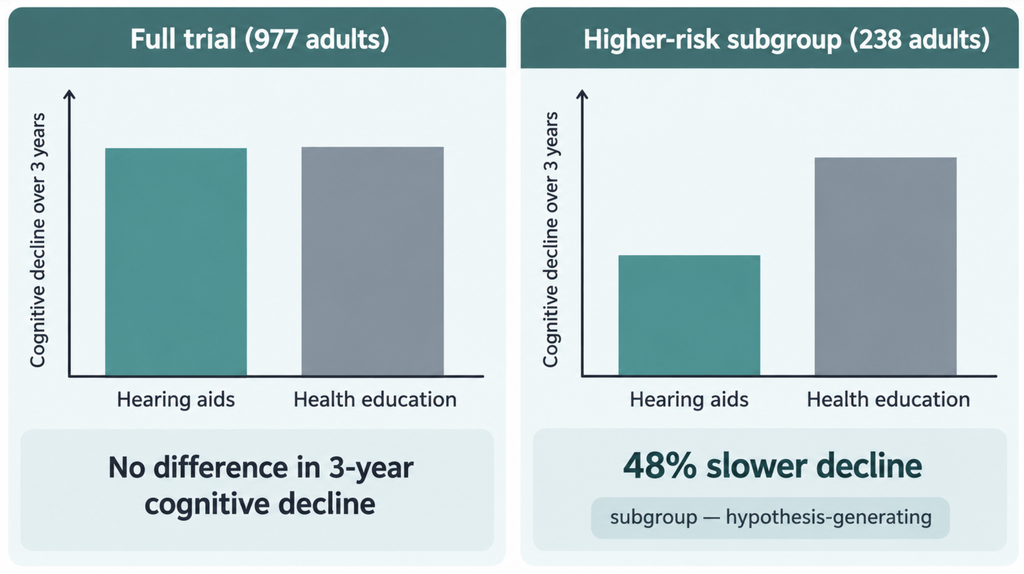
Three cautions apply. Subgroup findings generate hypotheses rather than settle them. Three years is short for a condition that typically develops over many years, so the trial could not judge dementia prevention either way. And about one in six people in the control group obtained hearing aids on their own, which blurred any difference. Longer follow-up of the ACHIEVE participants is under way, and a search of the published literature at the time of writing found no long-term results yet.
The trial does not rule out a cognitive benefit. It suggests that any benefit, if real, is limited to some people and slow to appear.
Clinical Perspective. The ACHIEVE results argue against promising cognitive benefit to healthy older adults. They offer a reason, though not yet proof, to pay closer attention to hearing in people who already carry other risks for cognitive decline.
Why “dementia prevention” is the wrong reason, and the wrong scorecard
The wrong reason: what “33% lower” means
“33% lower” sounds dramatic. In absolute terms, it is 5.0 versus 7.5 cases per 100 people over seven years, a difference of 2.5 per 100. Even if the effect were entirely real, roughly 40 people would need to wear hearing aids for seven years for one fewer dementia diagnosis, about 1 in 40. Across a population, that is not trivial; for any single buyer, it is modest.
Somewhere between the journal and the waiting-room poster, “associated with a lower risk” can turn into “can reduce the risk by as much as 61 percent.” The 61% comes from the study, but the study measured an association; it did not test whether hearing aids reduce risk. The original sources are careful: the press release for the Australian study states that the finding does not prove hearing aids reduce dementia risk, and the Framingham authors list self-report and access to care among their limitations. Much of the drift seems to come from compression rather than invention, as each retelling drops another caveat.
| Headline phrasing | What the study measured |
|---|---|
| “Hearing aids cut dementia risk by a third” | An estimated 7-year risk of 5.0% vs 7.5% in an observational analysis, with no difference in memory or thinking scores |
| “Start before 70 and cut risk by 61%” | Self-reported use; 70 was the age at hearing testing, and the plausible range ran from 11% to 83% |
| “Hearing aids slow cognitive decline” | True in a subgroup of 238 higher-risk adults in a randomized trial; no difference in the full group of 977 |
| “Healthy hearing, healthy brain” | A real association, with causation still unproven |
The wrong scorecard
A second problem is expectation. You can never know whether a hearing aid prevented your dementia, because you cannot see the life in which you went without one. A device bought for that reason has no way to visibly succeed, and its reliable benefits, such as easier conversation and less strain in a noisy restaurant, may get undervalued.
Non-use is already common. In a Welsh national survey covering 2004–2018, about 20% of adults with hearing aids never used them, 30% used them some of the time, and 50% used them most of the time [Dillon, Adoption, Use and Non-use of Hearing Aids, 2020]. Past users who had given up often pointed to problems with the devices themselves [Franks, Reasons for the Non-use of Hearing Aids, 2024]. Whatever a hearing aid might do for hearing or the brain, it can do only while it is worn.
A better test is whether conversations get easier, and you can check that within days of a fitting.
Earbuds as hearing aids: the open question, and what to do now
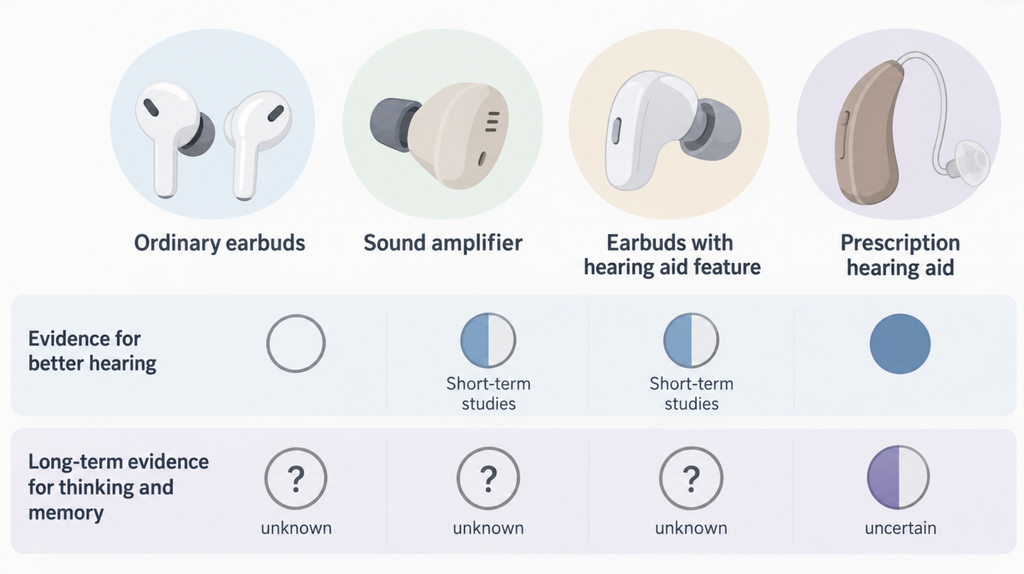
Hearing aids increasingly look like earbuds. In the US, the FDA authorized hearing-aid software for Apple’s AirPods Pro in September 2024 (Axios), and Samsung announced FDA clearance for a similar feature on the Galaxy Buds3 Pro and Buds4 Pro in August 2026, rolling out in late 2026 (Samsung). Both are intended for adults 18 and older with perceived mild-to-moderate hearing loss. Ordinary earbuds without such a feature, and simple sound amplifiers, are not the same thing.
A meta-analysis of 15 short trials (10 days to 8 weeks) with 774 participants suggests that self-fitted over-the-counter hearing aids help about as much as professionally fitted ones, based largely on how users rate their own hearing, though the underlying evidence is weak [De Sousa, Over-the-Counter Versus Professionally Fitted Hearing Aids, 2026]. The first independent test of Apple’s feature, in 25 participants aged 20–72, found high satisfaction alongside no measurable gain in understanding speech in noise (0.1 dB) and amplification generally below standard prescription targets [Kruger, Apple Over-the-Counter Hearing Aid Feature, 2026]. Some participants said they would wear the earbuds only in certain situations.
A search of the medical literature found no study that has followed people using earbud-style or over-the-counter hearing aids for mild hearing loss long enough to see what happens to their thinking in later life; even for people with dementia, outcomes of these devices are barely studied [Urbanski, OTC Hearing Aid Use in People With Dementia, 2026]. The dementia studies above were done mostly in older adults around 70 and above, using conventional hearing aids, and in the trial those aids were professionally fitted and worn about seven hours a day. Whether an earbud worn for some conversations does what a hearing aid worn all day may do has not been tested, and the answer matters.
A practical checklist
Get hearing measured properly. Over-the-counter devices can be bought without a hearing exam, but more significant or complicated loss may need a prescription device (NIDCD).
Treat fitting as part of the device. In the trial, audiologists fitted hearing aids to prescription targets, while the first independent test of an earbud feature found amplification below those targets [Lin, ACHIEVE Randomised Controlled Trial, 2023; Kruger, Apple Over-the-Counter Hearing Aid Feature, 2026].
Wear it. In the Australian study, more frequent use tracked with lower dementia risk. The finding is observational, but a device works only when worn [Cribb, Treating Hearing Loss With Hearing Aids, 2026].
Ask three questions of any number. Is it relative or absolute? Observational or randomized? Measured in whom, at what age, with what degree of loss and what device?
Buy the hearing aid for the conversation at dinner. Let the research settle the question of the brain.
Key Takeaways
Hearing aids substantially improve hearing and hearing-related quality of life, and that benefit is the best-established reason to use them.
Hearing loss is consistently associated with higher dementia risk, but whether treating it lowers that risk has not been proven.
The widely shared 33% and 61% figures come from observational studies in which people chose whether to wear hearing aids.
The only large randomized trial found no slowing of cognitive decline overall, with a possible benefit limited to a higher-risk subgroup.
A relative reduction of 33% corresponds to 2.5 fewer cases per 100 people over seven years, and only if the effect is real.
Earbuds with authorized hearing-aid features are a new, more accessible option, but no one has studied their long-term effect on thinking.
FAQ
Do hearing aids prevent dementia?
Not proven. Observational studies link hearing-aid use with lower dementia risk, but users differ from non-users in many ways. In the only large randomized trial, hearing aids did not slow cognitive decline over three years overall, though a higher-risk subgroup declined more slowly [Lin, ACHIEVE Randomised Controlled Trial, 2023].
Is it too late to benefit from hearing aids after 70?
No. The Framingham finding of no link after 70 concerned dementia risk, not hearing itself. Randomized trials showing large hearing benefits included participants with average ages up to 83 [Ferguson, Hearing Aids for Mild to Moderate Hearing Loss, 2026].
Can earbuds with a hearing aid feature replace a hearing aid?
It depends. The FDA-authorized features are intended for adults with perceived mild-to-moderate hearing loss, not for more severe loss. The first independent test of Apple’s feature found high user satisfaction but no measurable gain in understanding speech in noise, and amplification below standard prescription targets [Kruger, Apple Over-the-Counter Hearing Aid Feature, 2026].
Does mild hearing loss raise dementia risk?
Possibly. In the Baltimore Longitudinal Study of Aging, mild hearing loss was linked to nearly double the risk of dementia, although the estimate was imprecise [Lin, Hearing Loss and Incident Dementia, 2011]. Whether treating mild loss, with any kind of device, changes that risk has not yet been tested.
References
- Ferguson MA, Sarant JZ, Bennett RJ, McIlhiney P, Badcock N, Bothe E. Hearing aids for mild to moderate hearing loss in adults. Cochrane Database Syst Rev. 2026;8:CD012023.
- Chien W, Lin FR. Prevalence of hearing aid use among older adults in the United States. Arch Intern Med. 2012;172(3):292-293.
- Lin FR, Pike JR, Albert MS, et al. Hearing intervention versus health education control to reduce cognitive decline in older adults with hearing loss in the USA (ACHIEVE): a multicentre, randomised controlled trial. Lancet. 2023;402(10404):786-797.
- Lin FR, Metter EJ, O’Brien RJ, Resnick SM, Zonderman AB, Ferrucci L. Hearing loss and incident dementia. Arch Neurol. 2011;68(2):214-220.
- Loughrey DG, Kelly ME, Kelley GA, Brennan S, Lawlor BA. Association of age-related hearing loss with cognitive function, cognitive impairment, and dementia: a systematic review and meta-analysis. JAMA Otolaryngol Head Neck Surg. 2018;144(2):115-126.
- Livingston G, Huntley J, Liu KY, et al. Dementia prevention, intervention, and care: 2024 report of the Lancet standing Commission. Lancet. 2024;404(10452):572-628.
- Griffiths TD, Lad M, Kumar S, et al. How can hearing loss cause dementia? Neuron. 2020;108(3):401-412.
- Pichora-Fuller MK, Kramer SE, Eckert MA, et al. Hearing impairment and cognitive energy: the Framework for Understanding Effortful Listening (FUEL). Ear Hear. 2016;37 Suppl 1:5S-27S.
- Lin FR, Ferrucci L, An Y, et al. Association of hearing impairment with brain volume changes in older adults. Neuroimage. 2014;90:84-92.
- Yeo BSY, Song HJJMD, Toh EMS, et al. Association of hearing aids and cochlear implants with cognitive decline and dementia: a systematic review and meta-analysis. JAMA Neurol. 2023;80(2):134-141.
- Cribb L, Moreno-Betancur M, Pase MP, et al. Treating hearing loss with hearing aids for the prevention of cognitive decline and dementia. Neurology. 2026;106(3):e214572.
- Francis L, Seshadri S, Dillard LK, Kujawa SG, Welling DB, Alcabes RL, Beiser AS. Self-reported hearing aid use and risk of incident dementia. JAMA Neurol. 2025;82(11):1195-1197.
- Mur J, Klee M, Wright HR, et al. A hypothetical intervention on the use of hearing aids for the risk of dementia in people with hearing loss in UK Biobank. Am J Epidemiol. 2025;194(10):2844-2852.
- Pike JR, Huang AR, Reed NS, et al. Cognitive benefits of hearing intervention vary by risk of cognitive decline: a secondary analysis of the ACHIEVE trial. Alzheimers Dement. 2025;21(5):e70156.
- Dillon H, Day J, Bant S, Munro KJ. Adoption, use and non-use of hearing aids: a robust estimate based on Welsh national survey statistics. Int J Audiol. 2020;59(8):567-573.
- Franks I, Timmer BHB. Reasons for the non-use of hearing aids: perspectives of non-users, past users, and family members. Int J Audiol. 2024;63(10):794-801.
- De Sousa KC, Almufarrij I, Kruger M, Manchaiah V, Munro KJ, Swanepoel W. Effectiveness of over-the-counter hearing aids versus professionally fitted devices: a systematic review and meta-analysis. Otolaryngol Head Neck Surg. Published online June 17, 2026.
- Kruger M, Manchaiah V, Swanepoel W. Usability and performance of the Apple over-the-counter hearing aid feature. Am J Audiol. 2026;35(2):472-486.
- Urbanski DP, Hungs AM, Nelson PB, Gaugler JE. Facilitators and barriers to over-the-counter hearing aid use in people with dementia: semistructured interview study. JMIR Hum Factors. 2026;13:e83857.
Joonpyo Hong, MD is a board-certified otolaryngologist practicing in Korea. This article reflects his clinical interpretation of published research and does not constitute individual medical advice. This article is not intended to advertise or promote any specific company or product.
For more articles:
https://curiousmd.com/age-related-hearing-loss-hear-not-understand/
https://curiousmd.com/ai-speech-clarification-hearing-loss/
Link out to:
American Academy of Neurology: press release on the Australian hearing aid study — includes the researchers’ note that the finding does not prove causation.
UCL News: the Lancet Commission’s 14 modifiable dementia risk factors — plain-language summary of the report.
UNC Gillings School of Global Public Health: ACHIEVE trial results — summary of the randomized trial and its higher-risk subgroup.
NIDCD (NIH): Hearing Aids — federal guide to hearing aid types, including over-the-counter and prescription devices.
Alzheimer Europe: the 2024 Lancet Commission — patient-organization summary with caveats on the prevention estimate.