
Many physicians are still typing long after the last patient goes home. Healthcare AI is being sold as the fix for that late-night charting, and UnitedHealth Group is betting on it in both of its businesses. A 2017 study of 142 family physicians found they spent 5.9 hours of an 11.4-hour workday inside the electronic health record (EHR), more than half the workday, including 86 minutes after clinic hours, about an hour and a half [Arndt, Tethered to the EHR, 2017]. Clinicians have a name for that last stretch: pajama time.
The pitch is simple. Software listens to the visit, drafts the note, summarizes the chart, and gives the hours back. UnitedHealth’s Optum division is already rolling these tools out to its clinicians. The same company also runs UnitedHealthcare, its insurance arm, which is deploying the same class of tools on the other side of the transaction: coding claims, checking payments, and researching appeals.
That split is worth examining. So far, AI has shown it can give physicians back some of their time. It has not shown better patient outcomes. And on the insurance side, an engine that can approve a claim in seconds can, in principle, deny one just as fast.
The time savings are real. The evidence does not yet show whether that time turns into better care or into faster denials.
Two Healthcare AI Experiments Under One Roof
UnitedHealth runs two businesses: the insurer, UnitedHealthcare, and Optum, which delivers care, sells health technology, and manages pharmacy benefits [UnitedHealth Group, Q3 2026 Results, 2026]. Two parts of Optum matter here. Optum Health is the care-delivery arm. It says it cares for about 20 million patients, roughly 4 million of them, about one in five, under arrangements where Optum is responsible for the total cost of their care [Motley Fool, UNH Q3 2026 Call, 2026]. Optum Insight is the technology arm. It sells software, analytics, and claims services to hospitals, health plans, and UnitedHealthcare itself.
The company is placing its AI product bets in Optum Insight. In the third quarter of 2026, Optum Insight reported revenue of $5.5 billion, up 3%, and earnings from operations of $1.3 billion versus $920 million a year earlier. The company credited AI-enabled tools that speed up documentation and make payments faster and more accurate [UnitedHealth Group, Q3 2026 Results, 2026].
The two arms run different experiments. In the clinic, the doctor is the AI’s customer, and success means fewer minutes at the keyboard. At the claims desk, the customer is whoever bills or pays, and success means money moves faster and with fewer errors. Both goals can help patients, but neither one is measured in patient health.
| Optum Health: the exam room | Optum Insight: the claims desk | |
|---|---|---|
| What the AI does | Summarizes charts; listens to visits and drafts notes | Automates claims coding; checks payment accuracy; runs AI agents on complex claims |
| Who uses it | Optum’s employed clinicians | Hospitals, health plans, and UnitedHealthcare |
| Stated goal | Less paperwork, more time with patients | Faster, more accurate claims and payments |
| Company-reported result | More than 40% of employed clinicians using chart summaries; chart review about a third less | A coding product grew from 2 to 15 clients; one Medicaid plan settling complex claims in seconds instead of days |
| Independent evidence | Randomized trials of similar tools from other vendors; none of Optum’s own figures | None published |
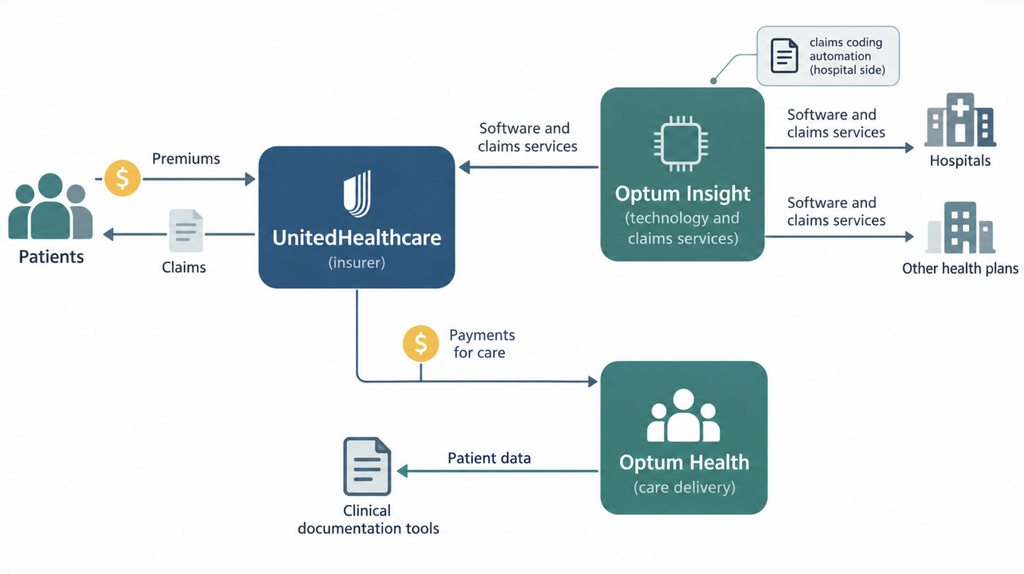
Keep one detail in mind for the rest of this piece. Integrity One, the coding product the company cites most often as an AI win, sits on the hospital’s side of the bill. It automates how claims are coded before they are submitted, not how insurers judge them [Motley Fool, UNH Q3 2026 Call, 2026]. The same company, with the same kind of technology, works both ends of the invoice.
What Has Actually Changed So Far
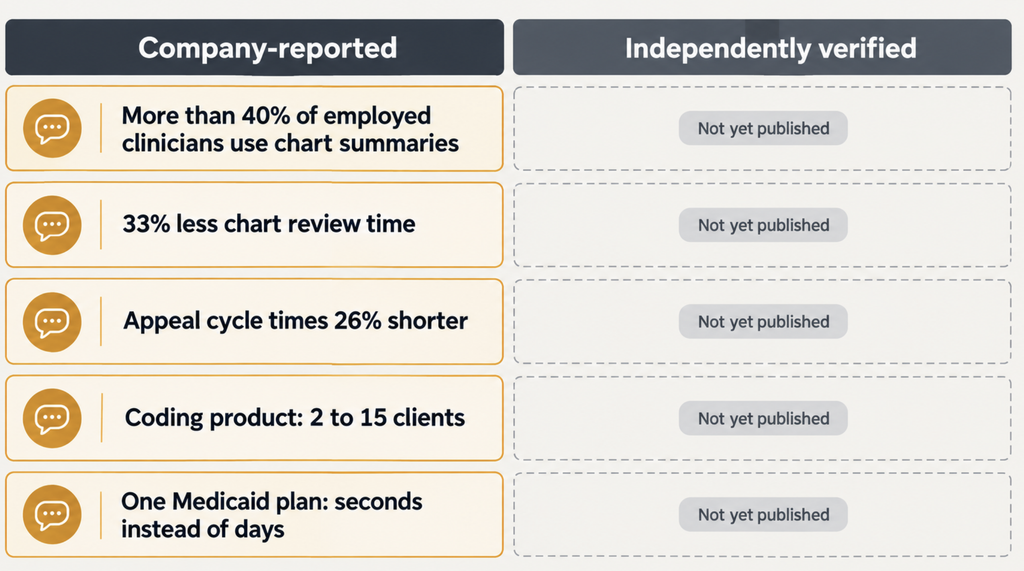
On its third-quarter 2026 earnings call, UnitedHealth told investors that more than 40% of its employed clinicians now use an AI chart-summary tool and that chart review takes 33% less time, about a third less [Motley Fool, UNH Q3 2026 Call, 2026]. The company also says AI-assisted research has cut appeal cycle times by 26%, about a quarter. It has not published how it measured either figure.
On the claims side, Optum says Integrity One went from 2 clients at the end of 2025 to 15 today, with 24 more implementing. Its consulting unit describes one Medicaid plan where AI agents now settle its most complex claims in seconds instead of days [Motley Fool, UNH Q3 2026 Call, 2026]. That is one customer’s example, and no public data yet show how often those decisions are right or later reversed.
Taken at face value, these are meaningful operational gains. Clinicians and billing staff lose hours to chart review, coding, and appeals, and chart summaries and coding tools can help without the AI making a medical judgment.
But every number in this section comes from the company, told to investors, with no published method, baseline, or comparison group. A third less of an unknown starting time tells you the direction of change, not its size. None of these figures has appeared in a peer-reviewed journal, and none says whether patients were helped. A claim made on an investor call still needs independent evidence behind it.
Does a Faster Note Mean Better Care?
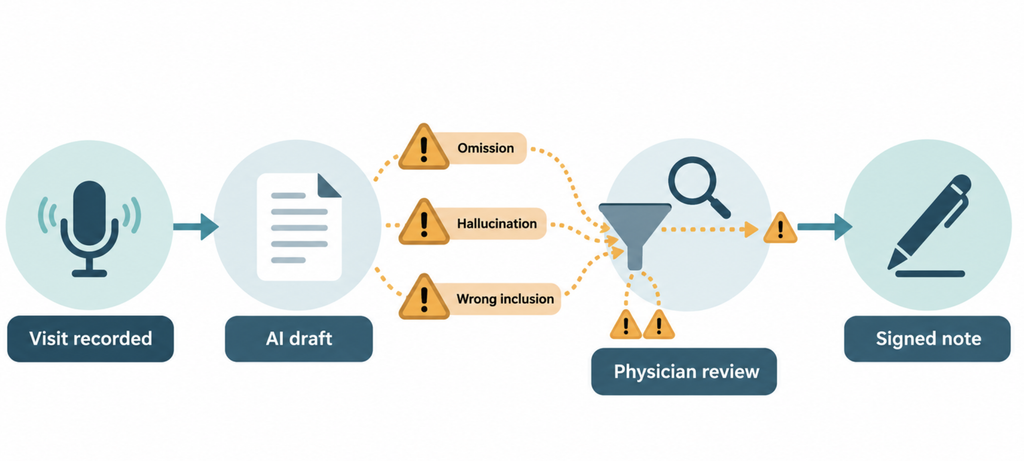
Ambient AI scribes work in three steps: the software listens to the visit, drafts the note, and the clinician edits and signs it [Wolfe, Ambient Documentation Scoping Review, 2026]. Unlike Optum’s own figures, this category of tool has been tested in randomized trials at academic health systems. The trials studied other vendors’ products, not Optum’s, but the technology is the same kind.
At UCLA, researchers randomly assigned 238 physicians to one of two commercial scribes or to usual care for 2 months. One product cut time in notes by 9.5%, roughly a tenth, while the other produced no significant change, at 1.7% [Lukac, Ambient AI Scribes RCT, 2025]. Survey scores for burnout and task load trended better with either scribe, though these were secondary outcomes that need confirmation.
A 24-week trial in Wisconsin with 66 clinicians found less work exhaustion and 0.36 hours less per day on notes, about 20 minutes a day, with no loss of note quality [Afshar, Ambient AI Well-Being RCT, 2025]. At Duke, a crossover trial of 160 clinicians found that both tools tested reduced burnout, but after-hours charting time barely moved [Chowdhury, Comparing Ambient Scribes, 2026]. Outside the trials, an observational study in a Stanford emergency department linked scribe use to about 73 seconds less documentation per patient. That is about a minute, or about 24 minutes over a 20-patient shift [Preiksaitis, ED Ambient Scribes, 2026].
These first randomized trials suggest ambient AI scribes trim note-writing time modestly and ease exhaustion, though results vary by product and setting. The minutes saved are real but small, and no trial has yet shown that patients end up healthier.
What the drafts get wrong
The speed comes with accuracy problems. In a single-center pilot at one academic health system, doctors reviewed a sample of 356 AI drafts. They found something missing in 18%, nearly one in five, and something invented in 11.5%, about one in nine [Taylor, AI Note Quality Pilot, 2026]. In 5.3%, about one in twenty, the error could have caused serious harm if left uncorrected. Editing data from the same pilot showed that clinicians signed 14.9% of AI-drafted notes, about one in seven, with no edits at all. Physician review is the safety net, and it has gaps.
A study from Boston raises a different concern. In 20,302 primary care notes, AI-scribed visits recorded more mental-health symptoms, yet were somewhat less likely to end with a documented referral, new diagnosis, or antidepressant (adjusted odds ratio 0.83). Visits with human scribes showed no such gap [Castro, AI Scribes and Psychiatric Management, 2026]. The study is observational and cannot show the AI caused this, and no one yet knows whether patients fared differently. Studies that measure only time saved would miss a signal like this.
The Claims Desk: Speed in Both Directions
Prior authorization, the insurer’s advance approval for a test, drug, or procedure, has long caused friction between doctors and insurers. In the American Medical Association’s survey of 1,000 physicians in December 2025, respondents reported handling about 40 prior authorizations a week, which took 13 hours of physician and staff time; 95% said it delays care [AMA, Prior Authorization Survey, 2026]. The AMA lobbies on this issue, so these are physicians’ reports, not measured outcomes.
Automation could ease this from both sides. Medicare estimates that 6.55% of its traditional fee-for-service payments in fiscal 2025, or $28.83 billion, were improper, and it stresses that most of that reflects missing paperwork, not fraud [CMS, FY2025 Improper Payments, 2026]. Payment-accuracy tools target that gap. Because so much of it is paperwork, an over-eager tool can also flag legitimate claims. UnitedHealth’s report that AI made appeals about a quarter faster shows that the same engine could, in principle, speed a yes as well as a no.
The worry runs the other way. A class action filed in 2023 alleges that UnitedHealth used a prediction tool called nH Predict to cut off rehabilitation care for Medicare Advantage patients. The company denies that the tool makes coverage decisions. A federal judge let parts of the case proceed in February 2025 and ordered broad discovery in March 2026, and the case remains unresolved [Georgetown Litigation Tracker, Lokken v. UnitedHealth, 2026]. Separately, a 2024 Senate majority staff report found that UnitedHealthcare’s denial rate for post-acute care requests, which cover rehabilitation and nursing care after a hospital stay, rose from 10.9% in 2020 to 22.7% in 2022 [Senate PSI Majority Staff, Refusal of Recovery, 2024]. The rate more than doubled. That shows a pattern, but it does not prove the cause.
Plan-reported data from 2024 add context. UnitedHealth denied 12.8% of its Medicare Advantage prior authorization requests in 2024, about one in eight and the highest share among large insurers. It also required fewer requests per enrollee than most, so the higher share came from a smaller pile [Biniek, KFF Medicare Advantage Prior Authorization, 2026].
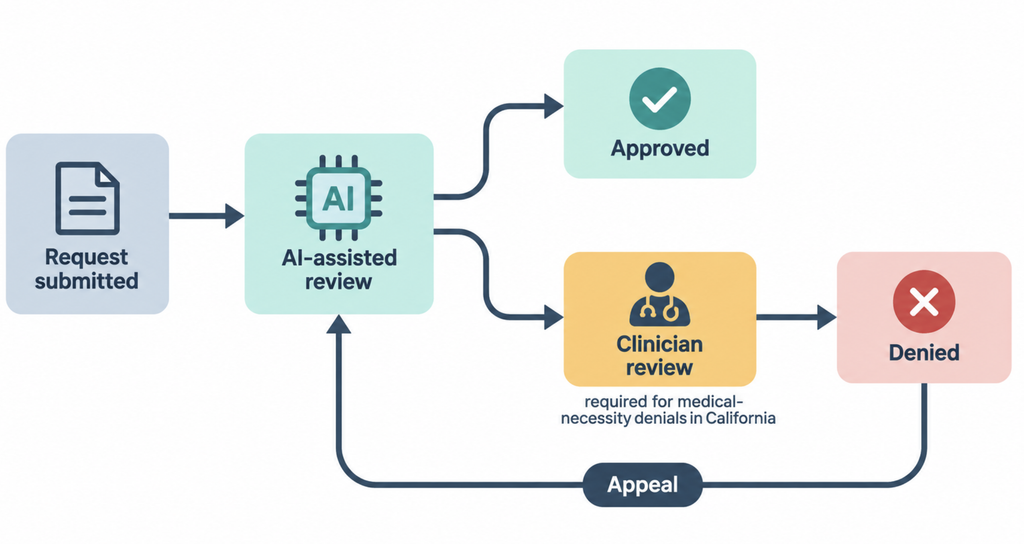
Six in 10 physicians in the AMA survey said they worry AI will push denial rates higher [AMA, Prior Authorization Survey, 2026]. Regulators have started setting limits. Federal guidance issued in February 2024 says a Medicare Advantage plan may use an algorithm to assist, but cannot end post-acute care based solely on a predicted length of stay [McDermott, CMS Guidance on AI in Coverage, 2024]. California went further. Since January 2025, a licensed clinician must make any denial based on medical necessity [Becker, California SB 1120, 2024].
One widely reported change should not be credited to AI. UnitedHealthcare says it will remove about 30% of its prior-approval volume by the end of 2026, including nearly two-thirds for children [UnitedHealth Group, Q3 2026 Results, 2026]. That is a policy decision, and for those services it removes the wait altogether.
What Comes Next: 2027 and Beyond
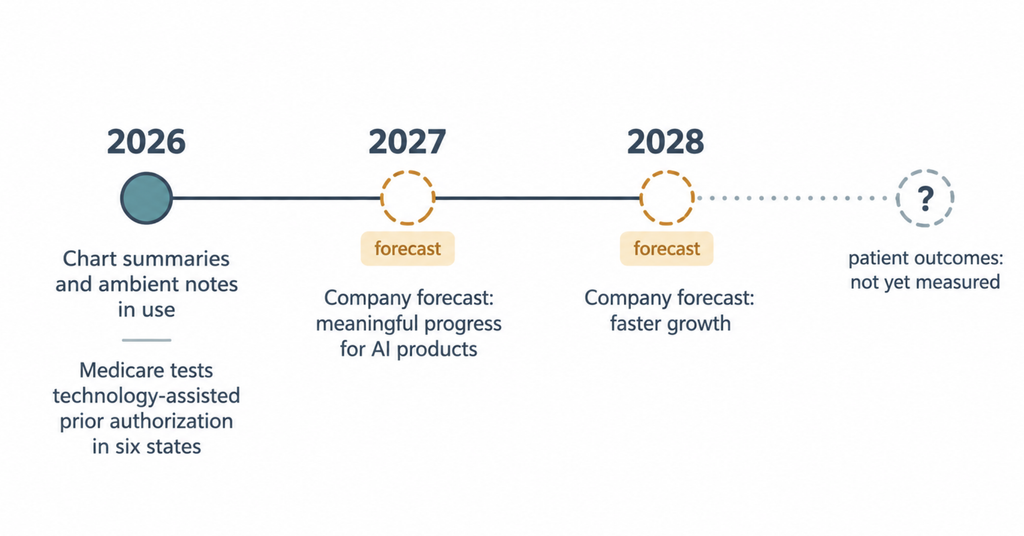
Management calls Optum Insight a multi-year bet. It expects meaningful progress in 2027 and faster growth from 2028, which is a forecast rather than a result [Motley Fool, UNH Q3 2026 Call, 2026]. Optum has also joined the Anthropic Partner Network and announced go-to-market partnerships with Microsoft and Google. In the clinic, executives plan to extend ambient listening from documentation to “next best action” prompts, suggestions to the clinician about what to do next [Motley Fool, UNH Q3 2026 Call, 2026].
Private insurers are not the only ones testing AI review. Since January 2026, Medicare has been testing technology-assisted prior authorization, including AI, for a set of services in six states [Biniek, KFF Medicare Advantage Prior Authorization, 2026].
Moving from drafting notes to suggesting decisions raises a known hazard: automation bias, the tendency to accept a machine’s answer over one’s own judgment. Experiments consistently show this pull. In one randomized simulation, pharmacists and trainees accepted 73.9% of deliberately wrong AI recommendations, about three in four [Surdilla, Automation Bias Pharmacist Trial, 2026]. In another study, breast-screening readers’ sensitivity on cancers the AI had missed fell from 71% to 39%, from about seven in ten to about four in ten [Taib, Automation Bias Mammography, 2026]. The size of this effect in everyday practice is not yet known.
The requirements for a trustworthy next phase are clear. The company would need to publish the methods behind its own figures. Patient outcomes would need independent evaluation. A human review would need to be visible at every adverse decision, and records would need to show where the machine wrote and where the clinician did. Without those, a tool that suggests the next step produces hypotheses that can look like decisions.
Key Takeaways
- So far, the clearest benefit of healthcare AI is clinician time and energy. Better patient health has not been demonstrated.
- Independent randomized trials of ambient AI scribes find modest documentation savings that vary by product, along with less exhaustion.
- UnitedHealth’s headline AI results, including faster chart review, faster appeals, and faster claims, are company-reported and not yet independently verified.
- AI-drafted notes can omit or invent details, so careful physician review is a safety requirement.
- In insurance, the same automation can speed approvals or denials. Federal guidance demands individualized decisions, and California law requires a clinician to make medical-necessity denials.
- Medicare Advantage denials are rarely appealed, yet most appeals succeed, so a questionable denial is usually worth contesting.
FAQ
Does healthcare AI make patients healthier?
That has not been shown yet. Randomized trials of ambient AI scribes have measured clinician time, burnout, and note quality, not patient outcomes. The best evidence shows modest documentation savings, about 20 minutes a day in one trial, plus less exhaustion [Afshar, Ambient AI Well-Being RCT, 2025]. No study has directly tested whether that time turns into better care.
Can an AI scribe make mistakes in a medical record?
Yes. In a single-center pilot, physicians reviewing a sample of AI drafts found omissions in nearly one in five and invented details in about one in nine. About one in twenty carried potentially serious errors [Taylor, AI Note Quality Pilot, 2026]. Careful review before signing remains essential.
Is AI deciding whether insurance claims are denied?
It depends. Federal guidance lets Medicare Advantage plans use algorithms to assist, but not to end post-acute care based solely on a predicted length of stay [McDermott, CMS Guidance on AI in Coverage, 2024]. California requires a licensed clinician to make medical-necessity denials. A lawsuit over UnitedHealth’s nH Predict tool, which the company says does not make coverage decisions, is still ongoing.
Is it worth appealing a Medicare Advantage denial?
Usually, yes. In 2024, only about one in nine denied prior authorization requests was appealed, but roughly four in five appeals overturned the denial in whole or in part [Biniek, KFF Medicare Advantage Prior Authorization, 2026]. Some reversals may reflect missing paperwork supplied later.
References
- Arndt BG, Beasley JW, Watkinson MD, et al. Tethered to the EHR: primary care physician workload assessment using EHR event log data and time-motion observations. Ann Fam Med. 2017;15(5):419-426.
- Lukac PJ, Turner W, Vangala S, et al. Ambient AI scribes in clinical practice: a randomized trial. NEJM AI. 2025;2(12).
- Afshar M, Baumann MR, Resnik F, et al. A pragmatic randomized controlled trial of ambient artificial intelligence to improve health practitioner well-being. NEJM AI. 2025;2(12).
- Chowdhury A, Casey M, Wilson J, et al. Comparing ambient scribes: a randomized crossover clinical trial addressing ambient scribe technologies’ impact on physician burnout. J Am Med Inform Assoc. 2026;33(5):990-999.
- Preiksaitis C, Alvarez A, Winkel M, et al. Ambient AI scribes and emergency department documentation burden: retrospective cohort study. JMIR AI. 2026;5:e92193.
- Wolfe J, Welsh SM. Ambient documentation systems in emergency medicine: a scoping review of clinical precision, patient experience, throughput, and quality. Cureus. 2026;18(4):e106643.
- Taylor SL, Jost M, MacDonald S, et al. Quality of clinical notes created by ambient listening generative AI: pragmatic prospective pilot study. JMIR Med Inform. 2026;14:e86474.
- Castro VM, McCoy TH, Verhaak P, Ramachandiran A, Perlis RH. Psychiatric documentation and management in primary care with artificial intelligence scribe use. JAMA Psychiatry. 2026;83(3):281-286.
- Surdilla D, Michaels B, Michael C, et al. Impact of AI assistance on pharmacist and pharmacy trainee accuracy and automation bias during medication order verification: a randomized simulation trial. Am J Health Syst Pharm. 2026.
- Taib AG, Partridge GJW, Phillips P, et al. Automation bias in action: eye tracking of humans reading screening mammograms with and without AI prompts. Radiology. 2026;320(1):e252590.
- Biniek JF, Sroczynski N, Freed M, Neuman T. Medicare Advantage insurers made nearly 53 million prior authorization determinations in 2024. KFF. Published January 28, 2026. https://www.kff.org/medicare/medicare-advantage-insurers-made-nearly-53-million-prior-authorization-determinations-in-2024/
- American Medical Association. AMA survey: prior authorization reform pledge falls short with physicians. Published May 13, 2026. https://www.ama-assn.org/press-center/ama-press-releases/ama-survey-prior-authorization-reform-pledge-falls-short-physicians
- Centers for Medicare & Medicaid Services (CMS). Fiscal year 2025 improper payments fact sheet. Published January 15, 2026. https://www.cms.gov/newsroom/fact-sheets/fiscal-year-2025-improper-payments-fact-sheet
- U.S. Senate Permanent Subcommittee on Investigations, Majority Staff. Refusal of recovery: how Medicare Advantage insurers have denied patients access to post-acute care. October 17, 2024. As reported in: Senate report slams Medicare Advantage insurers’ post-acute care denials. MMIT Health Plan Weekly. October 18, 2024. https://aishealth.mmitnetwork.com/blogs/health-plan-weekly/news-briefs-senate-report-slams-medicare-advantage-insurers-post-acute-care-denials
- Georgetown O’Neill Institute for National and Global Health Law. Estate of Gene B. Lokken et al. v. UnitedHealth Group Inc. et al. Health Care Litigation Tracker. Updated October 1, 2026. https://litigationtracker.law.georgetown.edu/litigation/estate-of-gene-b-lokken-the-et-al-v-unitedhealth-group-inc-et-al/
- McDermott Will & Schulte. CMS releases guidance on coverage criteria, utilization management and use of AI. February 20, 2024. https://www.mcdermottlaw.com/insights/cms-releases-guidance-on-coverage-criteria-utilization-management-and-use-of-ai/
- Becker J. Landmark law prohibits health insurance companies from using AI to deny healthcare coverage. California State Senate. December 9, 2024. https://sd13.senate.ca.gov/news/press-release/december-9-2024/landmark-law-prohibits-health-insurance-companies-using-ai-to
- UnitedHealth Group. UnitedHealth Group reports third quarter 2026 results. October 13, 2026. https://www.unitedhealthgroup.com/content/dam/UHG/PDF/investors/2026/unh-reports-third-quarter-2026-results.pdf
- Motley Fool Transcribing. UnitedHealth (UNH) Q3 2026 earnings call transcript. The Motley Fool. October 13, 2026. https://www.fool.com/earnings/call-transcripts/2026/10/13/unitedhealth-unh-q3-2026-earnings-call-transcript/
Joonpyo Hong, MD is a board-certified otolaryngologist practicing in Korea. This article reflects his clinical interpretation of published research and does not constitute individual medical advice. This article is not intended to advertise or promote any specific company or product.
For more articles:
https://curiousmd.com/medical-questionnaires-validity/
https://curiousmd.com/ai-doctor-recommendations-hidden-influence/
https://curiousmd.com/ai-clinical-decision-support-global-health-gap/
Link out to:
KFF: Medicare Advantage prior authorization denials and appeals in 2024 — Independent analysis of 2024 Medicare Advantage prior authorization denials and appeals.
CMS: Fiscal Year 2025 Improper Payments Fact Sheet — Official improper payment estimates, with the note that they are not a fraud measure.
American Medical Association: 2025 prior authorization physician survey — Physician-reported burden of prior authorization and concerns about AI-driven denials.
Georgetown Health Care Litigation Tracker: Estate of Lokken v. UnitedHealth — Docket and status of the nH Predict class action.
California State Senate: the Physicians Make Decisions Act — California’s law requiring clinicians, not algorithms, to make medical-necessity denials.
UnitedHealth Group: Third Quarter 2026 Results — The company’s own segment figures and prior-approval reforms.