Sodium thiosulfate for cisplatin ototoxicity became a labeled indication in September 2022, when the FDA approved Pedmark for children 1 month and older with localized, non-metastatic solid tumors [U.S. Food and Drug Administration, FDA approves sodium thiosulfate to reduce the risk of ototoxicity associated with cisplatin in pediatric patients, 2022]. The European Medicines Agency authorized it as Pedmarqsi in May 2023. Some cisplatin-treated cohorts report hearing loss rates of 75–80% [Duinkerken, Transtympanic sodium thiosulfate for prevention of cisplatin-induced ototoxicity, 2021].
The two pediatric phase 3 trials agree on hearing protection. The survival data in metastatic disease are less certain, and adult evidence is limited and mixed.
How cisplatin damages the cochlea
Cisplatin-induced hearing loss is bilateral, symmetric, sensorineural, dose-dependent, and irreversible. Adult otoprotection trials have defined clinically relevant loss as a threshold shift averaged across 8–12.5 kHz, mostly beyond the standard audiogram [Duinkerken, Transtympanic sodium thiosulfate for prevention of cisplatin-induced ototoxicity, 2021]. The leading mechanistic model involves reactive oxygen species damaging outer hair cells.
Roughly 40% of children receiving cisplatin develop hearing loss. Risk rises with age younger than 5 years, cumulative cisplatin dose above 200–400 mg/m², and cranial irradiation that includes the cochlea [Freyer, Effects of sodium thiosulfate versus observation on development of cisplatin-induced hearing loss in children with cancer (ACCL0431), 2017]. The radiation risk applies to head and neck chemoradiation, where the cochlea can lie near the field.
What sodium thiosulfate is, and why timing matters
The otoprotective mechanism of sodium thiosulfate is not fully understood. The US label describes a direct reaction with cisplatin that produces an inactive platinum species, and the Scottish Medicines Consortium lists increased antioxidant activity as a proposed route [Scottish Medicines Consortium, Sodium thiosulfate (Pedmarqsi) SMC2730, 2025].
The same reaction raises the main safety concern: sodium thiosulfate could inactivate cisplatin in the tumor as well as in the ear. In preclinical neuroblastoma models, sodium thiosulfate given with cisplatin blocked its cytotoxicity, while a 6-hour delay did not [Harned, Sodium thiosulfate administered six hours after cisplatin does not compromise antineuroblastoma activity, 2008].
The 6-hour rule
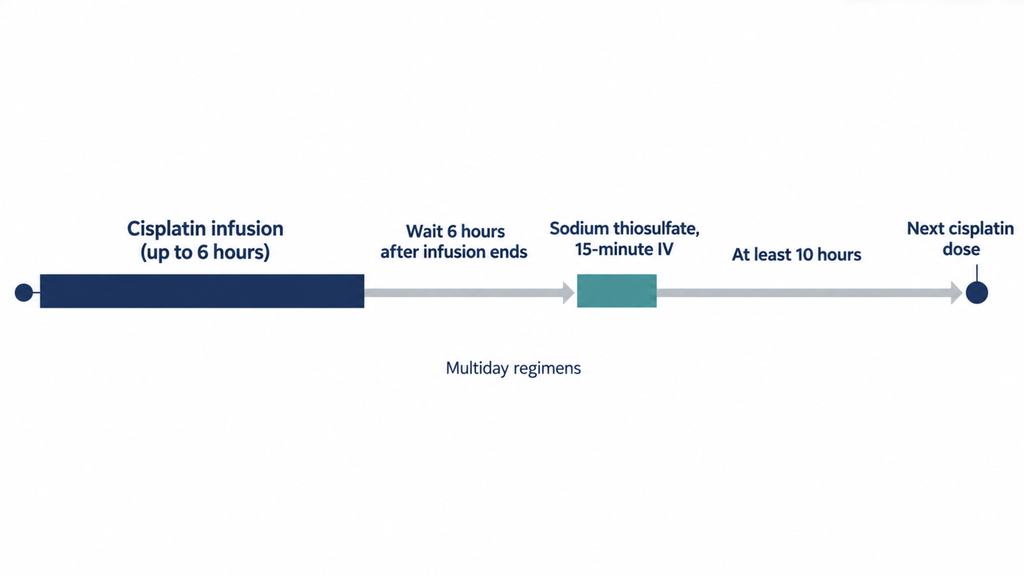
The label sets a fixed schedule: a 15-minute IV infusion starting 6 hours after the cisplatin infusion ends, and at least 10 hours before the next cisplatin dose in multiday regimens. Doses are 10, 15, or 20 g/m² for patients under 5 kg, 5–10 kg, and over 10 kg. Efficacy and safety are not established after cisplatin infusions longer than 6 hours [Pedmark (sodium thiosulfate injection) prescribing information, 2025].
In 2024 the FDA warned against substituting other sodium thiosulfate products, some co-packaged with sodium nitrite or containing potassium chloride.
Sodium thiosulfate for cisplatin ototoxicity: the two phase 3 trials
Two open-label randomized trials support approval.
| SIOPEL 6 | ACCL0431 | |
|---|---|---|
| Population | Standard-risk hepatoblastoma | Mixed new cancers, any stage, cumulative cisplatin ≥200 mg/m² |
| Randomized | 109 | 125 (104 assessable) |
| Dose, given 6 hours after cisplatin | 20 g/m² | 16 g/m² |
| Hearing criteria | Brock grade ≥1 | ASHA criteria |
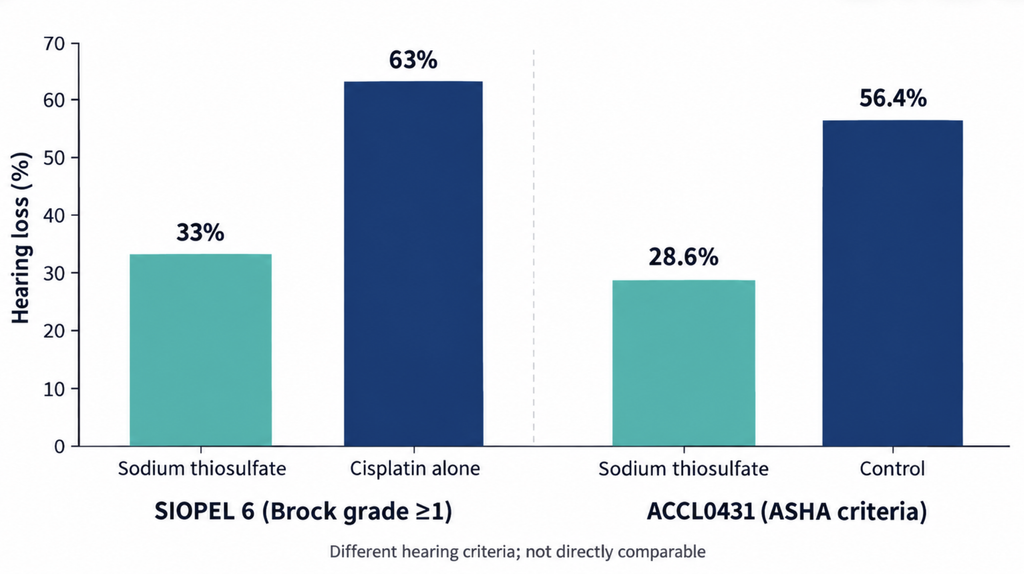
| Hearing loss, sodium thiosulfate vs control | 33% vs 63% | 28.6% vs 56.4% |
| Effect estimate | RR 0.52 (95% CI 0.33–0.81) | Adjusted OR 0.31 (95% CI 0.13–0.73) |
In SIOPEL 6, hearing loss occurred in 18 of 55 children given sodium thiosulfate and 29 of 46 given cisplatin alone, a 48% lower incidence [Brock, Sodium thiosulfate for protection from cisplatin-induced hearing loss, 2018]. The FDA’s analysis of the same trial gave 39% vs 68% (RR 0.58, 95% CI 0.40–0.83), a smaller effect in the same direction.
In the FDA’s subset of 77 ACCL0431 patients with localized disease, the labeled population, hearing loss was 44% vs 58% (RR 0.75, 95% CI 0.48–1.18). Because that interval crosses 1, the stronger evidence for the labeled group comes from SIOPEL 6.
The trials’ percentages are not directly comparable: Brock grading scores absolute thresholds, while ASHA criteria count change from baseline.
Does sodium thiosulfate compromise survival?
In SIOPEL 6, survival was not worse: at a median follow-up of 52 months, 3-year event-free survival was 82% vs 79% and overall survival 98% vs 92%.
In ACCL0431, at a median follow-up of 3.5 years, an unplanned analysis found no difference in localized disease (3-year overall survival 83% vs 89%) but lower survival with sodium thiosulfate in disseminated disease: 45% vs 84%, relative hazard ratio 4.10. On the basis of this finding, sodium thiosulfate is not used routinely in metastatic disease.
With median follow-up extended to 7.8 years, 6-year overall survival in localized disease stayed similar (80% vs 84%), but the disseminated-disease gap persisted at 45% vs 73% (relative hazard ratio 2.74, 95% CI 1.01–7.44) [Orgel, Sodium thiosulfate for prevention of cisplatin-induced hearing loss: updated survival from ACCL0431, 2022]. The investigators concluded the difference was not a short-follow-up artifact, although an imbalance in unrecorded prognostic factors cannot be excluded.
The 2020 guideline recommendations follow the same split: strong for non-metastatic hepatoblastoma, weak for other non-metastatic cancers, and weak against routine use in metastatic cancers [Freyer, Prevention of cisplatin-induced ototoxicity in children and adolescents with cancer: a clinical practice guideline, 2020].

Safety and practical considerations
Hypersensitivity reactions occurred in 8–13% of trial patients, and the product may contain sodium sulfite. Hypernatremia occurred in 12–26% and hypokalemia in 15–27%. The label advises withholding the drug when serum sodium is above 145 mmol/L.
A third of SIOPEL 6 children given sodium thiosulfate still lost hearing, so baseline and serial audiology remain part of care.
Can Pedmark be used in adults?
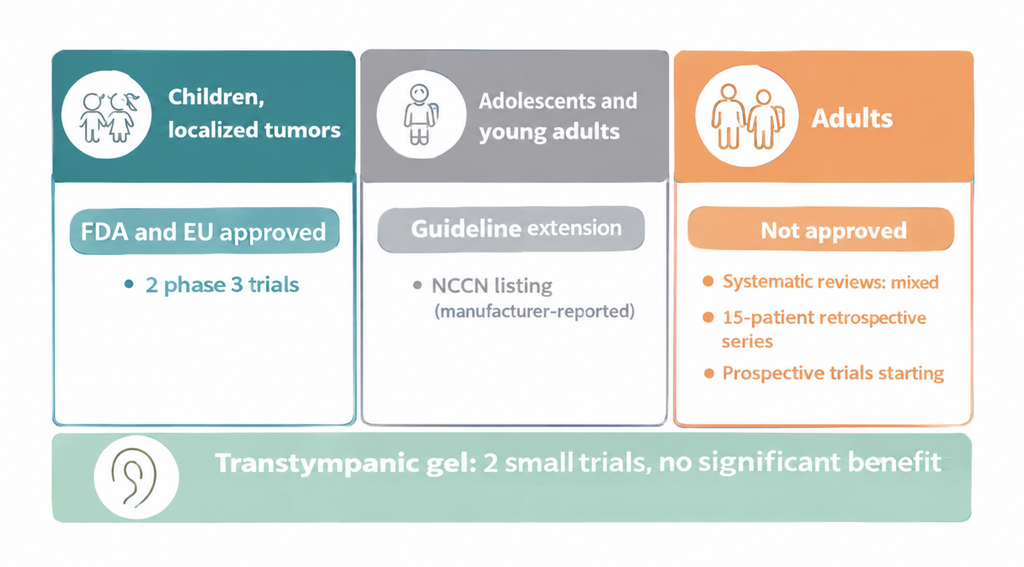
Adult use is off-label, although the 2020 guideline notes its recommendations might also apply to older adolescents and young adults. The manufacturer reports a category 2A listing in NCCN guidance for that group [Fennec Pharmaceuticals, Investigator-sponsored study to be conducted by University of Arizona Cancer Center, 2026].
A systematic review of 24 studies (1,673 patients) found only mild benefits across interventions, rated sodium thiosulfate the most promising, and judged only 6 trials at low risk of bias [Correa-Morales, Prevention and treatment of cisplatin-induced ototoxicity in adults: a systematic review, 2024]. A meta-analysis of 8 studies (431 patients) found no pooled difference, 63.3% vs 66.2%, but it combined six different agents [Briggs, Preventing cisplatin-induced hearing loss in adults: a systematic review and meta-analysis, 2025].
A company-reported retrospective review of 15 adults with head and neck cancer, presented in 2026, found dosing at least 6 hours after cisplatin feasible with no grade 3 or 4 toxicity but released no hearing numbers [Fennec Pharmaceuticals, Real world data supporting the integration and clinical use of Pedmark in treating adults with head and neck cancers, 2026]. Prospective trials are starting, including a randomized phase 1 trial in metastatic germ cell tumors and a phase 1/2 trial in head and neck cancer.
A transtympanic gel trial in 12 adults showed 12.7 dB of high-frequency loss in untreated ears vs 8.8 dB in treated ears, a non-significant difference [Duinkerken, Transtympanic sodium thiosulfate for prevention of cisplatin-induced ototoxicity, 2021]. A head and neck chemoradiation trial with cisplatin 100 mg/m² stopped after 13 patients for poor accrual, with 1.3 dB less loss in treated ears [Rolland, A randomized controlled trial to test the efficacy of trans-tympanic injections of a sodium thiosulfate gel to prevent cisplatin-induced ototoxicity in patients with head and neck cancer, 2019].
In adults on three-weekly cisplatin 100 mg/m², the timing rule is easy to meet, but hearing benefit and tumor safety remain unproven.
Key Takeaways
- Sodium thiosulfate given 6 hours after cisplatin reduced hearing loss in two pediatric phase 3 trials.
- Survival was not worse in localized hepatoblastoma, but ACCL0431 showed lower overall survival in disseminated disease that persisted at 7.8 years.
- Pedmark is approved only for children 1 month and older with localized, non-metastatic solid tumors.
- Adult evidence remains limited and mixed.
FAQ
Does sodium thiosulfate reduce the effectiveness of cisplatin?
No, not in localized disease, based on current trial data. SIOPEL 6 found similar 3-year event-free and overall survival [Brock, Sodium thiosulfate for protection from cisplatin-induced hearing loss, 2018]. In disseminated disease, ACCL0431 found lower survival with sodium thiosulfate, and the gap persisted with longer follow-up.
Can Pedmark be used in adults with head and neck cancer?
Not on label. Adult evidence comes from small trials, mixed systematic reviews, and a 15-patient retrospective series.
Is Pedmark the same as sodium thiosulfate for cyanide poisoning?
No. The FDA states Pedmark is not substitutable with other sodium thiosulfate products, some of which are co-packaged with sodium nitrite [U.S. Food and Drug Administration, FDA approves sodium thiosulfate to reduce the risk of ototoxicity associated with cisplatin in pediatric patients, 2022].
References
- Brock PR, Maibach R, Childs M, Rajput K, Roebuck D, Sullivan MJ, et al. Sodium thiosulfate for protection from cisplatin-induced hearing loss. N Engl J Med. 2018;378(25):2376-85.
- Freyer DR, Chen L, Krailo MD, Knight K, Villaluna D, Bliss B, et al. Effects of sodium thiosulfate versus observation on development of cisplatin-induced hearing loss in children with cancer (ACCL0431): a multicentre, randomised, controlled, open-label, phase 3 trial. Lancet Oncol. 2017;18(1):63-74.
- Orgel E, Villaluna D, Krailo MD, Esbenshade A, Sung L, Freyer DR. Sodium thiosulfate for prevention of cisplatin-induced hearing loss: updated survival from ACCL0431. Lancet Oncol. 2022;23(5):570-2.
- Freyer DR, Brock PR, Chang KW, Dupuis LL, Epelman S, Knight K, et al. Prevention of cisplatin-induced ototoxicity in children and adolescents with cancer: a clinical practice guideline. Lancet Child Adolesc Health. 2020;4(2):141-50.
- Harned TM, Kalous O, Neuwelt A, Loera J, Ji L, Iovine P, et al. Sodium thiosulfate administered six hours after cisplatin does not compromise antineuroblastoma activity. Clin Cancer Res. 2008;14(2):533-40.
- Duinkerken CW, de Weger VA, Dreschler WA, van der Molen L, Pluim D, Rosing H, et al. Transtympanic sodium thiosulfate for prevention of cisplatin-induced ototoxicity: a randomized clinical trial. Otol Neurotol. 2021;42(5):678-85.
- Rolland V, Meyer F, Guitton MJ, Bussières R, Philippon D, Bairati I, et al. A randomized controlled trial to test the efficacy of trans-tympanic injections of a sodium thiosulfate gel to prevent cisplatin-induced ototoxicity in patients with head and neck cancer. J Otolaryngol Head Neck Surg. 2019;48(1):4.
- Correa-Morales JE, Giraldo-Moreno S, Mantilla-Manosalva N, Cuellar-Valencia L, Borja-Montes OF, Bedoya-Muñoz LJ, et al. Prevention and treatment of cisplatin-induced ototoxicity in adults: a systematic review. Clin Otolaryngol. 2024;49(1):1-15.
- Briggs EE, Kallenberger EM, Nguyen SA, Dixon PR, Drawdy AV, Kejner AE, et al. Preventing cisplatin-induced hearing loss in adults: a systematic review and meta-analysis. Otol Neurotol. 2025;46(4):351-7.
- U.S. Food and Drug Administration. FDA approves sodium thiosulfate to reduce the risk of ototoxicity associated with cisplatin in pediatric patients with localized, non-metastatic solid tumors [Internet]. Silver Spring (MD): FDA; 2022 [updated 2024; cited 2026 Oct 25]. Available from: https://www.fda.gov/drugs/resources-information-approved-drugs/fda-approves-sodium-thiosulfate-reduce-risk-ototoxicity-associated-cisplatin-pediatric-patients
- Pedmark (sodium thiosulfate injection) prescribing information [Internet]. Research Triangle Park (NC): Fennec Pharmaceuticals; 2025 [cited 2026 Oct 25]. Available from: https://Drugs.com/pro/pedmark.html
- European Medicines Agency. Pedmarqsi: EPAR [Internet]. Amsterdam: EMA; 2023 [cited 2026 Oct 25]. Available from: https://www.ema.europa.eu/en/medicines/human/EPAR/pedmarqsi
- Scottish Medicines Consortium. Sodium thiosulfate solution for infusion (Pedmarqsi) SMC2730 [Internet]. Glasgow: SMC; 2025 [cited 2026 Oct 25]. Available from: https://scottishmedicines.org.uk/media/9137/sodium-thiosulfate-pedmarqsi-final-april-2025-for-website.pdf
- Fennec Pharmaceuticals. Fennec Pharmaceuticals presents real world data supporting the integration and clinical use of Pedmark in treating adults with head and neck cancers [Internet]. 2026 Feb 20 [cited 2026 Oct 25]. Available from: https://fennecpharma.com/?p=895396
- Fennec Pharmaceuticals. Fennec Pharmaceuticals announces investigator-sponsored study to be conducted by University of Arizona Cancer Center [Internet]. 2026 Apr 7 [cited 2026 Oct 25]. Available from: https://fennecpharma.com/?p=895424
Joonpyo Hong, MD is a board-certified otolaryngologist practicing in Korea. This article reflects his clinical interpretation of published research and does not constitute individual medical advice.
For more articles:
https://curiousmd.com/objective-hearing-tests-abr-assr-oae/
https://curiousmd.com/4-khz-notch-noise-induced-hearing-loss-diagnosis/
Link out to:
https://www.fda.gov/drugs/resources-information-approved-drugs/fda-approves-sodium-thiosulfate-reduce-risk-ototoxicity-associated-cisplatin-pediatric-patients — FDA approval notice for Pedmark, with the trial results behind the label and the 2024 warning against substituting other sodium thiosulfate products.
https://www.ema.europa.eu/en/medicines/human/EPAR/pedmarqsi — European Medicines Agency product page for Pedmarqsi, the EU name for sodium thiosulfate in cisplatin ototoxicity.
https://www.cancer.gov/news-events/cancer-currents-blog/2018/cisplatin-hearing-loss-sodium-thiosulfate — National Cancer Institute summary of the SIOPEL 6 results and why sodium thiosulfate is given 6 hours after cisplatin.
https://scottishmedicines.org.uk/media/9137/sodium-thiosulfate-pedmarqsi-final-april-2025-for-website.pdf — Scottish Medicines Consortium assessment covering dosing, mechanism, and trial evidence.