
Diagnostic pathway from patient encounter to written record, AI reasoning and shared risk decision, with only the reasoning step shaded as benchmark scope.
A 29-year-old woman is admitted with a sore throat, peritonsillar swelling and bleeding that antimicrobial therapy has not settled. Given only that opening line, a sequential diagnosis AI system from Microsoft asked for the history, ordered an ultrasound-guided core biopsy with an immunohistochemistry panel, added desmin, myogenin and MyoD1, then requested FOXO1 break-apart FISH, and named embryonal rhabdomyosarcoma of the right peritonsillar region. The adjudicating rubric scored the answer 5/5 against the published diagnosis [Nori, Sequential diagnosis with language models, 2026].
The Science paper, published in October 2026, opens with this case. The broader result is more startling. On 56 held-out clinicopathological conference cases from the New England Journal of Medicine, the system, called the Diagnostic Orchestrator (DxO), reached 83.2% accuracy, against 36.1% for generalist physicians working the same cases with search and reference tools. On emergency department admissions the figures were 80.3% and 46.8%. Both gaps were measured in a text-only simulation that the system’s developers built and ran.
Within that simulation, the authors report that DxO outperformed the participating physicians on CPC cases at every cost level they tested. The simulation starts after the untidy part is over — the patient’s words already converted into an ordered record — and stops at a diagnosis label, before anyone has to decide how much risk a particular patient should accept. On this benchmark DxO performed the reasoning between those two points better than an individual generalist, and the work at either end was never tested.
Four questions tend to come up on a first reading: what SDBench is, what DxO actually is, how to read its cost–accuracy frontier, and why the benchmark generates some test results that never existed. The later sections cover where the system is stronger and which parts of diagnostic work fall outside what the benchmark measures.
What a Sequential Diagnosis AI Benchmark Actually Tests
The Sequential Diagnosis Benchmark (SDBench) is not an established, independently validated instrument; the authors built it for this study. SDBench converts 304 NEJM case records and 325 emergency department–to–admission encounters from MIMIC-IV-ED, 629 cases in total, into stepwise encounters. A diagnostician, human or AI, starts from a short vignette and at each step may ask a question, order a test, or commit to a diagnosis. A Gatekeeper agent answers from the source record, a Judge agent scores the final diagnosis on a physician-written five-level rubric (scores of 4 or 5, meaning management would be unchanged, count as correct), and a cost estimator prices each test [Nori, Sequential diagnosis with language models, 2026].
The benchmark first appeared in a preprint posted in June 2025, when it contained only the CPC cases and the system was named MAI-DxO [Nori, Sequential Diagnosis with Language Models (preprint), 2025]. In that version, 21 physicians with a median of 12 years’ experience were barred from any reference resources and reached 19.9% at $2,963 per case.
The Science version adds an open-book condition, which answers the objection that the closed-book design handicapped physicians. The code is public, but by October 2026 no independent group had published a replication, and a public fork of the repository reviewed for this article reports no benchmark results of its own. All authors are Microsoft employees holding company equity, and eight are named on a patent application covering the evaluation framework. These facts do not invalidate the work; they place it among developer-run evaluations still awaiting outside confirmation.
The Methods also state that when a requested finding is absent from the source record, the Gatekeeper returns a diagnostically neutral synthetic result, to prevent information leakage.
A CPC record contains only the tests the treating team ordered. If the Gatekeeper replied “not available” to anything else, the reply would signal that the real clinicians did not pursue that line and would narrow the differential at no cost to the diagnostician. The preprint describes this problem directly: an early “not available” design was dropped because it hinted which queries were off the diagnostic path. Physicians reviewed 508 Gatekeeper responses, flagged 8 as potentially problematic, and on group review judged 0 to leak the diagnosis [Nori, Sequential Diagnosis with Language Models (preprint), 2025].
The design is reasonable for a fair test, but it assumes that a test the treating team never ordered would have come back unremarkable. In real patients an unordered test can be abnormal and can change the diagnosis. The safeguard therefore leaves the information environment cleaner than a ward, while the cost of every neutral result still counts against the diagnostician’s budget.
Flow diagram of SDBench showing the diagnostic agent, the Gatekeeper returning record-based or synthetic neutral results, the Judge rubric, and the cost estimator.

DxO Is a Protocol, Not a Model
The paper runs DxO on models from several providers, and the same system can be attached to GPT-5, Claude, Gemini or Llama. DxO is a set of role prompts and control code that calls an existing language model repeatedly under a fixed procedure; it is not a trained model [Nori, Sequential diagnosis with language models, 2026].
In the preprint version, a single model plays five roles in turn: one maintains the top three hypotheses, one selects up to three discriminating tests per round, one argues against the leading diagnosis, one polices cost, and one checks the panel’s output for consistency [Nori, Sequential Diagnosis with Language Models (preprint), 2025]. The control code decides who speaks, when to commit, how to stay within budget, and how to aggregate several independent runs.
Applying DxO to a model means keeping that procedure intact and swapping the engine that generates each role’s turn, with model weights untouched. On this basis the authors call the system model-agnostic, and the comparison with the same model under a minimal prompt shows what the procedure adds. Across the model families tested, the orchestration layer alone added an average of 7.9 percentage points on CPC cases and 4.4 on ED cases. Before publication the authors reran the full suite with GPT-5.5 without changing prompts or orchestration, and they report a larger gain [Nori, Sequential diagnosis with language models, 2026].
A fixed format of explicit differential, devil’s advocate, cost justification and pre-commitment check thus raised average accuracy across model families and sizes, so part of the reported advantage belongs to the procedure rather than to the model. The role design is described in the supplement and the preprint, not in the main text, and the contribution of each role cannot be judged from the Science paper alone.
Reading the Pareto Frontier Without the Headline
The paper’s central claim is that DxO established a new Pareto frontier for accuracy and cost. An illustrative set of four laptops shows what the term means.
| Option (illustrative) | Price | Performance score |
|---|---|---|
| A | $1,000 | 60 |
| B | $1,500 | 80 |
| C | $2,000 | 85 |
| D | $1,600 | 65 |
No one should choose D, because B costs less and performs better. A, B and C each survive, since buying more performance among them requires paying more. The line through A, B and C is the Pareto frontier, and any option below it is dominated. In the paper’s figures, the DxO configurations at different budgets trace that line, and every physician point sits below it [Nori, Sequential diagnosis with language models, 2026].
Pareto frontier diagram with three non-dominated options on a cost–accuracy curve and one dominated option below the line.
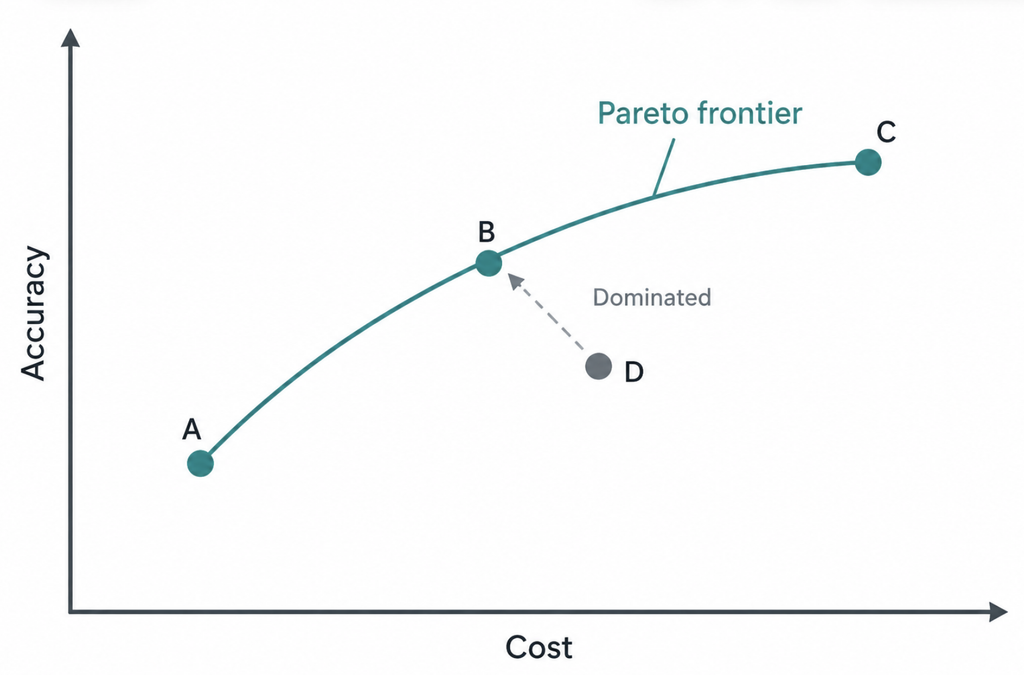
The reported operating points are as follows.
| Diagnostician | CPC accuracy | CPC cost per case | ED accuracy | ED cost per case |
|---|---|---|---|---|
| DxO, no budget | 83.2% | $5,431 | 80.3% | $4,979 |
| DxO, budget-constrained (higher setting) | 80.9% | $2,241 | 73.2% | $2,634 |
| DxO, budget-constrained (lower setting) | 79.6% | $1,303 | 69.5% | $2,037 |
| DxO, maximum accuracy | 84.5% | $8,945 | — | — |
| Physicians, closed book | 22.3% | $3,049 | — | — |
| Physicians, open book | 36.1% | $4,725 | 46.8% | $3,400 |
The lower budget settings are not identical across the two datasets, and ED physicians were assessed open book only.
The abstract’s 83.2% against 36.1%, a gap of 47.1 percentage points, pairs DxO’s unconstrained configuration with physicians who spent $706 less per case. The ED headline pairs physicians with a DxO configuration that spent $1,579 more per case. The statement that DxO is both more accurate and cheaper holds at the budget-constrained points: on ED cases, DxO at $2,634 scored 26.4 percentage points higher than the physician average while spending $766 less. The frontier claim holds on this reading, although the pair of points chosen for the abstract is the less favorable one for DxO on cost.
On CPC cases the best-performing physician reached 51.8% and was still dominated on both axes; on ED cases the best physician reached 62.5% at $3,332 over 40 cases. Physicians spent a mean of 11.9 minutes per case closed book and 18.1 minutes open book. The comparison group was individual generalists, not specialists or multidisciplinary teams, and the authors state that they would expect the gap to narrow against those groups.
Where DxO Actually Pulls Ahead
The two groups differed most clearly in their opening moves. On CPC cases, physicians asked a mean of 5.6 questions before ordering their first test, while DxO asked 25.5, about 4.6 times as many, before ordering anything [Nori, Sequential diagnosis with language models, 2026]. Overall, physicians asked 6.1 and 8.4 questions and ordered 7.1 and 12.1 tests per case in the closed-book and open-book conditions, interleaving the two compactly. DxO front-loaded a long, structured history and then tested selectively.
DxO’s gain over baseline models fell where that strategy would help: mostly in diagnoses that depend on history, such as rare exposures and travel-related infections, where deeper questioning surfaced clues a broad test battery would miss. In the authors’ error analysis, with failures first sorted by two language models and then checked by hand, DxO’s misses tended to be clinically adjacent diagnoses at the wrong level of specificity, whereas physicians’ errors sat further from the reference diagnosis.
The authors attribute part of this to the panel structure, in which explicit hypothesis tracking, adversarial critique and cost-aware test selection are designed to counter anchoring and premature closure. The paper does not measure cognitive bias directly, so this remains a plausible mechanism for the system’s consistency. The authors’ broader observation is harder to dispute: clinicians perform these operations implicitly, under time pressure and fatigue, and rarely with a colleague whose standing job is to challenge the leading hypothesis on every case [Nori, Sequential diagnosis with language models, 2026].
All of these observations come from a benchmark in which each question returns a clean, immediate answer. A 25.5-question history is efficient when every answer is already written down, and the benchmark does not show how the same strategy performs when answers are vague, inconsistent or slow to obtain.
Side-by-side comparison of mean questions asked before the first test: 5.6 for physicians and 25.5 for DxO within SDBench.
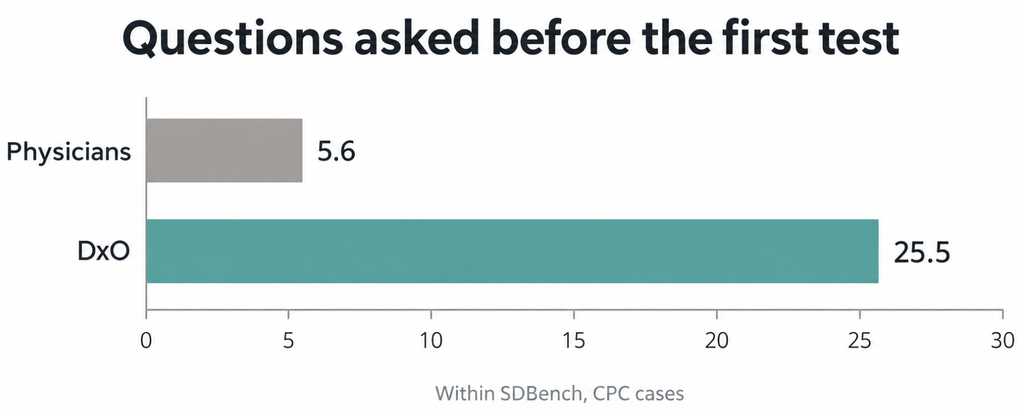
What Is Not a Moat
Papers like this invite a defensive list of what AI cannot do. A typical list names three things: translating a patient’s words into clinical language and re-asking until the history is clear, judging a case over time as follow-up accumulates, and reading information outside text, such as imaging, waveforms and pathology slides. The paper’s own limitations section touches on all three.
All three, however, sit squarely inside active research areas. In a randomized, double-blind crossover study with patient actors, a conversational diagnostic system from Google was compared with 20 primary care physicians across 159 case scenarios and outperformed them on 30 of 32 axes rated by specialists and 25 of 26 axes rated by patient actors, in text chat that its authors note is unlike usual consultations [Tu, Towards conversational diagnostic artificial intelligence, 2025].
The communication-quality argument has aged no better. In a cross-sectional study of 195 patient questions on a public forum, evaluators preferred the chatbot’s answers in 78.6% of evaluations and rated 45.1% of chatbot replies as empathetic against 4.6% of physician replies, although the chatbot’s mean reply of 211 words was about four times longer than the physicians’ 52 [Ayers, Comparing Physician and Artificial Intelligence Chatbot Responses, 2023].
The paper under discussion supplies the strongest counterexample. DxO’s most distinctive behavior was asking questions, and its advantage over baseline models concentrated in diagnoses that depend on history. Every such list has a shelf life. Defining clinical work by what a model cannot yet do only guarantees the definition will need rewriting after the next paper; the durable line has to be drawn from the structure of the work itself.
Two Ends of the Clean Record
At the input end, DxO asked 25.5 questions and received a clean answer each time. Those answers came from text that clinicians had already produced, or were synthesized to stay consistent with it: the CPC cases are curated by academic clinicians, and the ED cases are contemporaneous EHR notes [Nori, Sequential diagnosis with language models, 2026].
A clinician had already converted a patient’s “my stomach has been off” into onset, timing, relation to meals and associated symptoms. The authors state that the test sessions contained none of the noise of real encounters, such as patients omitting or forgetting information, incomplete documentation, or physiologic responses to early interventions. The study therefore measures reasoning over clinician-produced information and leaves the production of that information untested.
Earlier evidence suggests that this dependence matters. A 2024 evaluation of then-current models on 2,400 real patient cases across four abdominal conditions found them sensitive to the quantity and order of the information they were given [Hager, Evaluation and mitigation of the limitations of LLMs, 2024]. Newer orchestrated systems perform far better in an information-gathering setting, although the two studies use different cases and comparators, and the dependence on input has not been shown to disappear. As conversational systems take over parts of history-taking, checking that the record is accurate and answering for it remain with the clinician in the room.

Clinical timeline from first encounter to treatment, with SDBench scope marked between the written record and the final diagnosis label.
At the output end, the Judge scores the diagnosis label and nothing after it; the authors state that it does not assess therapeutic appropriateness, safety or longitudinal management. The decisions that follow a diagnosis fall outside the score: whether to test further or watch, whether a procedure’s benefit outweighs its risk, which risk this patient fears more.
A 2024 Cochrane review of 209 trials with 107,698 participants found that decision aids probably help patients reach choices consistent with their own values (relative risk 1.75) and improve knowledge and risk perception [Stacey, Decision aids for people facing health treatment or screening decisions, 2024]. Patient values shape the decision, and the acceptable level of risk is negotiated between a patient and a clinician who will answer for the outcome.
Some tests also carry consequences outside medicine. HIV testing, psychiatric assessment and genetic testing can raise concerns about insurance, employment and family that shape whether a patient agrees to proceed. AI can draft the explanatory text well, as the forum study shows. Recognizing which concern is driving this patient’s hesitation, and owning the decision that follows, cannot be delegated to a system that is not accountable for it.
Between these two ends sits the hospital’s own logistics. SDBench prices tests from a single US hospital chargemaster, with every test available and resulted at once; the authors note that time-to-result, invasiveness, patient discomfort and logistical availability are not captured. Actual workups depend on whether MRI is available overnight, whether a test is performed in-house or sent out, and whether transfer is safer than proceeding locally. This is a gap in the benchmark rather than a durable clinical moat, because availability and turnaround can be encoded as constraints, and DxO already operates under a budget constraint.
What resists encoding is the tacit, same-day knowledge of a particular unit and the responsibility for a transfer decision, which brings the question back to the decision end.
The authors draw the boundary themselves: the performance advantage refers to information gathering and diagnostic accuracy under idealized conditions, not to the full scope of clinical judgment.
On that reading, the study shows that in a simulated setting an orchestrated model can already reason over a well-written record more accurately than an individual generalist. As more of that middle step is delegated, more of the clinical weight falls on the two tasks at the edges: producing a record accurate enough to reason from, and making a risk decision with a patient that someone is accountable for. Clinicians whose documentation is precise may get more from such systems. The evidence still missing is prospective studies that start from unstructured encounters and end at patient outcomes.
Key Takeaways
- On a developer-built, text-only benchmark, Microsoft’s orchestrated system diagnosed NEJM cases far more accurately than individual generalists, with no independent replication yet published.
- DxO is a fixed reasoning procedure wrapped around existing language models, and that structure alone raised average accuracy across the model families tested.
- The abstract’s headline comparison uses DxO’s unconstrained configuration, which spent more per case than physicians; the claim of higher accuracy at lower cost holds at the budget-constrained settings.
- The system’s clearest behavioral difference was a long, structured history before any testing, which paid off most in exposure- and travel-dependent diagnoses.
- History-taking, communication and multimodal reading are moving targets; “what AI cannot do” is an unstable definition of clinical work.
- The benchmark starts from clinician-written records and ends at a diagnosis label, leaving record production and the patient-level risk decision untested.
FAQ
Did the sequential diagnosis AI outperform doctors with real patients?
No. All comparisons took place in SDBench, a text-only simulation in which a Gatekeeper agent answered from published case records and generated neutral results for tests the original team never ordered. No patients were involved, and the study measured diagnostic labels rather than outcomes [Nori, Sequential diagnosis with language models, 2026].
Is DxO cheaper than physicians?
It depends on configuration. Without a budget, DxO spent more per case than physicians on both datasets. With budget constraints it was both more accurate and less costly; on ED cases it reached 73.2% at $2,634 against 46.8% at $3,400 for physicians [Nori, Sequential diagnosis with language models, 2026].
Can the DxO approach be used with other language models?
Yes. DxO is a set of role prompts and control code rather than a trained model, so the underlying model can be swapped. Across the families tested, the orchestration added an average of 7.9 percentage points on CPC cases [Nori, Sequential diagnosis with language models, 2026].
Does SDBench assess treatment decisions?
No. The Judge agent scores only whether the final diagnosis matches the reference at the disease level. Therapeutic appropriateness, safety and longitudinal management fall outside the benchmark, as the authors state in their limitations [Nori, Sequential diagnosis with language models, 2026].
References
- Nori H, Daswani M, Kelly C, et al. Sequential diagnosis with language models. Science. 2026;394(6822):423-428.
- Nori H, Daswani M, Kelly C, et al. Sequential diagnosis with language models [preprint]. arXiv. 2025. arXiv:2506.22405.
- Ayers JW, Poliak A, Dredze M, et al. Comparing physician and artificial intelligence chatbot responses to patient questions posted to a public social media forum. JAMA Intern Med. 2023;183(6):589-596.
- Tu T, Schaekermann M, Palepu A, et al. Towards conversational diagnostic artificial intelligence. Nature. 2025;642(8067):442-450.
- Hager P, Jungmann F, Holland R, et al. Evaluation and mitigation of the limitations of large language models in clinical decision-making. Nat Med. 2024;30(9):2613-2622.
- Stacey D, Lewis KB, Smith M, et al. Decision aids for people facing health treatment or screening decisions. Cochrane Database Syst Rev. 2024;1(1):CD001431.
For more articles:
https://curiousmd.com/healthcare-ai-optum-notes-claims/
https://curiousmd.com/claude-for-healthcare/
https://curiousmd.com/personal-health-agent-ai-team-before-the-clinic/
Link out to:
The Path to Medical Superintelligence (Microsoft AI) — Microsoft’s June 2025 announcement of SDBench and MAI-DxO.
Sequential Diagnosis with Language Models, publication page (Microsoft Research) — the preprint version of the study.
Sequential Diagnosis with Language Models, full preprint (arXiv) — includes the five-role panel and the Gatekeeper design.
MIMIC-IV-ED dataset (PhysioNet) — the source of the emergency department cases.
CMS Hospital Price Transparency Final Rule (AAMC) — the rule behind the chargemaster used for cost estimates.