
Injection laryngoplasty materials are usually chosen by how long they should last, but the filler and the benefit do not always fade together. In a cohort of 94 patients given a single hyaluronic acid (HA) injection for acute unilateral vocal fold paralysis (UVFP), only 23.4% needed a second procedure [Lee, Single hyaluronate injection, 2021]. Most of those came more than 1 year later, long after the gel should have resorbed.
What Is Injection Laryngoplasty?
Injection laryngoplasty adds bulk to one vocal fold so that it meets the other fold at the midline [Mallur, Vocal fold injection review, 2010]. The added volume closes the glottic gap during phonation. The main indications are vocal fold paralysis, paresis, atrophy, and scar.
Injection and medialization thyroplasty seem to give similar short-term results. A meta-analysis of 13 studies with 896 patients found comparable Voice Handicap Index (VHI) gains within 6 months, and its authors call for larger long-term studies [Baali, Injection laryngoplasty versus thyroplasty, 2025].
How the Injection Is Done: Office or Operating Room
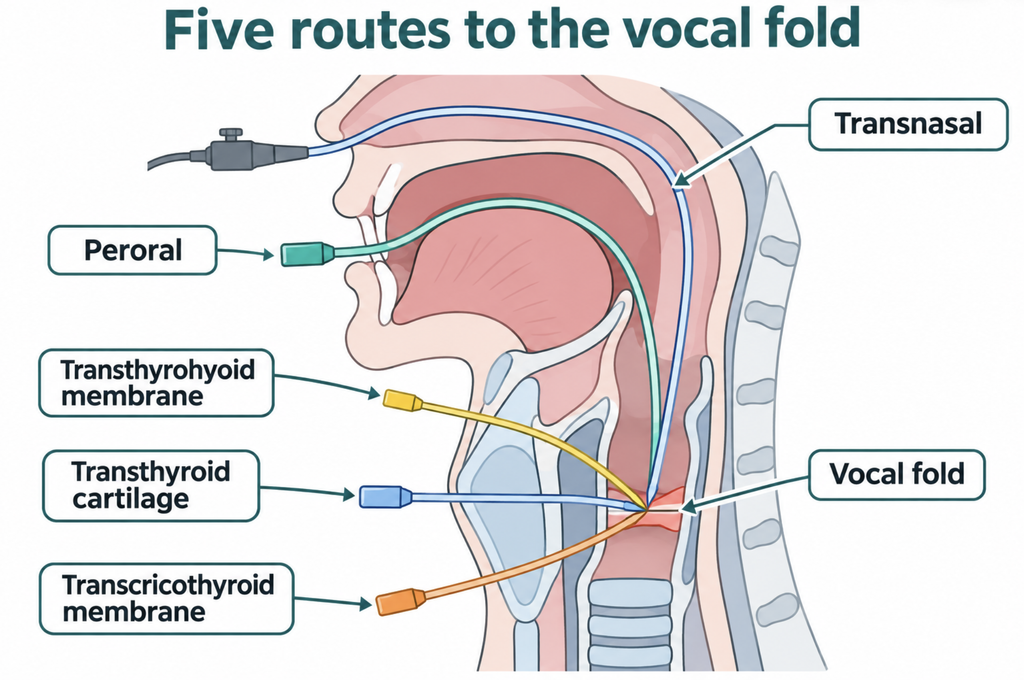
Five routes to the vocal fold
The needle can reach the fold by five routes [Mallur, Vocal fold injection review, 2010]:
- Peroral: a long curved needle over the tongue base.
- Transcricothyroid membrane: a bent needle angled up into the fold.
- Transthyroid cartilage: straight through the lamina, if it is not heavily calcified.
- Transthyrohyoid membrane: enters above the fold, so the tip is seen directly.
- Transnasal: a flexible needle through a channeled endoscope.
Technique authors note that the transthyroid cartilage route usually needs less material than the transcricothyroid route [Chhetri, Percutaneous injection, 2014].
Awake in the office or asleep in the operating room
Awake office injection lets the surgeon watch closure and hear the voice in real time, without general anesthesia and at lower cost [Mallur, Vocal fold injection review, 2010]. A systematic review of 4 comparative studies found no meaningful difference in voice outcomes between office and operating room injection [Ballard, Local vs general anesthesia injection, 2018]. The office setting gives less needle control, and minor complications may be slightly more common there.
Injection Laryngoplasty Materials and Where Each Goes
No guideline sets which material to use. A pediatric cohort of 44 children and 97 injections noted this gap and found no link between outcome and the 3 materials studied [Bishop, Pediatric injection material outcomes, 2022]. In practice, surgeons choose by how long the effect should last and how deep the material must go.
| Material | Class | Usual depth | Typical duration |
|---|---|---|---|
| Gelatin (Gelfoam) | Temporary | Deep, for medialization | 4-6 weeks |
| Carboxymethylcellulose (CMC) gel | Temporary | Deep, for medialization | 2-3 months |
| Micronized dermis (Cymetra) | Temporary | Deep, for medialization | 2-3 months |
| Hyaluronic acid | Temporary | Deep; superficial use is debated | 4-6 months, up to 12 months |
| Calcium hydroxylapatite (CaHA) | Long-lasting | Deep only | About 18 months; up to 2 years or more |
| Autologous fat | Long-lasting | Deep, for medialization | 6 months to 1 year in pooled data; reviews report longer |
| Polydimethylsiloxane (PDMS) | Permanent | Deep (paraglottic space) | Permanent; about 10 years of follow-up |
| Teflon | Permanent, now abandoned | Deep | Permanent |
Durations come from a review [Mallur, Vocal fold injection review, 2010] and a fat meta-analysis [Haddad, Lipoinjection meta-analysis, 2022]; other sources differ somewhat. Depth follows the general rule for medialization fillers.
Long-lasting and permanent options
CaHA is the main long-lasting option. In one series it gave an average benefit of 18.6 months, with a range of 8 to 36 months [Carroll, Long-term CaHA results, 2011]. Autologous fat needs a harvest and resorbs unpredictably, so surgeons overcorrect, by a mean of 30% in pooled data [Haddad, Lipoinjection meta-analysis, 2022].
PDMS particles are a permanent option used in Europe and placed in the paraglottic space [Sittel, PDMS particles, 2006]. Teflon is also permanent, but surgeons largely abandoned it because of foreign-body granulomas [Mallur, Vocal fold injection review, 2010].
Why depth matters
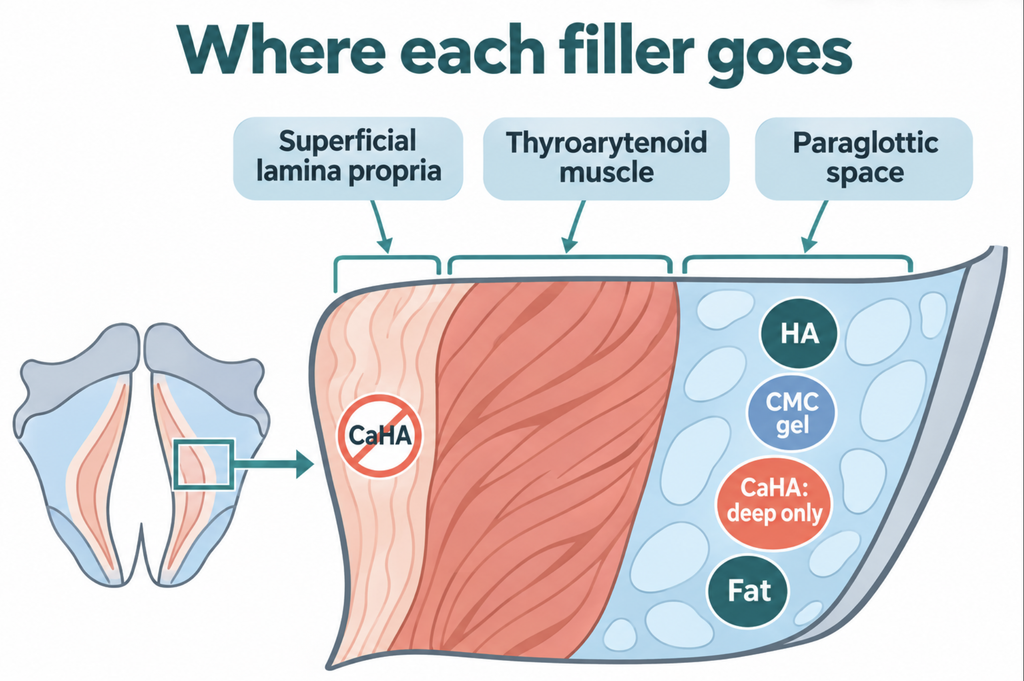
Augmentation fillers belong deep, in the lateral thyroarytenoid and lateral cricoarytenoid muscle complex, at the medial edge of the paraglottic space [Mallur, Vocal fold injection review, 2010]. Filler there pushes the free edge toward the midline, much like a type I thyroplasty. The superficial lamina propria is the vibrating layer, and stiff or bulky material there can damp the mucosal wave.
Superficial HA has worsened vibration in some reported patients [Mallur, Vocal fold injection review, 2010]. In a review of 1,044 awake CaHA injections, superficial placement occurred in 1.2%, and the authors suspect it is under-reported [Holland, Local anesthetic CaHA safety, 2025].
How Long Does Vocal Fold Injection Last?
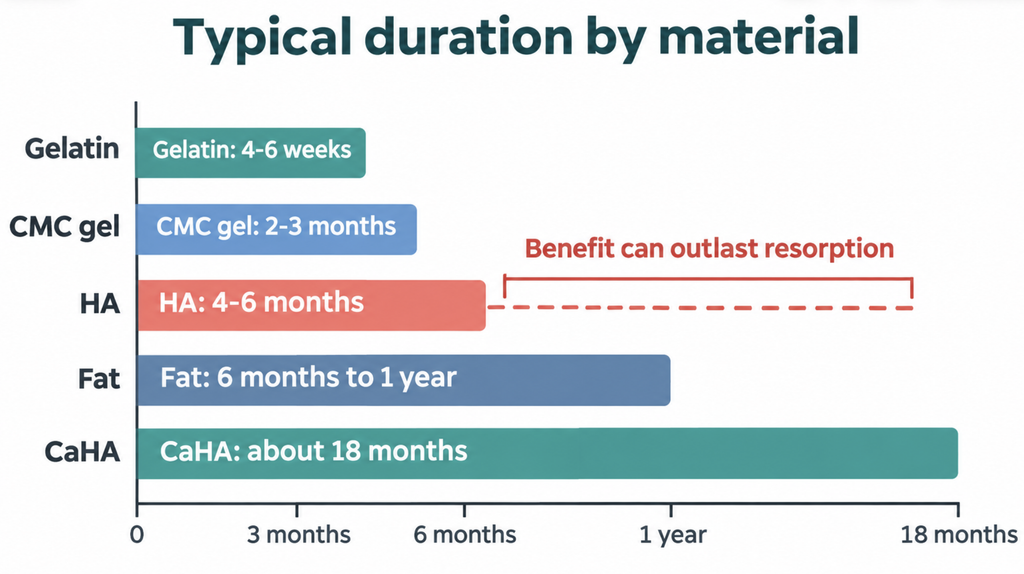
HA typically lasts 4-6 months [Mallur, Vocal fold injection review, 2010], but resorption time does not fully predict how long the benefit lasts. In the HA cohort above, 63.6% of secondary procedures came more than 1 year after the first injection [Lee, Single hyaluronate injection, 2021]. The authors suggest that natural nerve recovery and a lasting effect of early medialization partly explain this. High-concentration HA had a lower re-treatment rate than low-concentration HA, at 7.5% versus 18.2%.
CaHA benefit also fades. Its 18.6-month average came from VHI-10 scores, and most injections followed eventually lost benefit [Carroll, Long-term CaHA results, 2011].
Whether early temporary injection prevents later framework surgery is unsettled. In one series, 20 of 32 patients (62.5%) injected early with HA avoided open surgery, while all 3 late-injection patients needed it [Friedman, Early versus late injection, 2010]. A cohort of 633 patients found no reduction in framework surgery after early injection (OR 1.13, 95% CI 0.92-1.40) [Francis, Injection and framework surgery, 2016].
Patient Satisfaction and Voice Outcomes
Most studies report the VHI rather than satisfaction itself, and VHI gains are large. A meta-analysis of 12 HA and CaHA studies found a mean VHI-30 drop of 39.32 points at 4-6 weeks and 30.13 points at 6 months [Henriques, HA and CaHA meta-analysis, 2023]. For fat, pooled VHI-30 fell from 72.06 to 26.24 at 6 months across 49 articles and 1,166 patients [Haddad, Lipoinjection meta-analysis, 2022].
Most of this evidence comes from uncontrolled series. A meta-analysis of 82 single-arm studies found that injection volume and timing predicted part of the variation in MPT and HNR [Safia, Determinants of response, 2024]. After fat injection or medialization for non-paralytic dysphonia, the authors of one comparison advise expecting incomplete satisfaction and revision in a minority of patients [Rapoport, Fat injection vs medialization, 2021].
Major complications are uncommon. One CaHA series recorded 3 complications in 108 injections [Carroll, Long-term CaHA results, 2011]. A review of 1,044 awake CaHA injections reported complications in 7.1%, with major complications in 3.7% [Holland, Local anesthetic CaHA safety, 2025].
Choosing a Material: A Practical Framework
The choice depends mainly on expected recovery. Temporary fillers carry a safety margin, because a poor result fades. A widely cited review advises them when recovery is still possible, as in acute paralysis within about 6 months of onset [Mallur, Vocal fold injection review, 2010]. It advises a long-lasting material when laryngeal EMG predicts poor recovery or immobility persists past that window. A temporary injection can also serve as a trial before a long-lasting one, for example in atrophy.
For example, a hypothetical patient with new paralysis after thyroidectomy and an unclear prognosis would fit a deep HA or CMC injection. CaHA or framework surgery can wait until the course is clear, and any medialization filler still goes deep.
Key Takeaways
- Injection laryngoplasty adds bulk to one vocal fold to close the glottic gap.
- Augmentation fillers belong deep in the lateral thyroarytenoid muscle complex, not in the superficial lamina propria.
- Temporary gels such as HA typically last months, while CaHA averaged 18.6 months in one series.
- Voice benefit can outlast the filler, possibly helped in part by natural nerve recovery.
- No guideline fixes the material; expected recovery guides the choice.
FAQ
How long does injection laryngoplasty last?
It depends on the material. HA typically lasts 4-6 months [Mallur, Vocal fold injection review, 2010]. CaHA averaged 18.6 months in one series [Carroll, Long-term CaHA results, 2011]. Benefit can outlast resorption, possibly in part because the nerve recovers.
Where in the vocal fold is the material injected?
Deep. For medialization, filler goes into the lateral thyroarytenoid region next to the paraglottic space [Mallur, Vocal fold injection review, 2010]. Superficial placement can stiffen the vibrating cover.
Is injection laryngoplasty done in the office or the operating room?
Both. Voice outcomes appear similar in either setting [Ballard, Local vs general anesthesia injection, 2018]. The office avoids general anesthesia, and the operating room gives more needle control.
Can injection laryngoplasty be repeated?
Yes. In one HA cohort, 23.4% of patients had a secondary procedure, such as reinjection or framework surgery [Lee, Single hyaluronate injection, 2021].
References
- Mallur PS, Rosen CA. Vocal fold injection: review of indications, techniques, and materials for augmentation. Clin Exp Otorhinolaryngol. 2010;3(4):177-82.
- Lee YC, Pei YC, Lu YA, Chung HF, Li HY, Lee LA, et al. Long-lasting effect after single hyaluronate injection for unilateral vocal fold paralysis: does concentration matter? Biomolecules. 2021;11(11):1580.
- Baali MH, Bukhari MA, Almohizea MI, Almansour SA, Shaheen MH, Alswat SH. Injection laryngoplasty versus medialization thyroplasty for unilateral vocal cord paralysis: a comprehensive systematic review and meta-analysis. Eur Arch Otorhinolaryngol. 2025;282(12):6321-34.
- Chhetri DK, Jamal N. Percutaneous injection laryngoplasty. Laryngoscope. 2014;124(3):742-5.
- Ballard DP, Abramowitz J, Sukato DC, Bentsianov B, Rosenfeld RM. Systematic review of voice outcomes for injection laryngoplasty performed under local vs general anesthesia. Otolaryngol Head Neck Surg. 2018;159(4):608-14.
- Bishop R, Mousset M, Althubaiti A, Gerwig A, Kern C, Onwuka A, et al. Effect of injection laryngoplasty material on outcomes in pediatric vocal fold paralysis. Transl Pediatr. 2022;11(7):1114-21.
- Haddad R, Ismail S, Khalaf MG, Matar N. Lipoinjection for unilateral vocal fold paralysis treatment: a systematic review and meta-analysis. Laryngoscope. 2022;132(8):1630-40.
- Carroll TL, Rosen CA. Long-term results of calcium hydroxylapatite for vocal fold augmentation. Laryngoscope. 2011;121(2):313-9.
- Sittel C, Echternach M, Federspil PA, Plinkert PK. Polydimethylsiloxane particles for permanent injection laryngoplasty. Ann Otol Rhinol Laryngol. 2006;115(2):103-9.
- Holland JE, Evans W, Shahidi S, Marinakis K, Patel NN. Safety of local anesthetic injection laryngoplasty with calcium hydroxylapatite for unilateral vocal fold palsy: a systematic review. J Voice. 2025. Epub ahead of print.
- Friedman AD, Burns JA, Heaton JT, Zeitels SM. Early versus late injection medialization for unilateral vocal cord paralysis. Laryngoscope. 2010;120(10):2042-6.
- Francis DO, Williamson K, Hovis K, Gelbard A, Merati AL, Penson DF, et al. Effect of injection augmentation on need for framework surgery in unilateral vocal fold paralysis. Laryngoscope. 2016;126(1):128-34.
- Henriques DP, Martins RHG, Cataneo AJM. Efficacy of injectable laryngoplasty with hyaluronic acid and/or calcium hydroxyapatite in the treatment of glottic incompetence. Systematic review and meta-analysis. J Voice. 2025;39(4):945-53. Epub 2023 Feb 17.
- Safia A, Abd Elhadi U, Roch M, Kassem K, Safiya R, Zubeidat A, et al. Determinants of clinical response to injection laryngoplasty in unilateral vocal fold paralysis: a systematic review and meta-analysis. Int J Surg. 2024;110(11):7281-310.
- Rapoport SK, Murry T, Woo P. Voice assessment of fat injection vs medialization laryngoplasty in nonparalytic dysphonia. Laryngoscope Investig Otolaryngol. 2021;6(3):453-7.
Joonpyo Hong, MD is a board-certified otolaryngologist practicing in Korea. This article reflects his clinical interpretation of published research and does not constitute individual medical advice.
For more articles:
https://curiousmd.com/presbylarynx-diagnosis-and-treatment/
https://curiousmd.com/jon-bon-jovi-vocal-cord-surgery-medialization-thyroplasty/
https://curiousmd.com/vocal-nodule-vs-polyp-vs-cyst/
Link out to:
https://www.enthealth.org/conditions/vocal-cord-fold-paralysis/: ENT Health (AAO-HNS Foundation) overview of vocal fold paralysis, including vocal cord injection as a treatment option.
https://iowaprotocols.medicine.uiowa.edu/protocols/injectable-substances-injection-laryngoplasty — University of Iowa Head and Neck Protocols table of injectable materials with handling and depth notes.
https://laryngopedia.com/injection-laryngoplasty/: Laryngopedia’s illustrated entry on injection laryngoplasty materials and routes.
https://www.northshore.org/otolaryngology-head-neck-surgery/adult-programs/voice-center/treatment/office-procedures — NorthShore Voice Center description of awake, office-based vocal cord injection.