
Knowing how to stop a nosebleed matters most in winter, when dry air cracks the lining of the nose. At least 60% of people in the US have a nosebleed at some point, but only about 6% seek medical care [Tunkel, Clinical Practice Guideline: Nosebleed (Epistaxis), 2020]. This guide covers first aid, warning signs, hospital treatment, and the rare dangerous cases.
Why Nosebleeds Get Worse in Winter
In US emergency departments from 1992 to 2001, nosebleeds without injury made up 0.50% of visits from December to February, compared with 0.34% in other months [Pallin, Epidemiology of epistaxis in US emergency departments, 1992 to 2001, 2005]. Winter air dries out the lining of the nose, which then bleeds more easily [Fried, Nosebleeds, 2025].
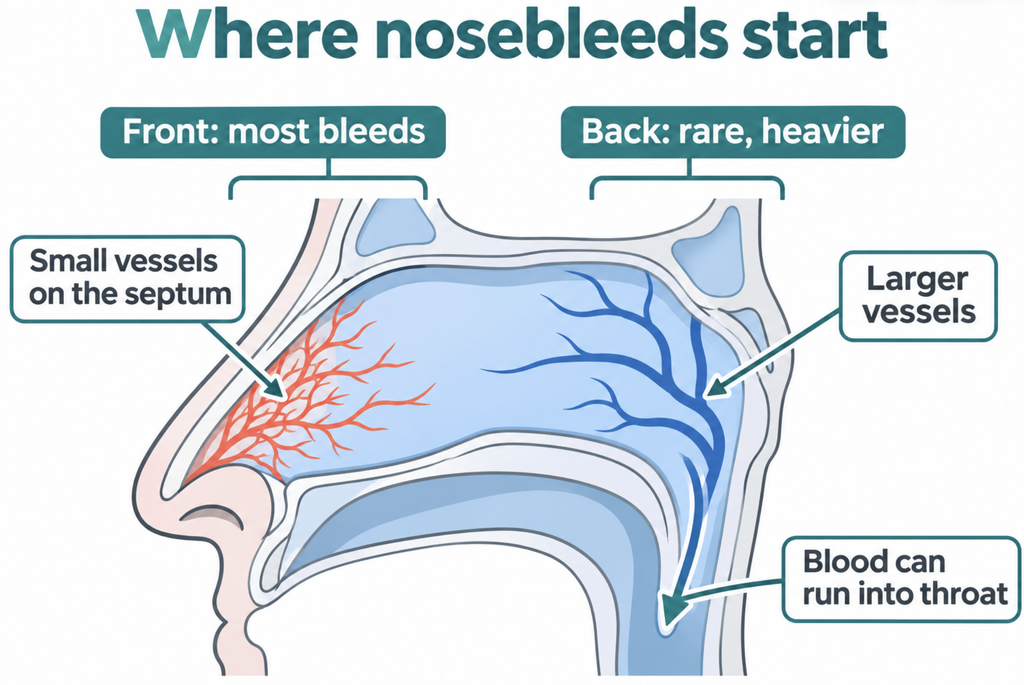
Most nosebleeds start at the front of the septum, the wall between the nostrils. In one study of 2,300 emergency patients in Turkey, 95% of bleeds came from the front and 5% from the back [Özbay, Overview of Etiology and Management of Epistaxis: Through the Mnemonic EPISTAXIS, 2025]. Bleeds from the back are heavier, occur almost only in adults, and are harder to stop [IQWiG, Nosebleeds, 2024].
How to Stop a Nosebleed at Home
The AAO-HNS (American Academy of Otolaryngology-Head and Neck Surgery) guideline recommends firm, steady pressure on the lower third of the nose for at least 5 minutes [Tunkel, Clinical Practice Guideline: Nosebleed (Epistaxis), 2020]. Its patient handout advises a full 15 minutes if the bleeding slows [AAO-HNS, Nosebleed FAQs, 2021]. The NHS advises 10 to 15 minutes [NHS, Nosebleed, 2023], so holding for 15 minutes by the clock meets all three.
- Sit up and lean slightly forward, so blood drains out and not down the throat.
- Gently blow out loose clots.
- Use a decongestant spray such as oxymetazoline in the bleeding side, if one is at hand and its label allows it.
- Pinch the soft lower part of the nose shut on both sides, and breathe through the mouth.
- Hold for 15 minutes without letting go to check. If bleeding goes on, repeat once.
In one emergency department study, oxymetazoline stopped bleeding in 71% of adults still bleeding after 15 minutes of pressure [Çelik, Comparison of the efficacy of oxymetazoline, tranexamic acid, and epinephrine-lidocaine combination in the treatment of epistaxis, 2025]. The study was not randomized, so this result needs confirming.
Common mistakes
Tilting the head back lets blood run into the throat. Leaning forward keeps blood out of the throat and airway [IQWiG, Nosebleeds, 2024], and swallowed blood can cause vomiting [NHS, Nosebleed, 2023]. Pressing the bony bridge misses the bleeding spot, which lies lower [Fried, Nosebleeds, 2025]. The evidence for ice packs is weak [NHS, Nosebleed, 2023].
After the bleeding stops
For 24 hours, avoid blowing or picking the nose, hot drinks, alcohol, heavy lifting, and lying flat [NHS, Nosebleed, 2023]. Saline spray or gel and a humidifier keep the lining moist and can help prevent the next bleed [AAO-HNS, Nosebleed FAQs, 2021].
When Does a Nosebleed Need a Doctor or the ER?
The NHS advises emergency care when a nosebleed lasts longer than 10 to 15 minutes [NHS, Nosebleed, 2023]. Mayo Clinic sets the line at 30 minutes, and also advises emergency care if a second round of pressure fails [Mayo Clinic, Nosebleeds: First aid, 2024]. Any red flag in the table below is a reason to go sooner.
| Go to the ER now | See a doctor soon |
|---|---|
| Bleeding continues after two rounds of correct pressure | Nosebleeds that keep coming back |
| Heavy bleeding, or swallowed blood that causes vomiting | Repeated bleeding from the same nostril |
| Feeling weak, dizzy, or faint | Bleeding while taking a blood thinner |
| Bleeding after a blow to the head | A known or suspected bleeding disorder |
| Trouble breathing | Any nosebleed in a child under 2 |
The AAO-HNS guideline recommends a scope exam of the nose for repeated bleeding from one side, or bleeding that returns after treatment [Tunkel, Clinical Practice Guideline: Nosebleed (Epistaxis), 2020]. Repeated bleeding from both sides, or a family history of it, calls for a check for hereditary hemorrhagic telangiectasia (HHT), an inherited blood vessel disorder. Blood thinners should not be stopped without the prescribing doctor [AAO-HNS, Nosebleed FAQs, 2021].

What Doctors Do When a Nosebleed Won’t Stop
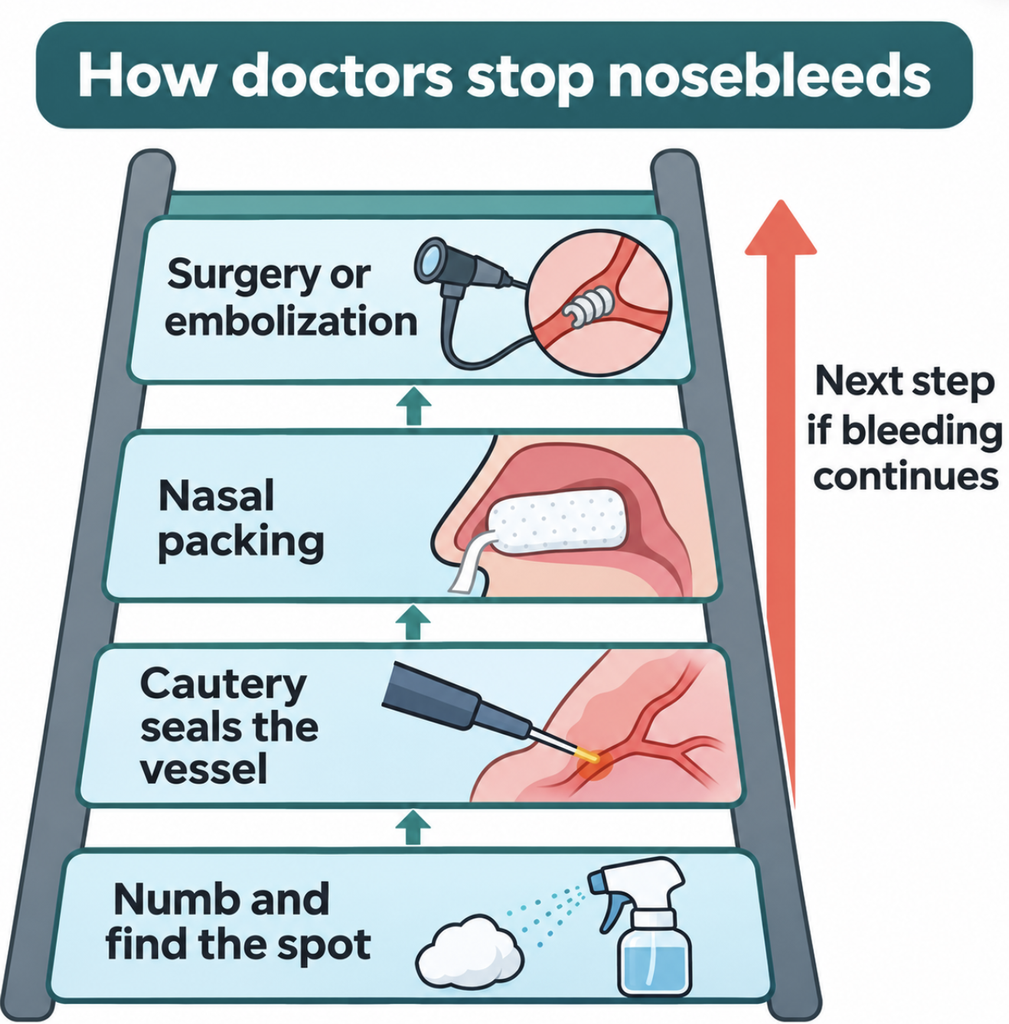
The AAO-HNS guideline lays out care that moves from simple to more involved steps [Tunkel, Clinical Practice Guideline: Nosebleed (Epistaxis), 2020].
Numb, shrink, and find the source
The doctor places cotton soaked in a numbing drug and a vessel-shrinking drug inside the nose [Fried, Nosebleeds, 2025]. A light, or a thin camera called an endoscope, helps find the bleeding spot.
Seal the vessel or pack the nose
When the spot is visible, the doctor numbs it and seals only that spot with cautery. If the source cannot be seen, or cautery fails, the doctor packs the nose with a sponge, balloon, or gauze. People on blood thinners need packing that dissolves on its own. Other packs are often removed after 1 to 2 days [IQWiG, Nosebleeds, 2024].
Surgery or embolization for stubborn bleeds
Surgery closes the main artery at the back of the nose through an endoscope. Embolization blocks it from inside with a thin tube. A systematic review found similar success: 73% to 100% for surgery and 75% to 92% for embolization [Swords, Surgical and interventional radiological management of adult epistaxis: systematic review, 2017]. None of the reviewed studies compared the two directly. Embolization carried a stroke risk of 1.1% to 1.5%.
Silver Nitrate, TCA, and Electric Cautery: How They Differ
Nasal cautery seals a bleeding vessel with a small, controlled burn from a chemical or from heat. All three methods use local numbing.
| Silver nitrate | TCA (trichloroacetic acid) | Electric cautery | |
|---|---|---|---|
| How it works | Chemical stick scars small vessels shut | Acid burn at the bleeding spot | Heat seals the vessel |
| Evidence | Quick office procedure | Like silver nitrate in one child trial, more pain | Fewer repeat bleeds in children |
With silver nitrate, silver ions cause scarring that closes the small vessels [ColumbiaDoctors, Nosebleeds: When to Get Medical Attention, 2025]. In an early adult trial, electric and silver nitrate cautery showed no clear difference [Toner, Comparison of electro and chemical cautery in the treatment of anterior epistaxis, 1990]. In one retrospective study of children, the risk of a repeat bleed was 2.45 times higher after silver nitrate than after electric cautery [Schafer, Comparing recurrence between cautery techniques in pediatric epistaxis, 2023].
The first randomized trial of TCA compared 15% TCA with silver nitrate in 157 children. Repeat bleeding was similar, but TCA hurt more [Gehad, Topical 15% trichloroacetic acid versus silver nitrate cauterization in the management of idiopathic childhood epistaxis: a prospective randomized clinical trial, 2026]. These child studies may not apply to adults. After any cautery, avoid nose blowing and heavy lifting for at least 1 week [AAO-HNS, Nosebleed FAQs, 2021].

Can a Nosebleed Be Dangerous? The Worst-Case Scenarios
Serious outcomes are rare: about 0.2% of people with nosebleeds are admitted to hospital [Tunkel, Clinical Practice Guideline: Nosebleed (Epistaxis), 2020].
- Back-of-the-nose bleeds need prompt treatment because of the risk of large blood loss [IQWiG, Nosebleeds, 2024].
- A person can choke on blood that runs into the throat.
- Packing for a back bleed usually means a hospital stay with oxygen and antibiotics [Fried, Nosebleeds, 2025]. Embolization carries a small stroke risk.
- Frequent nosebleeds can, rarely, point to HHT, a bleeding disorder, or a tumor of the nose or sinuses [Fried, Nosebleeds, 2025].
In a UK national audit of 985 patients seen by ENT teams, 3.4% died from any cause within 30 days, but none died from blood loss [INTEGRATE, Epistaxis and mortality, 2018]. Those who died were more likely to have heart disease, diabetes, or a bleeding tendency.
Key Takeaways
- Sit up, lean forward, and pinch the soft lower nose for 15 minutes without letting go.
- Tilting the head back sends blood into the throat.
- Mayo Clinic advises emergency care after 30 minutes of bleeding; the NHS sets a shorter limit.
- Doctors find the bleeding spot and treat it with cautery or packing.
- Repeated bleeding from one nostril calls for a scope exam.
FAQ
Is it safe to tilt the head back during a nosebleed?
No. Tilting back lets blood run into the throat. Leaning slightly forward keeps blood out of the throat and airway [IQWiG, Nosebleeds, 2024].
Does nasal cautery hurt, and can the bleeding come back?
A little. The nose is numbed first [Tunkel, Clinical Practice Guideline: Nosebleed (Epistaxis), 2020], and silver nitrate stings for a few minutes [ColumbiaDoctors, Nosebleeds: When to Get Medical Attention, 2025]. Bleeding can return. In children, repeat bleeds were more common after silver nitrate than after electric cautery [Schafer, Comparing recurrence between cautery techniques in pediatric epistaxis, 2023].
Should blood thinners be stopped after a nosebleed?
No, not without the prescribing doctor. The guideline advises treating the bleed first, unless it is life-threatening [Tunkel, Clinical Practice Guideline: Nosebleed (Epistaxis), 2020].
References
- Tunkel DE, Anne S, Payne SC, Ishman SL, Rosenfeld RM, Abramson PJ, et al. Clinical Practice Guideline: Nosebleed (Epistaxis). Otolaryngol Head Neck Surg. 2020 Jan;162(1_suppl):S1-S38.
- Pallin DJ, Chng YM, McKay MP, Emond JA, Pelletier AJ, Camargo CA Jr. Epidemiology of epistaxis in US emergency departments, 1992 to 2001. Ann Emerg Med. 2005 Jul;46(1):77-81.
- Özbay S, Bayar Muluk N, Yagci T, Ercan V, Özakin E, Yazir M, et al. Overview of Etiology and Management of Epistaxis: Through the Mnemonic EPISTAXIS. J Craniofac Surg. 2026;37(5):e307-e310. Epub 2025 Oct 8.
- Çelik T, Altun M, Kudu E, Korgan MB, Demir O, Karacabey S, et al. Comparison of the efficacy of oxymetazoline, tranexamic acid, and epinephrine-lidocaine combination in the treatment of epistaxis. Am J Emerg Med. 2025;91:104-109.
- Toner JG, Walby AP. Comparison of electro and chemical cautery in the treatment of anterior epistaxis. J Laryngol Otol. 1990 Aug;104(8):617-8.
- Schafer AD, McNutt M, Fulmer A, Bourgeois T, Elmaraghy CA. Comparing recurrence between cautery techniques in pediatric epistaxis. Int J Pediatr Otorhinolaryngol. 2023;176:111779.
- Gehad I, Elzayat S, Zaki Y, Kandil SE, Abdelhamid AS. Topical 15% trichloroacetic acid versus silver nitrate cauterization in the management of idiopathic childhood epistaxis: a prospective randomized clinical trial. Eur J Pediatr. 2026;185(12).
- Swords C, Patel A, Smith ME, Williams RJ, Kuhn I, Hopkins C. Surgical and interventional radiological management of adult epistaxis: systematic review. J Laryngol Otol. 2017 Dec;131(12):1108-1130.
- INTEGRATE (The National ENT Trainee Research Network). Epistaxis and mortality. J Laryngol Otol. 2018 Dec;132(12):1061-1066.
- NHS. Nosebleed [Internet]. London: NHS; 2023 [cited 2026 Nov 13]. Available from: https://www.nhs.uk/conditions/Nosebleed/
- Mayo Clinic Staff. Nosebleeds: First aid [Internet]. Rochester (MN): Mayo Clinic; 2024 [cited 2026 Nov 13]. Available from: https://www.mayoclinic.org/first-aid/first-aid-nosebleeds/basics/art-20056683
- AAO-HNS. Nosebleed FAQs: Clinical Practice Guidelines Patient Information [Internet]. Alexandria (VA): American Academy of Otolaryngology–Head and Neck Surgery; 2021 [cited 2026 Nov 13]. Available from: https://www.entnet.org/wp-content/uploads/2021/04/epistaxis_nosebleed_faqstable_patient.pdf
- IQWiG. Nosebleeds [Internet]. Cologne: Institute for Quality and Efficiency in Health Care (InformedHealth.org); 2024 [cited 2026 Nov 13]. Available from: https://www.informedhealth.org/nosebleeds.html
- Fried MP. Nosebleeds [Internet]. MSD Manual Consumer Version. Rahway (NJ): Merck & Co.; 2025 [cited 2026 Nov 13]. Available from: https://www.msdmanuals.com/home/ear-nose-and-throat-disorders/symptoms-of-nose-and-throat-disorders/nosebleeds
- ColumbiaDoctors. Nosebleeds: When to Get Medical Attention [Internet]. New York: ColumbiaDoctors; 2025 [cited 2026 Nov 13]. Available from: https://www.columbiadoctors.org/news/nosebleeds-when-get-medical-attention
Joonpyo Hong, MD is a board-certified otolaryngologist practicing in Korea. This article reflects his clinical interpretation of published research and does not constitute individual medical advice.
For more articles:
https://curiousmd.com/blood-pressure-control-in-epistaxis/
https://curiousmd.com/best-treatment-for-posterior-epistaxis/
Link out to:
https://www.nhs.uk/conditions/Nosebleed/ — NHS guide to stopping a nosebleed at home and the signs that mean going to A&E.
https://www.mayoclinic.org/first-aid/first-aid-nosebleeds/basics/art-20056683 — Mayo Clinic first-aid steps for nosebleeds and when to get emergency care.
https://www.entnet.org/wp-content/uploads/2021/04/epistaxis_nosebleed_faqstable_patient.pdf — Patient FAQ handout from the American Academy of Otolaryngology-Head and Neck Surgery, based on its nosebleed guideline.
https://www.msdmanuals.com/home/ear-nose-and-throat-disorders/symptoms-of-nose-and-throat-disorders/nosebleeds — MSD Manual overview of front and back nosebleeds and how doctors treat them.