
A cough that won’t go away after a cold is one of the most common complaints of cold and flu season. The fever broke a week ago, the congestion cleared, and by every reasonable measure the cold is over—except for the dry, nagging cough that still interrupts meetings, conversations, and sleep. Most people who have it ask the same two questions: why is this still happening, and what can I actually do about it?
This lingering cough has a name: post-infectious cough. One overview estimates it occurs in 11% to 25% of adults following an upper respiratory tract infection [Liang K, Postinfectious cough in adults, 2024]. Here is what the evidence says about why it lingers, how long to expect it, and which interventions are worth your time.
What Post-Infectious Cough Actually Is
A cough that persists for more than three weeks but less than eight weeks after the acute symptoms of an infection is classified as a subacute cough, and when it follows a respiratory infection it is called post-infectious cough [Braman SS, Postinfectious Cough: ACCP Evidence-Based Clinical Practice Guidelines, 2006].
The key insight is that the virus is usually long gone. The cough is not a sign of ongoing infection but of an airway still in recovery. The infection damages the lining of the airway and leaves behind inflammation, which heightens the sensitivity of the cough reflex, alters mucus production, and slows mucus clearance. The result is an airway that overreacts to small triggers—cold air, dust, perfume, a deep breath—long after the person feels otherwise well.
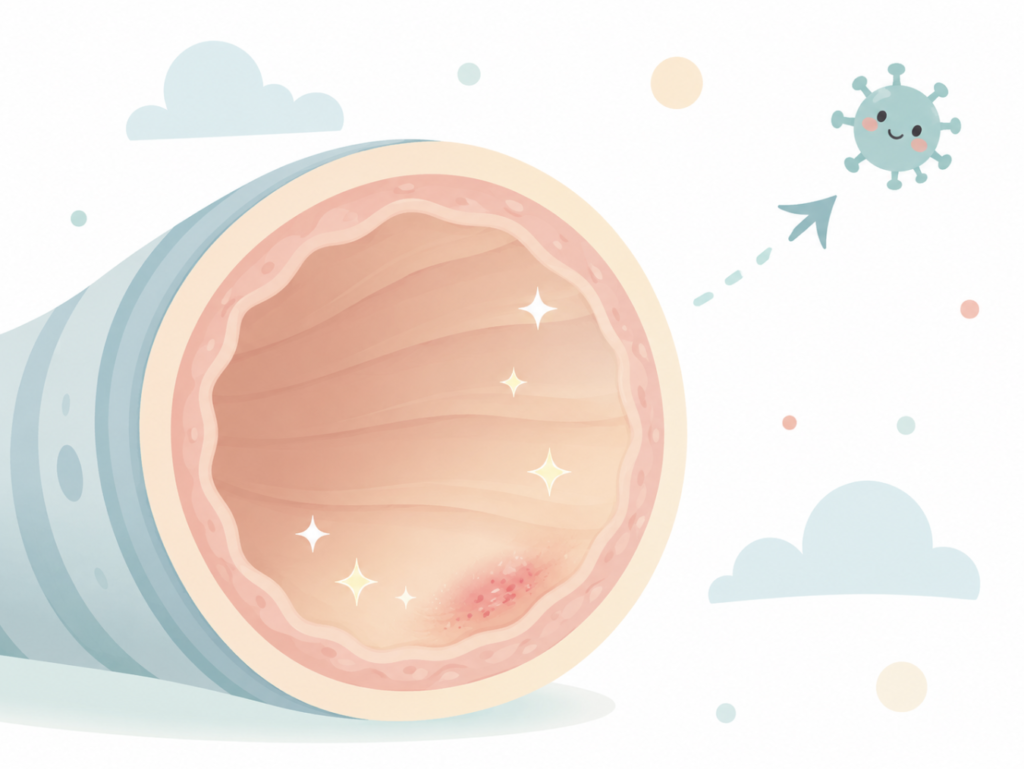
Clinical Perspective: A useful way to frame this is as a “raw” airway rather than a “sick” one. The throat and upper airway behave like a healing scrape: not infected, just easily provoked. That reframe alone can ease a great deal of anxiety—and reduce unnecessary antibiotic requests.
How Long Does a Cough That Won’t Go Away After a Cold Last?
The most common course is gradual improvement over several weeks, and most cases resolve without any specific treatment, which is why guidelines emphasize the self-limiting nature of the condition [Speich B, Treatments for subacute cough in primary care, 2018].
The eight-week mark matters. Once a cough crosses that threshold, it is reclassified as chronic, and the conversation changes. At that point, conditions that can masquerade as a lingering post-viral cough—asthma, postnasal drip, gastroesophageal reflux, or a cough triggered by ACE-inhibitor blood pressure medication—deserve a fresh look.
What Actually Helps
Here is the part many people find frustrating: the evidence does not support most medications for post-infectious cough, and pharmacologic treatment carries its own harms [Liang K, Postinfectious cough in adults, 2024]. That does not mean nothing helps. It means the most useful steps are often the simplest ones.
Start at Home: Honey, Hydration, and Avoiding Triggers
Honey is the most practical, lowest-risk option. A systematic review and meta-analysis from the University of Oxford found that honey improved both overall symptom scores and cough frequency compared with usual care [Abuelgasim H, Effectiveness of honey for symptomatic relief in upper respiratory tract infections, 2021]. It is cheap, widely available, and has virtually no downside—though it should never be given to infants under 12 months because of the risk of botulism.
Beyond honey, the foundational advice is unglamorous but effective: keep well hydrated, maintain reasonable indoor humidity, stop smoking, and steer clear of the specific triggers that set off your cough, whether that is cold air, dust, strong scents, or spicy food.

A Curious Trial: Honey Plus Coffee
One of the few randomized trials to study post-infectious cough directly tested an unusual combination. In a double-blind trial of 97 adults, a honey-plus-coffee paste produced a significantly greater reduction in cough frequency than either systemic steroid or guaifenesin [Raeessi MA, Honey plus coffee versus systemic steroid in the treatment of persistent post-infectious cough, 2013].
The details matter, because this was not a vague suggestion to “drink coffee” or “take a spoonful of honey.” Participants were given a jam-like paste and told to dissolve one tablespoon (about 25 g) in a glass of warm water (under 60°C) and drink it every eight hours for one week. In the honey-coffee group, each dose worked out to roughly 20.8 g of honey plus 2.9 g of instant coffee, taken three times daily.
The steroid comparator delivered about 13.3 mg of prednisolone per dose—roughly 40 mg daily, near the maximum suggested for this condition—and a separate control group received guaifenesin. In other words, this was a defined regimen tested under trial conditions, not a casual home remedy. It is also a single-center study with a modest sample, so it is best viewed as a low-risk option worth trying rather than a definitive prescription—but for someone desperate for relief, a warm honey-coffee drink is a reasonable and pleasant experiment.
Medications: Modest Expectations
For people whose quality of life is genuinely suffering, guidelines suggest a trial of inhaled ipratropium may attenuate the cough [Braman SS, Postinfectious Cough: ACCP Evidence-Based Clinical Practice Guidelines, 2006]. Inhaled corticosteroids are sometimes used next, but the evidence for them in subacute and chronic cough is inconsistent and has not shown clear benefit [Johnstone KJ, Inhaled corticosteroids for subacute and chronic cough in adults, 2013]. Antibiotics have no role unless there is a specific bacterial cause such as sinusitis or pertussis.
When It Becomes Chronic: Behavioral Therapy and New Drugs
If the cough pushes past eight weeks, two newer approaches are worth knowing. Behavioral cough suppression therapy—delivered by speech-language pathologists—teaches techniques such as suppressing the urge to cough, swallowing, sipping water, and modified breathing. A meta-analysis of randomized trials found moderate evidence that it improves quality of life and reduces cough severity, frequency, and sensitivity [Yi B, Efficacy of behavioral cough suppression therapy for refractory chronic cough or unexplained chronic cough, 2024]. This option is appealing precisely because it gives people concrete things to do when medication has failed them.
For genuinely refractory chronic cough, the drug gefapixant—which blocks the P2X3 receptor involved in cough hypersensitivity—became the first agent to show efficacy with an acceptable safety profile in large phase 3 trials, though taste disturbance is a notable side effect [McGarvey LP, Efficacy and safety of gefapixant in refractory chronic cough and unexplained chronic cough, 2022]. It is important to be precise about who this drug is for: it targets unexplained chronic cough (UCC) and refractory chronic cough (RCC)—coughs lasting more than eight weeks that persist despite treating the underlying cause—not the acute or subacute cough that resolves within a few weeks of an infection.
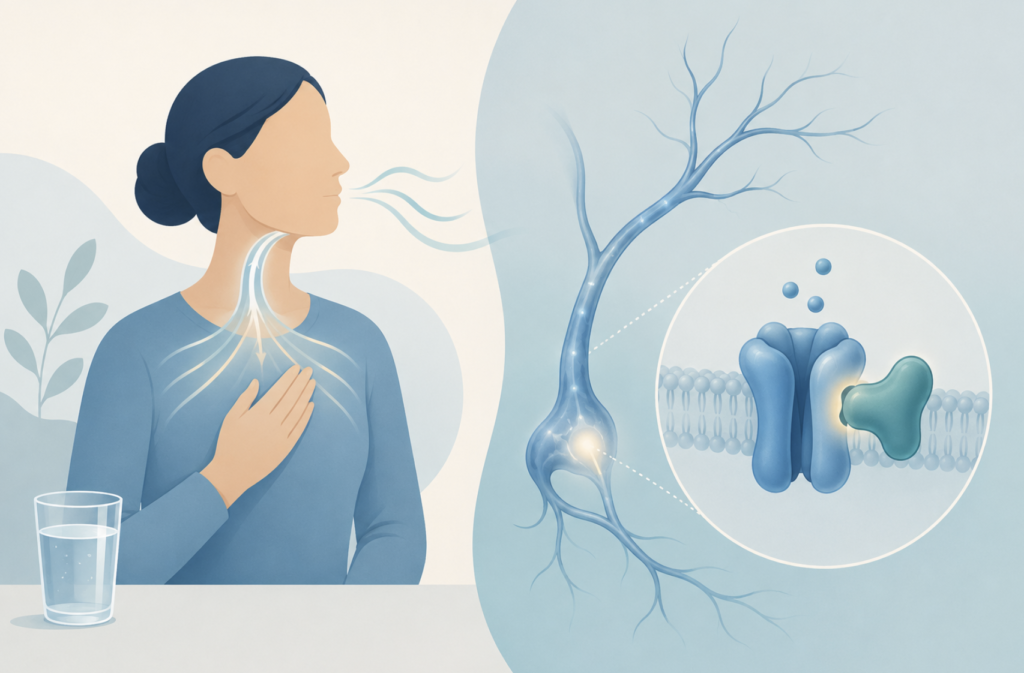
Its regulatory status also varies sharply by country, which is worth knowing before raising expectations. Gefapixant was approved in Japan and Switzerland in 2022 and in the European Union in September 2023, where it is marketed under the brand name Lyfnua. In the United States, however, the FDA declined to approve it twice—issuing complete response letters in 2022 and again in late 2023 after its advisory committee voted overwhelmingly against it, concluding the data did not establish a clinically meaningful benefit.
In South Korea, gefapixant does not appear to have received approval or to be commercially available as of early 2026. So while it represents a genuine advance in the science of cough, it remains a specialist-level option with limited or no access in many regions—and not something for the typical few-week post-viral cough.
When to See a Doctor
Most post-infectious coughs resolve completely with no lasting consequences. The real danger is not the cough itself but missing a different diagnosis hiding underneath it—pertussis, asthma, COPD, chronic sinusitis, or reflux can all produce a similar picture. Seek evaluation if the cough lasts beyond eight weeks, or sooner if you notice red flags: coughing up blood, shortness of breath, unintended weight loss, hoarseness, or a cough that worsens at night.
Clinical Perspective: The coughs that linger longest often have an “amplifier” upstream—postnasal drip, silent reflux, or a hypersensitive larynx. Treating the airway as a whole, rather than the cough alone, is often what finally turns the corner.

Key Takeaways
- Post-infectious cough is a subacute cough lasting 3 to 8 weeks after a respiratory infection, and it usually resolves on its own.
- A cough that won’t go away after a cold reflects a hypersensitive, healing airway—not a persistent infection—so antibiotics have no role.
- Evidence for medications is weak; honey is the safest first-line home remedy for symptom relief.
- A cough lasting beyond 8 weeks should be reassessed for asthma, postnasal drip, and reflux.
- Red flags—blood, breathlessness, weight loss, or hoarseness—warrant prompt medical evaluation.
FAQ
How long does a cough last after a cold?
Most post-infectious coughs last between 3 and 8 weeks and then fade on their own. The airway stays sensitive while it heals, which is why the cough outlasts every other symptom. If it persists beyond 8 weeks, it should be re-evaluated.
Why am I left with only a dry cough?
Because the infection has resolved but the cough reflex remains hypersensitive. The virus damaged the airway lining and left behind inflammation, so even minor triggers—cold air, dust, a deep breath—set off coughing while the airway recovers.
Is there a good medicine for post-infectious cough?
Not really—most medications lack strong evidence and carry side effects. Inhaled ipratropium may help some people, but simple measures like honey, hydration, and avoiding triggers are usually the most useful first steps.
When should I worry about a lingering cough?
See a doctor if the cough lasts more than 8 weeks, or sooner if you cough up blood, feel short of breath, lose weight unintentionally, become hoarse, or the cough sharply worsens at night.
References
- Liang K, et al. Postinfectious cough in adults. CMAJ. 2024;196(5):E157.
- Braman SS. Postinfectious cough: ACCP evidence-based clinical practice guidelines. Chest. 2006;129(1 Suppl):138S-146S.
- Speich B, Thomer A, Aghlmandi S, et al. Treatments for subacute cough in primary care: systematic review and meta-analyses of randomised clinical trials. Br J Gen Pract. 2018;68(675):e694-e702.
- Abuelgasim H, Albury C, Lee J. Effectiveness of honey for symptomatic relief in upper respiratory tract infections: a systematic review and meta-analysis. BMJ Evid Based Med. 2021;26(2):57-64.
- Raeessi MA, Aslani J, Raeessi N, Gharaie H, Karimi Zarchi AA, Raeessi F. Honey plus coffee versus systemic steroid in the treatment of persistent post-infectious cough: a randomised controlled trial. Prim Care Respir J. 2013;22(3):325-330.
- Johnstone KJ, Chang AB, Fong KM, Bowman RV, Yang IA. Inhaled corticosteroids for subacute and chronic cough in adults. Cochrane Database Syst Rev. 2013;(3):CD009305.
- Yi B, Wang S, Xu X, Yu L. Efficacy of behavioral cough suppression therapy for refractory chronic cough or unexplained chronic cough: a meta-analysis of randomized controlled trials. Ther Adv Respir Dis. 2024;18:17534666241305952.
- McGarvey LP, Birring SS, Morice AH, et al. Efficacy and safety of gefapixant, a P2X3 receptor antagonist, in refractory chronic cough and unexplained chronic cough (COUGH-1 and COUGH-2): results from two double-blind, randomised, parallel-group, placebo-controlled, phase 3 trials. Lancet. 2022;399(10328):909-923.
Joonpyo Hong, MD is a board-certified otolaryngologist practicing in Korea. This article reflects his clinical interpretation of published research and does not constitute individual medical advice.
For more interesting contents:
https://curiousmd.com/antivirals-vs-antibiotics-why-so-few/
https://curiousmd.com/long-term-effects-of-vaping-vs-smoking-ent/
https://curiousmd.com/silent-reflux-laryngopharngeal-disease/
Link out to:
CMAJ – Postinfectious cough in adults:
https://www.cmaj.ca/content/196/5/E157
University of Oxford (Nuffield Dept.) – Honey for respiratory symptoms:
https://www.phc.ox.ac.uk/news/honey-better-than-usual-care-for-easing-respiratory-symptoms-especially-cough
Cleveland Clinic – Post-Viral Cough:
https://my.clevelandclinic.org/health/diseases/post-viral-cough