
You’re in a loud restaurant and you can barely follow your friend across the table. Then you turn and face them — and somehow their words snap into focus. The fact that you hear better when you look at a speaker is usually chalked up to lip reading, and that’s partly right. But the more surprising truth is that your eyes sharpen your hearing in ways that have nothing to do with watching a mouth move.
This post walks through three different ways vision helps you hear, ending with the strangest one: simply pointing your eyes at a sound can change how well you process it — no lip reading, no visible cue required.
It Starts With, But Isn’t Only, Lip Reading
The oldest piece of this puzzle is straightforward. Watching a talker’s face makes speech far easier to understand when conditions are bad — an effect documented across decades of hearing research [Grant, The use of visible speech cues for improving auditory detection of spoken sentences, 2000].

The mechanism is partly predictive. Lip and jaw movements usually begin slightly before the sound arrives, giving your brain a head start on what’s coming [Karas, The visual speech head start improves perception and reduces superior temporal cortex responses to auditory speech, 2019]. A particular mouth shape is only compatible with a handful of speech sounds, so seeing it lets your brain rule out most of the alternatives before the audio even lands.
This is why a noisy room feels so much easier when you can see who’s talking. You’re not just hearing the words — you’re using the face as a decoder.
Your Eyes Actually Turn Up the Volume
Here’s where it gets interesting. Vision doesn’t only help you interpret speech; it makes faint sounds genuinely easier to detect. When a visual cue accompanies a sound, the threshold at which you can detect that sound drops by roughly 1–2 decibels [Grant, The use of visible speech cues for improving auditory detection of spoken sentences, 2000].
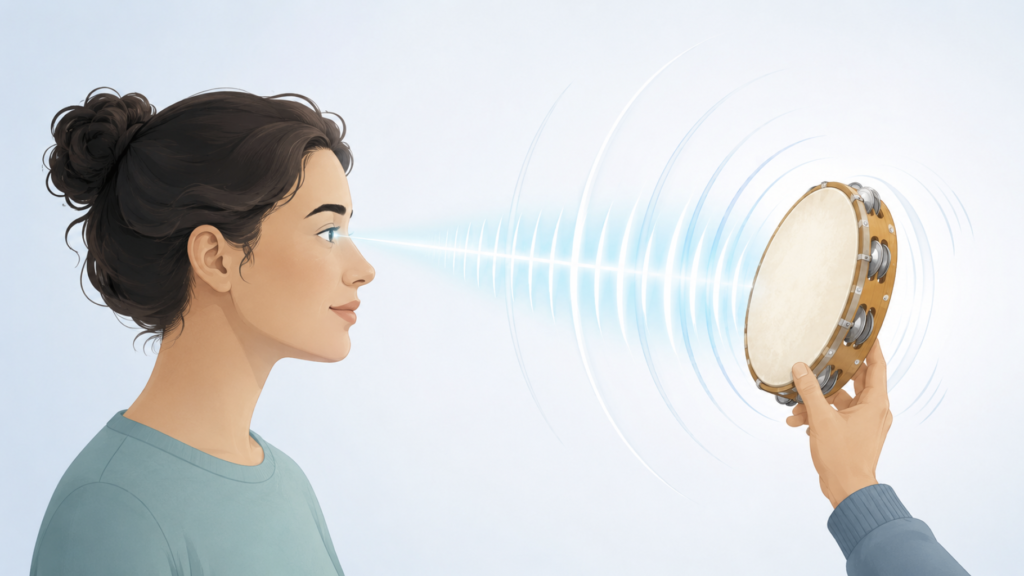
For a long time, researchers assumed this was special to speech. It isn’t. One study showed that simply seeing an object — a triangle being struck, a tambourine being shaken — lowered the auditory detection threshold for the sound that object makes, by a margin comparable to the lip-reading effect [Man, Seeing objects improves our hearing of the sounds they make, 2020]. Notably, the boost depended on actually being conscious of seeing the object.
In other words, “looking helps you hear” is a general feature of how the brain fuses senses, not a speech-only trick.
The Strangest Part: Just Pointing Your Eyes, Hear better
Now for the mechanism most people have never heard of. You don’t need a face, a moving object, or even any visible cue at all. Where you aim your eyes changes how well you process sound.
In a clever experiment, researchers had people judge tiny differences in the location of sounds while either looking toward the sound or looking away. Directing the eyes toward a sound sharpened spatial hearing — but directing attention toward it, without moving the eyes, did not [Maddox, Directing eye gaze enhances auditory spatial cue discrimination, 2014]. The benefit came specifically from the eye movement system, not from concentration.
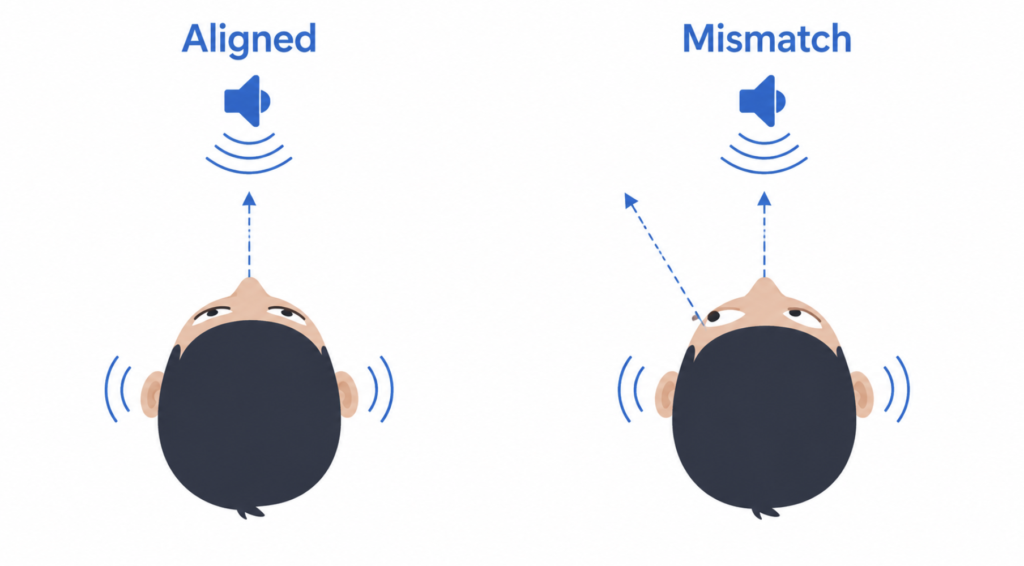
Why your brain works harder when you look away
This eye–ear coupling is strong enough to measure directly. When people tracked a sound while their gaze was pointed away from it, their reaction times slowed and their brains showed signs of working harder to compensate [Pomper, The impact of visual gaze direction on auditory object tracking, 2017].
The leading interpretation is that your brain expects your eyes and ears to point at the same thing. When they don’t, it has to spend extra effort reconciling the mismatch — effort that could have gone toward actually understanding the sound.
Clinical Perspective: Facing the speaker is more than social courtesy — it stacks three separate advantages: lip cues, a lower detection threshold, and aligned eye–ear orientation. For someone whose hearing is already strained, removing the cost of a gaze–sound mismatch can be the difference between following a conversation and giving up on it. It also helps explain why phone calls and voices from another room can feel disproportionately tiring.
What This Means in Everyday Life
The practical takeaways are simple. When listening is hard, face the person you’re talking to, make sure the room is well lit so facial cues are visible, and avoid conversing with someone behind you or in another room.
This matters most as we age. Hearing tends to decline gradually, and people lean more heavily on visual cues to fill the gaps — which is exactly why good lighting and clear sightlines become more important, not less, over time.
Key Takeaways
- Watching a speaker’s face improves understanding partly because lip movements begin before the sound, giving the brain a predictive head start.
- Seeing a sound’s source can lower your auditory detection threshold by roughly 1–2 decibels — the effect works for objects, not just speech.
- Simply directing your eyes toward a sound sharpens spatial hearing, while directing attention alone does not.
- Your brain expects your eyes and ears to point the same way; a mismatch slows responses and increases the mental effort of listening.
FAQ
Why can I hear someone better when I look at them? Because looking gives you three advantages at once: lip and facial cues that help decode speech, a lower threshold for detecting faint sound, and aligned eye–ear orientation that lets your brain process sound more efficiently. The effect is strongest in noisy settings.
Does where I look really affect how well I hear? There’s evidence pointing that way. When gaze is directed away from a sound source, reaction times slow and the brain appears to work harder to keep up [Pomper, The impact of visual gaze direction on auditory object tracking, 2017]. Aligning where you look with where the sound is seems to make listening easier.
Does this help people with hearing loss? Yes, and arguably more so. As hearing declines, people rely more on visual cues to follow conversation. Facing the speaker, ensuring good lighting, and keeping a clear line of sight can meaningfully reduce listening effort. None of this replaces an audiological evaluation, but it’s a low-cost everyday habit.
References
- Grant KW, Seitz PF. The use of visible speech cues for improving auditory detection of spoken sentences. J Acoust Soc Am. 2000;108(3 Pt 1):1197-1208.
- Karas PJ, Magnotti JF, Metzger BA, Zhu LL, Smith KG, Yoshor D, Beauchamp MS. The visual speech head start improves perception and reduces superior temporal cortex responses to auditory speech. eLife. 2019;8:e48116.
- Man K, Melo G, Damasio A, Kaplan J. Seeing objects improves our hearing of the sounds they make. Neurosci Conscious. 2020;2020(1):niaa014.
- Maddox RK, Pospisil DA, Stecker GC, Lee AKC. Directing eye gaze enhances auditory spatial cue discrimination. Curr Biol. 2014;24(7):748-752.
- Pomper U, Chait M. The impact of visual gaze direction on auditory object tracking. Sci Rep. 2017;7(1):4640.
Joonpyo Hong, MD is a board-certified otolaryngologist practicing in Korea. This article reflects his clinical interpretation of published research and does not constitute individual medical advice.
For more interesting contents:
https://curiousmd.com/objective-hearing-tests-abr-assr-oae/
https://curiousmd.com/music-genre-and-hearing-loss/
https://curiousmd.com/ai-hearing-aids-2026-ent-review/
Link out to:
https://elifesciences.org/articles/48116
https://pubmed.ncbi.nlm.nih.gov/24631242/
https://www.nature.com/articles/s41598-017-04475-1