
Sinonasal inverted papilloma is a benign tumor, yet a major US hospital’s patient page calls it “a precancerous growth” [Cleveland Clinic, Inverted papilloma, 2026]. Both labels fit: the slide looks benign, but the tumor remodels bone, recurs, and can turn into squamous cell carcinoma (SCC).
In a hypothetical but typical case, a middle-aged man with one blocked nostril is treated for sinusitis for a year, until pathology on a “polyp” shows inverted papilloma (IP).
What Is Sinonasal Inverted Papilloma?
Sinonasal inverted papilloma is a benign epithelial tumor of the Schneiderian mucosa that lines the nose and sinuses. Of the three sinonasal papilloma types (inverted, exophytic, oncocytic), it is the most common, at 62% in one major review [Lisan, Sinonasal inverted papilloma: from diagnosis to treatment, 2016].
The same review reports that IP makes up 0.4% to 7% of sinonasal tumors, with 0.2 to 1.5 cases per 100,000 people per year. Men are affected 2 to 5 times as often as women, and the mean age at diagnosis is 55 years. In a Korean series of 139 patients, the maxillary sinus was the most common origin (50.4%) [Yeom, Clinical outcomes of sinonasal inverted papilloma, 2023].
Why “Inverted”?
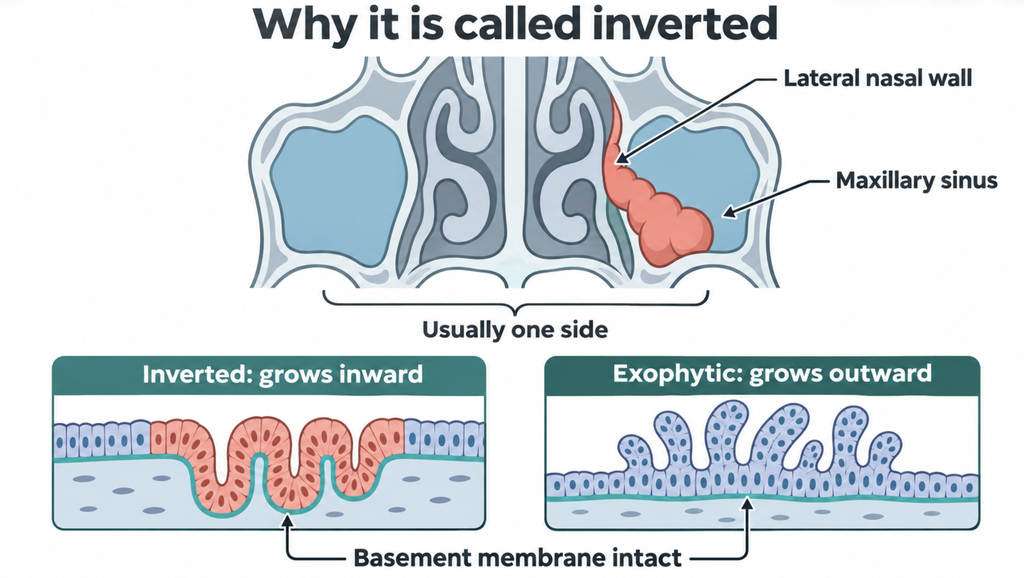
The surface epithelium folds down into the stroma instead of growing outward. The basement membrane stays intact, so the stroma is not invaded [Lisan, Sinonasal inverted papilloma: from diagnosis to treatment, 2016]. On histology, this intact membrane separates IP from invasive carcinoma.
Benign Under the Microscope while Aggressive in the Clinic
| Benign features | Cancer-like features |
|---|---|
| Intact basement membrane | Remodels bone; aggressive destruction raises concern for SCC |
| Harm comes from local growth, not distant spread | Recurs, often at the original site |
| Most lesions do not become cancer | Linked to SCC, at diagnosis or years later |
It Pushes Into Bone and Nearby Spaces
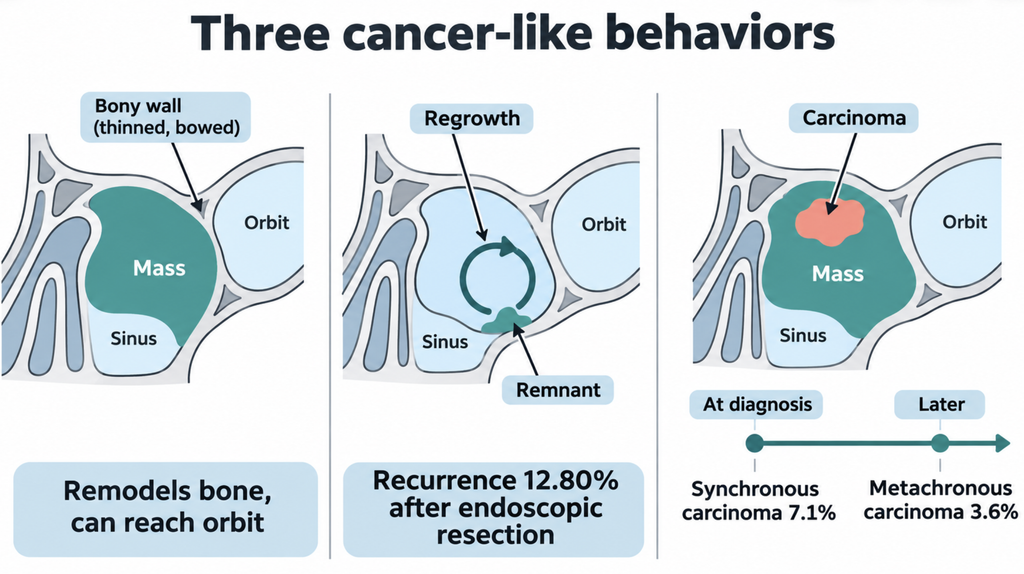
As IP enlarges, it can remodel or destroy the sinus walls and extend into the orbit or the intracranial space [Radiopaedia, Inverted papilloma, 2024].
It Comes Back After Surgery
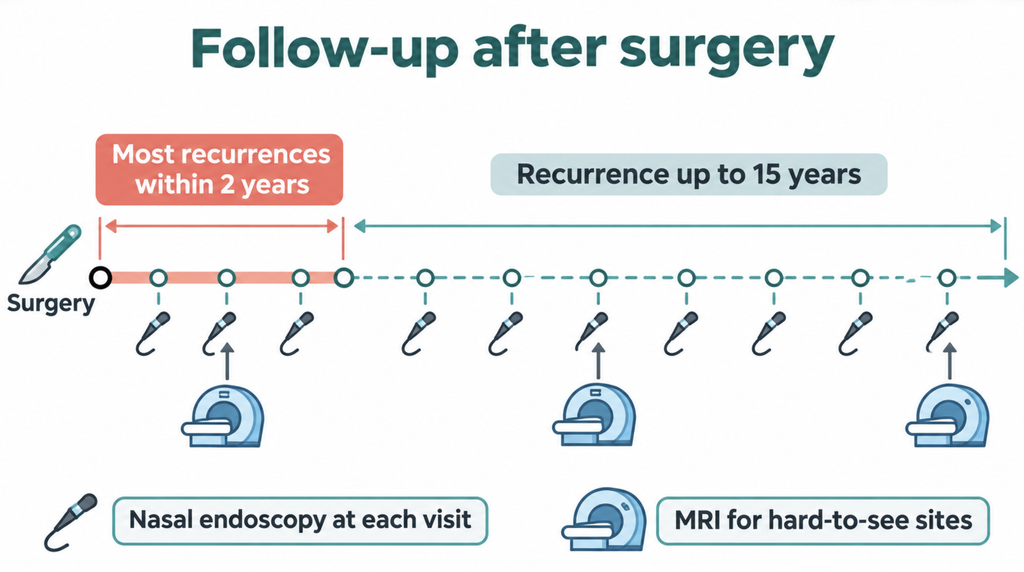
A meta-analysis of 96 studies and 4134 patients found recurrence in 12.80% after endoscopic resection [Peng, Outcomes of sinonasal inverted papilloma resection by surgical approach, 2019]. Most recurrences appear at the initial site within 2 years, which points to residual tumor rather than new disease [Lisan, Sinonasal inverted papilloma: from diagnosis to treatment, 2016]. In a French cohort of 110 patients, prior surgery was the only factor linked to recurrence (hazard ratio 4.91, 95% CI 1.80-13.39), consistent with incomplete first resection [Lisan, Sinonasal inverted papilloma: risk factors for local recurrence after surgical resection, 2017].
It Can Turn Into Cancer
A pooled analysis of 63 case series, many from tertiary centers that see more complex cases, found carcinoma already present at first treatment (synchronous) in 7.1% of 2297 cases [Mirza, Sinonasal inverted papillomas, 2007]. Carcinoma that developed during follow-up (metachronous) occurred in 3.6% of 2047 cases, a mean of 52 months later (range 6 to 180 months).
Molecular data link IP to the carcinoma that arises from it. Activating EGFR mutations were found in 88% of IPs and 77% of IP-associated SCCs, with matching genotypes in paired samples [Udager, High-frequency targetable EGFR mutations in sinonasal squamous cell carcinomas arising from inverted sinonasal papilloma, 2015]. EGFR status does not yet predict which lesion will transform.
What Causes It? Risk Factors
The cause is unknown, and HPV is a leading candidate. A meta-analysis of 76 studies found HPV in 37.8% of IPs [Syrjänen, Detection of human papillomavirus in sinonasal papillomas, 2013]. HPV is also linked to malignant change: in another meta-analysis, high-risk HPV types were tied to malignant transformation (OR 10.20, 95% CI 3.66-28.42) [Ferreli, Association between human papillomavirus infection and malignant transformation of sinonasal inverted papilloma, 2022].
Smoking is also linked to transformation. In a Korean series of 162 patients, 26.4% of smokers had malignant transformation, against 2.8% of nonsmokers (OR 12.7) [Hong, Smoking and malignancy in sinonasal inverted papilloma, 2013]. Work exposures are linked to the risk of IP itself. An Italian case-control study of 127 cases found higher risk with organic solvents (OR 2.11) and welding fumes (OR 2.14), and only solvents showed a dose-response trend [d’Errico, Occupational risk factors for sinonasal inverted papilloma, 2013].
Symptoms: One Side Is the Clue
In the 139-patient Korean series, nasal obstruction was the main complaint in 58.3% of patients, and 17.9% had no related complaint [Yeom, Clinical outcomes of sinonasal inverted papilloma, 2023]. Symptoms are usually on the side of the tumor and can resemble a sinus infection [Cleveland Clinic, Inverted papilloma, 2026], so an adult with one-sided “sinusitis” should have endoscopy.
Why It Is Often Mistaken for a Nasal Polyp
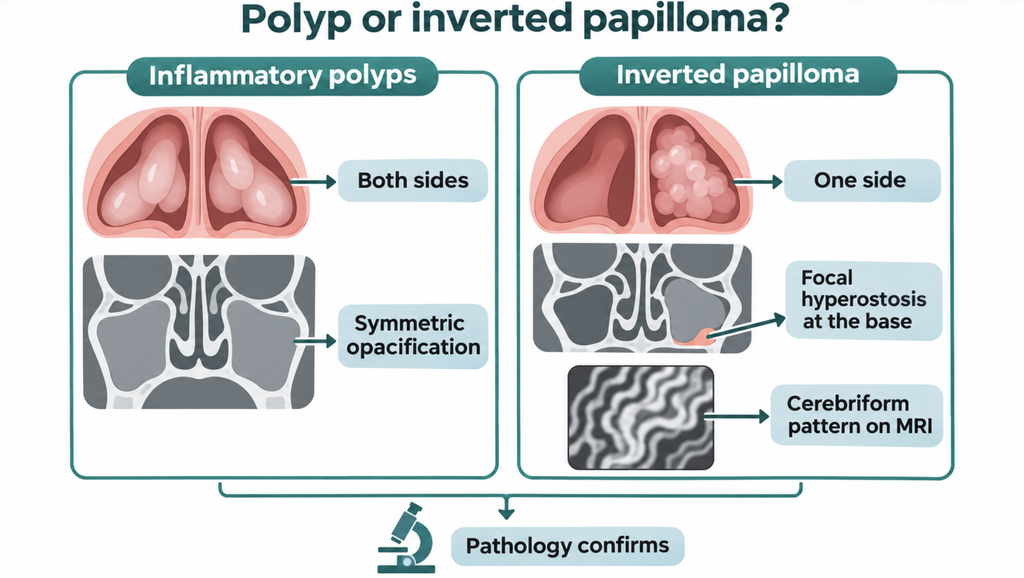
IP is usually diagnosed 1 to 4 years after the first sinonasal symptoms [Lisan, Sinonasal inverted papilloma: from diagnosis to treatment, 2016]. In an Edinburgh polypectomy series, 5 of 23 unilateral lesions were IP, while none of 75 bilateral lesions were neoplastic, so unilateral lesions need histology [Asimakopoulos, Incidence of neoplasia in patients with clinically suspicious nasal lesions and the value of computed tomography imaging in diagnosis, 2015]. Treating IP as a simple polyp also raises recurrence. In pooled data, limited resections such as polypectomy had 34.2% recurrence, against 12.8% for endoscopic resection [Mirza, Sinonasal inverted papillomas, 2007].
Imaging raises suspicion but does not settle the diagnosis. On CT, focal hyperostosis matched the tumor origin in 89.1% of 55 lesions [Lee, Focal hyperostosis on CT of sinonasal inverted papilloma as a predictor of tumor origin, 2007]. On MRI, a convoluted cerebriform pattern had 100% sensitivity and 87% specificity against malignant sinonasal tumors [Jeon, Sinonasal inverted papilloma: value of convoluted cerebriform pattern on MR imaging, 2008]. A focal loss of the pattern appeared in 4 of 8 IPs with coexisting SCC.
| Feature | Inflammatory polyps | Inverted papilloma |
|---|---|---|
| Side | Usually both | Usually one |
| CT | More symmetric opacification | Asymmetric; often focal hyperostosis at the base |
| Histology | Low yield if bilateral | Required, also to look for SCC |
How Is It Treated?
Surgery with complete removal is the treatment of choice [Lisan, Sinonasal inverted papilloma: from diagnosis to treatment, 2016]. Pooled data favor endoscopic resection, with recurrence of 12.80% after endoscopic and 16.58% after external approaches (RR 0.61, 95% CI 0.44-0.85) [Peng, Outcomes of sinonasal inverted papilloma resection by surgical approach, 2019].
A retrospective series of 127 endoscopically treated patients, which also included oncocytic papillomas, compared ways of handling the tumor base [Healy, Surgical risk factors for recurrence of inverted papilloma, 2016]. Recurrence was 52.2% after mucosal stripping alone (12 of 23) and 4.9% when the bone at the base was drilled (3 of 61).
Outlook and Follow-Up
Recurrence can appear as late as 15 years after treatment, and some authors advise lifelong follow-up [Lisan, Sinonasal inverted papilloma: from diagnosis to treatment, 2016]. Follow-up should combine nasal endoscopy with MRI for sites that are hard to see [Suh, Surveillance recommendations following resection of sinonasal inverted papilloma, 2015], so that small recurrences are found before symptoms return.
For IP-associated SCC, a meta-analysis found a pooled 5-year overall survival of 65%, against 56% for de novo sinonasal SCC [Lee, Survival outcomes of de novo vs inverted papilloma-associated sinonasal squamous cell carcinoma, 2021].
Key Takeaways
- Sinonasal inverted papilloma is benign on histology but remodels bone, recurs, and can turn into SCC.
- A unilateral nasal polyp should go to pathology.
- Most recurrences arise at the attachment site, so surgery targets the tumor base and its bone.
- Endoscopic resection is the usual approach for IP.
- Follow-up should last years, because recurrence and SCC can appear late.
FAQ
Is inverted papilloma cancerous?
No. It is benign on histology, but it can coexist with or turn into SCC. A pooled analysis found synchronous carcinoma in 7.1% of cases and metachronous carcinoma in 3.6% [Mirza, Sinonasal inverted papillomas, 2007].
How often does inverted papilloma come back after surgery?
Fairly often. Pooled data show recurrence in 12.80% after endoscopic resection and 16.58% after external approaches [Peng, Outcomes of sinonasal inverted papilloma resection by surgical approach, 2019].
How is inverted papilloma different from a nasal polyp?
Polyps are usually bilateral, and IP is usually unilateral. Imaging raises suspicion, but pathology confirms the diagnosis [Radiopaedia, Inverted papilloma, 2024].
How long is follow-up needed after inverted papilloma surgery?
Years. Recurrence can appear as late as 15 years after treatment, and some authors advise lifelong follow-up [Lisan, Sinonasal inverted papilloma: from diagnosis to treatment, 2016].
References
- Cleveland Clinic. Inverted papilloma [Internet]. Cleveland (OH): Cleveland Clinic; 2026 [cited 2026 Nov 16]. Available from: https://my.clevelandclinic.org/health/diseases/inverted-papilloma
- Lisan Q, Laccourreye O, Bonfils P. Sinonasal inverted papilloma: from diagnosis to treatment. Eur Ann Otorhinolaryngol Head Neck Dis. 2016;133(5):337-41.
- Yeom S, Lee DH, Lim SC. Clinical outcomes of sinonasal inverted papilloma: a retrospective analysis of 139 cases. J Laryngol Otol. 2023;137(10):1154-7.
- Radiopaedia. Inverted papilloma [Internet]. Radiopaedia.org; 2024 [cited 2026 Nov 16]. Available from: https://radiopaedia.org/articles/inverted-papilloma
- Peng R, Thamboo A, Choby G, Ma Y, Zhou B, Hwang PH. Outcomes of sinonasal inverted papilloma resection by surgical approach: an updated systematic review and meta-analysis. Int Forum Allergy Rhinol. 2019;9(6):573-81.
- Lisan Q, Laccourreye O, Bonfils P. Sinonasal inverted papilloma: risk factors for local recurrence after surgical resection. Ann Otol Rhinol Laryngol. 2017;126(6):498-504.
- Mirza S, Bradley PJ, Acharya A, Stacey M, Jones NS. Sinonasal inverted papillomas: recurrence, and synchronous and metachronous malignancy. J Laryngol Otol. 2007;121(9):857-64.
- Udager AM, Rolland DCM, McHugh JB, et al. High-frequency targetable EGFR mutations in sinonasal squamous cell carcinomas arising from inverted sinonasal papilloma. Cancer Res. 2015;75(13):2600-6.
- Syrjänen K, Syrjänen S. Detection of human papillomavirus in sinonasal papillomas: systematic review and meta-analysis. Laryngoscope. 2013;123(1):181-92.
- Ferreli F, Di Bari M, Moya-Plana A, et al. Association between human papillomavirus infection and malignant transformation of sinonasal inverted papilloma: a systematic review and meta-analysis. Am J Otolaryngol. 2022;43(6):103614.
- Hong SL, Kim BH, Lee JH, Cho KS, Roh HJ. Smoking and malignancy in sinonasal inverted papilloma. Laryngoscope. 2013;123(5):1087-91.
- d’Errico A, Zajacova J, Cacciatore A, et al. Occupational risk factors for sinonasal inverted papilloma: a case-control study. Occup Environ Med. 2013;70(10):703-8.
- Asimakopoulos P, Hathorn I, Monaghan H, Williams AT. Incidence of neoplasia in patients with clinically suspicious nasal lesions and the value of computed tomography imaging in diagnosis. J Laryngol Otol. 2015;129(3):254-60.
- Lee DK, Chung SK, Dhong HJ, Kim HY, Kim HJ, Bok KH. Focal hyperostosis on CT of sinonasal inverted papilloma as a predictor of tumor origin. AJNR Am J Neuroradiol. 2007;28(4):618-21.
- Jeon TY, Kim HJ, Chung SK, et al. Sinonasal inverted papilloma: value of convoluted cerebriform pattern on MR imaging. AJNR Am J Neuroradiol. 2008;29(8):1556-60.
- Healy DY, Chhabra N, Metson R, Holbrook EH, Gray ST. Surgical risk factors for recurrence of inverted papilloma. Laryngoscope. 2016;126(4):796-801.
- Suh JD, Chiu AG. Surveillance recommendations following resection of sinonasal inverted papilloma. ENTtoday [Internet]. 2015 Sep 30 [cited 2026 Nov 16]. Available from: https://www.enttoday.org/article/surveillance-recommendations-following-resection-of-sinonasal-inverted-papilloma/
- Lee JJ, Peterson AM, Embry TW, et al. Survival outcomes of de novo vs inverted papilloma-associated sinonasal squamous cell carcinoma: a systematic review and meta-analysis. JAMA Otolaryngol Head Neck Surg. 2021;147(4):350-9.
Joonpyo Hong, MD is a board-certified otolaryngologist practicing in Korea. This article reflects his clinical interpretation of published research and does not constitute individual medical advice.
For more articles:
https://curiousmd.com/fungal-sinusitis-types-symptoms-treatment/
https://curiousmd.com/sinus-microbiome-chronic-sinusitis/
https://curiousmd.com/empty-nose-syndrome-symptoms/
Link out to:
https://my.clevelandclinic.org/health/diseases/inverted-papilloma — Cleveland Clinic’s overview of inverted papilloma: symptoms, causes, surgery, and follow-up.
https://pennmedicine.org/for-patients-and-visitors/patient-information/conditions-treated-a-to-z/inverted-papilloma — Penn Medicine’s summary of how inverted papilloma is diagnosed and removed endoscopically.
https://www.enttoday.org/article/surveillance-recommendations-following-resection-of-sinonasal-inverted-papilloma/ — A Triological Society best-practice summary on surveillance after inverted papilloma resection.