
Functional rhinoplasty for nasal obstruction exists because a straight septum does not guarantee an open airway. In one single-center series of 219 rhinoplasty patients, 33 had already undergone septoplasty. All 33 still reported obstruction, often linked to residual deviation, nasal valve dysfunction or external deformity [Serdoura Alves, Back for more: why patients seek rhinoplasty after septoplasty, 2026].
What Is Functional Rhinoplasty?
Functional rhinoplasty is a set of surgical techniques that correct obstruction at the internal or external nasal valve, with breathing as the primary goal [Kandathil, Repair of the Lateral Nasal Wall in Nasal Airway Obstruction: A Systematic Review and Meta-analysis, 2018]. The internal valve is the narrowest part of the nasal airway and a common site of inspiratory collapse [Kiyohara, A Comparison of Over-the-Counter Mechanical Nasal Dilators: A Systematic Review, 2016]. A consensus panel classified nasal valve compromise as a distinct clinical entity [Rhee, Clinical consensus statement: Diagnosis and management of nasal valve compromise, 2010]. This helps explain why some septoplasties fail: straightening the septum does not stiffen a sidewall that collapses on inspiration.
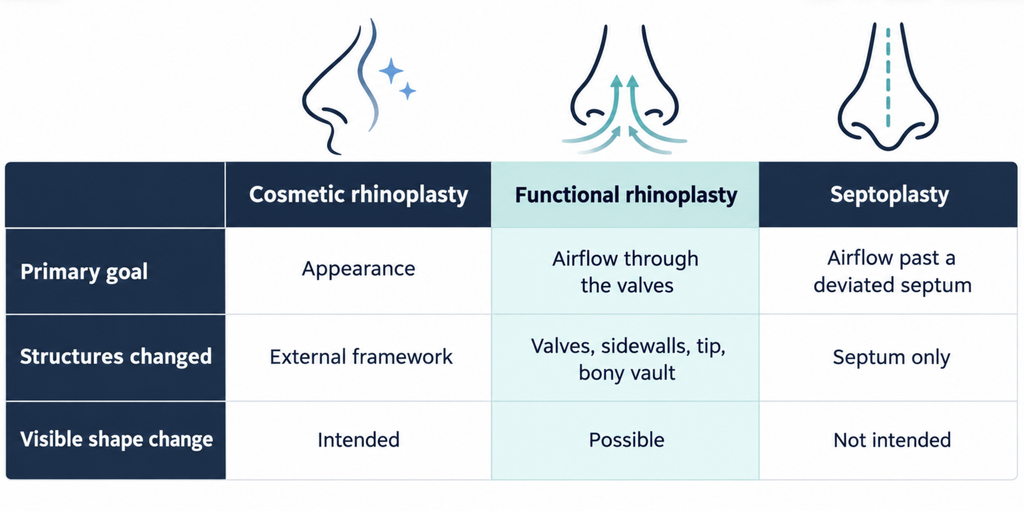
| Cosmetic rhinoplasty | Functional rhinoplasty | Septoplasty | |
|---|---|---|---|
| Primary goal | Appearance | Airflow through the valves | Airflow past a deviated septum |
| Structures changed | External framework | Valves, sidewalls, tip, bony vault | Septum only |
| Visible shape change | Intended | Possible | Not intended |
When Is Functional Rhinoplasty for Nasal Obstruction Indicated?
Typical anatomical targets
A recent systematic review calls nasal valve dysfunction a common but underrecognized cause of obstruction [Daoud, Diagnostic Approaches and Surgical Outcomes in Nasal Valve Dysfunction: A Systematic Review, 2026]. Collapse may be static or dynamic. In a Korean cohort, most internal valve dysfunction was static, and the authors observed that dynamic collapse appears less common in Asian patients [Jung, Functional and esthetic outcomes of functional rhinoplasty for internal nasal valve dysfunction in Asian patients, 2024].
How the obstruction site is identified
The consensus panel judged history and examination to be the best evaluation. In its view, endoscopy helps but is not routinely required, and imaging is not useful [Rhee, Clinical consensus statement: Diagnosis and management of nasal valve compromise, 2010]. The AAO-HNS medical-necessity criteria for valve repair include at least 12 weeks of moderate-to-severe obstruction, confirmed valve collapse and counseling about nasal dilators. The statement also advises against requiring prior septoplasty or turbinate surgery [American Academy of Otolaryngology–Head and Neck Surgery, Position Statement: Nasal Valve Repair, 2026]. The Daoud review adds that rhinomanometry and peak nasal inspiratory flow appear more reliable than isolated maneuvers such as the Cottle test. In practice, a lateral wall that collapses on gentle inspiration needs a different repair than a valve angle narrowed by high dorsal septal deviation.
How Functional Rhinoplasty Is Performed
Surgeons match each component to an obstruction site, as summarized in the table below. Open and endonasal approaches perform similarly: across rhinoplasty in general, a meta-analysis of 12 studies and 1067 patients found no difference in NOSE scores or complications [Abi Zeid Daou, Outcomes of Open Versus Closed Rhinoplasty, a Systematic Review and Meta-analysis, 2025].
Spreader grafts or flaps placed between the dorsal septum and upper lateral cartilages widen the internal valve. In a randomized trial of 40 patients, both reduced nasal resistance on rhinomanometry at 6 months, with no difference between them [Zeid, Objective Comparison Between Spreader Grafts and Flaps for Mid-Nasal Vault Reconstruction: A Randomized Controlled Trial, 2020].
Alar batten and lateral crural strut grafts stiffen the lateral wall. Across 15 studies and 1052 patients, NOSE improved by 15.8–65.6 points in lateral crural strut studies and by 25.6–69.0 points in alar batten studies. Heterogeneity prevented pooling [Jackson, Alar Battens Grafts Versus Lateral Crural Strut Grafts: A Systematic Review of Postoperative Outcomes, 2025]. When too little septal cartilage is available, surgeons use autologous or irradiated homologous rib.
| Obstruction site | Typical technique |
|---|---|
| Narrow internal valve angle | Spreader graft or flap |
| Dynamic lateral wall collapse | Alar batten or lateral crural strut graft |
| Deviated septum | Septoplasty or extracorporeal septoplasty |
| Deviated bony pyramid | Osteotomies |
| Inferior turbinate hypertrophy | Turbinate reduction |

Functional and Aesthetic Benefits
Breathing outcomes
Pooled observational studies show large symptom gains. Across 16 studies of patients with moderate-to-severe obstruction, NOSE scores (0–100, higher is worse) fell by 43 to 50 points through 12 months [Floyd, Systematic Review and Meta-analysis of Studies Evaluating Functional Rhinoplasty Outcomes with the NOSE Score, 2017]. For lateral wall repair, 10 studies with 324 participants gave a pooled change of −47.7 points (95% CI, −53.4 to −42.1), with heterogeneity of 72% [Kandathil, Repair of the Lateral Nasal Wall in Nasal Airway Obstruction: A Systematic Review and Meta-analysis, 2018]. The Daoud review, covering 12 studies and 1210 patients, reported mean reductions of 40–55 points across surgical and minimally invasive treatments.
All of these are before-and-after comparisons without controls. In a sham-controlled implant trial, NOSE still fell by 22.7 points in the sham arm [Stolovitzky, Assessment of bioabsorbable implant treatment for nasal valve collapse compared to a sham group: a randomized control trial, 2019], so part of any uncontrolled change may reflect expectation and regression toward the mean.

Aesthetic effects
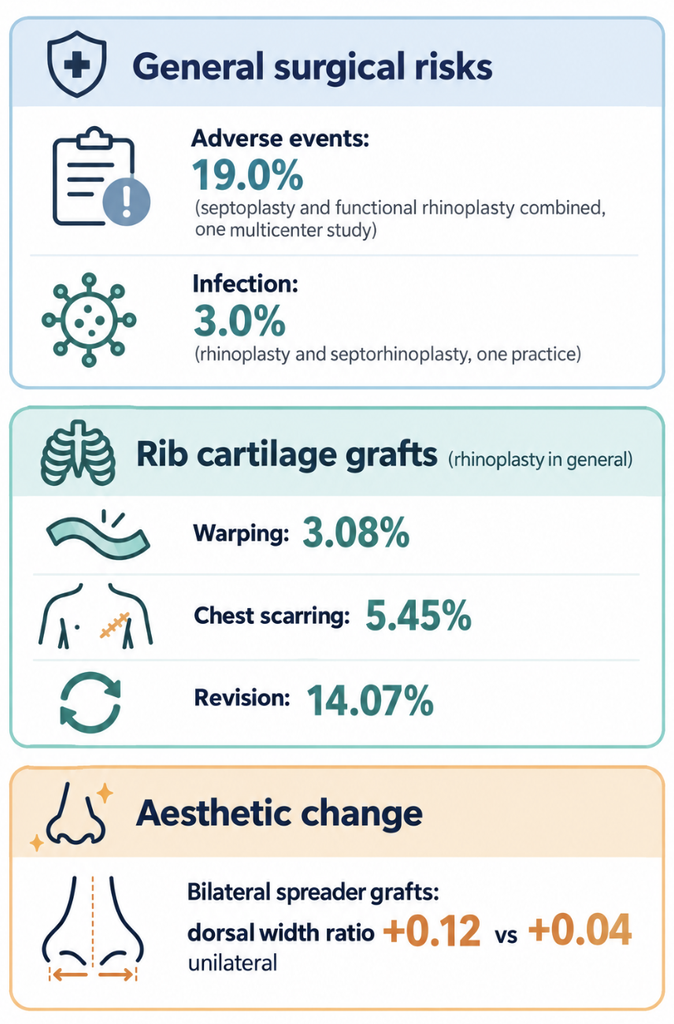
Function-driven surgery may also improve appearance. In 57 Korean patients whose functional rhinoplasty included extracorporeal septoplasty and spreader grafting, breathing improved and objective aesthetic scores were favorable across every rated feature [Jung, Functional and esthetic outcomes of functional rhinoplasty for internal nasal valve dysfunction in Asian patients, 2024]. The same grafts can also change shape in ways the surgeon did not intend. In a retrospective study of 35 patients, bilateral spreader grafts raised the dorsal width ratio by 0.12, compared with 0.04 for unilateral grafts, although patient-rated outcomes did not differ [Gimeno-Torres, Unilateral Versus Bilateral Spreader Grafts to Correct Cartilaginous Deviations in Structural Rhinoplasty: A Comparative Study on the Aesthetic and Functional Outcomes, 2026]. Patients considering bilateral spreader grafts should hear about possible dorsal widening during consent.
Risks and Complications
In a multicenter comparison, adverse events occurred in 19.0% of surgical patients (septoplasty and functional rhinoplasty combined) and in 6.9% after office radiofrequency. Median return to work after functional rhinoplasty was 7.5 days [Davis, Temperature-Controlled Radiofrequency for Severe Nasal Airway Obstruction: A Non-Inferiority Comparison With Surgical Intervention, 2026]. Infection occurred in 3.0% of 363 consecutive rhinoplasty and septorhinoplasty patients in one practice [Yoo, Microbiology and antibiotic prophylaxis in rhinoplasty: a review of 363 consecutive cases, 2015].
Rib cartilage grafts carry additional risks. Across rhinoplasty in general, a meta-analysis of 10 studies and 491 patients (mean follow-up 33.3 months) reported pooled rates of 3.08% for warping, 5.45% for hypertrophic chest scarring, 0.56% for infection and 14.07% for revision [Wee, Complications associated with autologous rib cartilage use in rhinoplasty: a meta-analysis, 2015]. Among 141 functional septorhinoplasty patients, autologous and irradiated homologous rib gave similar NOSE outcomes, but the homologous group had more infections [Justicz, Comparison of NOSE Scores Following Functional Septorhinoplasty Using Autologous versus Cadaveric Rib, 2019].
Prior septal surgery can also leave a perforation. Three of the 33 post-septoplasty patients in the series cited at the start of this article had one.
Alternatives Before or Instead of Surgery
According to the Kiyohara review, dilator strips and nasal clips relieve internal valve obstruction on objective measures in some patients. In the sham-controlled implant trial (137 patients), 3-month responder rates were 82.5% for implant versus 54.7% for sham, and NOSE changed by −42.4 versus −22.7 points. In the Davis study, radiofrequency was non-inferior to surgery at 3 months among 174 patients with NOSE ≥55 (responder rates 90.5% versus 95.7% for functional rhinoplasty). That study was open-label and not randomized. The AAO-HNS accepts implants and radiofrequency alongside grafting and suture techniques.
Key Takeaways
- Functional rhinoplasty is a set of valve-targeted procedures for a problem that septoplasty alone does not treat.
- Diagnosis is clinical, but objective airflow testing appears more reliable than isolated maneuvers such as the Cottle test.
- Pooled observational studies report NOSE reductions of roughly 43 to 50 points, but the evidence remains almost entirely uncontrolled.
- Grafts placed for breathing can change nasal shape, including dorsal widening with bilateral spreader grafts.
- Rib cartilage adds warping, chest scarring and revision risks.
FAQ
What is functional rhinoplasty?
Functional rhinoplasty is valve surgery. It combines techniques that open or stabilize the internal and external nasal valves, often with septal and turbinate work, to relieve obstruction rather than change appearance [Kandathil, Repair of the Lateral Nasal Wall in Nasal Airway Obstruction: A Systematic Review and Meta-analysis, 2018].
How is functional rhinoplasty different from septoplasty?
The two procedures have different targets. Septoplasty straightens the septum, while functional rhinoplasty supports the valves and sidewalls. The AAO-HNS advises against requiring septoplasty before valve repair [American Academy of Otolaryngology–Head and Neck Surgery, Position Statement: Nasal Valve Repair, 2026].
How soon does breathing improve after functional rhinoplasty?
Improvement can start early. In a cohort of 302 rhinoplasty patients, breathing scores in the functional and combined groups improved within 2 months and stayed improved beyond 12 months [Kandathil, Natural History of the Standardized Cosmesis and Health Nasal Outcomes Survey After Rhinoplasty, 2021].
References
- Abi Zeid Daou C, Jalkh RM, Semaan ZM, Daou AM. Outcomes of open versus closed rhinoplasty, a systematic review and meta-analysis. Plast Reconstr Surg Glob Open. 2025;13(8):e7047.
- American Academy of Otolaryngology–Head and Neck Surgery. Position statement: nasal valve repair. Approved March 2023; revised July 2026.
- Daoud M, Gherasie LM, Fufezan ML, Hainăroșie R, Voiosu C, Rusescu A, et al. Diagnostic approaches and surgical outcomes in nasal valve dysfunction: a systematic review. Diagnostics (Basel). 2026;16(9):1324.
- Davis G, Aziz Z, Barrera J, Blythe W, Davis C, Davis S, et al. Temperature-controlled radiofrequency for severe nasal airway obstruction: a non-inferiority comparison with surgical intervention. Int Forum Allergy Rhinol. 2026;16(10):1073-1083.
- Floyd EM, Ho S, Patel P, Rosenfeld RM, Gordin E. Systematic review and meta-analysis of studies evaluating functional rhinoplasty outcomes with the NOSE score. Otolaryngol Head Neck Surg. 2017;156(5):809-815.
- Gimeno-Torres L, Calvo-Gómez J, Pérez-Carbonell T, Roselló MV, Vallejo-García A, Marrero-Pérez JC, et al. Unilateral versus bilateral spreader grafts to correct cartilaginous deviations in structural rhinoplasty: a comparative study on the aesthetic and functional outcomes. Facial Plast Surg. 2026;42(4):524-530.
- Jackson JM, DeSisto NG, Sharma RK, Walden R, Yang SF, Stephan SJ, et al. Alar battens grafts versus lateral crural strut grafts: a systematic review of postoperative outcomes. Otolaryngol Head Neck Surg. 2025;173(6):1328-1336.
- Jung HJ, Park MW, Shim WS, Wee JH. Functional and esthetic outcomes of functional rhinoplasty for internal nasal valve dysfunction in Asian patients. Braz J Otorhinolaryngol. 2024;90(4):101430.
- Justicz N, Fuller JC, Levesque P, Lindsay RW. Comparison of NOSE scores following functional septorhinoplasty using autologous versus cadaveric rib. Facial Plast Surg. 2019;35(1):103-108.
- Kandathil CK, Spataro EA, Laimi K, Moubayed SP, Most SP, Saltychev M. Repair of the lateral nasal wall in nasal airway obstruction: a systematic review and meta-analysis. JAMA Facial Plast Surg. 2018;20(4):307-313.
- Kandathil CK, Saltychev M, Patel PN, Most SP. Natural history of the Standardized Cosmesis and Health Nasal Outcomes Survey after rhinoplasty. Laryngoscope. 2021;131(1):E116-E123.
- Kiyohara N, Badger C, Tjoa T, Wong B. A comparison of over-the-counter mechanical nasal dilators: a systematic review. JAMA Facial Plast Surg. 2016;18(5):385-389.
- Rhee JS, Weaver EM, Park SS, Baker SR, Hilger PA, Kriet JD, et al. Clinical consensus statement: diagnosis and management of nasal valve compromise. Otolaryngol Head Neck Surg. 2010;143(1):48-59.
- Serdoura Alves C, Mesquita B, Lino J, Gonçalves Ferreira M, Santos M. Back for more: why patients seek rhinoplasty after septoplasty. J Laryngol Otol. 2026;140(7):751-755.
- Stolovitzky P, Senior B, Ow RA, Mehendale N, Bikhazi N, Sidle DM. Assessment of bioabsorbable implant treatment for nasal valve collapse compared to a sham group: a randomized control trial. Int Forum Allergy Rhinol. 2019;9(8):850-856.
- Wee JH, Park MH, Oh S, Jin HR. Complications associated with autologous rib cartilage use in rhinoplasty: a meta-analysis. JAMA Facial Plast Surg. 2015;17(1):49-55.
- Yoo DB, Peng GL, Azizzadeh B, Nassif PS. Microbiology and antibiotic prophylaxis in rhinoplasty: a review of 363 consecutive cases. JAMA Facial Plast Surg. 2015;17(1):23-27.
- Zeid NG, Mohamed AS, ElSayed ElFouly M, Azooz KO, Aleryan MM, Abd Elmottaleb Sabaa M. Objective comparison between spreader grafts and flaps for mid-nasal vault reconstruction: a randomized controlled trial. Plast Surg (Oakv). 2020;28(3):137-141.
Joonpyo Hong, MD is a board-certified otolaryngologist practicing in Korea. This article reflects his clinical interpretation of published research and does not constitute individual medical advice.
For more articles:
https://curiousmd.com/empty-nose-syndrome-symptoms/
https://curiousmd.com/best-treatment-for-posterior-epistaxis/
https://curiousmd.com/blood-pressure-control-in-epistaxis/
Link out to:
https://entnet.org/resource/position-statement-nasal-valve-repair — American Academy of Otolaryngology–Head and Neck Surgery position statement on nasal valve repair: clinical diagnosis, accepted techniques and medical-necessity criteria.
https://www.enttoday.org/?p=22227 — ENTtoday (Triological Society) best-practice review of what the evidence shows across functional rhinoplasty grafts and techniques.
https://my.clevelandclinic.org/health/diseases/24977-nasal-valve-collapse — Cleveland Clinic overview of nasal valve collapse: causes, the Cottle maneuver and surgical and nonsurgical options.
https://www.bmc.org/ht/content/functional-rhinoplasty-0 — Boston Medical Center overview of functional rhinoplasty and its goal of improving airflow through the nasal valves.