
The best treatment for posterior epistaxis is rarely the one that happens first. A nosebleed from the back of the nose runs down the throat, is hard to see, and often continues after the nose is packed. Reviews report packing failure rates of 25% to 60% [Koskinas, Posterior epistaxis management: review of the literature and proposed guidelines of the hellenic rhinological-facial plastic surgery society, 2024]. The sections below sort the options into bedside treatments that need no anesthesia and surgical treatments, then compare their outcomes.
Why Posterior Nosebleeds Are Different
Most nosebleeds start at the front of the septum, where a few minutes of pinching works. Posterior bleeds come from deeper vessels, most often branches of the sphenopalatine artery (SPA), the main artery supplying the back of the nasal cavity [Rudmik, Management of intractable spontaneous epistaxis, 2012]. Think of a leak behind a cabinet. You can see the water on the floor, but the pipe is out of reach of a finger and hard to see without an endoscope.
The patients also tend to be older. In one emergency department series of 81 patients with posterior bleeds, the mean age was 64 and hypertension was common [Viducich, Posterior epistaxis: clinical features and acute complications, 1995].
Bedside Options That Need No Anesthesia
Posterior balloon and Foley packing
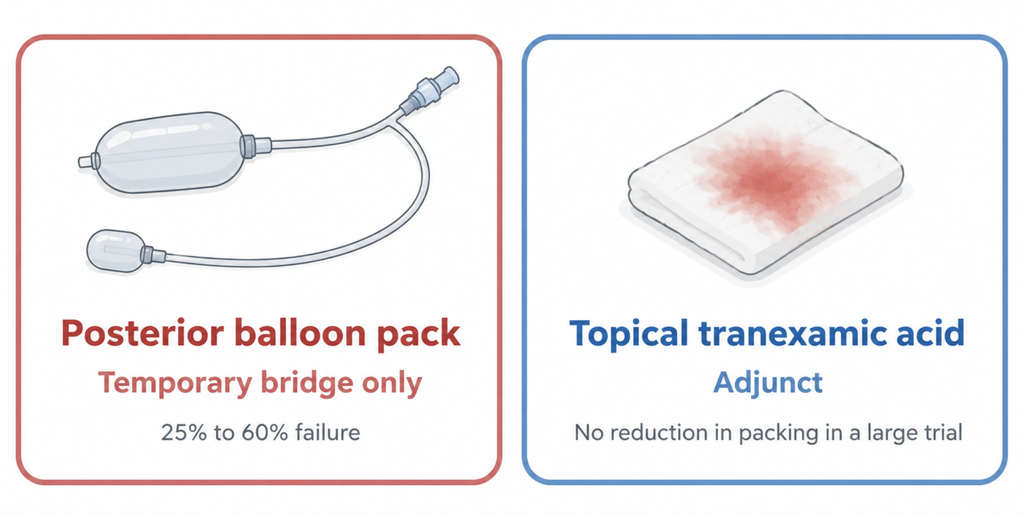
In posterior packing, the clinician passes a balloon catheter (or a Foley urinary catheter as a stand-in) through the nose, inflates it in the nasopharynx, and pulls it forward against the back of the nasal cavity, usually with an anterior pack in front. It can stop bleeding for a while, but patients are typically admitted to a monitored bed and the device stays in for 48 to 72 hours [Abuzeid, How To Treat Posterior Epistaxis With a Balloon, 2025].
The outcomes are poor. In the Viducich series, where every patient received a posterior pack, 29.6% rebled, 21% developed acute sinusitis, and 3.7% needed intubation. In a Swiss epistaxis cohort of 537 patients, packing controlled 62% of posterior bleeds, compared with 97% for surgery [Soyka, On the effectiveness of treatment options in epistaxis: an analysis of 678 interventions, 2011]. The Hellenic review describes complications in up to 68% of packed patients, from severe pain and blocked breathing to pressure necrosis and low oxygen levels. Most of these figures come from retrospective studies published in 1995 and 2011, and few recent studies have revisited posterior packing outcomes directly.
From a rhinologist’s standpoint, posterior balloon or Foley packing is not a recommended treatment. It is painful and fails often, and it keeps an older patient in hospital for days with the nasal airway blocked. Its role is narrow: a short bridge for life-threatening bleeding until the vessel itself can be treated. The AAO-HNS guideline still lists packing for active bleeding when the source cannot be seen, but it directs clinicians to evaluate arterial ligation or embolization when packing fails [Tunkel, Clinical Practice Guideline: Nosebleed (Epistaxis) Executive Summary, 2020].
Topical tranexamic acid
Tranexamic acid (TXA) stabilizes clots, and a soaked pledget needs no anesthesia. A Cochrane review found topical TXA probably stops bleeding faster than other topical agents, with 70% versus 30% of patients controlled within 10 minutes [Joseph, Tranexamic acid for patients with nasal haemorrhage (epistaxis), 2018]. A large UK trial, however, randomized 496 patients and found no reduction in the need for packing: 43.7% with TXA versus 41.3% with placebo [Reuben, The Use of Tranexamic Acid to Reduce the Need for Nasal Packing in Epistaxis (NoPAC): Randomized Controlled Trial, 2021]. Neither study isolated posterior bleeds. TXA is reasonable as an adjunct, but it does not deal with a deep arterial source.
What the Evidence Says Is the Best Treatment for Posterior Epistaxis
The options that reliably end a posterior bleed all treat the vessel itself, either surgically or through an endovascular procedure. One of the surgical options can avoid general anesthesia.
Endoscopic SPA cautery under local anesthesia
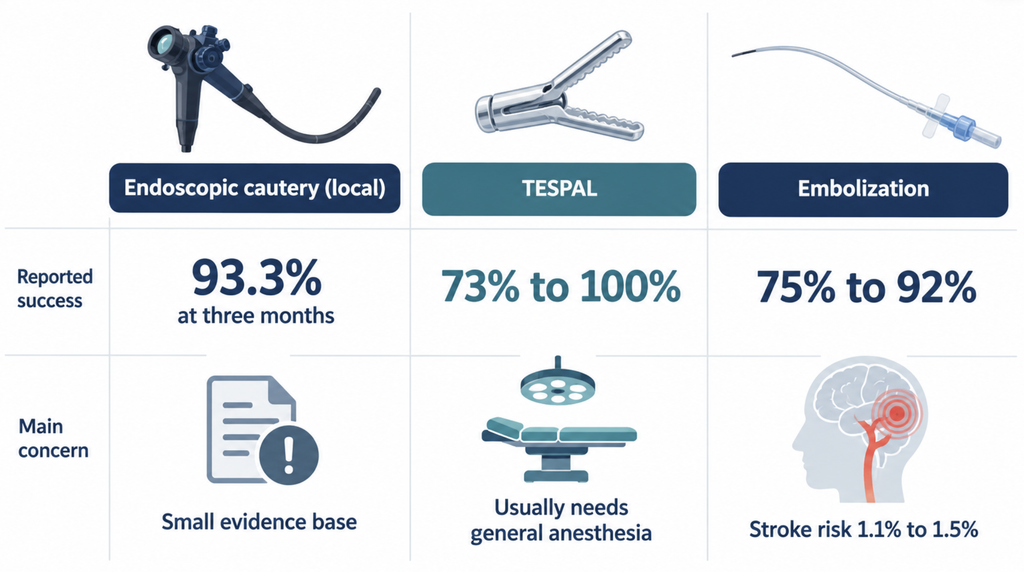
Under topical anesthesia, often with a pterygopalatine fossa block, the surgeon passes an endoscope, finds the bleeding branch, and seals it with cautery. It can sometimes be done outside the operating room, but it is still surgery: it needs an endoscope, cautery, and training in nasal anatomy. In a prospective study of 35 patients, mean pain during the procedure was 3.6 on a 10-point scale, and 93.3% had no rebleeding at three months [Gurung, Endoscopic Sphenopalatine Artery Cauterization Under Local Anesthesia for Posterior Epistaxis: A Prospective Cohort Study of its Tolerability and Efficacy, 2024]. The evidence is early and comes from a single center, but it suggests general anesthesia is not always needed.
Endoscopic sphenopalatine artery ligation (TESPAL)
In TESPAL, the surgeon clips or cauterizes the SPA where it enters the nose, usually under general anesthesia. A systematic review found success rates of 73% to 100% and the most favorable side-effect profile of any surgical artery ligation [Swords, Surgical and interventional radiological management of adult epistaxis: systematic review, 2017]. One single-center series reported 87% in 45 patients [McDermott, Sphenopalatine Artery Ligation for Epistaxis: Factors Influencing Outcome and Impact of Timing of Surgery, 2016].
Endovascular embolization
In embolization, the interventionalist blocks branches of the internal maxillary artery from inside the vessel through a catheter. A meta-analysis of 1,664 patients reported 87% procedural success, but 16.4% rebled, and stroke and vision loss occurred in 2.1% and 1.8% [Hoffman, Endovascular embolization for the treatment of epistaxis: Systematic review and meta-analysis, 2023]. It remains useful when a patient cannot tolerate anesthesia or when surgery has failed.
Ligation vs embolization
No randomized trial has compared the two directly. In a multi-hospital network, success was similar (95% vs 93%), but median direct cost was $5,002 for ligation versus $12,985 for embolization [Lelegren, Variations in utilization and clinical outcomes for endoscopic sphenopalatine artery ligation and endovascular arterial embolization in a single multi-hospital network, 2021].
| Endoscopic cautery (local) | TESPAL | Embolization | |
|---|---|---|---|
| Reported success | 93.3% at three months | 73% to 100% | 75% to 92% |
| Main concern | Small evidence base | Usually needs general anesthesia | Stroke risk 1.1% to 1.5% |
| Median direct cost | Not reported | $5,002 | $12,985 |
Early Surgery or Pack First?
The traditional sequence was pack, admit, wait, and operate only after packing failed. A small randomized trial of 19 patients challenged that sequence. After initial packs failed, endoscopic ligation was 89% effective and cost $5,133 per patient versus $12,213 for continued packing, with shorter stays [Moshaver, Early operative intervention versus conventional treatment in epistaxis: randomized prospective trial, 2004]. Timing also mattered in the McDermott series: ligation within 24 hours of admission was linked to stays of 3 versus 6 days and costs of €5,905 versus €10,001.
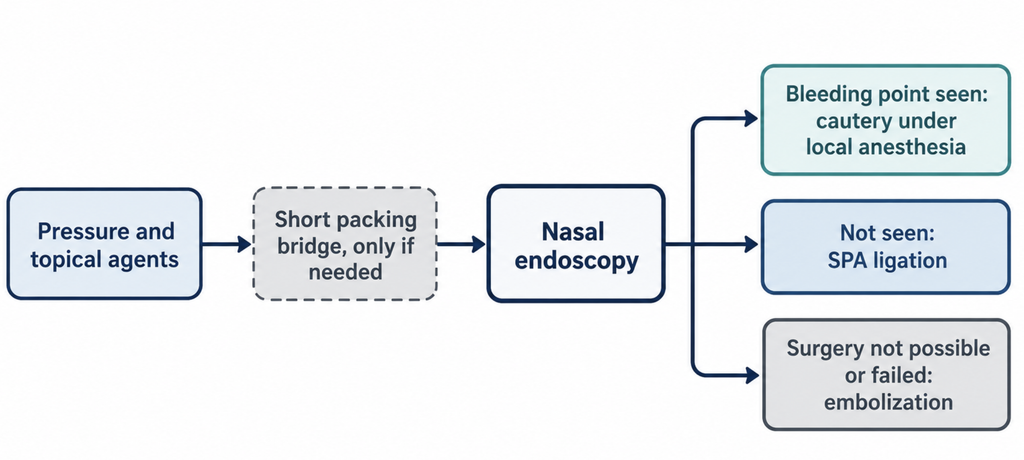
The Hellenic Rhinological Society’s review concluded that recent literature favors early surgery over packing as definitive treatment. The evidence supports a shorter sequence: stabilize the patient, then move quickly to endoscopy.
Key Takeaways
- Posterior balloon or Foley packing is a short bridge for severe bleeding and is not recommended as treatment.
- Reviews report posterior packing failure rates of 25% to 60%, along with significant pain and complications.
- Endoscopic sphenopalatine artery ligation reports success rates of 73% to 100% with a favorable safety profile.
- Endoscopic SPA cautery under local anesthesia is a surgical option that may avoid general anesthesia.
- Embolization controls bleeding at similar rates but carries a small risk of stroke and vision loss.
FAQ
What is the best treatment for posterior epistaxis?
Usually, endoscopic treatment of the sphenopalatine artery. Ligation reports success rates of 73% to 100% with fewer serious complications than other surgical or endovascular options [Swords, Surgical and interventional radiological management of adult epistaxis: systematic review, 2017]. Cautery under local anesthesia is an alternative when the bleeding point is visible.
Can a posterior nosebleed be stopped without surgery?
Sometimes, but often only temporarily. In one cohort, packing controlled 62% of posterior bleeds versus 97% for surgery [Soyka, On the effectiveness of treatment options in epistaxis: an analysis of 678 interventions, 2011]. Topical TXA did not reduce the need for packing in a large trial.
How long does a posterior nasal pack stay in?
Usually 48 to 72 hours, with hospital monitoring [Abuzeid, How To Treat Posterior Epistaxis With a Balloon, 2025]. Recommended removal times vary, and the long stay is one reason early endoscopic treatment is increasingly preferred.
References
- Abuzeid WM. How to treat posterior epistaxis with a balloon [Internet]. Rahway (NJ): Merck & Co., Inc.; 2025 [cited 2026 Oct 19]. Available from: https://www.msdmanuals.com/professional/ear,-nose,-and-throat-disorders/how-to-do-nose-procedures/how-to-treat-posterior-epistaxis-with-a-balloon
- Gurung U, Thapa N, Khadgi S. Endoscopic sphenopalatine artery cauterization under local anesthesia for posterior epistaxis: a prospective cohort study of its tolerability and efficacy. Turk Arch Otorhinolaryngol. 2024;62(3):88-94.
- Hoffman H, Ashok Kumar A, Raventhiranathan N, Masoud HE, Gould GC. Endovascular embolization for the treatment of epistaxis: systematic review and meta-analysis. Interv Neuroradiol. 2023;29(2):172-182.
- Joseph J, Martinez-Devesa P, Bellorini J, Burton MJ. Tranexamic acid for patients with nasal haemorrhage (epistaxis). Cochrane Database Syst Rev. 2018;12(12):CD004328.
- Koskinas I, Terzis T, Georgalas C, Chatzikas G, Moireas G, Chrysovergis A, et al. Posterior epistaxis management: review of the literature and proposed guidelines of the hellenic rhinological-facial plastic surgery society. Eur Arch Otorhinolaryngol. 2024;281(4):1613-1627.
- Lelegren M, Bhat K, Sheehan B, Lamichhane R, Han JK, Lam KK. Variations in utilization and clinical outcomes for endoscopic sphenopalatine artery ligation and endovascular arterial embolization in a single multi-hospital network. Am J Otolaryngol. 2021;42(6):103066.
- McDermott AM, O’Cathain E, Carey BW, O’Sullivan P, Sheahan P. Sphenopalatine artery ligation for epistaxis: factors influencing outcome and impact of timing of surgery. Otolaryngol Head Neck Surg. 2016;154(3):547-552.
- Moshaver A, Harris JR, Liu R, Diamond C, Seikaly H. Early operative intervention versus conventional treatment in epistaxis: randomized prospective trial. J Otolaryngol. 2004;33(3):185-188.
- Reuben A, Appelboam A, Stevens KN, Vickery J, Ewings P, Ingram W, et al. The use of tranexamic acid to reduce the need for nasal packing in epistaxis (NoPAC): randomized controlled trial. Ann Emerg Med. 2021;77(6):631-640.
- Rudmik L, Smith TL. Management of intractable spontaneous epistaxis. Am J Rhinol Allergy. 2012;26(1):55-60.
- Soyka MB, Nikolaou G, Rufibach K, Holzmann D. On the effectiveness of treatment options in epistaxis: an analysis of 678 interventions. Rhinology. 2011;49(4):474-478.
- Swords C, Patel A, Smith ME, Williams RJ, Kuhn I, Hopkins C. Surgical and interventional radiological management of adult epistaxis: systematic review. J Laryngol Otol. 2017;131(12):1108-1130.
- Tunkel DE, Anne S, Payne SC, Ishman SL, Rosenfeld RM, Abramson PJ, et al. Clinical practice guideline: nosebleed (epistaxis) executive summary. Otolaryngol Head Neck Surg. 2020;162(1):8-25.
- Viducich RA, Blanda MP, Gerson LW. Posterior epistaxis: clinical features and acute complications. Ann Emerg Med. 1995;25(5):592-596.
Joonpyo Hong, MD is a board-certified otolaryngologist practicing in Korea. This article reflects his clinical interpretation of published research and does not constitute individual medical advice.
For more articles:
https://curiousmd.com/when-to-fix-a-broken-nose/
https://curiousmd.com/empty-nose-syndrome-symptoms/
https://curiousmd.com/ai-electronic-nose/
Link out to:
https://www.entnet.org/condition/nosebleed/ — The American Academy of Otolaryngology–Head and Neck Surgery guideline hub for nosebleed, with patient handouts on nasal packing.
https://bulletin.entnet.org/article/clinical-practice-guideline-nosebleed-epistaxis — A summary of the AAO-HNSF nosebleed guideline, including when to consider arterial ligation or embolization.
https://www.msdmanuals.com/professional/ear,-nose,-and-throat-disorders/how-to-do-nose-procedures/how-to-treat-posterior-epistaxis-with-a-balloon — MSD Manual’s step-by-step description of posterior balloon tamponade and its complications.
https://my.clevelandclinic.org/health/diseases/13464-nosebleed-epistaxis — Cleveland Clinic’s patient-level overview of anterior and posterior nosebleeds and their treatment.